
The common mistake is thinking the best comparison comes from stacking review scores and calling that objectivity. It does not. A five-star review can still be a bad fit, and a grumpy three-star review can be exactly right for your situation. The useful comparison is not “which review sounds nicest?” It is “which review answers the buyer questions I actually have, with enough context to trust the answer?”
That shift matters because tool reviews are rarely neutral by accident. Some are written to rank. Some are written to sell. Some are written by people who genuinely used the tool but only for one narrow workflow. So the job is not to find a perfectly pure review. The job is to compare reviews against the questions a real buyer needs answered, then weigh the evidence like a grown adult instead of a panicked squirrel.
If you want the broader framework behind this cluster, start with the parent guide to tool reviews. For a more practical next step, see how to choose tool reviews without wasting money and tool review examples that actually help a buyer decide.
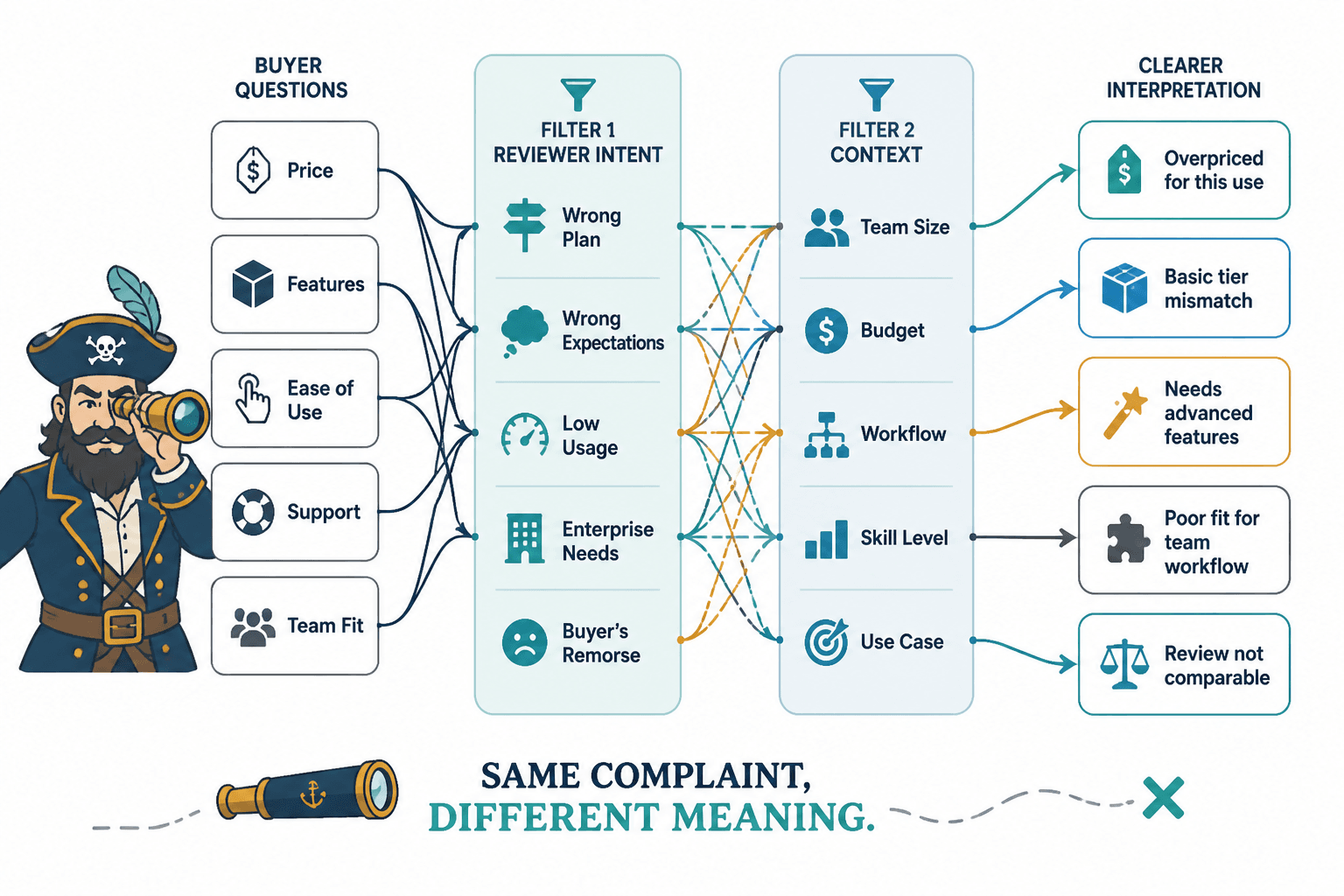
What buyer questions are actually telling you
Buyer questions are not just shopping noise. They are the shape of the decision. A reader asking “Is this tool worth it?” may really mean:
- Will this solve my specific problem?
- Does it work for my size of operation?
- What will this cost me beyond the monthly price?
- What breaks, slows down, or gets annoying in real use?
- What am I giving up if I choose this over the alternative?
That is why comparing reviews by headline rating usually fails. One review may answer the workflow question well but ignore onboarding pain. Another may be excellent on screenshots and terrible on fit. A third may be enthusiastic about features that do not matter to your use case at all. None of those are automatically “bad” reviews. They are just answering different questions.
Useful comparison starts when you map the review against the buyer’s real decision points. That is also where bias shows up. If a review spends 800 words on polished features and five words on limitations, it is not helping you compare fairly. It is decorating the product.
The bias filter: compare the question, not the enthusiasm
A fair comparison asks whether the review gives you enough evidence to make a decision. That means looking for four things:
- Point of view – Who is this review written for?
- Usage evidence – Does it show the tool in actual use, not just describe it?
- Tradeoffs – Does it admit where the tool falls short?
- Fit – Does the advice match your budget, workflow, and team size?
This is the same reason strong reviews feel grounded and weak reviews feel slippery. Strong reviews usually tell you what the tool does, what it does well, what gets annoying, and who should skip it. Weak reviews often flatten everything into generic praise. That is not neutrality; that is evasiveness with better typography.
1. Check whether the reviewer has a real point of view
Every review has a point of view, even when it pretends not to. The question is whether that point of view is visible and useful.
Good signs:
- The reviewer says what kind of buyer the review is for.
- The review names the use case before discussing features.
- The criteria are obvious and relevant.
- The writer explains why a feature matters in context.
Bias warning signs:
- The review tries to cover every possible audience.
- It uses vague praise like “great value” without saying for whom.
- It compares tools using generic standards instead of buyer-specific needs.
For creators, this matters a lot. A tool that is ideal for a solo creator can be a clunky mess for a small team, and the reverse is equally true. If the review does not specify who it is talking to, it is leaving the most important context out of the room.
2. Look for real usage, not review perfume
The easiest way to spot a useful review is to see whether it shows the tool doing actual work. That can be screenshots, setup notes, workflow steps, output examples, or a description of friction that only appears after use.
Useful proof answers questions like:
- What does setup look like?
- What is the first real task inside the tool?
- What does the output look like?
- Where does the workflow slow down?
- What happens when something goes wrong?
If a review only repeats marketing claims, it is not comparison-ready. It may still be readable. It may even be persuasive. But it is not very helpful when you are trying to decide whether the tool fits your actual work.
If you want a deeper proof framework, see what to screenshot in tool reviews and simple tool review proof screenshots framework for creators.
3. Separate missing negatives from harmless brevity
Not every short review is biased. Some are just concise. The problem is when the review has room to praise but no room to criticize.
Ask a simple question: what does the review not say?
- No mention of learning curve?
- No discussion of pricing limits?
- No note about setup time?
- No mention of who should not buy it?
That silence is often where the bias lives. Not always, but often enough to matter. A useful review usually includes at least one negative that is specific, not decorative. “The interface is a little busy” is not much help. “The reporting is limited unless you upgrade, which changes the total cost of ownership” is.
This is also why budget readers need different comparison filters. A review that ignores implementation cost, usage limits, or upgrade pressure may look cheap on paper and expensive in reality. For that angle, see how to review tool reviews when you have a tiny budget.
4. Compare total cost, not just sticker price
One of the most common review mistakes is treating price as the whole story. It is not. The real cost can include:
- time to learn the tool
- time to migrate data
- team adoption friction
- hidden add-ons or usage caps
- the cost of mistakes during setup
A review that ignores those pieces may still be honest, but it is incomplete. And incomplete is how money leaks out through the floor while the pricing page smiles politely.
For a broader look at evaluation mistakes, see tool review use-case scoring mistakes that waste money. The big trap there is scoring for maximum capability instead of actual fit.
5. Judge the fit for your buyer type
Bias often appears when a review assumes one kind of buyer and then speaks as if everyone shares that setup. They do not.
Compare reviews through the lens of:
- Solo creator – wants simplicity, speed, low overhead, and fewer moving parts.
- Small team – needs collaboration, permissions, process consistency, and fewer handoff errors.
- Budget-first buyer – needs the tool to justify itself quickly and transparently.
- Workflow-heavy buyer – cares about integration, repeatability, and operational fit.
If a review sounds great for one of those buyers and useless for the others, that is not a flaw. That is information. Bias is pretending the difference does not exist.
For a focused comparison on buyer types, see tool reviews for solo creators vs small teams.
How to compare two reviews without getting lost
When two reviews disagree, do not start by asking which writer is smarter. Start by asking which one is answering your question more directly.
Use this quick process:
- Write your buying question in one sentence.
- List the review criteria that matter most to that question.
- Check each review for evidence on those criteria.
- Mark missing negatives, missing proof, and obvious audience mismatch.
- Choose the review that best matches your situation, not the loudest one.
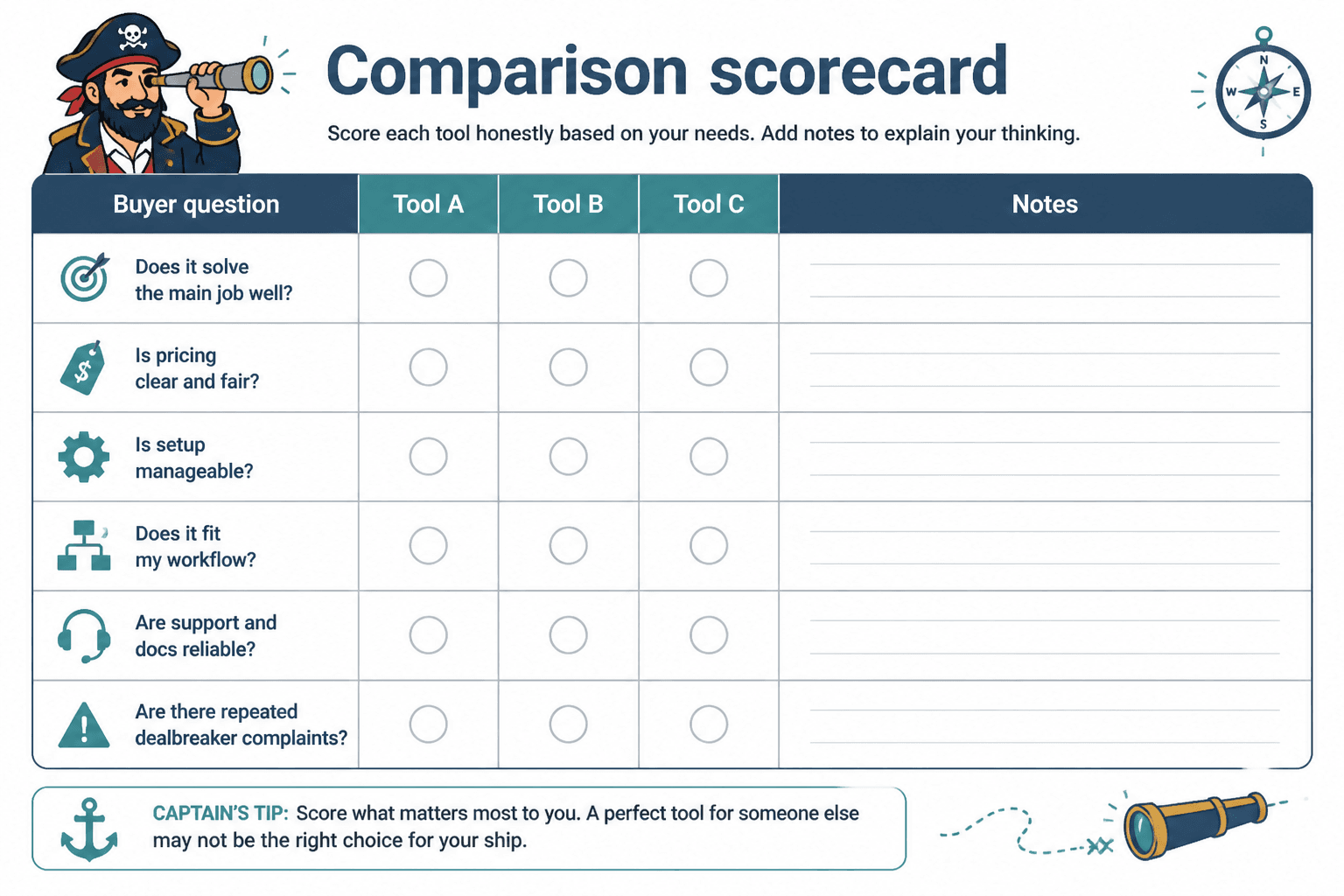
A simple scorecard helps here. You do not need a complicated spreadsheet with twelve fake precision decimals. You need a basic comparison grid with columns for the question, the answer, the evidence, and the fit for your use case.
If the review is a roundup, also ask whether the format itself is helping. Simple reviews often beat giant roundups when the buyer is close to a decision. Roundups are good for discovery. Reviews are better for decision-making. That distinction is not glamorous, but it saves time and sanity.
Related reading: when simple tool reviews beat giant roundups.
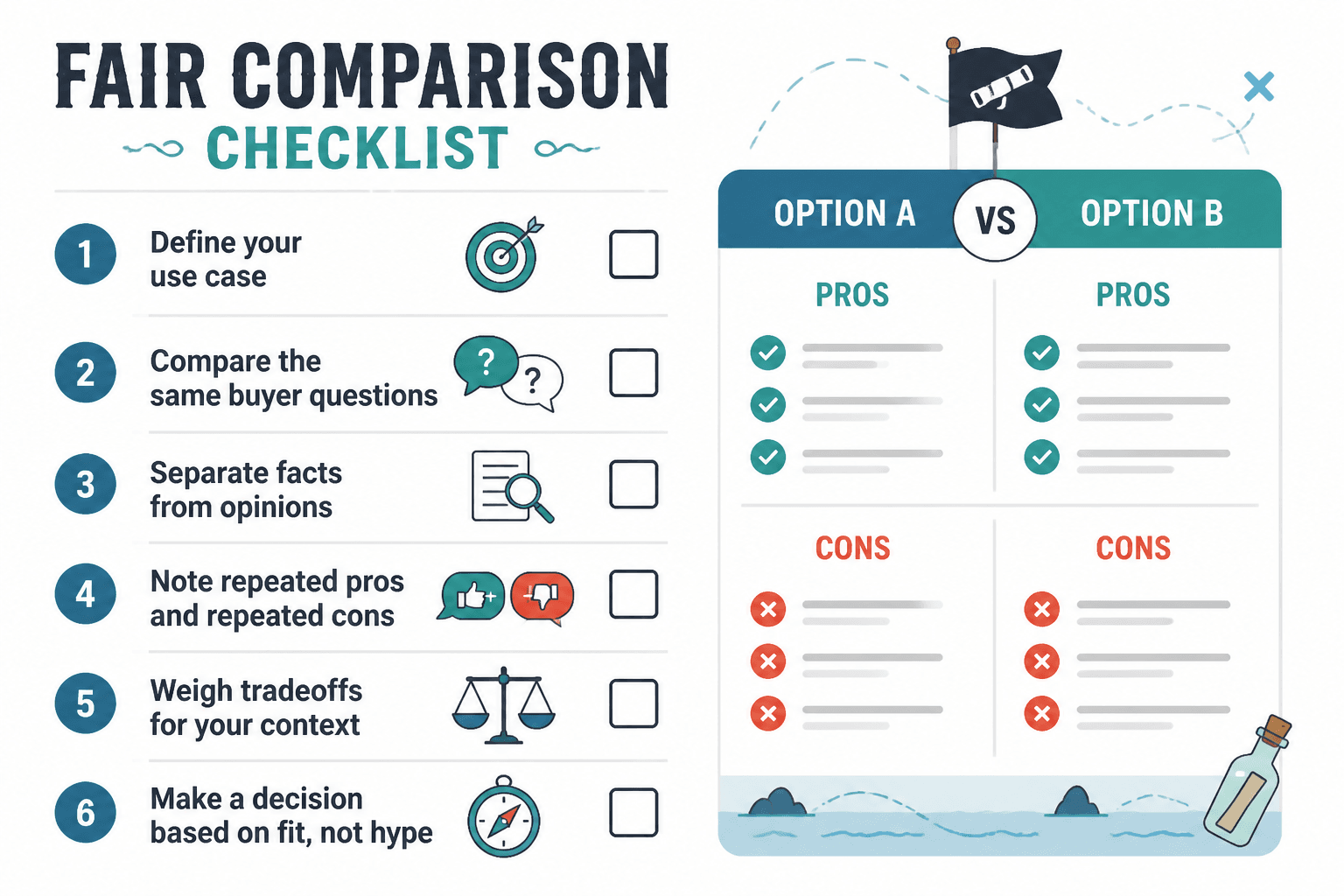
The questions every tool review should help answer
Use these as your comparison baseline:
- Who is this tool actually for?
- What problem does it solve better than the alternatives?
- What does it do well in real use?
- What gets annoying, limited, or expensive?
- What does setup or adoption require?
- What kind of buyer should skip it?
- Does the total cost match the value for my situation?
If a review cannot help answer most of those questions, it is not a strong basis for comparison. It may still have useful fragments. But the frame is weak.
Common comparison mistakes
- Comparing star ratings instead of evidence – ratings compress nuance into a number and lose the useful parts.
- Overweighting one reviewer’s preference – a workflow preference is not universal law.
- Ignoring implementation cost – the cheapest tool can be the most expensive to adopt.
- Mixing up popularity and fit – “everyone uses it” is not the same as “it fits me.”
- Forgetting the team context – solo and team workflows are different animals.
- Trusting polished screenshots without friction – smooth UI is not the same as smooth work.
These mistakes show up everywhere in the cluster, including the review-structure and proof-screenshot pieces. For a clean framework on structure, see how to evaluate tool review structure. For a credibility-focused guide, see how to write tool reviews without sounding like affiliate fluff.
What to do when reviews conflict
Conflicting reviews are normal. In fact, they are useful because they force you to check assumptions instead of outsourcing judgment.
When reviews disagree:
- Check whether they are written for different buyer types.
- Check whether one includes real usage proof and the other does not.
- Check whether one is discussing the tool’s strengths and the other its weaknesses.
- Check whether the disagreement is about features, workflow, or cost.
If the conflict is really a context problem, the solution is not more reading. It is better matching. Once you know who the review is for, the disagreement often stops looking mysterious.
A practical way to compare reviews without bias
Here is the simplest usable method:
- Define your exact use case.
- Pick the 3 to 5 buyer questions that matter most.
- Read the reviews only for those questions.
- Ignore opinion that does not come with evidence.
- Discount any review that hides the tradeoffs.
- Choose the review that best matches your workflow, budget, and buyer type.
That is the whole game. Not perfect objectivity. Not review worship. Just a clean comparison method that keeps you from buying a tool because somebody wrote a confident paragraph about it.
Where this fits in the tool reviews cluster
If you are building or evaluating money-content around tools, this page sits alongside other useful pieces in the cluster: the parent guide, the buyer-fit guides, the structure guide, and the proof/screenshot guides. Together they cover the full path from “what should I buy?” to “how do I trust this review?” and finally “how do I write or update the review so it actually helps?”
Start with the parent guide to tool reviews, then move to best tool reviews tools for creators in 2026 if you need a broader discovery page.
Sources and trust signals
For review and endorsement transparency, the FTC’s endorsement guides are worth keeping in view: FTC Endorsements, Influencer Marketing, and Reviews. For comparison and decision design principles, Nielsen Norman Group’s usability writing is a reliable reference point, especially on clarity, scannability, and trust: Nielsen Norman Group articles. For conversion and trust research, CXL’s library is also useful background: CXL blog.
The short version: compare the questions, not the theater. The right review is the one that helps a buyer decide with less noise and more context. Everything else is just elaborate furniture.