
Most LinkedIn posts do not fail because the algorithm betrayed them, your audience is asleep, or the platform hates creators. They fail because they are bland, vague, over-explained, or written like a networking event got turned into paste.
If you want better results from LinkedIn, you usually do not need to post more. You need to post with more clarity, better positioning, sharper openings, and a stronger sense of what the post is actually trying to do.
This LinkedIn Posts Guide for Creators Who Want Better Results will help you write posts people actually read, trust, and respond to. Not posts that collect a few sympathy likes from peers and then vanish into the corporate mist.
If you are a creator, coach, consultant, freelancer, founder, or personal brand, the game is pretty simple: say something useful, make it easy to read, give people a reason to care, and do it in a voice that sounds like a real person with a working brain. That is the job.
For the main guide behind this topic, visit the parent guide.
What better LinkedIn results actually look like
“Better results” is where people get fuzzy. They say they want more reach, but what they really want is better business outcomes.
On LinkedIn, a good post can do a few different jobs:
- Attract the right people to your profile
- Build trust with potential clients or collaborators
- Show what you know without sounding like a blowhard
- Start conversations that lead somewhere useful
- Create demand for an offer, service, newsletter, or resource
- Strengthen your positioning over time
Not every post needs to do all of that. In fact, trying to do all of that in one post is how you end up with content that sounds like a brochure having a panic attack.
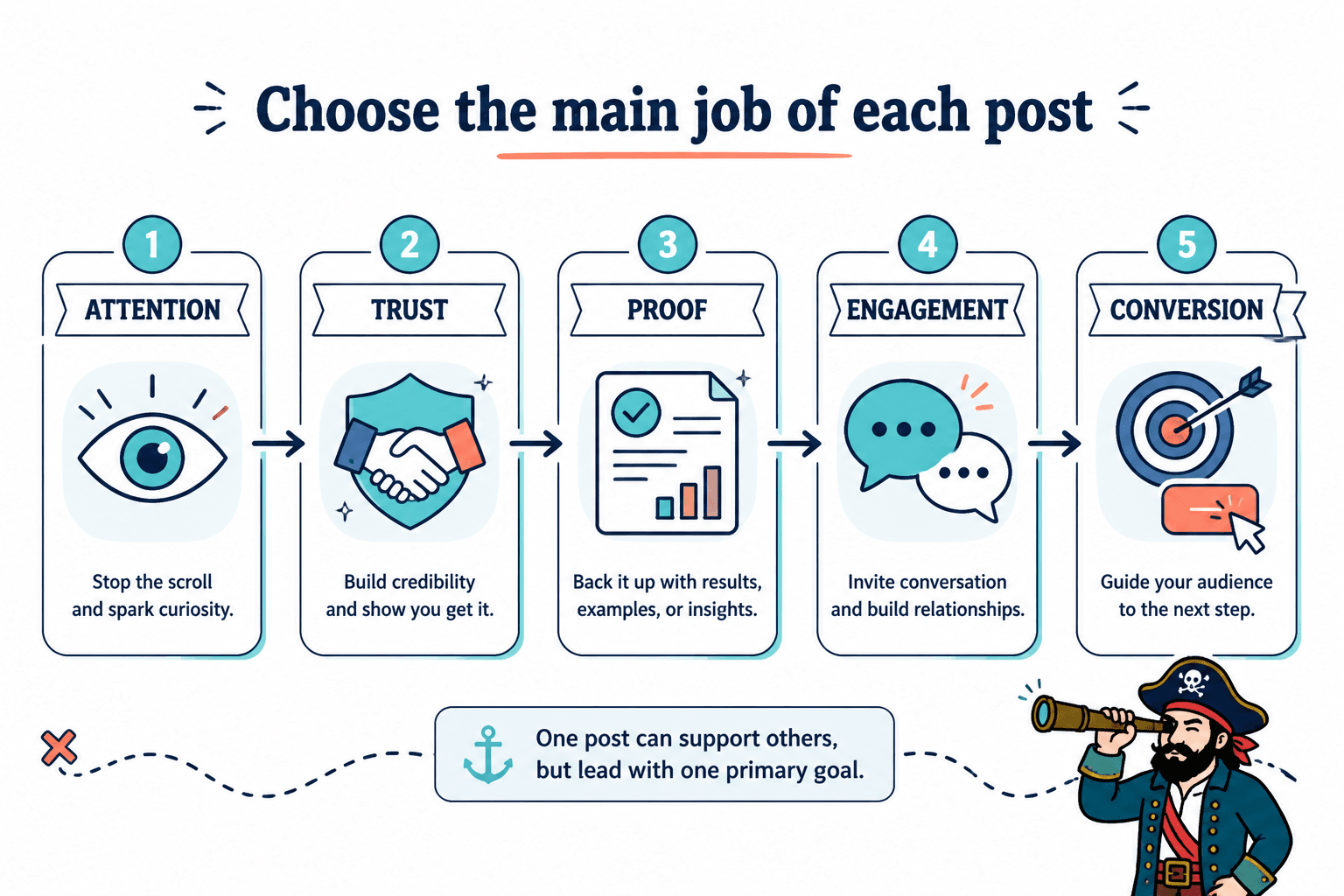
Before you write, decide the main job of the post. Is it for attention, trust, proof, engagement, or conversion? Once you know that, the writing gets much easier.
Why most LinkedIn posts underperform
There are a few repeat offenders, and yes, they show up constantly.
They open with nothing
The first line is doing heavy lifting on LinkedIn. If it is weak, the rest of the post rarely gets a fair chance.
Bad openings tend to sound like this:
- “I’m excited to share…”
- “I’ve been reflecting on…”
- “Here’s something I learned recently…”
- “A lot of people ask me…”
These are not hooks. They are throat-clearing with a blazer on.
They are too generic to matter
“Consistency matters.” Sure. So does oxygen. If your post could apply to every industry, every creator, and every platform, it probably says very little.
Specificity is what gives a post weight. Real examples, sharper opinions, actual situations, and concrete advice make people stop and think, “Okay, this person knows what they are talking about.”
They sound polished in the worst way
There is a type of LinkedIn post that feels technically correct and completely dead. It uses clean grammar, respectable formatting, and zero pulse. Usually because the writer tried to sound “professional” instead of useful.
Professional does not mean stiff. It means clear, credible, and worth reading.
They ask for too much too early
If every post ends with “DM me if you want to scale” or “Book a call here,” people stop listening. Content should earn trust before it tries to cash it in.
A lot of creators are not under-posting. They are under-earning attention and over-requesting action.
How to write LinkedIn posts that get better results
You do not need a hundred post formulas. You need a reliable process.
1. Start with one sharp point
A strong LinkedIn post usually has one core idea, not seven. The reader should be able to tell what the post is about almost immediately.
Good starting points include:
- A mistake people keep making
- A useful opinion you can defend
- A lesson from client work or real experience
- A pattern you keep seeing in your niche
- A practical framework or checklist
- A before-and-after insight
If you cannot summarize the point of the post in one sentence, the post probably is not ready.
2. Write a first line that actually earns the second line
Your hook does not need to be dramatic. It needs to be clear and interesting.
Here are a few strong opening styles that work well on LinkedIn:
- Call out a mistake: “Most LinkedIn posts do not fail because the idea is weak. They fail because the opening says nothing.”
- Name a tension: “Being good at your work does not automatically make you good at posting about it.”
- Make a useful claim: “Short LinkedIn posts work best when the idea is sharp enough to carry the weight.”
- Challenge lazy advice: “You do not need to post every day on LinkedIn. You need to stop posting forgettable things.”
What matters is that the first line creates enough clarity or tension to pull the reader forward.
3. Make the middle do real work
This is where a lot of posts collapse. The hook is decent, but the rest turns into fluff, repetition, or motivational wallpaper.
The middle of the post should do at least one of these well:
- Explain the idea clearly
- Give an example
- Add proof or context
- Show a contrast between weak and strong
- Offer steps, a framework, or a useful takeaway
That means fewer filler sentences and more substance. If a sentence does not add meaning, cut it. LinkedIn does not reward ceremonial phrasing.
4. End with a CTA that fits the post
Not every post needs a hard call to action. Sometimes the best move is simply to invite thought, response, or the next logical step.
Good CTA options include:
- Ask a specific question worth answering
- Invite people to follow for more on that topic
- Point readers to a useful resource
- Prompt profile visits naturally
- Offer a soft next step, like a guide or newsletter
Weak CTA: “DM me if you want to 10x your brand.”
Better CTA: “If your posts are useful but still getting ignored, start with your first line. That is usually where the leak is.”
The second version is not even a direct ask, but it reinforces your positioning and nudges the right reader toward your profile or future content. Much less needy. Much more effective.
LinkedIn post types creators should actually use
You do not need endless variety for the sake of variety. You need a small set of post types you can execute well and repeat consistently.
Useful opinion posts
These work well because they help people see how you think. Not just what you know.
Example angle: “Most people are not bad at LinkedIn. They are bad at packaging what they already know.”
The key is having an opinion with substance behind it. Not fake controversy. Not “hot takes” reheated from other people’s posts.
If you want practical structures for this, read simple LinkedIn opinion post templates for busy creators.
Proof posts
These show evidence that your approach works. That could be a client result, a content experiment, a lesson from repeated patterns, or a practical teardown.
The point is not to brag. It is to reduce doubt.
Good proof sounds like this:
- What changed
- What you did differently
- Why it worked
- What the reader can apply from it
Teach posts
This is classic creator territory: break something down, simplify it, and make it useful. The trick is avoiding obvious advice everyone has heard 40 times.
Bad teach post: “Be consistent and know your audience.”
Better teach post: “If your LinkedIn posts are getting polite silence, check three things: weak first line, no real point, and a CTA that asks strangers for marriage on the first date.”
Story-led lesson posts
Stories can work beautifully on LinkedIn when they lead somewhere useful. They fail when they exist only to stage-manage an emotional reveal before a generic business lesson.
A simple structure works well:
- Set up the moment or problem
- Show the shift, mistake, or realization
- Extract the lesson
- Tie it back to the reader
If the story does not improve the point, skip it.
Observation posts
These are underrated. A sharp observation can perform incredibly well because it feels fresh and grounded in reality.
Example: “A lot of creators think they need better content ideas. Most need better angles on the ideas they already have.”
Simple. True. Useful. Easy to expand with examples.
For more inspiration, see best LinkedIn post ideas and examples for creators.
Formatting LinkedIn posts so people actually read them
Formatting matters because people scan first and commit second. But there is a difference between readable formatting and dramatic line-break abuse.
Good formatting helps the eye move. Bad formatting looks like the post is wheezing.
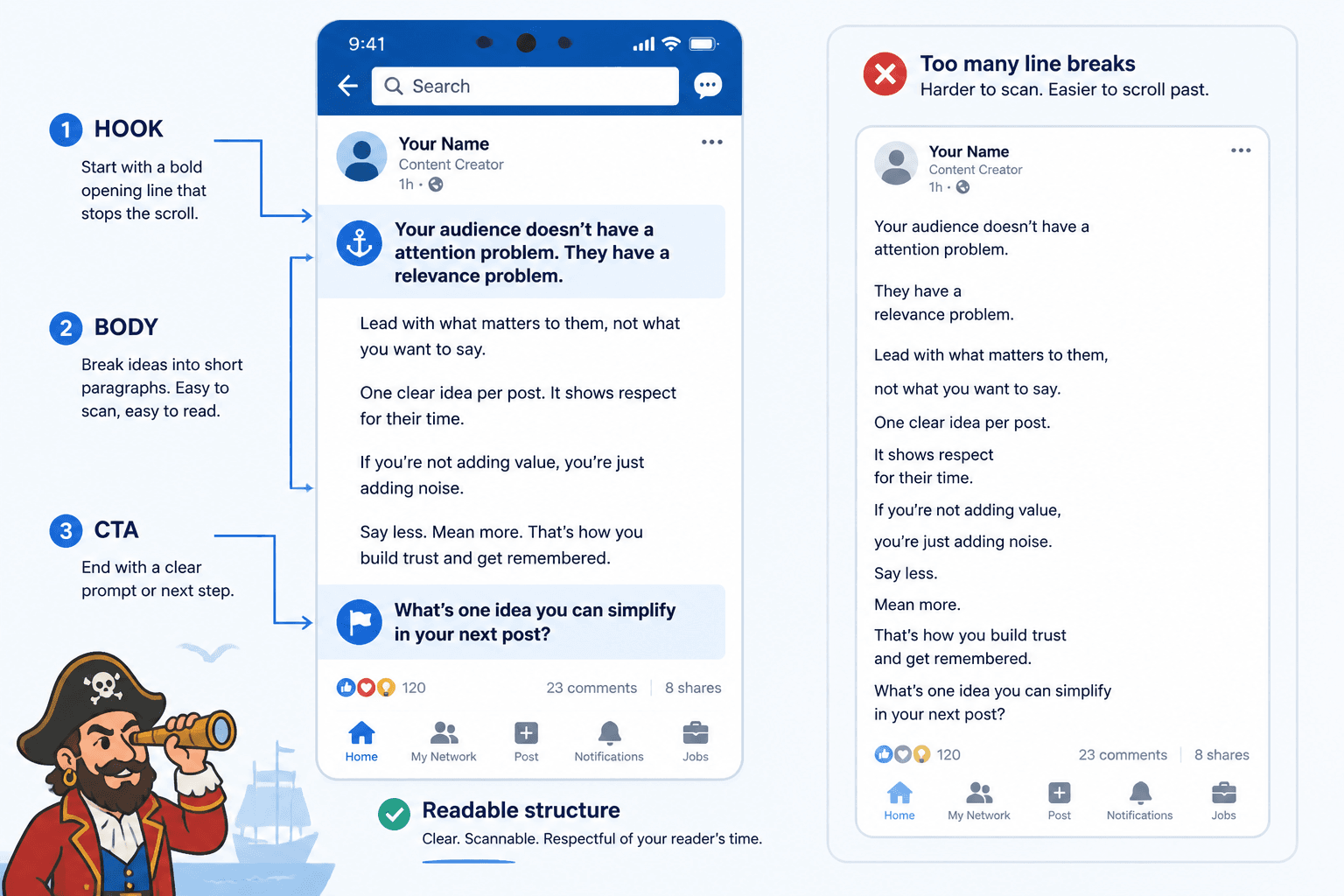
Use short paragraphs
Two to four lines is usually a safe range. Longer is fine if the writing is strong, but giant slabs of text lower your odds.
Keep the structure visible
If the post has steps, list them. If it has contrasts, separate them. If it has an example, make it easy to spot.
The reader should never have to excavate the point.
Do not break every sentence into its own line
Some creators format like they are sending distress flares.
A little white space helps. Too much makes the post feel childish, manipulative, or exhausting. Write with rhythm, not gimmicks.
Use lists when the idea benefits from them
Lists are great for checklists, frameworks, mistakes, and examples. They are not automatically better than paragraphs. Use them because they improve clarity, not because they make the post look “content-y.”
A simple LinkedIn post formula that does not sound robotic
If you want a repeatable structure, use this:
- Hook: Start with a clear claim, mistake, tension, or observation
- Point: Explain what you mean fast
- Proof: Add example, context, or contrast
- Takeaway: Give the reader something useful to apply
- CTA: End with a soft, relevant next step
Here is a rough example:
Most LinkedIn posts do not need better ideas.
They need better framing.I see smart creators posting solid advice that gets ignored, not because the advice is bad, but because the post opens weakly and buries the actual point.
If your first line is vague, your reader assumes the rest will be too.
A better approach:
Lead with the mistake.
Name the tension.
Give one useful fix.That is usually enough to make a good idea feel worth reading.
If your posts feel useful but forgettable, start with the framing.
That structure is simple, but it works because each part has a job.
Before-and-after LinkedIn post rewrites
The easiest way to improve your writing is to see what weak posts are doing wrong.
Example 1: Generic lesson post
Before:
Consistency is key on LinkedIn. Showing up every day helps build trust, authority, and your personal brand. Keep going and results will come.
After:
Posting every day on LinkedIn is not the goal.
Posting things worth remembering is.
I have seen creators post daily for months and build exactly nothing because every post sounded interchangeable.
Consistency helps.
But consistency only multiplies what is already there.
If the content is vague, daily posting just gives you more vague posts.
Start with clarity, then add consistency.
Why the rewrite works: stronger opening, clearer point, more tension, less empty advice.
Example 2: Salesy authority post
Before:
I help founders grow their brand with strategic content. If you want better content that converts, DM me today.
After:
A lot of founder content sounds smart and converts badly.
Usually for one of three reasons:
- It talks about the founder, not the buyer
- It says broad things with polished language
- It asks for action before building trust
Good content does not just sound credible.
It makes the right person feel understood.
If your posts are getting seen but not moving people, the problem may not be reach. It may be relevance.
Why the rewrite works: it leads with insight, teaches something useful, and still positions the writer as someone who understands conversion.
How often creators should post on LinkedIn
There is no magic number, and anybody pretending otherwise is selling certainty because it sounds nicer than reality.
For most creators, a good starting range is 2 to 5 posts per week. That is enough to stay visible, test angles, build pattern recognition, and improve without turning your content workflow into a hostage situation.
If your quality drops when you push volume, lower the frequency. Better posts less often usually beat mediocre posts on autopilot.
That matters even more if you have a small audience. In that stage, every post is helping people decide what bucket to put you in. Clear, useful, well-positioned content beats noisy output every time.
If that is where you are, read LinkedIn posts for creators with small audiences.
What creators should stop doing on LinkedIn
A quick cleanup list, because sometimes better strategy starts with fewer bad habits.
- Stop writing openings that say nothing
- Stop copying LinkedIn voices that sound polished and hollow
- Stop posting generic lessons with no examples
- Stop forcing fake vulnerability for attention
- Stop ending every post with a pitch
- Stop confusing impressions with progress
- Stop writing for peers if you want clients
- Stop making every post about your journey instead of the reader’s problem
This is where some creators get stuck. They think they need better “content strategy,” but what they really need is cleaner judgment. More restraint. Better taste. Stronger editorial decisions.
Not every thought deserves a post. Not every post deserves publishing. And not every high-performing post deserves repeating if it attracts the wrong people.
Tools can help, but they will not save boring posts
Templates, AI tools, scheduling tools, and swipe files can absolutely make LinkedIn easier. They can help you draft faster, test hooks, organize ideas, and maintain consistency.
What they cannot do is hand you taste, positioning, or a worthwhile point of view.
Use tools to support your workflow, not replace your thinking. If you want help choosing useful ones, check best templates and tools for LinkedIn posts.
And if you want a broader hub for this topic, the LinkedIn posts section is a good place to keep going. You can also browse the wider social media writing and LinkedIn writing paths if you are building a fuller content system.
A practical weekly workflow for better LinkedIn posts
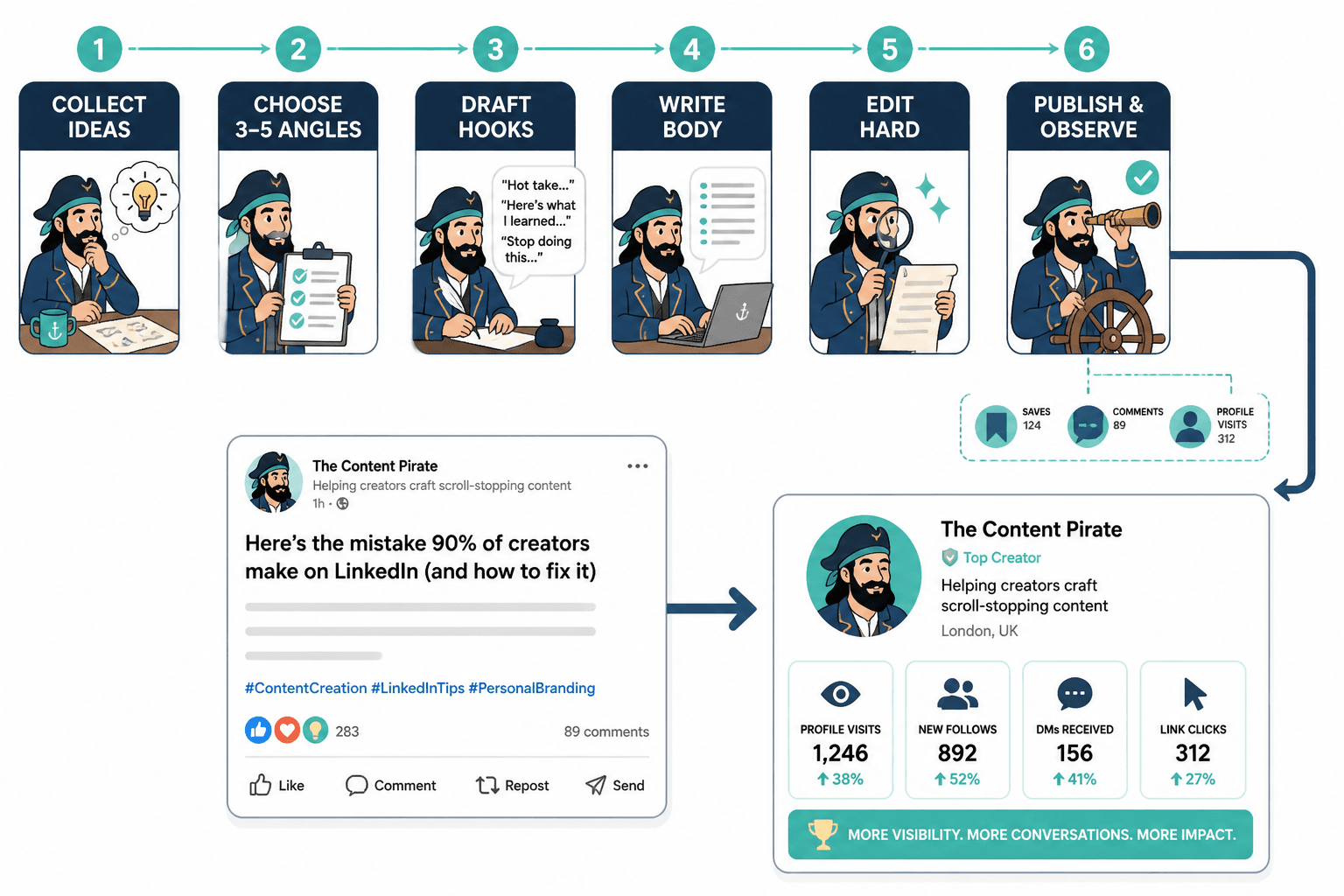
If your posting process feels chaotic, use this simple weekly rhythm:
- Collect ideas: Write down client questions, mistakes you keep seeing, opinions you can defend, and examples from your work
- Choose 3 to 5 angles: Pick ideas with a clear point and a useful outcome for the reader
- Draft hooks first: Test a few opening lines before writing the full post
- Write the body fast: Focus on clarity before polish
- Edit hard: Cut filler, tighten examples, sharpen the CTA
- Publish and observe: Watch for saves, comments, profile visits, and the quality of response, not just raw impressions
This kind of workflow matters because better results usually come from better reps, not random inspiration. You do not need to become a content machine. You need to become easier to understand, trust, and remember.
FAQ
The bigger point is simple: clearer structure and clearer writing make the piece more useful. That is usually what makes the ending land better too.
LinkedIn posts usually improve when the point gets clearer and the fluff gets shorter. Stronger usefulness tends to outperform polished vagueness.