
Most creators do not have an email sequence problem. They have a recycling problem.
They keep trying to write email sequences from scratch, as if the internet did not already watch them publish 50 posts, 18 threads, 9 half-decent rants, 4 client stories, and one extremely solid article that deserved better than a polite little spike of traffic and then death.
If you want to learn how to turn old content into better creator email sequences, the move is not copying and pasting your old posts into email and calling it strategy. That’s how you get a sequence that feels like a garage full of mismatched furniture. Technically full. Not exactly good.
The real job is to mine your old content for what already proved useful, interesting, persuasive, or trust-building, then rebuild it into an email sequence with a clear role for each message.
Here’s how to do that without producing a stitched-together mess your subscribers ignore after email two.
For the full path around this topic, head to the parent guide.
Why old content is one of the best sources for creator email sequences
Old content already contains signals. Not perfect signals, but useful ones.
You already know which posts got replies, which ideas people quoted back to you, which stories made prospects DM you, which frameworks were clear enough to reuse, and which opinions actually separated you from every other “helping founders grow online” person with a beige Canva carousel.
Email sequences work best when they do a few things well:
- build trust
- clarify your positioning
- teach something useful
- handle objections
- create momentum
- point people toward a next step
Your old content probably already does some of that. Just not in order, not with intention, and not in a format designed to move someone from “who are you?” to “alright, I get it.”
That is the shift. You are not republishing. You are sequencing.
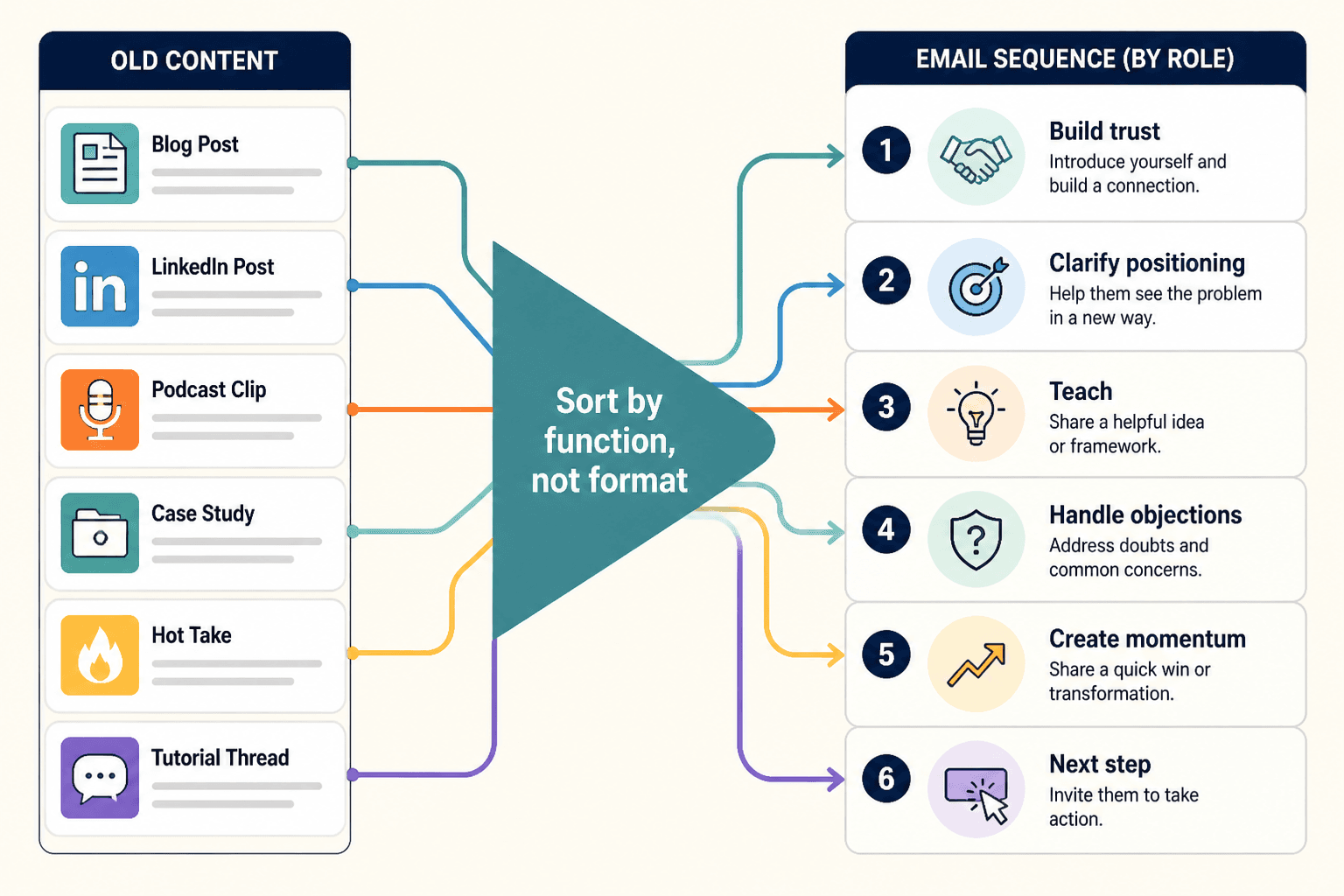
Start by sorting your old content by function, not format
This is where people go wrong. They sort content by platform or type.
“Here are my LinkedIn posts.”
“Here are my blogs.”
“Here are my podcast clips.”
Fine. Mildly organized. Not yet helpful.
To turn old content into better creator email sequences, sort by job. Ask what each piece actually does for the reader or buyer.
Useful content buckets for email sequences
- Authority content: ideas that show expertise, frameworks, strong opinions, or useful analysis
- Trust content: stories, lessons, behind-the-scenes decisions, honest process notes, or moments that make your approach feel real
- Problem-aware content: pieces that name what the audience is doing wrong, why they are stuck, or what they misunderstand
- Solution-aware content: pieces that explain your method, process, or philosophy
- Proof content: case studies, examples, client wins, before-and-after breakdowns, or pattern recognition from real work
- Objection-handling content: ideas that answer “Do I need this?”, “Will this work for me?”, “Is now the right time?”, “Why not just do it myself?”
- Conversion content: content that naturally leads to a CTA, resource, call, product, or offer
Once you sort content this way, your archive stops looking like a pile and starts looking like raw material.
Do not repurpose your best-performing content blindly
A post doing well on social does not automatically make it a strong email.
Sometimes a post performs because it is punchy, controversial, or extremely skimmable. Great for feeds. Weak for inboxes. Email usually needs a bit more coherence, more relational trust, and less theatrical packaging.
So instead of asking, “What got the most likes?” ask better questions:
- What made people reply?
- What made prospects mention it later?
- What clearly explained something important?
- What changed how people saw the problem?
- What led naturally to interest in my offer?
- What still feels true and useful six months later?
Vanity metrics are noisy. Reaction quality is better. Reusability is better. Relevance to the sequence goal is best.
A simple process for turning old content into better creator email sequences
You do not need an elaborate content operation for this. You need a clean process and a little editorial judgment.
1. Pick one sequence goal
Before you touch your archive, decide what the sequence is supposed to do.
- Welcome new subscribers
- Nurture leads before a call
- Warm people up for a paid offer
- Follow up after a free resource
- Re-engage colder subscribers
- Educate readers around one problem or method
If the goal is fuzzy, the sequence will feel fuzzy too. And yes, readers can feel that.
2. Pull 10 to 20 strong pieces of old content
These can come from posts, articles, newsletters, podcast notes, webinar transcripts, comments, sales pages, DMs, or voice notes you turned into captions.
The source matters less than the quality of the idea.
Look for content that has one of these traits:
- a clear point
- a useful framework
- a sharp opinion
- a memorable example
- a good story with a lesson
- a repeated objection
- a strong bridge to your offer
3. Strip each piece down to its core idea
This part matters more than people think.
Do not just paste the whole post into a doc. Write one line under each piece:
This content proves/explains/shifts: _______
Examples:
- Most content does not fail because the advice is bad. It fails because the packaging is vague.
- Clients trust clear process more than loud confidence.
- A short email can sell if the idea is specific and timely.
- People do not need more tips. They need a better way to diagnose the problem.
This forces you to work with the real asset, not the original wording.
4. Match each core idea to a sequence role
Now decide where each idea belongs.
| Email role | What it should do | Good source content |
|---|---|---|
| Welcome | Set expectations and tone | Best intro post, brand philosophy, origin note |
| Problem | Name the reader’s mistake or friction | Strong opinion post, myth-busting article, rant with a point |
| Teach | Give practical value | Framework post, tutorial, checklist, process breakdown |
| Proof | Show results or credibility | Case study, client story, before/after example |
| Objection | Reduce hesitation | FAQ answer, comment thread, sales call pattern |
| CTA | Invite a next step | Offer explanation, resource pitch, consultation bridge |
5. Rewrite for inbox reading, not platform leftovers
This is the part people skip because they are in a hurry, and it shows.
A good email sequence should feel intentionally written for a subscriber, not dragged out of a content graveyard. So rewrite the piece around the email’s job.
That usually means:
- cutting social-media throat clearing
- removing references that only made sense on the original platform
- adding transitions so one email leads naturally into the next
- making the lesson clearer
- tightening the CTA
- adding context where a post was previously too compressed
Sometimes a short post becomes a much better email with two extra paragraphs. Sometimes a bloated article becomes three cleaner emails. Repurposing is editing, not hauling.
If your sequence drafts still sound like chopped-up posts, it may help to study how to rewrite boring creator email sequences before you finalize them.
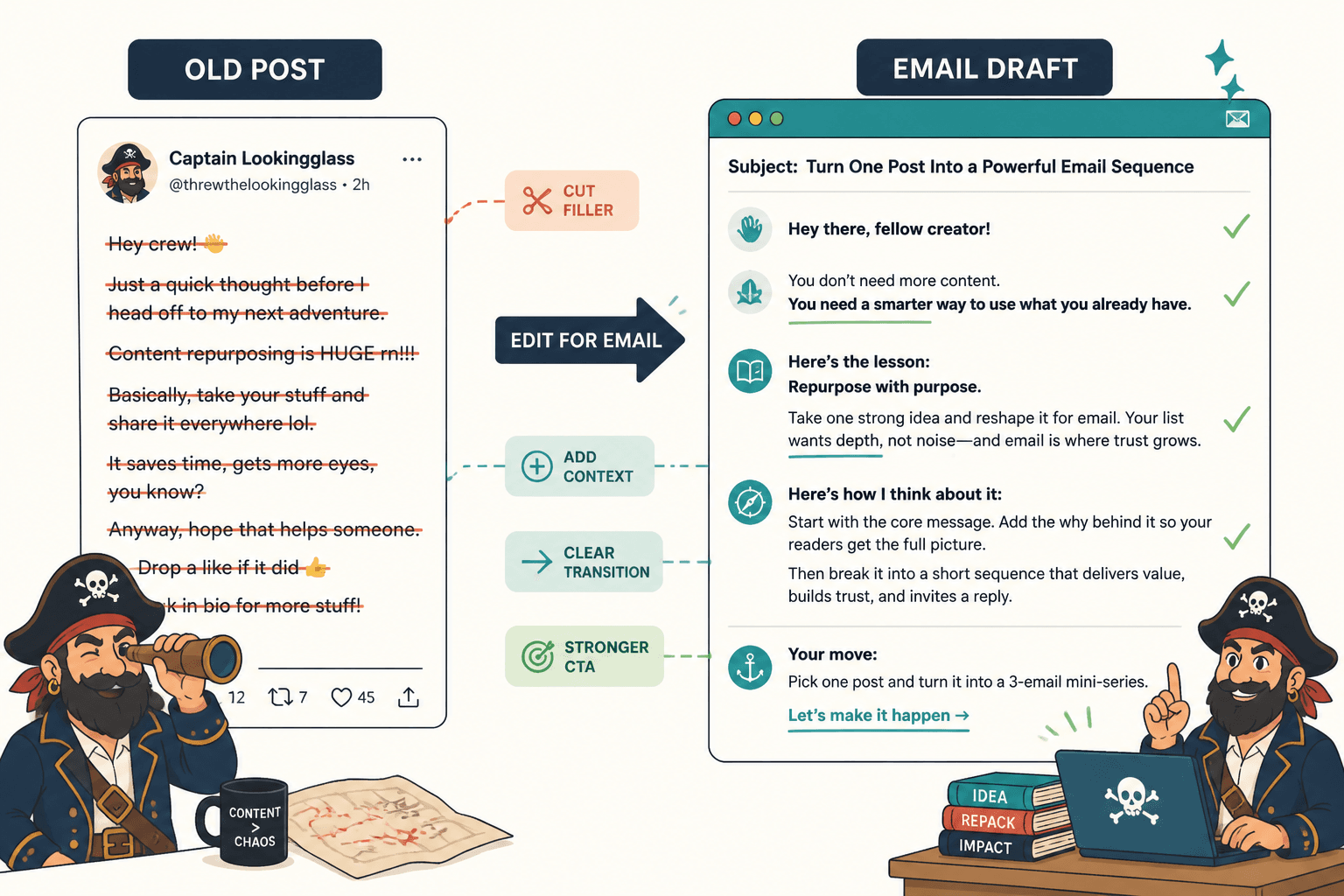
What to keep, cut, and add when repurposing old content into email
Keep
- strong opinions that clarify your positioning
- specific examples
- useful frameworks
- memorable phrasing
- actual reader questions
- proof from real work
Cut
- engagement bait
- platform-specific filler like “curious if anyone else feels this?”
- repetitive setup lines
- performative vulnerability that does not help the reader
- generic motivation
- anything that only exists to pad length
Add
- a clearer reason for why the reader should care now
- a stronger opening line
- more connective tissue between ideas
- deeper explanation where a social post was too compressed
- one direct next step
- sequence logic so each email earns the next one
This is one of those places where a little elaboration helps. Social content often wins by being fast. Email wins by being clear and deliberate. If your original post relied on quick pattern recognition from people who already follow you, your email may need more framing because inbox readers are in a different mode. They are not scrolling. They are deciding whether you are worth their attention at all.
So yes, brevity matters. But email brevity is not the same as social brevity. A 120-word post and a 250-word email can contain the same idea, with the email version performing better because it actually lands the point instead of just hinting at it.
A practical example of turning old content into a sequence
Let’s say you are a coach or consultant who helps creators build better offers and content systems.
Your old content archive includes:
- a LinkedIn post about why “posting consistently” is bad advice without positioning
- a thread explaining your 3-step content audit
- a client story showing how clearer messaging improved leads
- an article about why attention does not automatically turn into revenue
- a Facebook post about common mistakes in low-trust CTAs
That could become a simple five-email sequence like this:
| Source content | New angle in the sequence | |
|---|---|---|
| Email 1 | Positioning post | Welcome readers by reframing the real problem: content is not broken, strategy is |
| Email 2 | 3-step audit thread | Teach a practical way to diagnose weak content performance |
| Email 3 | Client story | Show proof that messaging clarity changes lead quality |
| Email 4 | Attention vs revenue article | Handle the objection that more reach alone will solve things |
| Email 5 | CTA mistake post | Bridge readers to a service, call, or free resource with a sharper next step |
Notice what happened there: the content is reused, but the sequence has progression. That progression matters more than the source material.
How to make repurposed emails feel fresh instead of recycled
If you are worried subscribers will recognize your old ideas, good. That means you have a perspective.
You are not trying to become a novelty machine. You are trying to become clear, credible, and consistent. Repetition is not the problem. Lazy repetition is.
Here’s how to make reused content feel better:
- Change the angle: what was once a hot take can become a lesson, story, or objection handler
- Add context: explain why the idea matters in the buyer journey
- Update examples: use newer client situations, current patterns, or clearer proof
- Focus the lesson: one post might contain three ideas; one email should usually carry one main point
- Adjust the tone: email can be a little more direct, personal, or explanatory than a public post
This is also why creators with a documented body of work often write stronger sequences than creators chasing novelty all day. They have material. They know what they believe. They can say the same core thing in a sharper way because they have already tested it in public.
Common mistakes when turning old content into creator email sequences
- Copy-pasting posts into email with no rewrite: readers can smell this immediately
- Using only top-of-funnel content: useful, but weak if the sequence never builds toward trust or action
- Ignoring sequence flow: good individual emails can still make a bad sequence
- Keeping platform fluff: what works in a feed often feels flimsy in an inbox
- Overstuffing each email: if one email contains five ideas, none of them land properly
- No CTA until the very end: not every email needs a hard ask, but readers should know what direction this relationship is going
- Repurposing outdated ideas: old content is useful only if the thinking still holds up
A sneaky mistake is treating your archive like a content bank instead of a pattern bank. The real value is not just the finished post. It is the recurring themes, objections, stories, frameworks, and phrases that keep proving useful. That is what gives your sequence coherence.
Build a lightweight content-to-email workflow so this gets easier
If you do this once and then go back to improvising forever, you are making your life harder than necessary.
Create a simple system where every strong piece of content gets tagged for future email use. Nothing fancy. A spreadsheet, Notion table, or doc works fine if you actually maintain it.
Track things like:
- content title or first line
- platform/source
- main idea
- content function
- best quote or lesson
- proof element
- possible CTA
- which sequence it could fit
That turns future email writing into assembly and refinement instead of blank-page suffering.
The bigger point is simple: clearer structure and clearer writing make the piece more useful. That is usually what makes the ending land better too.