Most newsletter subject line advice stops at the open.
That is useful, sure. But it is also incomplete. Because a subject line is not the finish line. It is the first little shove into a bigger path. If that path is sloppy, disconnected, or weirdly aggressive, you do not have a funnel. You have a click followed by disappointment.
The best funnel ideas to pair with newsletter subject lines are the ones that match the promise of the email, respect the reader’s attention, and lead naturally to the next step. Not “here is my free checklist” jammed under every email like a default office signature. Not a hard pitch after one mildly useful paragraph. And definitely not a bait-y subject line attached to a landing page that feels like it was built by three different people in a panic.
Here’s what actually works: subject lines that create the right expectation, emails that deliver on it, and funnels that continue the conversation without making the reader regret opening anything. This article will show you which funnel types pair best with newsletter subject lines, when to use each one, and how to connect them so the whole thing feels clean, useful, and commercially sane.
If you are still treating subject lines like tiny isolated copywriting puzzles, start here: newsletter subject lines. But if the real goal is leads, bookings, sales, and trust that lasts longer than one email open, the funnel matters just as much as the line itself.
For the full path around this topic, head to the parent guide.
Why subject lines and funnels need to be planned together
A good subject line gets attention. A good funnel turns attention into motion.
Those are not the same job, and a lot of newsletters underperform because the writer nailed one and ignored the other. They wrote a sharp subject line, got the open, then sent readers into a vague article, a random sales page, a mismatched freebie, or no next step at all. So the email “performed” in one metric and failed everywhere that matters.
Planning them together solves three big problems:
- Expectation mismatch: the subject line promises one thing and the funnel delivers another.
- Conversion friction: the next step is too big, too early, or too unclear.
- Wasted relevance: a reader just showed interest in a topic, but the offer or CTA goes somewhere else entirely.
The simplest way to think about it is this: your subject line is the doorway, not the house. If the room behind the door feels wrong, people leave.
That is why the best funnel ideas to pair with newsletter subject lines are usually specific, topic-aligned, and modest in the ask. Readers do not mind taking a next step. They mind taking a clumsy one.
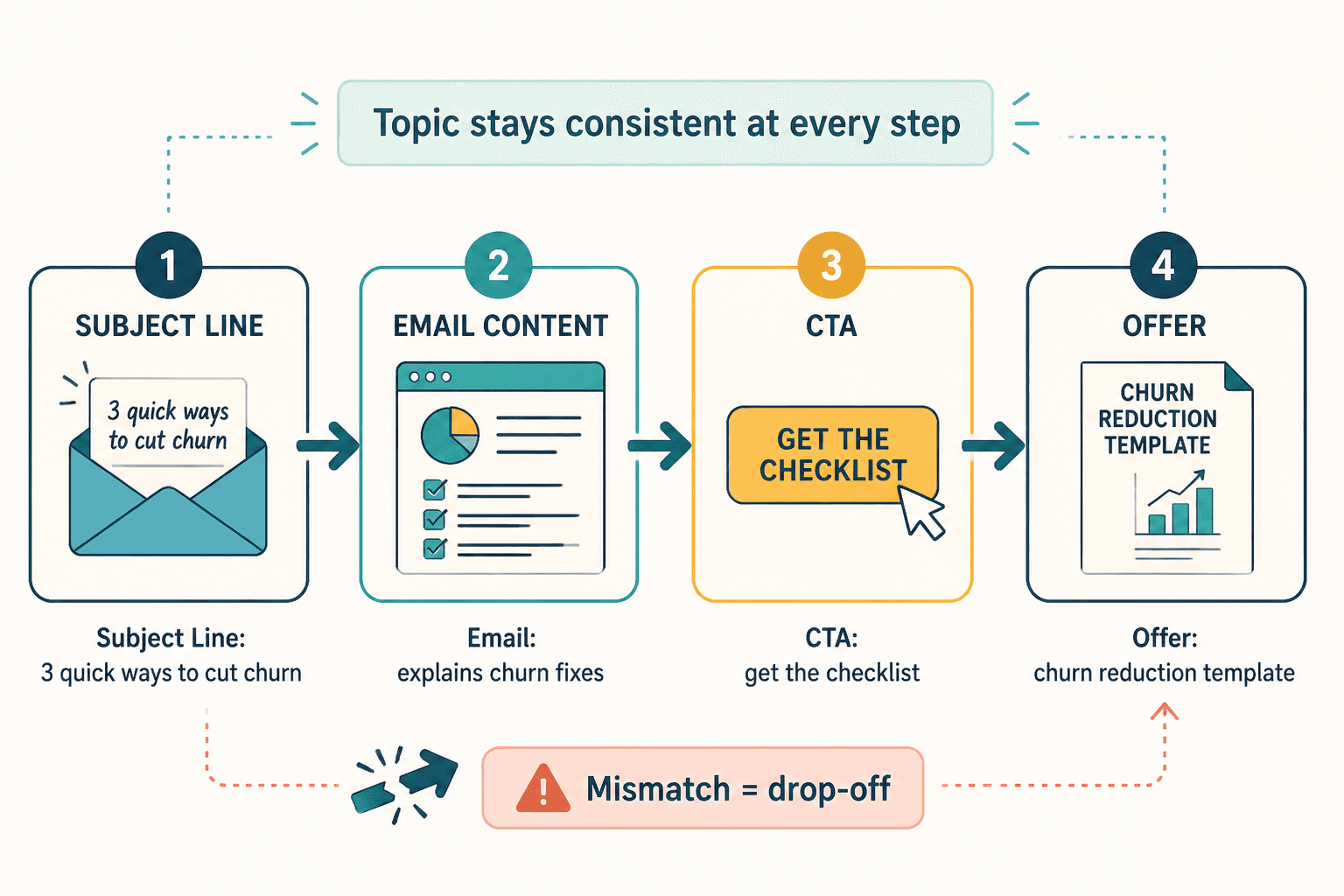
What makes a subject-line-to-funnel pairing work
Before we get into the actual funnel ideas, it helps to know what “good pairing” looks like. There are a few principles that hold up across nearly every newsletter model.
1. The subject line should attract the right click, not just any click
High opens are nice. High opens from the wrong people are not. If your line is so broad or dramatic that it pulls in curious readers who were never going to care about the actual offer, you just rented attention for no reason.
Better subject lines pre-qualify. They hint at the problem, angle, audience, or outcome so the people opening are more likely to care about the next step.
For more examples of that, see best newsletter subject lines ideas and examples for creators.
2. The body copy should bridge to the funnel naturally
The CTA should not appear like it got dropped in from another email. If the email is about fixing weak offers, the next step should feel like a logical extension of that topic. A worksheet on offer positioning? Great. A booking page for offer audits? Also fine. A random mini-course on Instagram reels? That is how trust quietly dies.
3. The ask should match the temperature of the reader
Some subject lines trigger curiosity. Some trigger intent. Some trigger urgency. Those states are different, and your funnel should respect that.
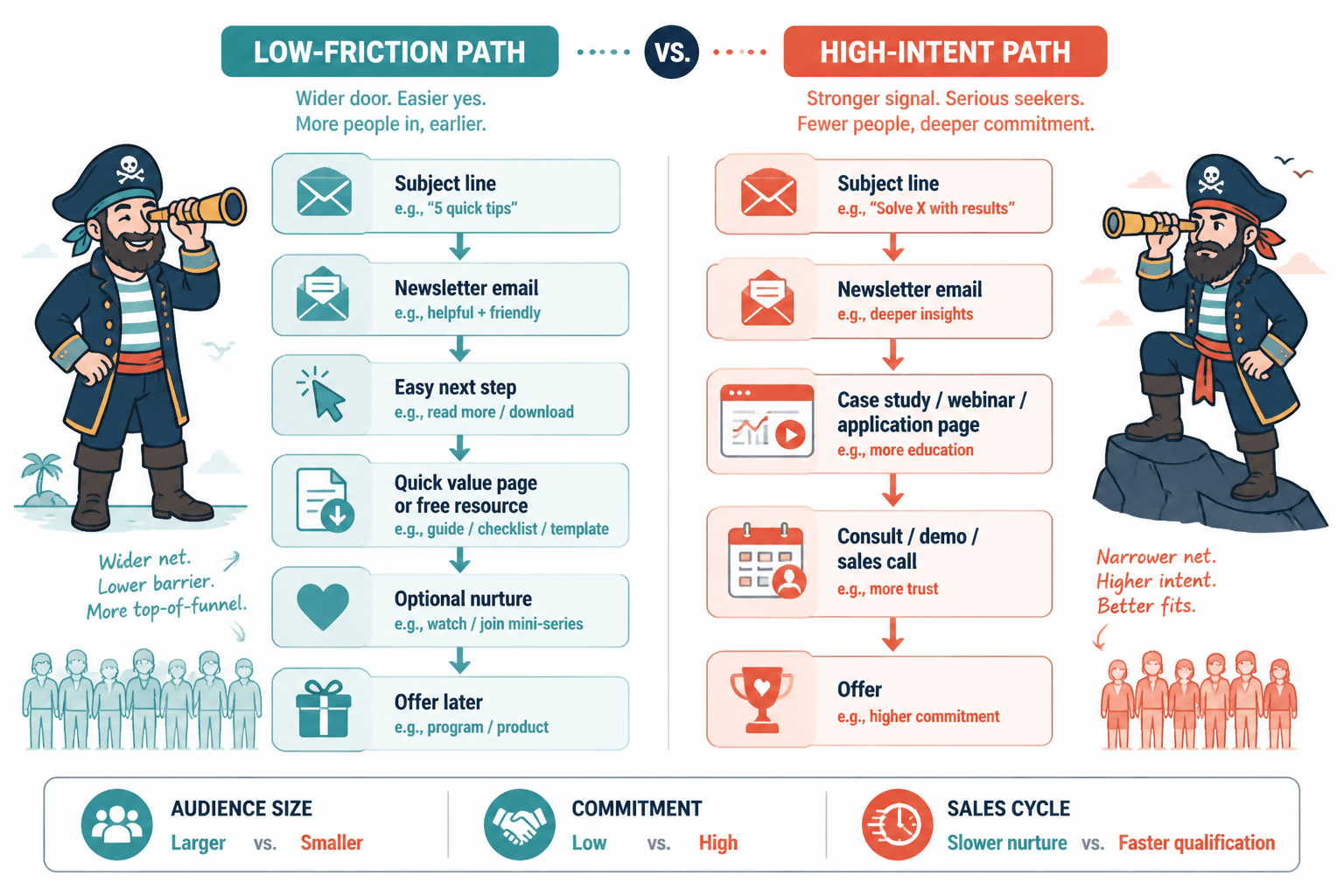
A light curiosity subject line usually pairs better with a low-friction next step, like a free resource or related article. A high-intent subject line can lead to a consultation, product page, or waitlist. If you ask for too much too soon, conversions get weirdly quiet.
4. The funnel should continue the same conversation
The best newsletter funnels feel like a straight line, not a teleportation accident. Same topic. Same emotional thread. Same level of sophistication. Same reader problem. If your subject line is practical and grounded, the landing page should not suddenly start screaming about “explosive growth.”
7 best funnel ideas to pair with newsletter subject lines
These are the funnel types that tend to work well for creators, coaches, consultants, solo founders, and service-based businesses. Not because they are trendy, but because they are structurally sensible.
1. Subject line to free resource funnel
This is one of the cleanest options when the subject line opens a practical problem and the email offers a fast win.
Best for: list growth, lead capture, early trust, warm but not hot readers
How it works: the subject line introduces a pain point, mistake, or missed opportunity. The email gives useful context, then offers a downloadable template, checklist, prompt sheet, script, or swipe file that helps solve that exact issue.
Example pairing:
- Subject line: Your welcome email is probably too vague
- Email angle: why welcome emails fail to convert when they try to “sound nice” instead of setting clear expectations
- Funnel next step: download a welcome email framework
This works because the CTA is not random. It is the obvious next move for someone who already cared enough to open.
If you want to turn that structure into direct leads or sales later, pair it with a nurture sequence. The free resource gets the hand-raise. The sequence deepens the trust.
2. Subject line to article or pillar content funnel
This is a strong fit when the topic needs more room than a short email can reasonably hold. Instead of cramming all the nuance into the email, you use the email to create interest and move readers toward a deeper article.
Best for: authority, SEO support, longer consideration cycles, educating skeptical readers
How it works: the subject line frames the problem. The email gives a sharp insight or preview. Then the CTA pushes readers to a related article with examples, frameworks, or deeper strategy.
Example pairing:
- Subject line: Why some subject lines get opens but no action
- Email angle: opens alone do not matter if the message and funnel are disconnected
- Funnel next step: link to how to turn newsletter subject lines into more leads or sales
This is also a smart way to connect your email strategy with your content library. If you are building topic authority, sending readers to deeper content is often more useful than pitching immediately.
You can also link readers toward broader topic hubs when they need context rather than a single answer. That is where a page like email newsletter writing or newsletter writing can make sense naturally.
3. Subject line to booking page funnel
This is where a lot of people get overeager and ruin things. A booking CTA can work beautifully, but only when the subject line and email attract people who already feel the problem strongly enough to want help.
Best for: consultants, coaches, strategists, service providers, high-ticket offers
How it works: the subject line speaks to a specific pain, bottleneck, or costly mistake. The email names the issue clearly, shows some expertise, and offers a call as the next step for readers who want help fixing it.
Example pairing:
- Subject line: Your newsletter might be leaking qualified leads
- Email angle: three common handoff problems between email content and conversion paths
- Funnel next step: book a funnel review or messaging consult
The key here is specificity. “Book a call with me” is weak when it floats alone. “If your emails get opens but your offers keep stalling, here’s where the leak usually is, and here’s how to get help” is much stronger.
This works especially well for high-intent subject lines tied to revenue, lead quality, onboarding, positioning, or conversion problems. Readers who open these topics are often not casually browsing. They are trying to fix something expensive.
4. Subject line to low-ticket product funnel
If you sell templates, mini-products, workshops, audits, prompt packs, or small toolkits, this is a very practical pairing. It is less friction than a consultation and more direct than endless “free value” loops.
Best for: digital products, creators with warm audiences, validating buyer intent
How it works: the subject line highlights a common struggle. The email explains the cost of getting that thing wrong, offers one useful shift, and then points to a low-ticket product that helps the reader implement it quickly.
Example pairing:
- Subject line: Subject lines do not need to be clever to convert
- Email angle: why clarity and relevance outperform forced cleverness
- Funnel next step: buy a swipe file of high-clarity subject line templates
This can work well with readers who do not want custom help but do want a faster shortcut. It also gives you a cleaner commercial path than stuffing every email with broad “learn more” links and hoping something eventually happens.
5. Subject line to email sequence funnel
Sometimes the smartest next step is not a page. It is another sequence.
This works when the reader’s problem is real, but the buying decision needs more context, proof, or trust. Instead of sending them cold to a pitch page, you guide them into a short sequence built around one problem cluster.
Best for: warm-up funnels, segmented lead nurture, more complex offers
How it works: the subject line gets the open. The email introduces a topic and invites readers to join a short focused series, workshop sequence, or challenge-style set of emails. That sequence then moves toward a sale, consult, or application.
Example pairing:
- Subject line: Why your best ideas keep getting ignored in the inbox
- Email angle: the issue is often not the idea but the framing, timing, and audience fit
- Funnel next step: join a 5-email mini-series on fixing underperforming newsletters
This is especially useful when your main offer is not impulse-friendly. Asking someone to buy a strategic service or premium product from one email can work, but often not at scale. A tight sequence gives you space to educate without writing a novel inside the newsletter itself.
6. Subject line to case study funnel
This one is underrated. If your audience is skeptical, analytical, or tired of generic advice, case studies can do more heavy lifting than broad educational content.
Best for: B2B services, consulting, agencies, strategy work, high-trust sales
How it works: the subject line calls out a result, mistake, or shift. The email tees up the lesson and links to a case study showing what happened, why it worked, and what changed. The case study then leads to a call, audit, or offer.
Example pairing:
- Subject line: We changed one email angle and lead quality improved
- Email angle: topic alignment between subject lines and offer path matters more than flashy copy
- Funnel next step: read the case study, then book a strategy consult
Case studies are useful because they answer the silent question under a lot of newsletter offers: “Sure, but does this actually work in real life?”
If your audience is sophisticated, proof usually beats enthusiasm.
7. Subject line to reply-and-DM funnel
Not every funnel needs to be page-based. For service businesses and smaller personal brands, a reply funnel can be one of the most effective options, especially when the topic is nuanced or custom.
Best for: small audiences, relationship-driven sales, personalized offers, high-trust niches
How it works: the subject line tees up a specific challenge. The email explores it briefly and ends with an invitation to reply with a keyword, question, or situation. That reply opens a conversation, and from there you can guide the right people toward a resource, booking link, audit, or offer.
Example pairing:
- Subject line: Is your newsletter trying to do too many jobs?
- Email angle: one email cannot build trust, close sales, educate, and entertain equally well every time
- Funnel next step: reply with “funnel” and I’ll send the framework
This works because it reduces friction and increases relevance. It also creates useful signal. The people who reply are often much more qualified than the people who casually click and vanish.
If you have a smaller audience, this matters even more. You do not need a giant funnel empire. You need the right next step for the right people. For that angle, newsletter subject lines for creators with small audiences is worth reading too.
How to choose the right funnel based on the subject line type
Not every subject line should lead to the same kind of funnel. The easiest way to choose is by looking at what kind of intent the line creates.
| Subject line type | Reader mindset | Best funnel match |
|---|---|---|
| Curiosity-driven | Interested but not committed | Article, free resource, mini-series |
| Pain-point-driven | Problem-aware | Checklist, booking page, case study |
| How-to or tactical | Solution-seeking | Template, toolkit, article, low-ticket product |
| Proof/result-driven | Skeptical but attentive | Case study, consult, demo, application |
| Question-based | Self-diagnosing | Reply funnel, audit, article, guide |
| Urgency or opportunity-based | Action-ready | Waitlist, product page, booking page |
This is not a rigid law. It is just a useful way to avoid mismatches.
If the subject line creates light curiosity, asking for a high-ticket call immediately is often too much. If the subject line surfaces an expensive problem with obvious urgency, a soft “read this article someday” CTA may be too weak. Match the step to the energy.
Common mistakes when pairing funnels with newsletter subject lines
This is where a lot of otherwise smart newsletters get clunky.
Mistake 1: Writing subject lines for opens, not for fit
If your line gets attention from people who do not care about the next step, your funnel quality drops. You do not need more random opens. You need more relevant opens.
Mistake 2: Sending every email to the same CTA
Yes, consistency matters. No, that does not mean every email should end with the exact same link to the exact same page regardless of topic. That is not strategy. That is autopilot wearing a nice shirt.
Mistake 3: Making the email useful, then making the CTA generic
The stronger the email, the more painful a vague CTA feels. If the email is precise and the ask is “learn more here,” you are wasting momentum.
Mistake 4: Jumping to the pitch before trust is earned
Readers can smell a trap. If the subject line offers insight and the email exists mostly to shove them into a sales page, they notice. Sometimes immediately. Sometimes a few emails later when they quietly stop opening.
Mistake 5: Ignoring segmentation
Different readers click different topics for different reasons. If possible, use those clicks to segment follow-up paths. Someone interested in subject lines may want copy templates. Someone interested in funnel leaks may want strategic help. Treating both readers the same is lazy and expensive.
Mistake 6: Testing subject lines but never testing downstream conversion
This is a quiet analytics trap. You test opens, pick a winner, and assume success. Meanwhile, another subject line with slightly fewer opens might have sent far better leads into the funnel. If you are serious about performance, test the path, not just the door.
For that side of things, best email testing tools and newsletter software for newsletter subject lines can help you build a less guessy workflow.
A simple subject-line funnel test
Before you keep a funnel idea, ask three blunt questions: does it match the promise of the subject line, does it help the reader take a natural next step, and does it attract the kind of lead you actually want more of?
If the answer is yes across all three, the funnel is probably aligned. If not, the problem is not the subject line alone. It is the handoff.