
Most people do not wreck trust with the product. They wreck it earlier, in the title.
They write a headline that promises drama, secrets, instant results, or some suspiciously convenient transformation. Then the article delivers a normal, decent, mildly useful post. Which means the reader feels baited before they even see the offer.
That is the real tension behind How to Monetize Blog Titles and Headlines Without Wrecking Trust. Yes, titles can help you get clicks, leads, and sales. They should. But if the headline acts like a carnival barker and the content acts like an intern with a checklist, you are not building demand. You are teaching people to doubt you.
So the goal is not to make titles less persuasive. It is to make them persuasive without becoming a liar in nice typography. You want headlines that attract the right reader, frame the commercial value clearly, and create a clean path toward revenue. Not a path toward eye-rolling.
This article will show you how to do that: how to write monetizable blog titles and headlines that still feel credible, how to connect them to offers without turning every post into a funnel with a skin condition, and what kinds of title moves quietly damage trust even when they do get clicks.
For the main guide behind this topic, visit the parent guide.
What “monetizing a title” actually means
Monetizing a title does not mean stuffing a sales pitch into it.
It means the title does at least one of these jobs well:
- Attracts readers who are likely to want your offer
- Frames a problem your paid service or product solves
- Builds trust and authority around a profitable topic
- Creates a natural bridge to a next step
- Pulls in search traffic with commercial relevance, not just random curiosity
That is an important distinction. A high-traffic title is not automatically a monetizable title. If it brings in people who will never buy, never subscribe, and never care about the actual problem you solve, congratulations on your vanity metric.
A monetizable title attracts attention from the right people and sets up the article to lead somewhere useful. Usually that means a service, template, consultation, newsletter, lead magnet, product, or another piece of strategic content.
For a broader framework on title systems, it helps to explore the main blog titles and headlines content hub, especially if you are trying to build this into a repeatable process instead of improvising every Tuesday.
Why trust gets broken so easily
Trust is fragile because titles set expectations fast.
The reader sees the title before they see your nuance, your examples, your credibility, or your CTA. So the title becomes the first contract. If it promises one thing and the content delivers another, the damage happens early. And yes, readers notice.
Here is where trust usually breaks:
- The title overpromises and the article underdelivers
- The title sounds helpful but the article is really a thin sales page
- The title uses urgency or fear that the content does not earn
- The title sounds specific, but the article stays vague
- The title is written for clicks from everyone, not relevance from the right people
None of this means you need dull titles. It means your title needs to be a fair invitation, not a small act of fraud.
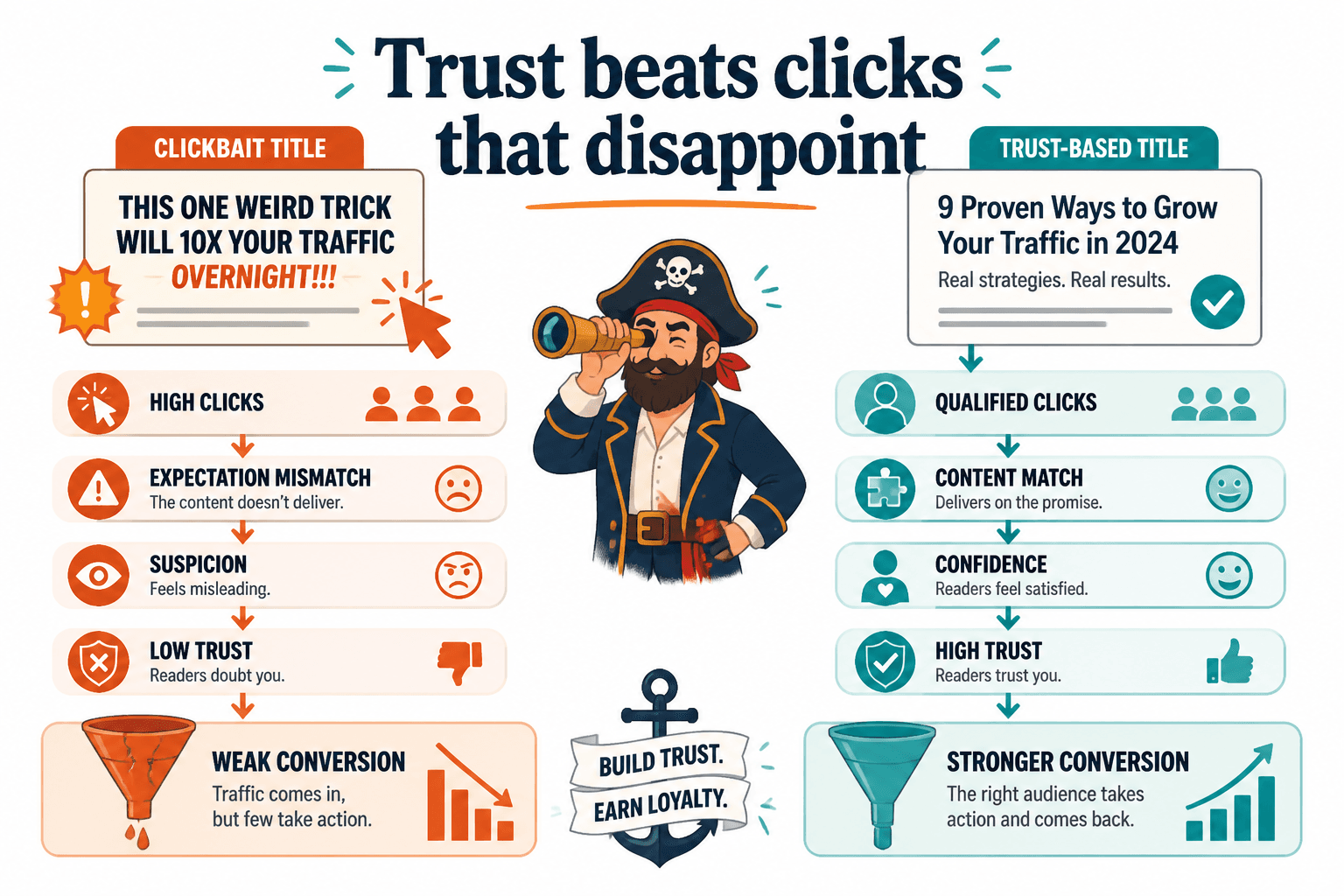
There is also a quieter issue: even if a manipulative title gets the click, it can reduce conversion later. People who feel tricked do not suddenly become trusting when they reach the CTA. They become suspicious, defensive, and much harder to move.
That is why trust-friendly titles are not just morally nicer. They are commercially smarter.
The three things a monetizable headline needs
If you want a title to support revenue without sounding greasy, make sure it has these three ingredients:
1. Clear relevance
The reader should quickly understand what the article is about and why it matters to them. Cleverness is optional. Relevance is not.
Bad example: “The Content Shift That Changed Everything”
Better: “How to Turn Blog Titles and Headlines Into More Leads or Sales”
The second one has commercial relevance. It pulls in someone who actually cares about converting attention into business. That is a more useful reader than someone who clicked because “changed everything” made them curious for six seconds.
2. Honest tension
The title should surface a real problem, conflict, or desired outcome. But it needs to do that without cartoon drama.
“Without Wrecking Trust” works because it names the fear. Plenty of creators want more revenue from content but do not want to sound gross. That tension is real. It does not need fake outrage piled on top.
3. Natural commercial alignment
The title should connect to something you can actually help with. This sounds obvious. It is not.
If you sell messaging strategy, content consulting, title templates, editorial services, funnels, SEO writing, or conversion-focused audits, then headlines around trust, clicks, leads, and conversion make sense. If you sell something completely unrelated, trying to monetize this topic is going to feel stitched together and weird.
The best monetizable titles do not just get traffic. They pre-qualify attention.
What to avoid if you do not want your headlines to smell like bait
Some title moves look persuasive but quietly lower trust. Here are the big offenders.
Vague big promises
Examples:
- How to Explode Your Blog Revenue Overnight
- The Secret Formula for Headlines That Convert Like Crazy
- This One Weird Trick for Unlimited Clicks
These do not sound confident. They sound like they were found in a trench coat.
Readers with any discernment have seen these patterns too many times. Even if your content is good, the title makes you look less trustworthy before you start.
Specificity theater
This is when writers use numbers or precision to create authority they have not earned.
Example: “The 7.3% Headline Tweak That Doubled Revenue”
If you cannot support that claim clearly, do not use it. A fake-specific title is worse than a broad honest one.
Disguised sales content
This is the article that pretends to educate but exists mainly to pitch.
The title says “how to,” but the post gives two soft points and then a hard turn into “that is why you need my premium solution.” Readers can smell the trap. Usually before paragraph three.
Emotion without substance
Fear, urgency, curiosity, and frustration can absolutely help a title. But if the article does not deliver depth, evidence, examples, or a usable idea, that emotion becomes manipulation.
Strong titles create tension. Weak titles rent tension from clichés.
How to write titles that attract buyers, not just browsers
If your title is going to support revenue, it should attract people close to a meaningful problem. Not just people in a vague mood to read stuff.
Here are the levers that help.
Lead with a commercially relevant problem
Titles that monetize well usually focus on one of these:
- Getting more qualified traffic
- Improving leads or sales
- Fixing trust issues that block conversion
- Making content support a funnel
- Improving positioning, clarity, or buyer intent
That does not mean every title should scream “sales.” It means the topic should connect to a real business result.
Compare these:
- How to Write Catchy Blog Headlines
- How to Write Blog Headlines That Bring in Better Leads
The first attracts general interest. The second attracts someone with buying-adjacent intent.
Use the problem-and-protection structure
One of the cleanest formats for trust-friendly monetization is:
How to get desirable result without undesirable cost
Examples:
- How to Monetize Blog Titles and Headlines Without Wrecking Trust
- How to Write Sales-Friendly Headlines Without Sounding Pushy
- How to Increase Clicks Without Using Cheap Clickbait
- How to Get More Leads From Articles Without Turning Them Into Ads
This works because it acknowledges the reader’s skepticism. They want the result, but they are wary of the cost. Good. Respect that wariness. It means they are paying attention.
Qualify the reader when useful
Sometimes a title becomes more monetizable when it narrows the audience.
Examples:
- Blog Headline Strategies for Coaches Who Sell Through Content
- How Consultants Can Write Article Titles That Pre-Sell Their Expertise
- SEO Blog Titles for Service Businesses That Need Better Leads, Not More Noise
Narrower titles may get fewer clicks. Fine. If they bring in better-fit readers, they can be far more valuable.
How to connect a headline to revenue without making the article feel like a trap
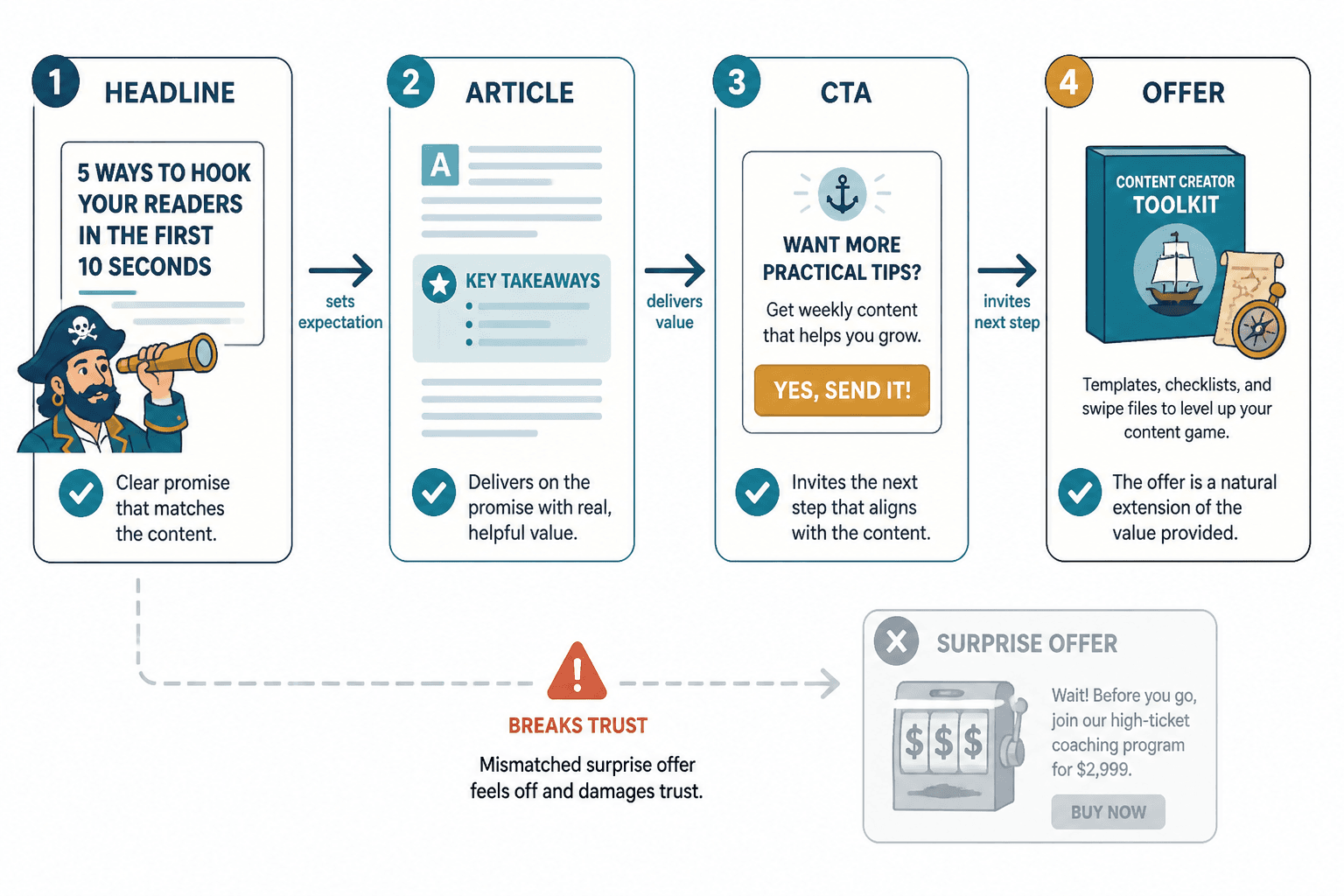
The title is not doing the monetization alone. It is the front end of a chain.
Usually the chain looks like this:
- Title attracts the right reader
- Opening proves relevance fast
- Article delivers actual value
- CTA offers the logical next step
If one of those pieces is broken, the title gets blamed for a conversion problem that actually belongs to the article or offer.
For example, if your title promises practical guidance on monetizing headlines, the article should include practical guidance on monetizing headlines. Not just broad branding philosophy and a surprise booking link at the end.
This is also why weak openings hurt conversion. If the first few paragraphs wander around clearing their throat, readers lose momentum before they ever reach the value or CTA. If you need help there, this guide on starting blog titles and headlines without a weak opening is worth reading next.
And if your next step is offer design, funnel sequencing matters too. A smart title can only do so much if it leads into a clumsy path. For that, see best funnel ideas to pair with blog titles and headlines.
A simple framework for monetizable, trust-safe titles
Here is a practical framework you can use when drafting titles:
The RTA framework: Relevance, Tension, Alignment
- Relevance: Is the topic clearly useful to the right reader?
- Tension: Is there a real problem, desire, risk, or contrast in the title?
- Alignment: Does this naturally connect to the offer, service, or next step?
Test your draft title against all three.
| Draft title | What is wrong | Stronger version |
|---|---|---|
| Better Headlines for More Traffic | Too broad, weak commercial intent | How to Write Blog Headlines That Attract Better-Fit Leads |
| The Secret to Monetizing Content | Vague and hypey | How to Monetize Blog Content Without Making It Feel Like a Pitch |
| Headlines That Sell | Thin, generic, not trust-aware | How to Write Sales-Friendly Headlines Without Burning Credibility |
| Why Your Blog Is Not Converting | Negative but unspecific | Why Your Blog Titles Attract Clicks but Not Buyers |
Notice the pattern. The stronger versions are not louder. They are clearer. That is usually the better trade.
Before-and-after title rewrites
Let’s make this more concrete.
Example 1: too broad
Before: How to Write Better Blog Titles
After: How to Write Blog Titles That Attract Readers Likely to Buy
Why it works: The rewrite adds commercial intent and audience quality. It shifts from generic improvement to business relevance.
Example 2: too salesy
Before: Blog Headlines That Skyrocket Sales
After: Blog Headlines That Support Sales Without Sounding Like Ads
Why it works: The rewrite keeps the revenue angle but removes the infomercial residue.
Example 3: curiosity with no anchor
Before: The Headline Mistake Costing You Everything
After: The Blog Headline Mistake That Lowers Clicks and Damages Trust
Why it works: The rewrite keeps the tension but tells the reader what kind of mistake this is and what damage it causes.
Example 4: useful but flat
Before: Tips for Monetizing Blog Headlines
After: How to Monetize Blog Titles and Headlines Without Wrecking Trust
Why it works: The rewrite adds tension, consequence, and a more concrete promise.
If your titles keep sliding too far toward hype or too far toward blandness, this related guide on how to write blog titles and headlines without sounding salesy or robotic will help you find the middle.
Good monetization starts with article-topic selection, not just wording
Sometimes the title is not the main problem. The topic is.
If you keep choosing article ideas with weak buying intent, no amount of title polish will turn them into strong monetization assets. You can improve packaging, yes. But packaging cannot rescue a topic that has no strategic path to an offer.
Good monetizable article topics often sit close to one of these zones:
- A problem your paid work directly solves
- A mistake that creates demand for your expertise
- A comparison that helps readers understand why your approach matters
- A tactical issue that naturally leads to a tool, audit, consultation, or template
- A trust blocker that keeps buyers from moving forward
Bad monetizable article topics, on the other hand, tend to attract broad curiosity with weak commercial fit. They may bring in traffic, but the traffic drifts. It does not convert because the article was never aimed at a meaningful next step.
That is why title strategy works best inside a larger content system. If you are building that kind of system, the broader blog SEO writing and article systems resources can help connect titles to the rest of the machine.
Where the CTA should show up in a trust-friendly article
If the title is strong and the article is useful, the CTA does not need to kick the door down.
In fact, the cleanest monetization often happens when the article earns enough trust that the next step feels obvious. Not forced. Obvious.
Some simple title-to-CTA pairings:
- Educational title → CTA to a related template or checklist
- Problem-focused title → CTA to an audit, consultation, or service page
- Comparison title → CTA to a case study or deeper guide
- Process title → CTA to a tool, framework, or implementation offer
What you want to avoid is the hard pivot. You know the one. The article teaches headline clarity, then suddenly says “book a discovery call to transform your entire business.” Calm down.
The CTA should match the promise and scope of the article. If the title is specific, the next step should feel specific too.
If your goal is to make titles actively support revenue, not just attention, read how to turn blog titles and headlines into more leads or sales after this. It pairs nicely with what we are covering here.
Trust-friendly title formulas that still have commercial bite
You do not need formulas for every title, but they help when you want structure without sludge. Here are a few that work without turning the article into a billboard.
- How to [result] without [trust-killing downside]
- The clearer way to [goal] when your audience hates hype
- [Number] title approaches that attract better-fit readers
Used well, formulas give you structure without draining the honesty out of the title. That balance is what keeps monetization from feeling greasy.