
Changing a few sentences and swapping in a new year is not a refresh. That is cosmetic surgery for a page that needed a diagnosis. A better rewrite or refresh starts with a sharper question: what is this post supposed to do now, and what is stopping it from doing that?
That small shift changes everything. Instead of “make it newer,” you get a useful editorial job: improve the angle, fix the structure, tighten the proof, and remove the parts that only exist to look finished. The result should feel like the article finally learned what it was trying to say.
What a rewrite or refresh is actually for
A good update does one or more of these things:
- makes the post more useful to the reader
- matches the current search intent better
- clarifies the point faster
- improves the article’s conversion path
- rescues a strong topic from weak execution
That is different from polishing for polish’s sake. Clean wording is nice. Useful wording is better. Search engines are not grading your prose with a little silver star; readers are deciding whether to keep going.
If you want the broader system behind this, see the parent guide on blog rewrites and refreshes. For examples and idea generation, the sibling guide best blog rewrites and refreshes ideas and examples for creators is useful.
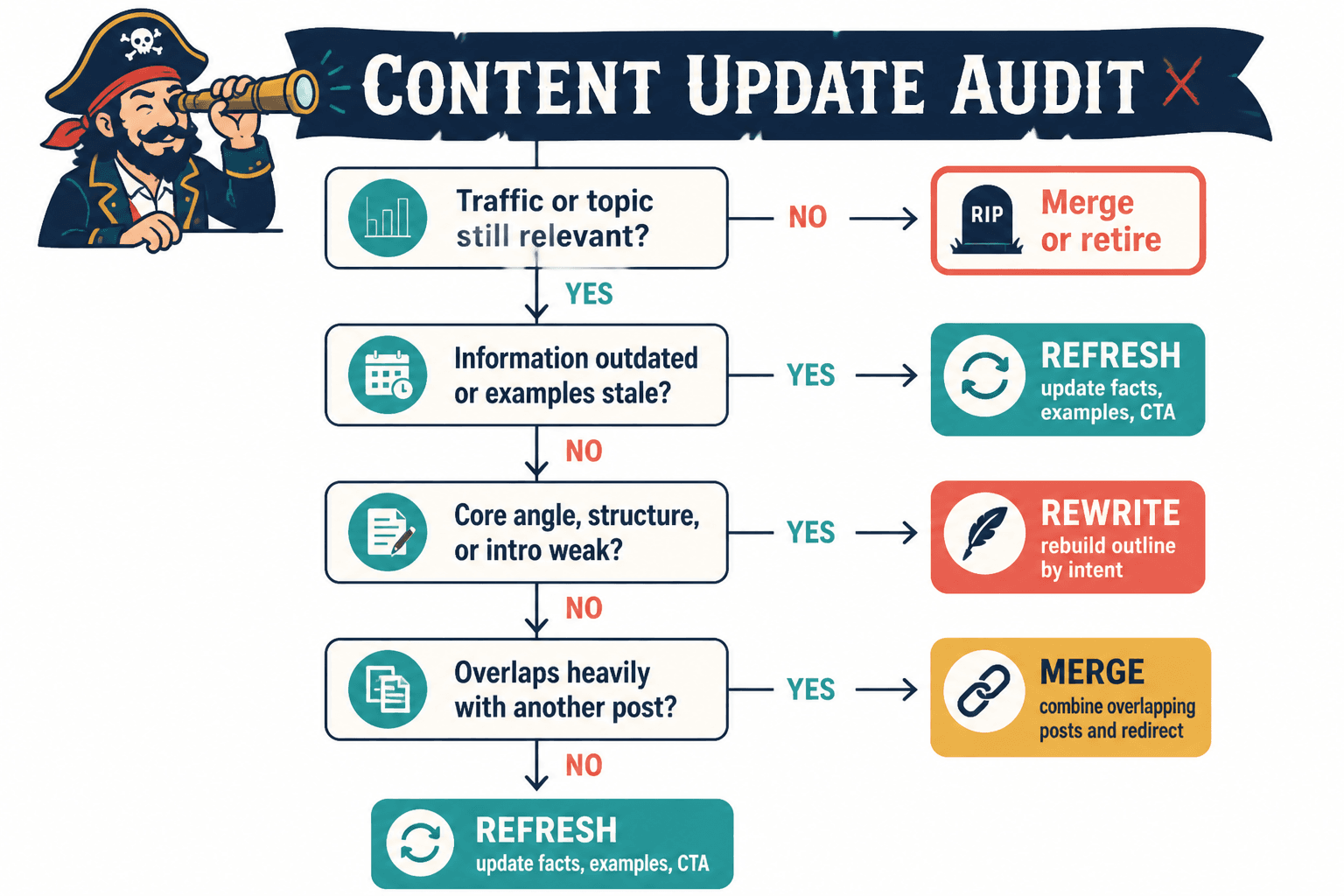
Refresh, rewrite, merge, or retire?
Not every old post deserves the same treatment. Before you edit, decide what kind of rescue mission this actually is.
- Refresh when the topic is still right, but details, examples, links, or structure are stale.
- Rewrite when the angle, organization, or usefulness is weak enough that the article needs a deeper reset.
- Merge when two posts overlap so much that one stronger version makes more sense.
- Retire when the topic no longer fits your site, audience, or goals.
That distinction saves time and prevents the classic edit spiral: one post needs a light update, so you accidentally rebuild half your content library and call it “quick.”
A simple framework before you touch the draft
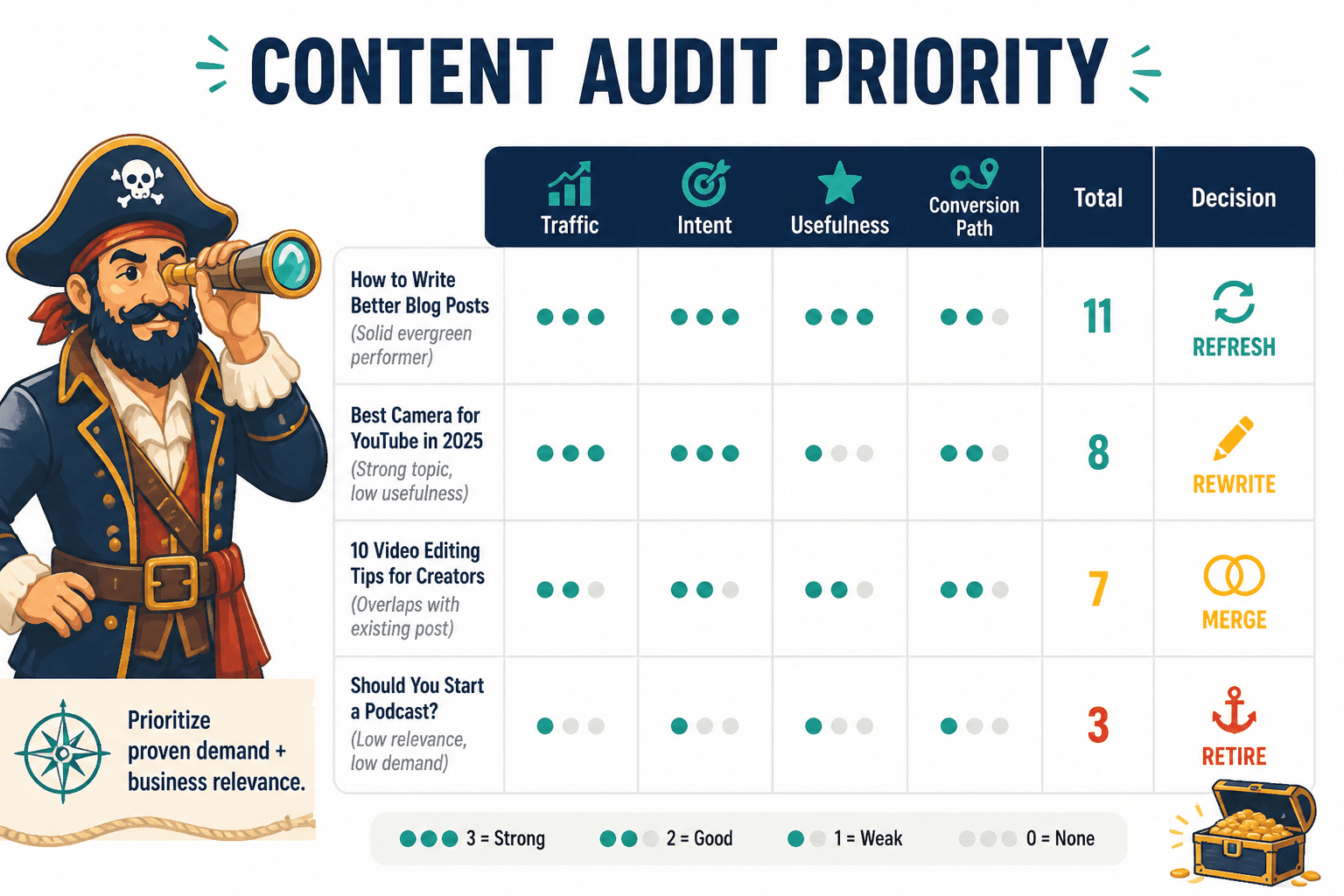
Use four questions to decide what kind of update to do.
1. Traffic
Does the post already attract impressions, clicks, or some kind of steady attention? Posts with existing visibility are often the best refresh candidates because you are improving something that already has momentum.
2. Intent
Does the article still match what the audience is trying to do now? Search intent drifts. So do reader expectations. A post can be technically accurate and still miss the real question.
3. Usefulness
Is the article still helpful, or just present? A lot of underperforming content is not wrong, just thin, vague, or oddly proud of its own generality.
4. Conversion path
Does the post lead anywhere useful? If the article gets attention but never links to the next step, that is not a mystery. It is a missing path.
When those four checks point in the same direction, the edit gets much easier. You are no longer “improving content.” You are solving a specific problem.
What to fix first in a blog refresh
Start where the article is weakest, not where the easiest sentence is.
1. Fix the angle
If the post feels stale, the angle may be the real problem. Sometimes the topic is fine but the framing is flat. A stronger refresh usually sharpens the promise, narrows the focus, or makes the point more specific.
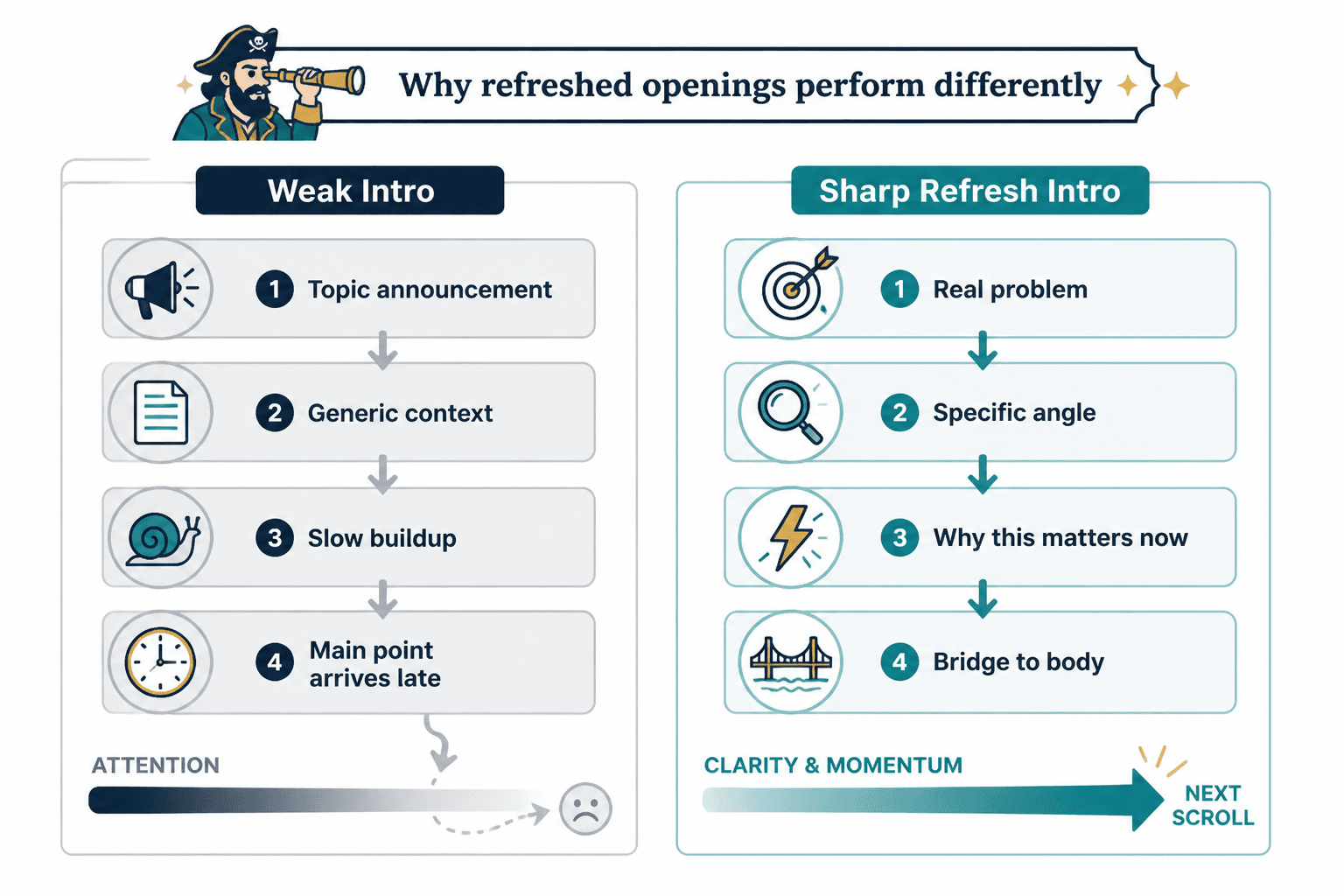
2. Rewrite the opening
The opening has one job: earn the next paragraph. Do not spend three paragraphs warming up to the topic like it is a meeting nobody wanted.
Lead with the tension, the problem, or the payoff. Explain why the post matters now. State what the reader will be able to do after reading.
3. Tighten the structure
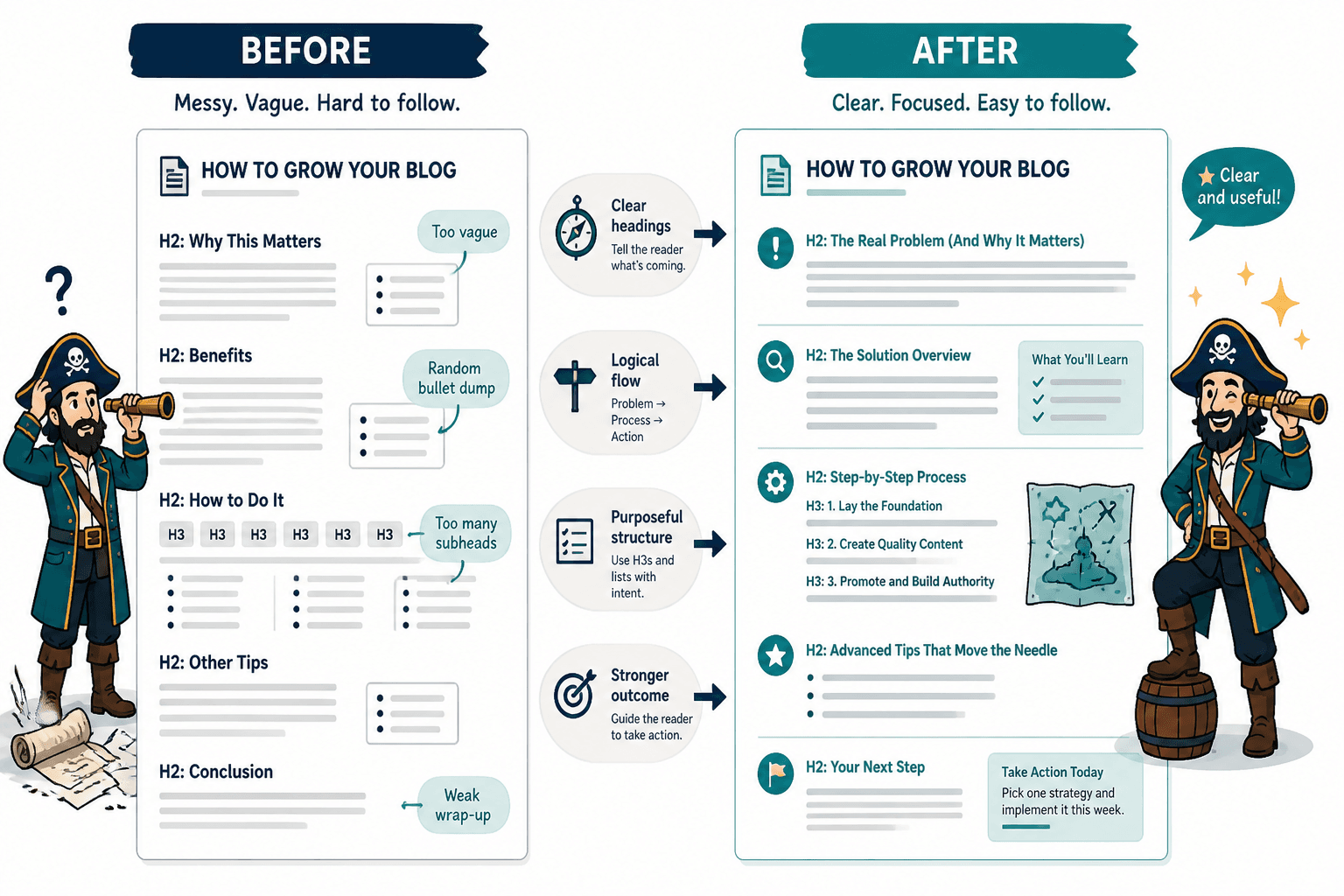
A refresh should make the article easier to follow. That often means reorganizing sections, improving H2s, and moving key information earlier.
Use headings to guide the reader, not just to break up the page so it looks obedient.
4. Replace vague advice with usable examples
Generic phrasing is the quiet killer of blog refreshes. “Improve clarity,” “add value,” and “make it more engaging” are editing notes, not final copy.
Show what changed. Use concrete examples, specific steps, and plain language that tells the reader something they can actually use.
5. Clean up the conversion path
If the post should lead somewhere, make that path visible. Add or strengthen internal links, place a useful CTA where it makes sense, and avoid dropping the pitch before the article has earned it.
For a more practical follow-up on turning a refreshed post into business results, see how to turn blog rewrites and refreshes into more leads or sales.
How to keep the edit from sounding generic
A rewrite gets generic when the writer starts sanding off every specific edge. The sentence becomes smoother, but the meaning gets blurrier. Very efficient, if your goal is to sound like a committee.
To avoid that:
- keep the original point, but improve the delivery
- cut filler that exists only to sound complete
- replace abstractions with examples or scenarios
- use plain language instead of fake-polished language
- make claims specific enough to be testable
A useful test: read the revised paragraph and ask whether it says something a reader could apply, question, or act on. If not, it may be prettier but not better.
For a deeper look at what not to do, the guide on blog clarity edit mistakes that hurt performance is a helpful companion.
When a short refresh is enough
Not every post needs a heavy overhaul. Sometimes a short refresh is the smarter move.
- The article is still relevant, just slightly stale.
- The structure works, but the clarity needs a pass.
- The post gets impressions but weak clicks.
- The content already covers the main intent well.
- The page has authority you do not want to disrupt.
In those cases, a focused update can outperform a total rewrite. Change the opening, improve a few sections, refresh the examples, update links, and move on. No ceremonial rebirth required.
If you want a sharper rule of thumb on update size, see when short blog refreshes beat long ones.
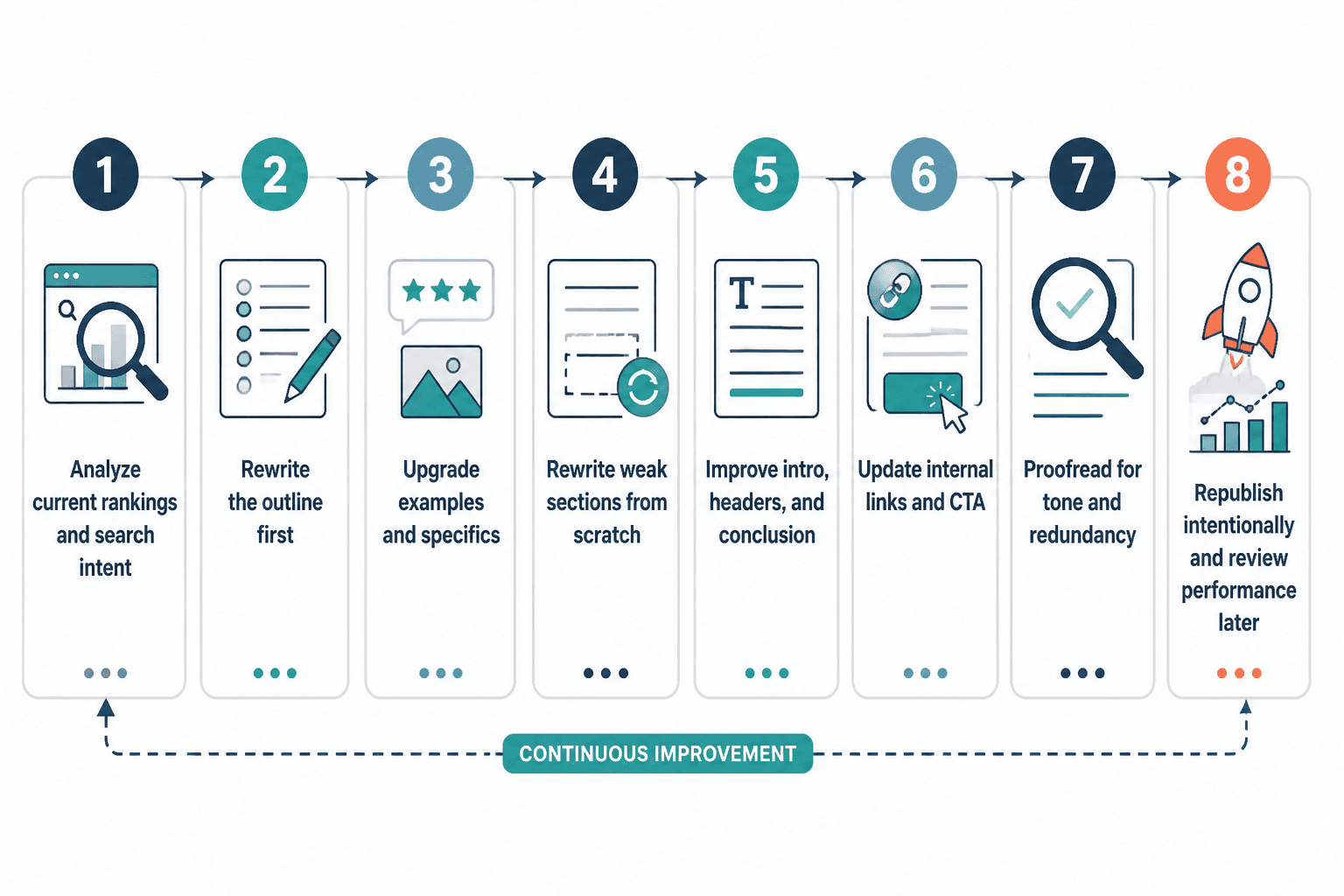
A repeatable workflow for better rewrites and refreshes
- Audit the post. Check traffic, intent, usefulness, and conversion path.
- Choose the right edit type. Refresh, rewrite, merge, or retire.
- Rework the angle. Clarify what the post is really saying now.
- Fix the opening. Lead with tension, not throat-clearing.
- Restructure the body. Put the strongest material in the clearest order.
- Upgrade examples and proof. Replace vague claims with specific support.
- Repair the CTA and internal links. Make the next step obvious.
- Review for tone. Make sure it sounds like a person, not a brand template in a blazer.
That workflow is simple on purpose. The best content edits are rarely magical. They are just honest about what is broken and disciplined about fixing it.
Quick checklist before you republish
- Does the title still match the improved article?
- Does the opening state a real problem or payoff quickly?
- Are the headings doing actual organizational work?
- Are the examples specific enough to be useful?
- Did you remove filler that sounded “helpful” but said little?
- Does the article point readers somewhere useful next?
- Does the final version still sound like you, just clearer?
For more angle and format ideas, the sibling post best AI tools for blog rewrites and refreshes may also help with workflow planning, though the writing judgment still has to come from a human brain with standards.
Final thought
Better blog rewrites and refreshes are not about making old content look busy. They are about making it earn its place again. Start with the real problem, choose the right kind of edit, and keep the useful parts useful. That is usually enough to turn a tired post into something that can actually do its job.
Sources
For search intent and result quality context, Google’s Search Central guidance on creating helpful, reliable, people-first content is worth keeping nearby: Creating helpful, reliable, people-first content.
For search-focused editorial basics, see Google’s SEO Starter Guide.
For a stable reference on how search engines crawl and process updated content, Bing’s Webmaster Guidelines are also useful.