
Most CTAs are weak for a boring reason: they were written at the very end, with whatever energy was left in the tank.
That is why so many calls to action sound like “let me know your thoughts,” “DM me if this resonates,” or the timeless classic, “click here to learn more.” Technically functional. Emotionally dead. About as persuasive as a laminated brochure in a waiting room.
If you want to know how to turn old content into better CTA writing, start here: your best CTA ideas are usually already buried inside your existing content. In your old posts, emails, articles, threads, comments, sales pages, and FAQs, you have raw material that tells you what your audience wants, what language they respond to, what problems they actually care about, and what next step makes sense.
So this is not about inventing sharper CTAs from thin air. It is about mining what you have already said, finding the parts that carry real tension or intent, and turning those into calls to action that feel relevant instead of stapled on.
Here is how to do that without turning every piece of old content into a needy little sales pitch.
For the main guide behind this topic, visit the parent guide.
Why old content is a goldmine for better CTAs
A strong CTA is not just a button phrase or a closing line. It is the logical next step after a clear idea.
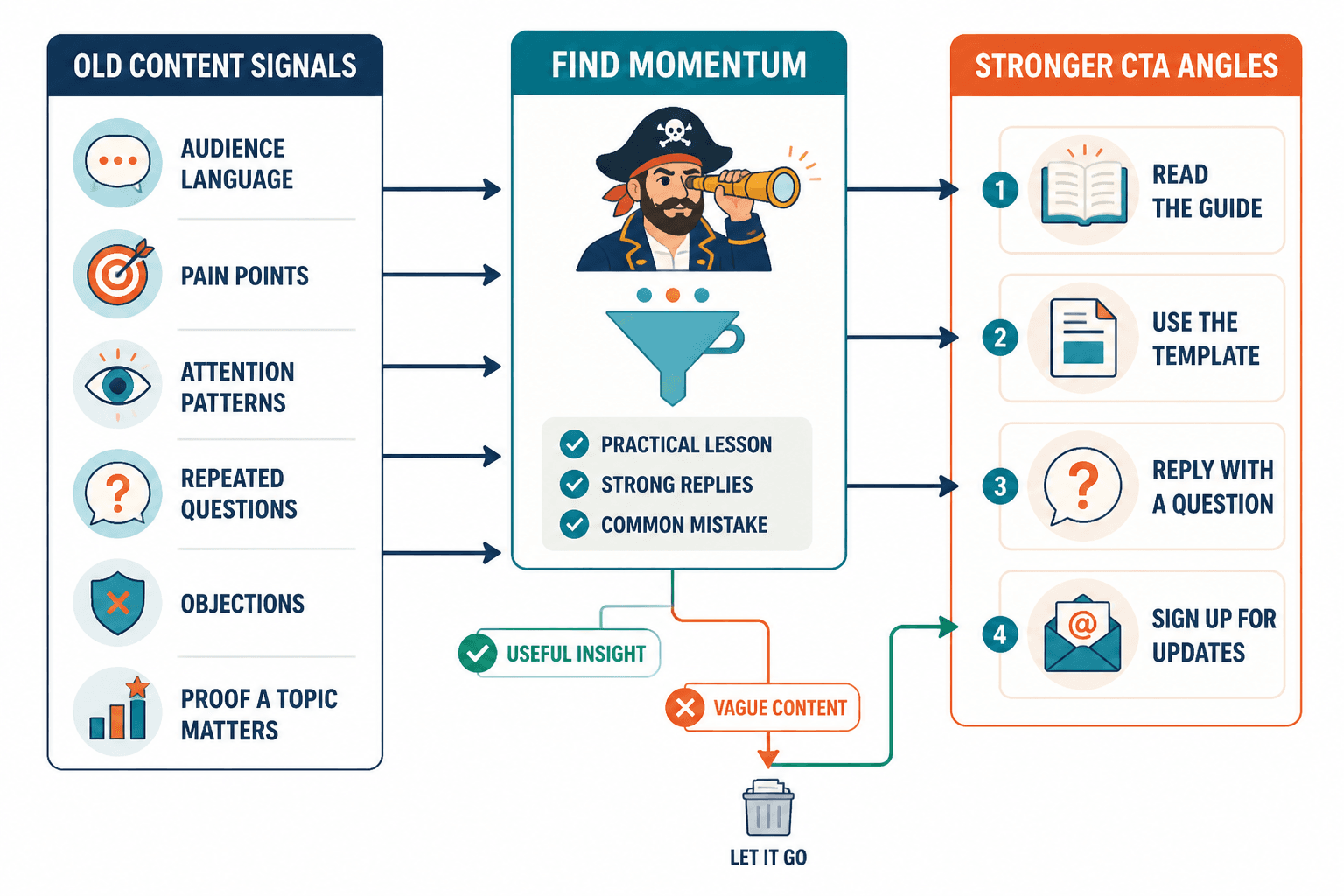
Old content helps because it already contains the useful stuff most people skip when they rush to write a CTA:
- real audience language
- specific pain points
- patterns in what got attention
- questions people kept asking
- objections that came up repeatedly
- proof that a topic actually matters
- natural bridges to an offer, reply, click, or signup
In other words, your archive shows you what deserves a CTA. That matters, because the worst CTA mistake is trying to force action where no real momentum exists.
If a post taught something practical, sparked strong replies, or exposed a common mistake, there is probably a useful CTA hiding in it. If it was vague thought leadership wallpaper, maybe not. Some content deserves repurposing. Some deserves a quiet burial.
What makes a CTA worth improving
Before you start pulling lines from old content, it helps to know what a better CTA actually does.
A useful CTA usually has four things going for it:
- Context: it fits the content that came before it
- Clarity: people know what to do next
- Relevance: the next step matches their likely intent
- Motivation: there is a reason to act now, not someday-ish
That means “Book a call” is not automatically a good CTA just because your business sells services. If the content was top-of-funnel and educational, “Read the guide,” “Steal the template,” or “See how this works” might be much stronger. Ask for the relationship stage the content has earned, not the one you wish it had earned.
This is where old content becomes useful. It shows you the stage of awareness, the level of trust, and the kind of action people are most ready for.
How to turn old content into better CTA writing
The process is pretty simple. The judgment part is where people get weird.
Do not just skim old content for lines that sound clever. Look for the moments that reveal desire, friction, and next-step readiness.
1. Start with content that already proved something
Do not begin with your random forgotten posts from 14 months ago that got three pity likes and one bot comment. Start with content that already showed signs of life.
Good places to pull from:
- high-performing posts
- emails with strong click or reply rates
- articles that kept getting traffic
- sales calls notes
- FAQ responses
- comment threads with repeated questions
- DMs where people asked how to work with you
- webinar or workshop questions
You are looking for proof that the idea mattered. Better CTA writing starts with existing demand signals, not wishful thinking.
2. Highlight the lines with tension
In old content, the strongest CTA seeds are often not the polished conclusions. They are the lines where the reader feels a problem more clearly.
Highlight phrases that do one of these things:
- name a frustrating mistake
- show the cost of not fixing something
- contrast bad and better approaches
- expose a hidden problem
- make a desirable outcome feel concrete
- answer “why should I care?” fast
For example, say an old article includes this line:
Your homepage is probably not underperforming because the design is ugly. It is underperforming because the next step is vague.
That line contains CTA fuel. It points to a problem, raises stakes, and implies a fix. From there, you can build stronger calls to action like:
- See how to make your next step clearer
- Fix the vague CTA that is costing you leads
- Read the guide to writing CTAs people actually click
Notice the difference. The CTA is no longer generic. It is attached to a real tension the reader already feels.
3. Match the CTA to the intent of the original piece
This is where a lot of CTA writing goes off the rails.
If the old content helped someone diagnose a problem, the CTA should probably continue that diagnostic journey. If the content built trust with examples, the CTA can push slightly further. If the content handled objections, a direct offer may finally make sense.
Quick rule of thumb:
| Old content type | Best CTA direction |
|---|---|
| Awareness post | Read, save, follow, get the guide |
| Educational article | Download template, explore related article, join newsletter |
| Case study | Book consult, view service, request audit |
| FAQ or objection content | See offer, compare options, start conversation |
| Opinion post with strong engagement | Reply, comment, read deeper breakdown |
When the CTA asks for too much too soon, it feels pushy. When it asks for too little after a high-intent piece, it wastes momentum. Both are common. Neither is helping.
4. Pull repeated phrases from audience responses
If people repeatedly commented things like “I need this,” “this is exactly my issue,” “how do I fix that,” or “do you have a template,” congratulations: your audience has basically handed you better CTA writing language.
You do not need to mimic those phrases word for word every time, but they are excellent clues. They tell you what the next step should feel like from the reader’s side.
For example:
- Audience response: “Do you have an example of this?”
CTA angle: See the examples - Audience response: “I always get stuck here”
CTA angle: Fix the part most people get wrong - Audience response: “Can you break this down?”
CTA angle: Get the step-by-step breakdown - Audience response: “This is exactly my problem”
CTA angle: Solve the problem before it keeps costing you
This works because good CTAs often echo the reader’s own internal language. Not in a creepy way. Just in a clear, useful one.
5. Find the natural “next question” and use that
One of the easiest ways to improve a CTA from old content is to ask: what would the reader naturally want next after consuming this?
Not what do you want them to do. What would make sense to them?
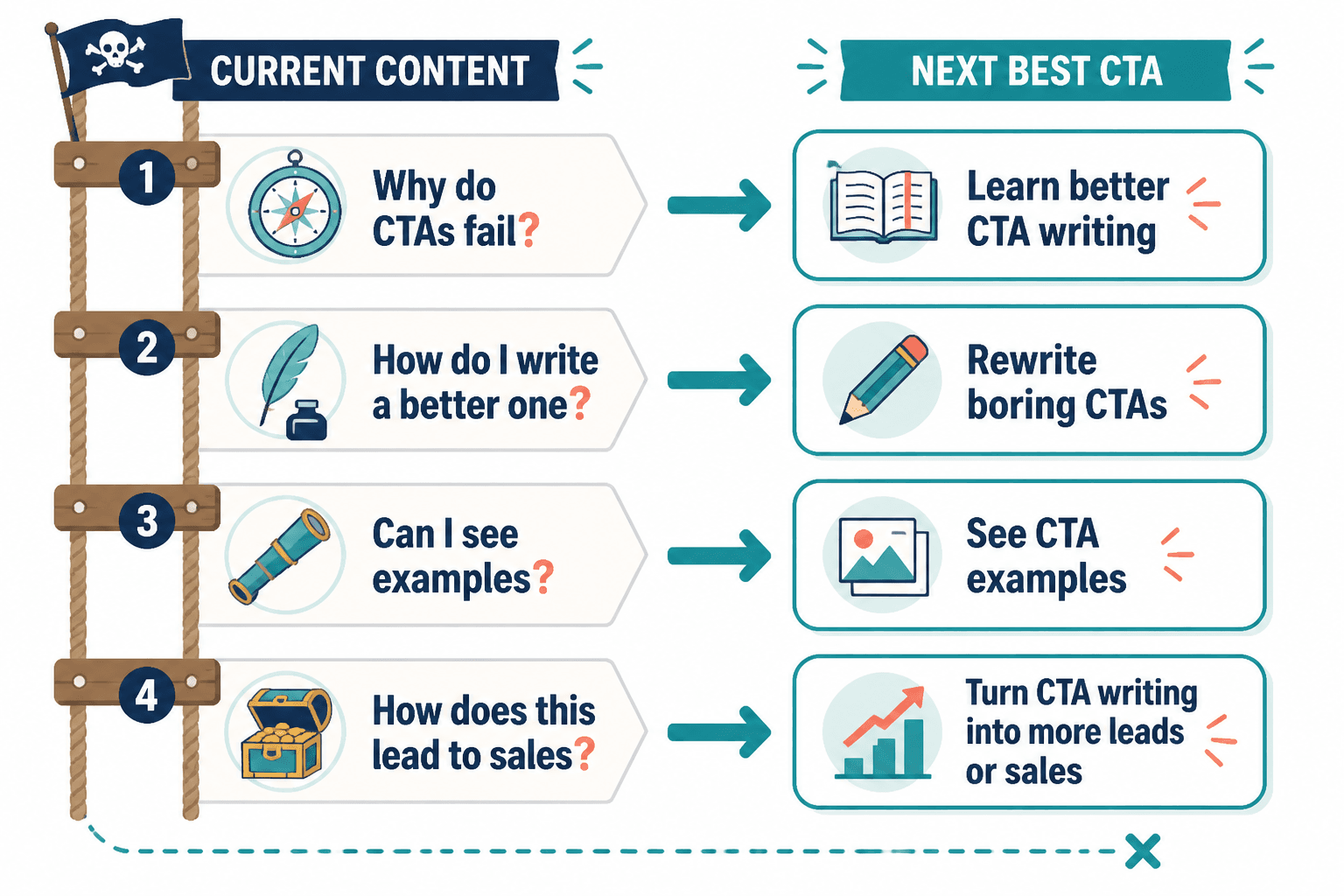
If the piece explains why most CTAs fail, the next question might be:
- How do I write a better one?
- Can I see examples?
- What should I say instead?
- How does this lead to sales?
Those questions can become direct CTA pathways to relevant internal content like how to write better CTA writing, how to rewrite boring CTA writing, or how to turn CTA writing into more leads or sales.
This is also why internal linking works best when it feels like a continuation, not a desperate SEO scavenger hunt in paragraph form.
A simple framework for rewriting old content into better CTAs
Use this quick framework when you are sitting on a pile of old content and need sharper CTA options.
The 4-part CTA extraction method
- Find the point. What is the most useful, tension-filled idea in the piece?
- Name the desire. What does the reader likely want after reading it?
- Choose the step. What action best matches that desire?
- Write the CTA in plain English. Make the next step clear and specific.
Example:
Old content point: Most service pages fail because the CTA is broad and low-stakes.
Reader desire: They want to know what to say instead.
Best next step: Read practical examples.
Weak CTA: Learn more here.
Better CTA: See the CTA examples that make service pages easier to act on.
That is the whole game. Not more hype. Better alignment.
Before-and-after examples of turning old content into better CTAs
Example 1: From educational blog post to resource CTA
Old content line: “Most people bury their offer under three paragraphs of context because they are afraid of sounding direct.”
Weak CTA: Contact us for more information.
Better CTA: Read the guide to CTA writing that gets to the point faster.
A natural internal link here would be the main CTA writing guide or CTA writing guide for creators who want better results.
Example 2: From audience question to lead CTA
Old audience question: “How do I know if my CTA is too vague?”
Weak CTA: Book a discovery call.
Better CTA: Start by fixing the vague parts. Here is how to rewrite boring CTA writing.
This works because it respects intent. The reader wants diagnosis and improvement, not an immediate calendar invitation from a stranger in a blazer.
Example 3: From case study to sales CTA
Old content line: “After simplifying the CTA and matching it to page intent, conversion rate improved because visitors could finally tell what to do next.”
Weak CTA: Let us know your thoughts below.
Better CTA: Want your CTA to pull more weight? See how to turn CTA writing into more leads or sales.
The stronger CTA carries the case study forward. It does not dump the reader out of the article into some limp comment prompt that no one needed.
Where to find reusable CTA material inside old content
If you are sitting there thinking, fine, but where exactly do I look, here is your scavenger list.
- Open loops: places where you raised a problem but did not fully solve it
- Subheads: often cleaner and sharper than your conclusion lines
- Comment replies: great source of plain-language audience phrasing
- Email subject lines: useful for CTA angle testing
- Testimonials: reveal what outcomes people actually value
- Objections: can become action-driving CTA copy
- FAQs: perfect for turning hesitation into movement
- Past offers: especially if one framing worked better than another
One useful habit: create a swipe file just for CTA ingredients. Not finished CTAs. Ingredients.
Save lines under categories like:
- problem language
- desired outcomes
- common objections
- proof phrases
- next-step questions
- soft CTA options
- direct CTA options
That gives you a stronger source bank than trying to improvise every time you publish.
Common mistakes when repurposing old content into CTAs
Some caution here, because this can get ugly fast.
- Using the most dramatic line instead of the most relevant one. Drama gets attention. Relevance gets action.
- Forcing a sales CTA onto low-intent content. Not every post is trying to marry your booking page.
- Keeping the original wording too literally. Sometimes the insight is useful, but the phrasing needs tightening.
- Writing generic CTAs after very specific content. This kills momentum immediately.
- Ignoring audience language. If comments and replies gave you cleaner phrasing, use it.
- Adding too many CTA options. Confused readers do not convert better. They just leave politely.
A better CTA is not necessarily more clever. It is more connected.
How to build a repeatable workflow for better CTA writing
If you publish regularly, do not treat this as a one-time cleanup project. Turn it into a system.
A simple workflow:
The bigger point is simple: clearer structure and clearer writing make the piece more useful. That is usually what makes the ending land better too.