Most creator bios are not empty because people have nothing to say.
They are empty because people keep trying to write them from scratch, in one sitting, while staring at a blinking cursor and suddenly forgetting what they actually do.
That is usually the wrong move.
If you have published posts, emails, threads, articles, sales pages, client notes, podcast appearances, or even half-decent captions, you already have raw material for a much better bio. The issue is not lack of words. It is that the useful words are buried inside old content nobody thought to mine.
How to Turn Old Content Into Better Creator Bios & Profile Copy really comes down to this: stop inventing, start extracting. Your best positioning, clearest promise, strongest proof, and most natural voice are usually hiding in things you have already written when you were focused on helping, explaining, selling, or arguing a point.
Here is how to pull the right material out of old content, shape it into sharp profile copy, and end up with a bio that sounds like a real human with a real point of view, not a networking event nametag with delusions.
If you want the bigger picture, start with the parent guide.
Why old content is usually better than a blank page
When people write a bio from scratch, they tend to reach for vague, polished nonsense.
That is how you end up with lines like “I help ambitious founders grow with authentic content strategies” or “Helping experts amplify their message and impact.” It sounds professional in the same way hotel wall art looks decorative. Technically fine. Emotionally absent.
Old content is better because it contains language you used when you were actually trying to communicate something real. It is where your natural phrasing lives. It is where your useful specifics show up. It is where you accidentally said the clearest thing about your work before trying to make it sound important.
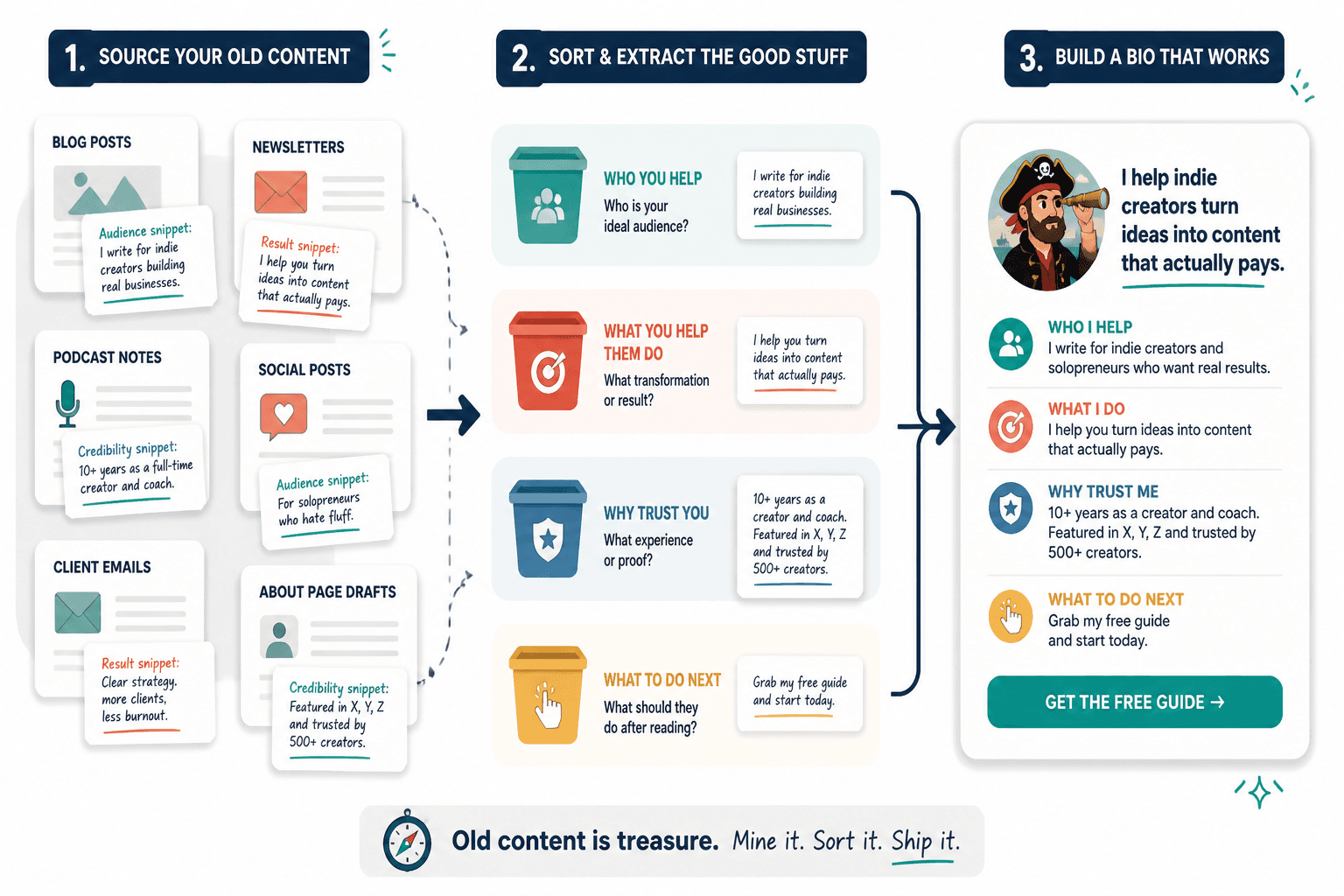
A good bio usually needs four things:
- Who you help
- What you help them do
- Why they should trust you
- What they should do next
Your old content probably already contains all four. Just not in one place yet.
What to look for inside your old content
Do not reread everything hoping the perfect bio magically appears. You want to scan for specific ingredients.
1. Audience clues
Look for repeated references to the kinds of people you serve best.
- Solo consultants
- B2B founders
- Coaches with messy messaging
- Creators trying to turn audience into leads
- Writers building a personal brand
If your content keeps attracting or speaking to one type of person, that belongs in your profile copy. Not every possible customer. The right ones.
2. Outcome language
Find lines where you described what your work actually helps people achieve.
- Get clearer positioning
- Write better LinkedIn posts
- Turn content into leads
- Launch offers without sounding salesy
- Simplify a messy message
Notice these are outcomes people care about. Not vague virtues like alignment, empowerment, visibility, or impact. Those words have been dragged through too many bios already.
3. Proof points
Proof often hides in case studies, casual examples, post comments, testimonials, old launch copy, and “about” sections you forgot existed.
- Clients served
- Audience size if it is relevant
- Revenue results if they are credible and ethical to mention
- Well-known publications or appearances
- Years of experience
- Specific project types completed
You do not need to sound like a walking trophy shelf. But you do need a reason to believe you are not just very confident on the internet.
4. Phrases that sound like you
This part matters more than people think. A strong bio should sound like the same person who writes the posts, sells the offer, and shows up on calls.
Look for repeated phrases, favorite contrasts, natural rhythms, and blunt little one-liners. If your old content tends to say things like “without sounding robotic,” “without the cringe,” “for smart people with messy messaging,” or “clearer offers, better content, more trust,” that is useful voice material.
A simple process for turning old content into better creator bios and profile copy
You do not need a giant brand strategy workshop for this. You need a sorting process.
Step 1: Gather your best old content
Pull together 10 to 20 pieces of content that reflect your best work or best-fit audience. That might include:
- Top-performing social posts
- Emails that got replies
- Articles that still feel solid
- Sales page copy
- Workshop descriptions
- Podcast guest intros
- Testimonials
- Client onboarding answers
Do not choose content just because it did numbers. Sometimes your most useful positioning is hiding in the post with modest reach and excellent comments from exactly the right people.
Step 2: Highlight the useful bits
Create four buckets:
- Audience
- Problem
- Outcome
- Proof
As you read old material, copy any strong lines into one of those buckets. Do not edit yet. Just collect.
You are looking for patterns. If ten different pieces of content suggest you help experts simplify complex ideas into better content, that is not random. That is positioning trying to get your attention.
Step 3: Cut what is impressive but not useful
This is where a lot of bios go sideways. People keep lines that make them sound accomplished, but not lines that make them understandable.
“Founder, strategist, speaker, advisor, educator, and thought leader” may all be technically true. It is also profile confetti.
Keep what helps a stranger quickly answer:
- Is this for me?
- Is this person credible?
- What do they actually help with?
- What should I do next?
Step 4: Turn repeated themes into short profile lines
Now start compressing.
If your old content says, over and over, that you help consultants explain what they do more clearly so their content and offers convert better, your bio does not need to become a novel. It needs to become a sharp line.
I help consultants clarify their positioning and content so more of the right people understand, trust, and buy.
That is already stronger than most bios because it names the audience, the work, and the outcome without sounding like it was assembled by committee.
Step 5: Add one clean proof point
One specific proof point often does more than three inflated claims.
- Worked with 60+ coaches and consultants
- Writer behind 10M+ views across founder content
- Former agency strategist turned content consultant
- Helping B2B experts turn posts into inbound leads
Short is fine. Relevant is better.
Step 6: Finish with a CTA that matches the profile’s job
A profile CTA does not need to sound like a mini funnel trapped in a trench coat. It just needs to tell people where to go next.
- Read the newsletter
- Book a consult
- Grab the free guide
- See how I work
- DM me “bio” for details
If you want help with this part specifically, it is worth reading better creator bios and profile CTAs for personal brands.
What old content usually turns into best
Different old assets are good for different parts of your bio. Here is the practical version.
| Old content type | Best use in profile copy |
|---|---|
| Top-performing posts | Voice, positioning lines, audience language |
| Sales pages | Outcome language, problem framing, CTA ideas |
| Testimonials | Proof, phrasing your audience naturally uses |
| Articles and newsletters | Clear explanations of your method or angle |
| Podcast bios and guest intros | Concise credibility lines |
| Client FAQs or onboarding forms | Sharp wording around what people hire you for |
| Comments and DMs | Audience pain points in plain language |
This is why profile writing is often an editing job, not a creativity job. You are shaping evidence, not summoning genius.
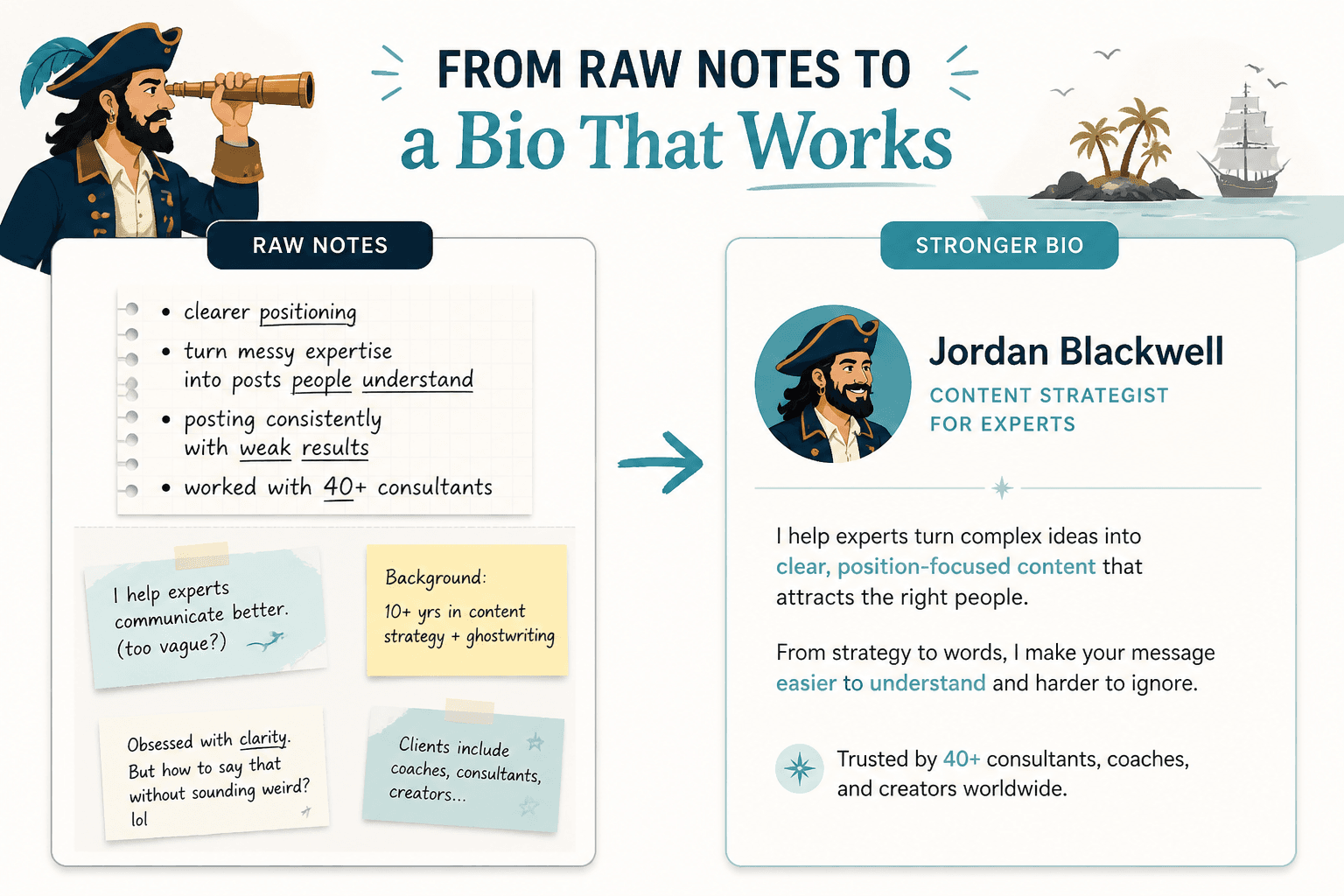
Before and after: turning old content into a stronger bio
Let’s make this less abstract.
Example 1: Content consultant
Old content clues:
- “Most experts do not need more content ideas. They need clearer positioning.”
- “I help consultants turn messy expertise into posts people actually understand.”
- “Clients usually come to me after posting consistently with weak results.”
- “Worked with 40+ consultants and service businesses.”
Weak bio:
Helping entrepreneurs elevate their brand through authentic content and messaging.
Better bio:
I help consultants and service businesses clarify their positioning and turn expertise into content that earns trust and leads. Worked with 40+ clients. See how I work below.
Same business. Much better signal.
Example 2: Career coach
Old content clues:
- “Most resumes are too broad because people are trying to sound qualified for everything.”
- “I help mid-career professionals position themselves for better roles without rewriting their whole identity.”
- “Interview prep, resume strategy, LinkedIn profile rewrites.”
- “Clients have landed roles at major tech and healthcare companies.”
Weak bio:
Career coach empowering professionals to unlock their potential and step into aligned success.
Better bio:
I help mid-career professionals sharpen their resume, LinkedIn profile, and interview story so they can land better roles with less vague self-marketing. Clients have landed roles across tech and healthcare.
That last phrase has a bit of voice. Good. Bios do not need to sound sterile to sound credible.
Example 3: Newsletter-first creator
Old content clues:
- Writes about creator business models, audience trust, and better offers
- Known for blunt breakdowns of online business fluff
- Newsletter is the main product ecosystem
- Strong repeated phrase: “practical content for creators who are tired of vague advice”
Better bio:
Practical content for creators tired of vague advice. I write about offers, content, trust, and monetization without the usual beige nonsense. Join the newsletter.
That will not be for everyone. Excellent. Bios should filter, not just attract.
The parts of your bio old content can help you write
A strong profile usually has a few small components. You can build each one from existing material.
The bigger point is simple: clearer structure and clearer writing make the piece more useful. That is usually what makes the ending land better too.