
The bigger point is simple: clearer structure and clearer writing make the piece more useful. That is usually what makes the ending land better too.
Most weak homepage openings are not weak because the writer lacks talent. They are weak because they open with scene-setting fluff, broad claims, or brand throat-clearing that nobody asked for.
“Welcome to our website.”
“We help businesses grow.”
“Your trusted partner in success.”
That kind of opening does not build trust. It slides right past the reader’s brain like wet cardboard.
If you want to know How to Start Homepage Copy Without a Weak Opening, the fix is simple in theory and annoyingly harder in practice: stop introducing yourself like a brochure and start with something the reader can recognize, want, or care about fast.
A strong homepage opening should do three jobs almost immediately:
- Tell the right person they are in the right place
- Make the value clear without sounding inflated
- Create enough interest to keep them scrolling
That is it. Not twelve jobs. Not your whole life story. Not every service you have ever sold since 2019.
This guide will help you write homepage openings that are clearer, sharper, and much less likely to die on contact. If your current hero section sounds vague, overpolished, or painfully interchangeable, this is where to fix it.
For the broader learning path, visit our parent guide.
Why homepage openings fall flat so often
Homepage copy usually gets weak at the exact moment it tries to sound important.
People start writing as if they are applying for the role of “respected business on the internet.” So the copy gets padded with words like innovative, tailored, empowering, premium, results-driven, and other beige suspects. The result is technically polished and emotionally dead.
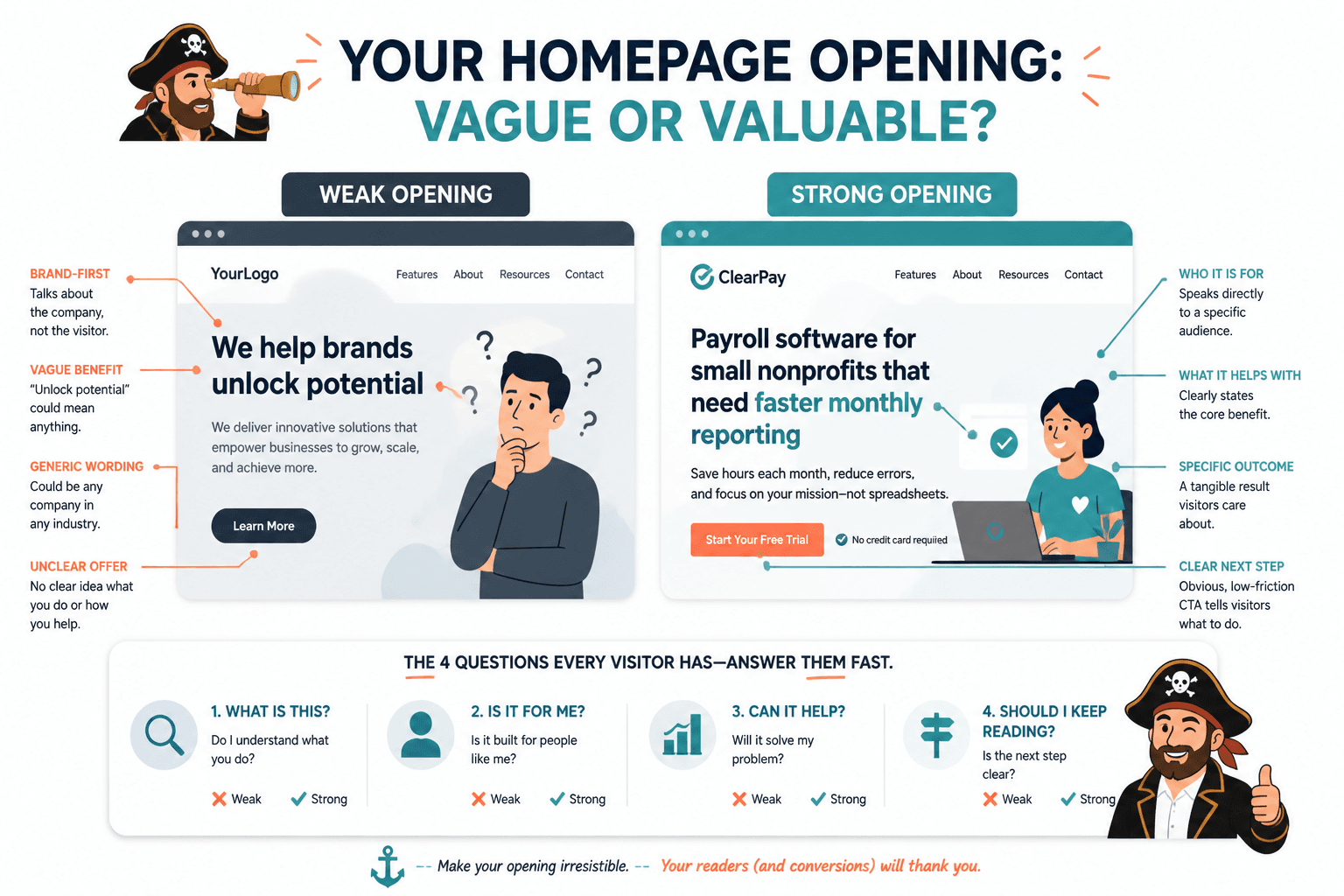
Your reader is not looking for ceremonial language. They are trying to answer a few basic questions:
- What is this?
- Is it for me?
- Can you help with the thing I actually need help with?
- Should I keep reading?
If your opening does not help them answer those questions quickly, it is weak. Even if it sounds fancy.
Weak homepage openings usually have one of these problems:
- They start with the brand instead of the reader
- They use vague benefits instead of specific outcomes
- They sound like every other homepage in the category
- They try to sound premium by becoming less clear
- They hide the actual offer behind style
Clarity is not boring. Generic copy is boring. There is a difference.
What a strong homepage opening actually needs
You do not need a clever slogan. You need a useful first impression.
At minimum, a strong homepage opening usually includes:
- A clear audience or use case
- A clear outcome, benefit, or problem solved
- Enough specificity to feel credible
- A tone that matches the brand without burying the point
If you can say who it is for and what it helps them do in a way that feels concrete, you are already ahead of a depressing amount of the internet.
The opening is not there to say everything
This is where people overcomplicate it. They try to cram the headline, subheadline, brand story, positioning statement, emotional hook, proof, and CTA into one strained little block of text.
Your opening does not need to carry the entire site on its back. It needs to create immediate orientation and momentum. The rest of the homepage can deepen the case. The opening just has to earn the next few seconds.
How to Start Homepage Copy Without a Weak Opening: a practical approach
Here is the easiest way to write a stronger opening: stop trying to begin with “branding” and begin with decision-making.
In other words, write for the person deciding whether to stay.
Use this four-part process.
1. Pin down who the homepage is for
If your opening is weak, there is a decent chance the targeting is mushy too.
You do not always need to name the audience directly in the headline, but you should know exactly who the page is speaking to. “Business owners” is often too broad. “Independent consultants booking better-fit clients” is much better. “Creators building a cleaner personal brand site” is better. “Service businesses” might work if the offer is broad, but usually it still needs more shape.
The more specific your reader is in your head, the less likely you are to write copy that sounds like it came free with a website template.
2. Choose the main outcome, not every possible benefit
Weak openings often try to sell five things at once. Better visibility, more confidence, stronger messaging, higher conversions, deeper trust, standout positioning, and maybe inner peace while we are at it.
Pick the main outcome the homepage should lead with. Usually that is the result closest to the reader’s current pain or desire.
For example:
- A copywriter might lead with clearer website messaging that turns visitors into inquiries
- A designer might lead with a polished brand presence that makes the business look worth the price
- A coach might lead with a simple path to solving a specific problem
One sharp promise beats a pile of fuzzy ones.
3. Start with a claim the reader can recognize quickly
Your opening should feel easy to process. Not simplistic. Just clear on first contact.
Strong homepage openings often begin in one of these ways:
- Audience + outcome
- Problem + solution
- Offer + result
- Sharp positioning statement
Examples:
- Homepage copy for service businesses that need more than a prettier paragraph.
- Clear brand messaging that helps consultants sound worth hiring.
- Websites for creators who are tired of sounding vague, polished, and forgettable.
- Turn your homepage into a better filter for the right clients.
None of those are literary masterpieces. Good. They are not supposed to be. They are supposed to work.
4. Add texture in the subheadline, not confusion in the headline
Your headline should carry the core message. Your subheadline can add detail, nuance, audience fit, process, or proof.
That balance matters. When people try to make the headline do everything, it becomes a bloated sentence with the energy of a mission statement trapped in an elevator.
A cleaner pattern looks like this:
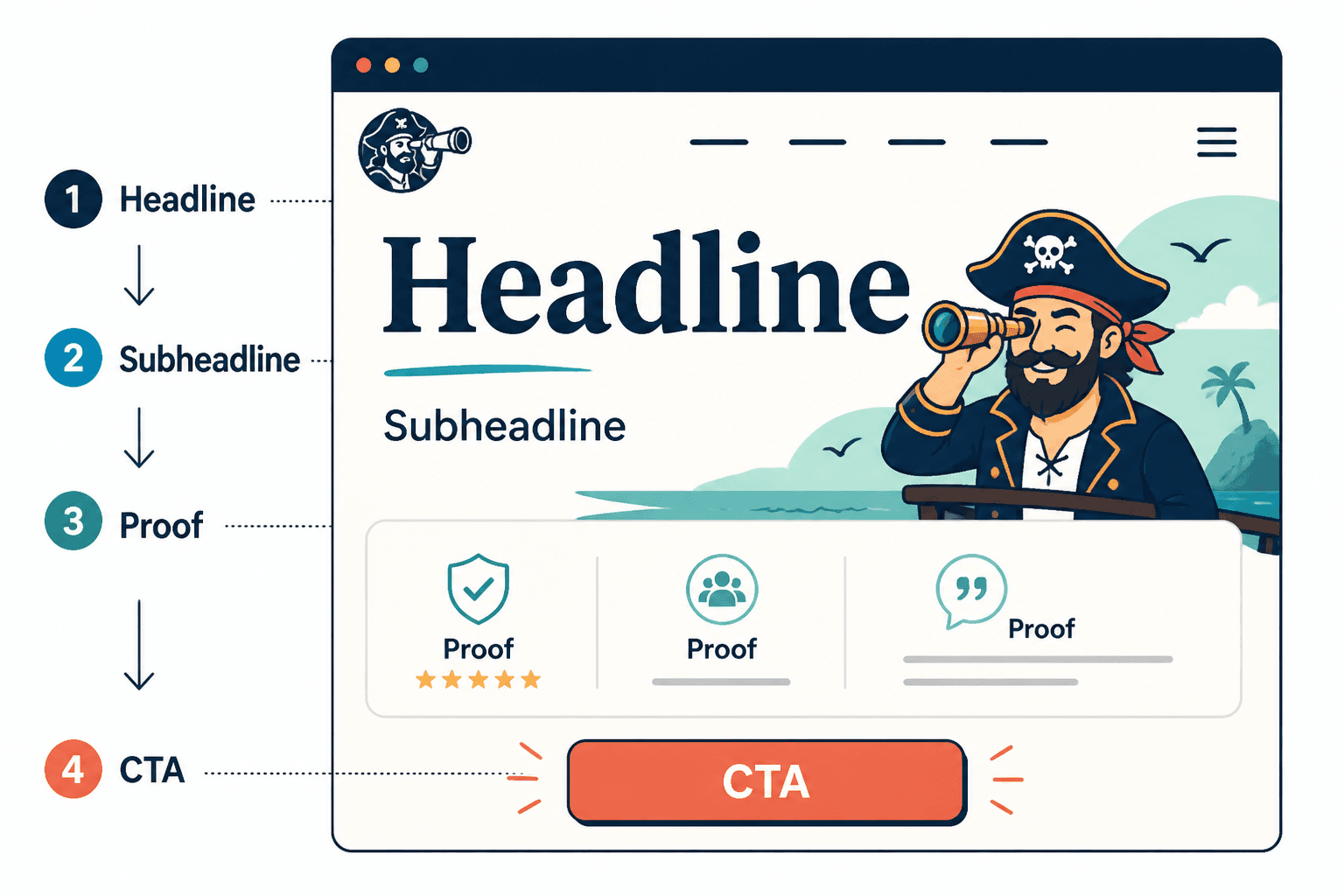
- Headline: clear point
- Subheadline: who it is for, what it helps with, and maybe how
- CTA: obvious next step
Bad opening habits to cut immediately
If you want a better homepage opening fast, removing the bad habits is often more effective than hunting for one magical line.
Starting with “welcome” language
“Welcome to…” is polite. It is also usually a waste of premium space.
The top of your homepage is not a receptionist. It is a decision point. Use it accordingly.
Leading with empty adjectives
Words like trusted, leading, premium, bespoke, transformative, innovative, and exceptional are not persuasive on their own. They are self-issued medals.
If a claim matters, support it with specifics elsewhere. Do not ask the headline to wear fake authority.
Trying to sound clever before sounding clear
There is a time for personality. There is also a time to just say what the thing does.
If your homepage opening needs a second read to figure out what you offer, it is doing too much performance and not enough communication.
Using giant universal promises
“Helping you thrive.”
“Building better futures.”
“Solutions for growth.”
These are not openings. They are wallpaper.
Before-and-after homepage opening rewrites
Sometimes the fastest way to understand this is to see weak copy next to something stronger.
| Weak opening | Stronger rewrite |
|---|---|
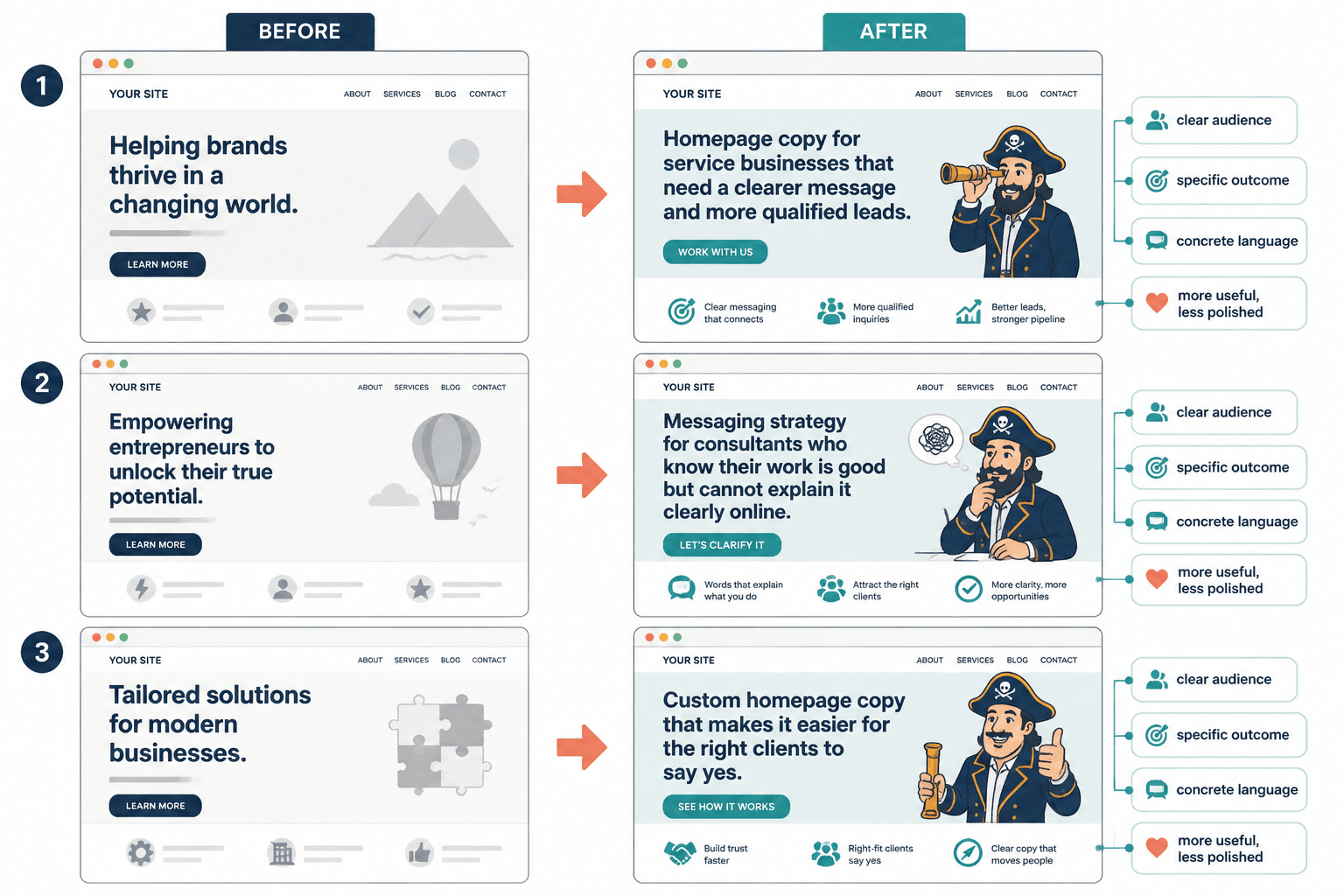
| We help businesses grow through innovative digital solutions. | Website copy and messaging for service businesses that want more qualified inquiries, not just more traffic. |
| Welcome to our website. We are passionate about helping brands succeed. | Sharp homepage copy for brands that are tired of sounding polished but forgettable. |
| Empowering entrepreneurs to unlock their true potential. | Messaging strategy for consultants who know their work is good but cannot explain it clearly online. |
| Tailored solutions for modern businesses. | Custom homepage copy that makes it easier for the right clients to say yes. |
Notice what improved:
- The audience got clearer
- The outcome got sharper
- The language got more concrete
- The copy stopped trying to sound impressive and started trying to be useful
That shift is usually what separates homepage copy that gets skimmed from homepage copy that actually moves people deeper into the site.
Simple homepage opening formulas that do not sound robotic
Formulas are useful when they give you structure without forcing you into canned nonsense. Here are a few that work well for homepage openings.
Formula 1: Audience + result
[What you offer] for [specific audience] who want [specific result].
Example: Homepage copy for coaches who want more trust and fewer vague inquiries.
Formula 2: Problem + better outcome
If your [thing] feels [problem], here is the better version.
Example: If your website sounds professional but says very little, it is time for sharper homepage copy.
Formula 3: Offer + practical promise
[Offer] that helps [audience] do [useful thing].
Example: Messaging strategy that helps solo consultants explain their value without sounding inflated.
Formula 4: Clear positioning statement
We do [specific thing] for [specific people].
Example: We write homepage copy for service brands that need clearer positioning and better conversions.
If you need more headline help, these related guides can help sharpen the top of the page without turning it into copy mush: How to Improve Homepage Copy Home Page Hooks Without Sounding Generic and Homepage Copy Hero Sections Examples Creators Can Adapt Fast.
How to know if your opening is still too weak
Run it through this quick test. If your homepage opening could fit almost any competitor with only minor edits, it is not strong enough yet.
Ask:
- Does it clearly signal who this is for?
- Does it hint at a real outcome or problem?
- Could a stranger understand it in a few seconds?
- Does it sound like an actual human brand, not committee copy?
- Would the right reader feel seen or at least intrigued?
If the answer is mostly no, keep tightening.
And yes, you can be clear and still have personality. Those are not competing goals. In fact, personality tends to work much better once the reader is not busy decoding your headline.
Where the opening fits into the rest of the homepage
A strong opening matters, but it does not work alone. It needs support from the rest of the page.
Once the opening gets attention, the homepage should back it up with some combination of:
- A clearer explanation of what you offer
- Specific outcomes or benefits
- Proof, examples, or credibility signals
- A simple path to the next step
If the opening is strong but the rest of the page gets vague, the whole thing still wobbles. If you want to tighten the entire page, start with How to Write Better Homepage Copy and How to Write Homepage Copy Without Sounding Salesy or Robotic.
You can also explore the broader hub for website conversion copy or go directly into the website core copy and homepage copy sections if you are rebuilding the whole page instead of just the opening.
The bigger point is simple: clearer structure and clearer writing make the piece more useful. That is usually what makes the ending land better too.