
Most homepage hero sections do one of two bad things.
They either say almost nothing in a very polished way, or they try to cram an entire sales page into the top 20% of the screen.
That is why so many creator websites open with vague lines like “Helping brands tell better stories” or chaotic stacks of text, buttons, badges, and headshots all fighting for oxygen.
A good hero section is not supposed to do everything. It is supposed to do the first important thing: help the right person understand what you do, who it is for, and what they should look at next. Fast.
This guide gives you homepage hero section examples creators can adapt fast, without sounding like a generic personal brand template someone dragged out of a stale funnel course. You will get practical formulas, strong examples, common mistakes, and quick rewrites you can actually use.
If your homepage currently sounds impressive but converts like wet cardboard, this should help.
If you want the bigger picture, start with the parent guide.
What a homepage hero section actually needs to do
Before the examples, a reality check.
Your hero section is not there to explain your life story, prove your entire philosophy, or show off your vocabulary. It has a tighter job than that.
A strong homepage hero section usually needs these pieces:
- A clear headline
- A supporting line that adds context or outcome
- Some signal about who it is for
- A next step, usually through one primary CTA
- Enough specificity to feel credible
That does not mean every hero section needs to look identical. It means every good one answers the same silent questions in the visitor’s head:
- Am I in the right place?
- Is this for someone like me?
- What do they help with?
- Why should I trust this?
- What do I do next?
If your top section misses those, the rest of the page has to work much harder. And usually, it does not.
If you want the bigger picture on page structure, read this homepage copy guide for creators who want better results and these homepage copy section order mistakes that hurt performance. A hero section works better when the rest of the page is not wandering around in circles.
Why most creator hero sections feel weak
The usual problem is not design. It is positioning mixed with cowardly copy.
Creators often write hero copy that sounds broad because they are afraid of excluding people. So they end up with lines that could belong to a coach, consultant, strategist, agency, course creator, freelancer, podcast host, or someone who once made a Canva deck and got a little too confident.
Broad copy feels safer. It also tends to be worse.
Weak hero sections often have one or more of these issues:
- The headline is vague and abstract
- The audience is missing
- The value sounds inflated
- The CTA is weak or generic
- There is no proof, specificity, or reason to believe the claim
- The section tries to say six things at once
You do not need more adjectives. You need a clearer promise.
And yes, sometimes the fix is surprisingly small. One sharper noun. One real outcome. One audience mention. One less fluffy sentence. Homepage copy can improve fast when you stop trying to make it sound “professional” and start trying to make it useful.
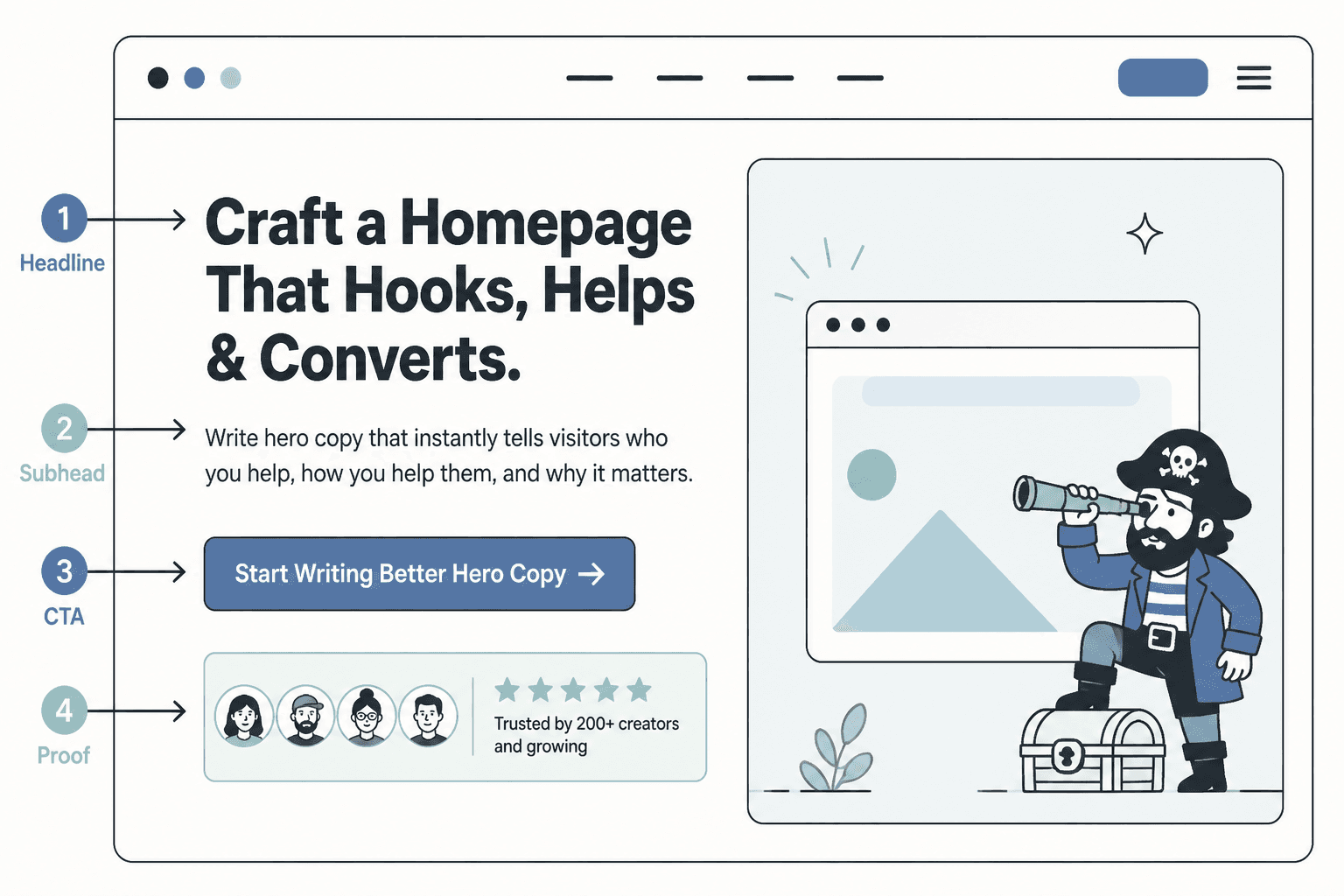
Homepage hero section formulas creators can adapt fast
Here are the most useful formats. You do not need to follow them like sacred text. But if your current homepage opens with fog, these will give you a much better starting point.
1. Clear outcome + clear audience
This is the most reliable format for creators selling a service, offer, or expertise.
Headline: I help [audience] get [outcome]
Support line: Through [method, service, approach, or differentiator]
Example:
I help coaches turn vague expertise into clear homepage copy that gets more inquiries.
Messaging strategy, page structure, and conversion-focused writing without the brand-babble.
Why it works: it is direct, readable, and easy to trust. Not dazzling. Just useful. Which is the point.
2. Problem solved + better alternative
This works well when your audience is frustrated with a common bad option.
Headline: Stop [frustrating thing]. Start [better result].
Support line: [How you help them make that shift]
Example:
Stop sounding polished and forgettable.
Get homepage copy that makes your work clear, credible, and easier to buy.
This one has more edge, so use it if your brand voice can carry it. If your audience is tired of bland sameness, this can land nicely.
3. Specific result + specific type of creator
Good for niche positioning.
Headline: Homepage copy for [specific audience] who want [specific result]
Support line: [What makes your approach useful or different]
Example:
Homepage copy for consultants who need their site to sell the right kind of expertise.
I help you clarify your offer, sharpen your message, and turn your homepage into a better first conversation.
This format sacrifices cleverness for clarity. That is often a smart trade.
4. Strong statement + grounding detail
Best for established creators, thought leaders, or personal brands with a clear point of view.
Headline: [Bold but believable statement]
Support line: [Who it is for and what you help them do]
Example:
Your website should not need a sales call to explain what you do.
I write homepage copy for service-based creators who want clearer positioning, stronger trust, and more qualified leads.
This style works when the statement sounds earned, not like fake swagger.
5. Personal brand headline that still says something useful
Some personal brands want the founder’s name or identity to carry more weight. Fine. But the copy still needs a job.
Headline: [Name or role], helping [audience] do [result]
Support line: [Proof, method, or specific angle]
Example:
I’m Maya, and I help experts turn messy ideas into content and website copy that sells with more clarity.
Strategy, messaging, and writing support for coaches, consultants, and creators who are tired of sounding like everyone else.
The trick here is not letting “personal” become “self-centered.” Visitors care about themselves first. As they should.
Homepage hero section examples by creator type
Below are practical examples you can adapt fast. Steal the structure, not the exact sentence.
For a coach
Headline: Career coaching for people who are done pretending their current job is “fine.”
Support line: I help mid-career professionals make sharper career moves with clear strategy, honest feedback, and a plan that does not collapse after one hard week.
CTA: See coaching options
Why it works: it has a real audience, a real emotional angle, and a grounded promise.
For a consultant
Headline: Messaging strategy for B2B founders who need their website to pull its weight.
Support line: I help you clarify your offer, sharpen your homepage, and make your message easier for buyers to understand and trust.
CTA: Book a strategy call
For a freelance writer
Headline: Website copy that sounds like a smart human, not a brochure with anxiety.
Support line: I write homepage, sales, and service page copy for creative businesses that need clearer positioning and better conversion.
CTA: View copy services
For a course creator
Headline: Learn content strategy that makes your expertise easier to notice and easier to buy.
Support line: Courses, templates, and practical training for creators who want better messaging, stronger content, and less guesswork.
CTA: Explore the training
For a designer
Headline: Brand and website design for founders who are tired of looking almost right.
Support line: I create visual identities and websites that feel sharper, clearer, and far more aligned with the level of business you are building.
CTA: See recent projects
For a personal brand with content offers
Headline: Better content systems for experts who want to grow without posting nonsense every day.
Support line: I share frameworks, templates, and strategy for turning expertise into content that builds trust, attention, and leads.
CTA: Start with the guides
If you want more homepage direction beyond the hero section, these homepage copy ideas and examples for creators can help you build the rest of the page without defaulting to dull filler.
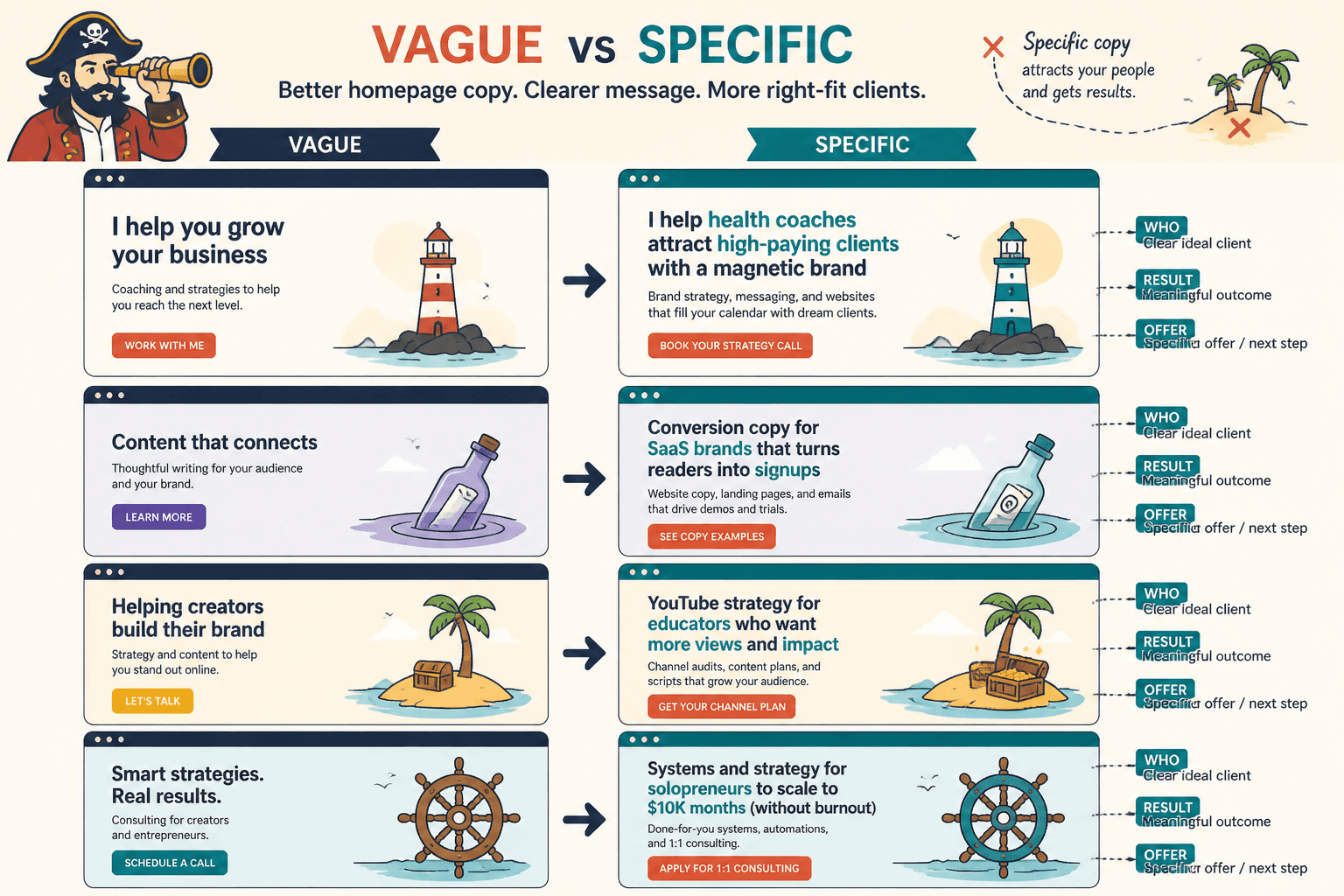
Bad hero copy vs better hero copy
Sometimes it helps to see the shift more clearly.
| Weak version | Better version |
|---|---|
| Helping businesses grow through authentic storytelling | Homepage copy for service businesses that want clearer messaging and more qualified leads |
| Transforming ideas into impact | I help creators turn messy ideas into sharp content and conversion-focused website copy |
| Empowering ambitious leaders to reach their next level | Leadership coaching for managers who need clearer decisions, stronger communication, and less second-guessing |
| Creative solutions for modern brands | Brand strategy and copy for small businesses that are tired of sounding expensive but vague |
Notice the pattern. The better versions are not more complicated. They are more concrete.
That is usually the whole game.
How to write your hero section without overthinking it for six business days
Here is a simple process.
- Name the audience. Not everyone. The people you actually help.
- Pick the main outcome. What result matters most at this stage?
- Add your method or angle. Strategy, coaching, writing, design, systems, consulting, whatever fits.
- Choose one CTA. Read, book, browse, start, apply, explore. Not five buttons having a nervous breakdown.
- Trim the fluff. If a phrase sounds grand but says nothing, cut it.
If you are stuck, write the ugliest clear draft first. Something brutally plain like:
I help nutrition coaches write homepage copy that explains their offer clearly and gets more discovery calls.
That may not be the final version. But it is already better than “Helping wellness entrepreneurs amplify their message.” That kind of line sounds like it was approved by a committee that fears verbs.
Once the clear draft exists, then you can tighten the rhythm and tone. Clarity first. Style second. This order saves a lot of pointless suffering.
If your opening line keeps coming out weak, this guide on how to start homepage copy without a weak opening is worth reading next.
What to include under the headline
The subheadline is where a lot of homepage hero sections quietly improve or quietly fall apart.
Your headline should carry the main idea. The supporting line should make that idea easier to trust.
Good things to include in the supporting line:
- Your method
- The type of service or offer
- The kind of client you help
- A practical outcome
- A small differentiator
What not to do: repeat the headline in softer words.
For example:
The bigger point is simple: clearer structure and clearer writing make the piece more useful. That is usually what makes the ending land better too.