
Most creator bios do not start weak because the writer lacks talent. They start weak because the writer is trying to sound acceptable to everyone.
So you get openings like “I help individuals and businesses achieve their goals” or “Passionate about storytelling, strategy, and impact.” Which is technically English, sure. It is also fog. Nobody remembers it. Nobody feels pulled in by it. Nobody thinks, yes, this person clearly gets me.
If you want to know how to start creator bios & profile copy without a weak opening, the fix is not to make it fancier. It is to make it clearer, sharper, and more audience-aware. Your opening line needs to tell the right person, quickly, what kind of person you are, who you help, and why they should keep reading.
That does not mean cramming your entire life story into one sentence. It means opening with a line that has an actual job. A good bio opening should position you. A weak one just sits there in a blazer, hoping nobody asks follow-up questions.
To see how this fits into the wider strategy, open the parent guide.
What a weak bio opening usually sounds like
Weak openings tend to fail in a few predictable ways. They are vague, overly polished, stuffed with generic virtues, or trying so hard to sound impressive that they forget to be useful.
- “Helping brands grow through innovative content strategies”
- “Founder, speaker, coach, creator, consultant, and visionary”
- “I am passionate about helping people become their best selves”
- “We provide high-quality solutions tailored to your needs”
- “Thoughts on marketing, mindset, business, and life”
These lines are not weak because they are short. They are weak because they do not create a strong mental picture. They do not signal a clear audience. They do not give the reader a reason to care.
The biggest problem is this: a weak opening makes the rest of the profile work harder than it should. If your first line is mush, your proof, CTA, and personality all show up late to a party that already lost momentum.
What a strong opening actually needs to do
A strong creator bio opening does not need to be clever. It needs to be useful fast.
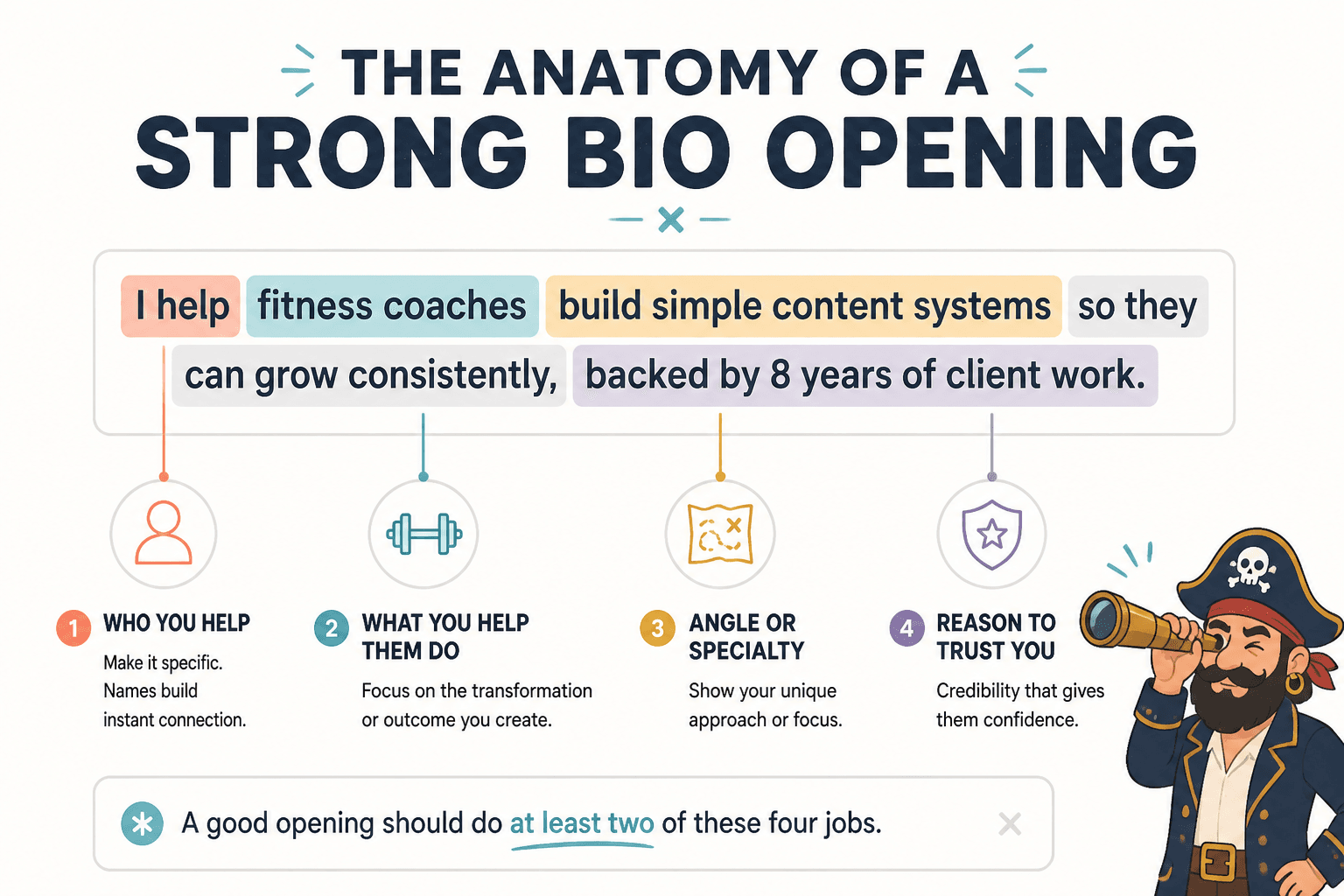
In most cases, the opening should do at least two of these four things:
- Say who you help
- Say what you help them do
- Signal your angle or specialty
- Set up a reason to trust you
That is it. Not mystical. Not precious. Just functional.
If someone lands on your LinkedIn profile, Instagram bio, site about page, or creator homepage, they should not need to decode your personality puzzle. Good profile copy reduces friction. It says, in plain language, “Here is what I do, who it is for, and why this may matter to you.”
How to start creator bios & profile copy without a weak opening
If you want a practical way to write the first line, start here.
1. Start with the audience, not your personality traits
“Curious,” “passionate,” “multi-skilled,” and “creative” are not openings. They are adjectives people use when they do not yet know what the sentence should actually say.
Instead, begin with the person you help or the type of problem you solve.
Weak: Passionate content strategist and storyteller
Stronger: I help consultants turn scattered ideas into clear content that brings in better-fit clients
Weak: Personal branding expert for modern professionals
Stronger: I help founders and creators clean up their online presence so strangers understand their value faster
The second version gives the reader a role, an outcome, and a practical reason to keep reading. Much better start.
2. Lead with the result, but make it believable
Results matter. But if your result is too inflated, too vague, or too polished, it starts sounding like a funnel page with a trust problem.
Good result-driven openings feel specific and grounded.
- Write sharper LinkedIn posts
- Turn expertise into better client-facing content
- Clarify your positioning
- Build a profile that gets more replies and leads
- Explain your work without sounding robotic
Bad result claims tend to sound inflated.
- Transform your life and business
- Unlock your true voice
- Scale your authority to 7 figures
- Become magnetic online
You are writing a bio, not summoning a webinar ghost.
3. Add a specificity cue early
Specificity is what separates a useful opening from a generic one. It can come from the audience, the platform, the method, the offer, or the type of work.
Here is the difference.
Generic: I help people with content strategy
Specific: I help coaches and solo consultants turn their expertise into LinkedIn content that sounds human and sells without the cringe
Generic: I help brands grow online
Specific: I help B2B founders tighten their messaging, profile copy, and authority content so the right buyers understand them faster
Specificity does not make your bio smaller. It makes it more convincing.
4. Do not open with your job title pile
A lot of bios begin with a stack of roles. Something like this:
Writer | Strategist | Speaker | Founder | Coach | Consultant | Creator
This is common because it feels safe. It also says almost nothing. A list of titles is not positioning. It is admin.
If you wear multiple hats, fine. Most independent people do. But your opening should focus on the main value you create, not your whole professional costume rack.
Instead of: Founder, marketer, advisor, speaker, and creator
Try: I help service businesses turn muddled messaging into sharper content and cleaner conversion paths
If you need help clarifying that core angle, this piece on improving creator bios and profile copy positioning lines without sounding generic is the next logical stop.
5. Use plain language before you try to sound impressive
A lot of weak openings are really just normal ideas trapped inside bloated phrasing.
Bloated: Empowering visionary entrepreneurs to elevate their digital presence through strategic storytelling
Clear: I help online business owners explain what they do in a way that people actually understand
Bloated: Building authentic brands through purpose-led communication
Clear: I help creators write bios, posts, and profile copy that sound like a real person, not a committee
Plain language is not less professional. It is easier to trust.
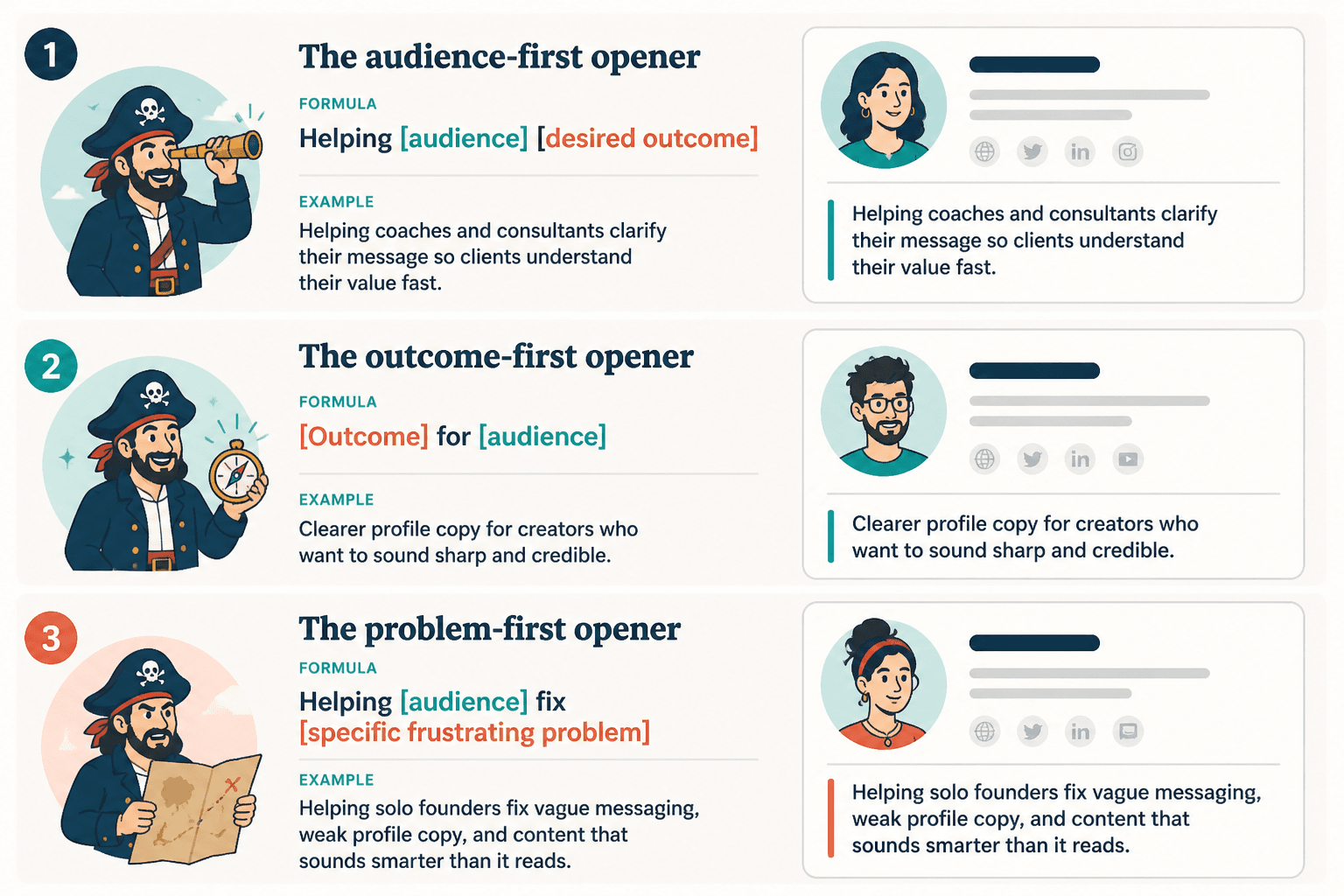
Three reliable ways to open a creator bio
If you are staring at a blank profile field and your brain is giving you polished nonsense, use one of these structures.
The direct value opener
Format: I help [audience] do [specific outcome] through [service, skill, or angle]
Example: I help coaches and consultants turn rough expertise into clear content, sharper profiles, and better client trust
This works well when clarity matters more than personality. Which, honestly, is most of the time.
The specialty opener
Format: [What you do] for [specific audience] who need [practical result]
Example: Profile and bio writing for creators who are good at their work but terrible at describing it
This one works nicely if you want a more compact, punchy style.
The problem-first opener
Format: Helping [audience] fix [specific frustrating problem]
Example: Helping solo founders fix vague messaging, weak profile copy, and content that sounds smarter than it reads
This works best when your audience already feels the pain of the problem you solve.
For broader profile-writing help, you can also explore how to write better creator bios and profile copy.
Before-and-after rewrites of weak openings
Sometimes the fastest way to improve your opening is to see what changed.
Example 1: vague and polished
Before: Helping brands elevate their voice through authentic storytelling and strategic communication
After: I help founders and consultants write clearer brand messaging so their content sounds sharper and sells with less effort
Why it works: clearer audience, clearer outcome, less airy fluff.
Example 2: title pile with no payoff
Before: Entrepreneur | Speaker | Coach | Mentor | Community Builder
After: I help early-stage founders simplify their message, sharpen their content, and build trust faster online
Why it works: turns a vague identity list into a value statement.
Example 3: too broad to matter
Before: I help people grow their business online
After: I help service providers turn their profile, content, and CTA into a cleaner path from attention to inquiry
Why it works: more specific audience, more concrete growth path, less empty ambition.
Example 4: personality-first with no practical meaning
Before: Curious creative obsessed with ideas, connection, and meaningful work
After: I write bio and profile copy for creators who want to sound credible, human, and immediately understandable
Why it works: keeps the human angle but gives it a job.
If your current profile reads like this kind of beige fog, go straight to how to rewrite boring creator bios and profile copy.
What to do right after the opening line
A strong opening matters, but it cannot carry the whole bio alone. Once you have the first line, the next lines should support it instead of wandering off into résumé soup.
A simple sequence works well:
- Opening line: Who you help and what you help them do
- Credibility line: Proof, experience, or relevant angle
- Personality line: Optional, but only if it adds texture
- CTA: What the reader should do next
Example:
I help consultants and solo founders turn messy expertise into clear profile copy and useful content.
I focus on positioning, bios, and posts that make people understand your value faster.
Need your profile to sound less generic and more like someone worth hiring? Start here.
That is not flashy. It does not need to be. It works.
If your challenge is less about clarity and more about tone, this article on writing creator bios and profile copy without sounding salesy or robotic will help.
Mistakes that make bio openings weaker than they need to be
Trying to sound premium instead of understandable
A premium-sounding bio that nobody understands is not premium. It is just expensive fog.
The bigger point is simple: clearer structure and clearer writing make the piece more useful. That is usually what makes the ending land better too.