
Stale posts and random internal links do not just look neglected. They waste trust, weaken the next click, and make every lead harder to earn. A page can still pull traffic and still fail the business if readers land, skim, and disappear with no clear path to the offer, the signup, or the next useful page.
The fix is not to stuff in more links and call it strategy. It is to update the content so it earns attention again, then connect that page to a conversion path that makes sense for the reader’s intent. Done well, internal linking and content updates stop being cleanup work and start acting like a sales system with manners.
If you want the broader system behind this, the parent guide on internal linking and updating is the right place to start. This article focuses on the money side: how to turn those updates into more leads or sales without making the page feel rigged.
Why updated content and internal links convert better together
Internal links do more than move people around a site. They shape what the reader thinks the site is for. A useful link says, “Here is the next thing you probably need.” A sloppy one says, “Please continue for the spreadsheet’s sake.” Readers can feel the difference.
Content updates help because they remove friction before you ask for action. A post that is clearer, fresher, and better aligned with the reader’s intent makes the next click easier. That next click is where conversion usually starts: a service page, a lead magnet, a pricing page, a case study, or a newsletter signup.
For search visibility and content freshness, Google’s guidance on helpful content and how Search works are useful reference points. For the broader link structure idea, internal links still matter because they help search engines and readers understand what belongs together.
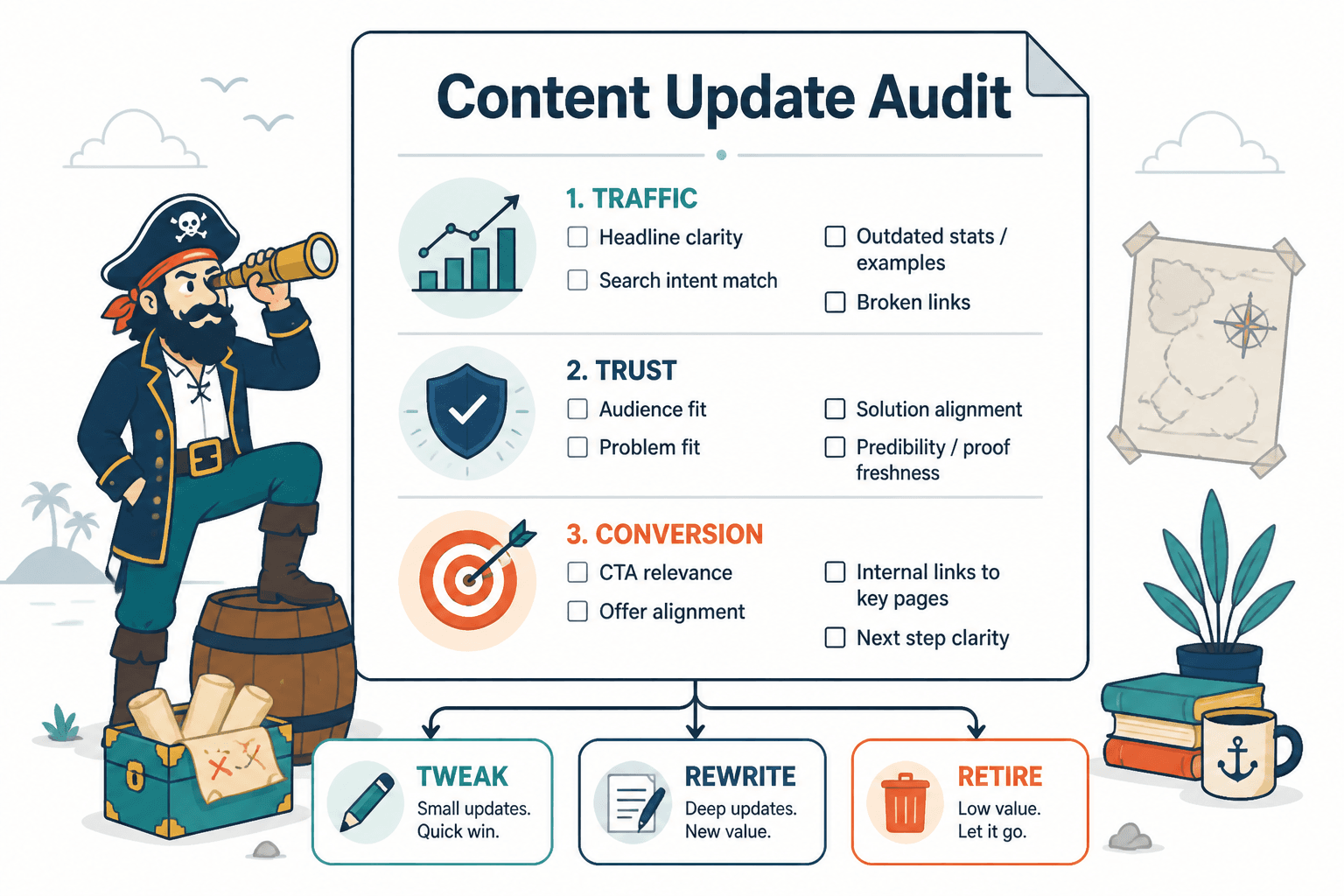
What to update before you try to monetize the page
Not every old article should be turned into a sales path. Start with the parts that affect reader confidence and action.
- Match the current intent. If the post is attracting beginners, do not send them straight to an advanced service pitch.
- Remove outdated claims and stale examples. Old screenshots, old stats, and vague year-swaps make a page feel half alive.
- Fix the strongest missing answer. Often the post is already getting attention but still leaves one obvious question hanging.
- Reduce friction in the path to the next step. If the CTA is buried, mismatched, or too abrupt, the page loses momentum.
A simple audit helps here. Look at what the page attracts, what it promises, and what it should logically lead to next. If you want a practical companion piece, see how to write better internal linking and updating for the editorial side of the process, and best internal linking and updating ideas and examples for creators for patterns you can adapt.
The best link destinations for lead and sales growth
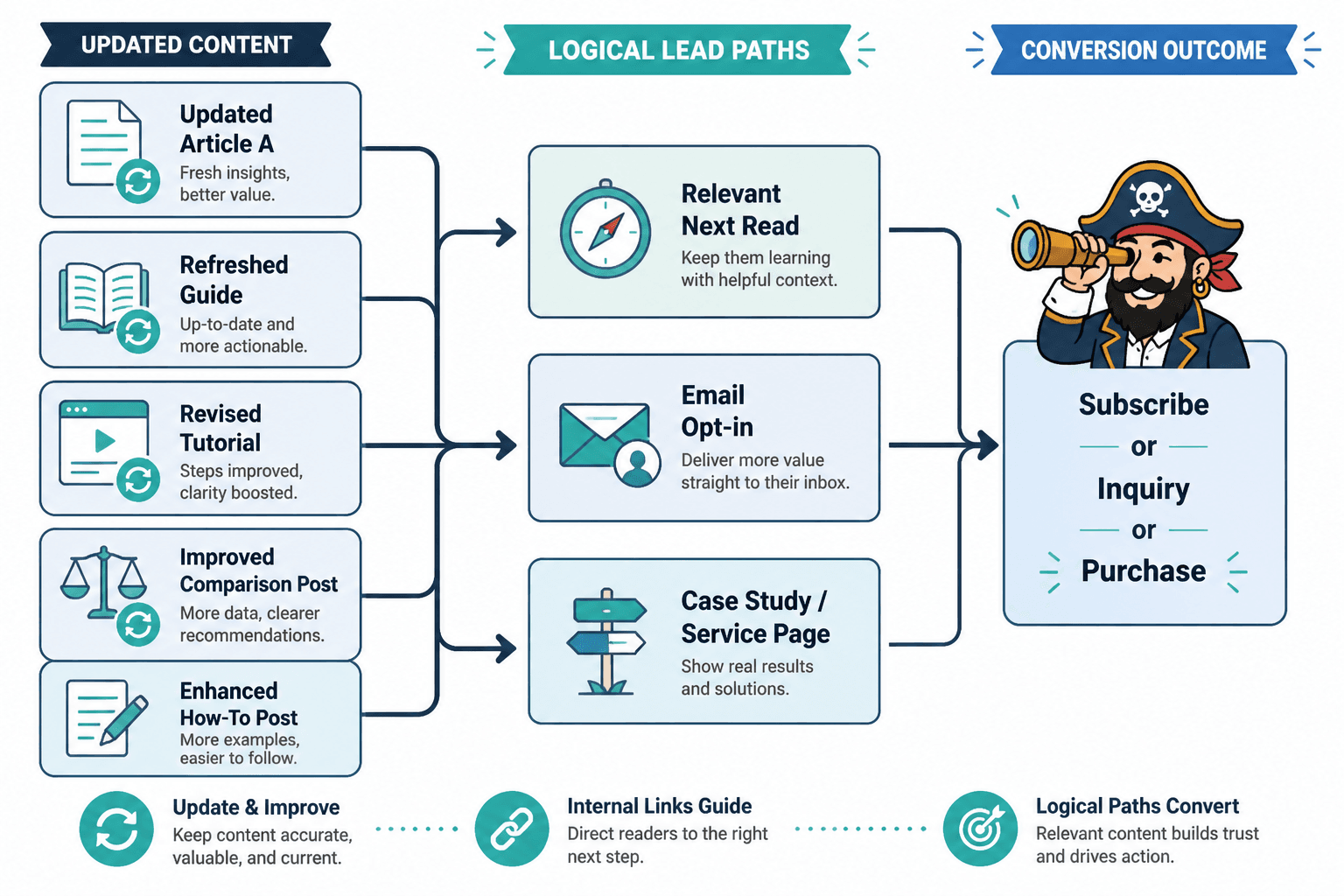
Internal links work best when they move readers to the next sensible step, not the loudest one. In practice, that usually means one of these destinations.
1. Article to article to lead magnet
This is the cleanest path when a reader needs more context before they are ready to hand over an email address. Update the article, then link to a deeper companion post that naturally leads into a download, checklist, or template.
Use this when the original post answers the “what” but not the “how.”
2. Article to service page
Use this when the reader has crossed from curiosity into evaluation. A service page should not be shoved into every post, but it absolutely belongs when the content already signals readiness.
For example, a post about fixing content structure may naturally lead to a page about editorial consulting, content strategy, or SEO support.
3. Article to newsletter signup
This works best when the post is useful, broadly relevant, and not yet a buying page. The newsletter gives the reader a lower-friction way to stay in the loop. It is a good fit when the article is educational and the next step is relationship-building.
4. Article to case study to consultation
Use the article to warm the reader up, the case study to reduce doubt, and the consultation page to close the loop. This is a strong path when the topic is high-consideration and the buyer needs proof before action.
5. Article to topic hub to multiple conversion points
When a topic cluster is strong, one updated article can feed a hub page that routes readers to several choices: related posts, a lead magnet, a service page, or a contact page. This works especially well when the audience has different needs at different stages.
If you want more funnel-style patterns, the sibling guide on best funnel ideas to pair with internal linking and updating expands this into full paths.
How to place links without making the article feel salesy
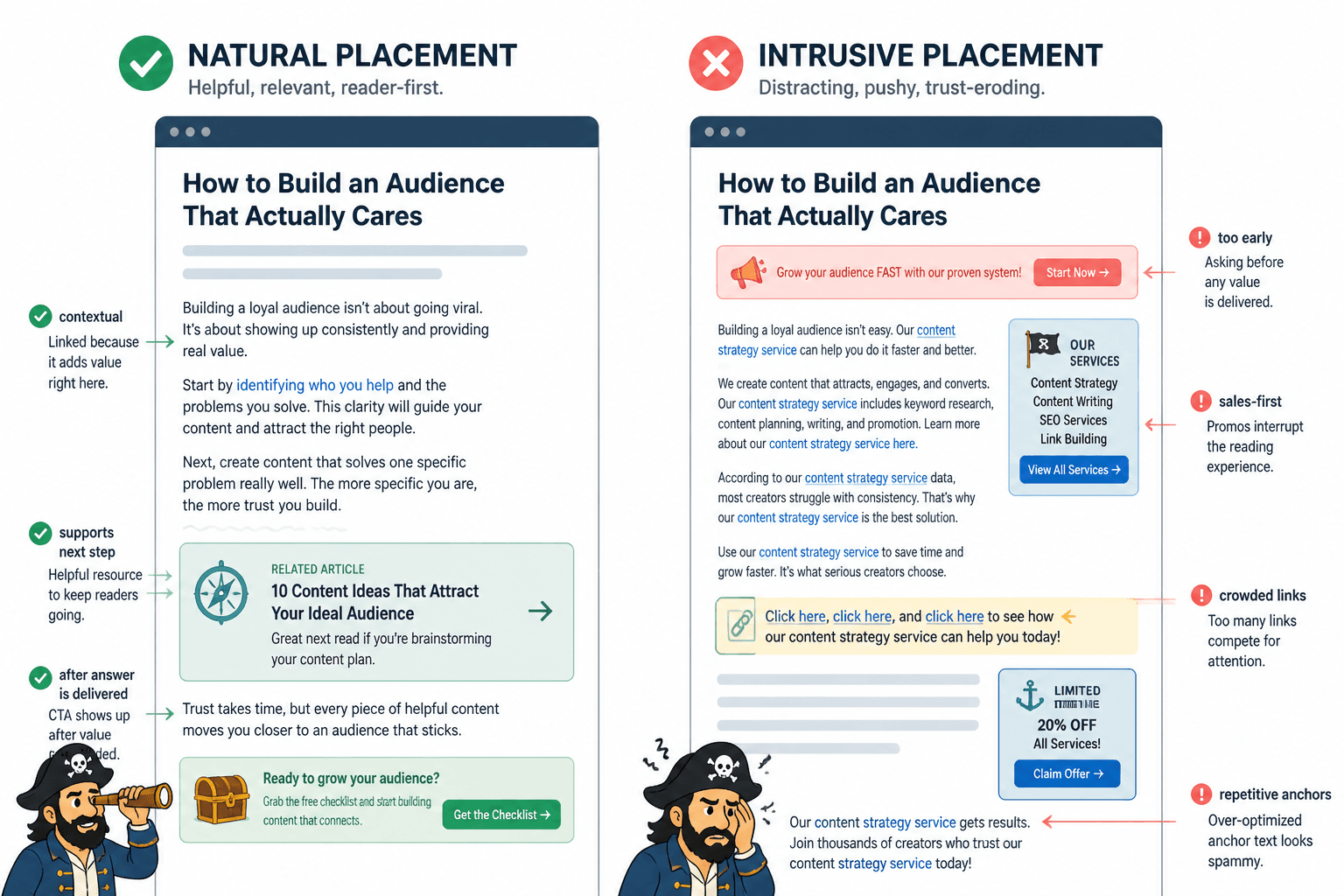
The trick is not to hide the commercial goal. The trick is to make the path feel earned.
- Link where the reader naturally wants more detail. Don’t interrupt the thought. Extend it.
- Use descriptive anchor text. “Learn the full update workflow” is better than “click here.”
- Keep the first link helpful, not aggressive. A useful next step builds trust before the CTA asks for action.
- Match the temperature of the page. A light educational post may earn a soft signup. A high-intent article may support a stronger offer.
- Limit the number of competing actions. Too many links can turn a clean path into a buffet line nobody enjoys.
A good rule: the page should feel more useful after the update, not more crowded. If a link does not improve the reader’s next step, it is probably there to make the dashboard feel busy.
A simple workflow for turning one old post into a conversion asset
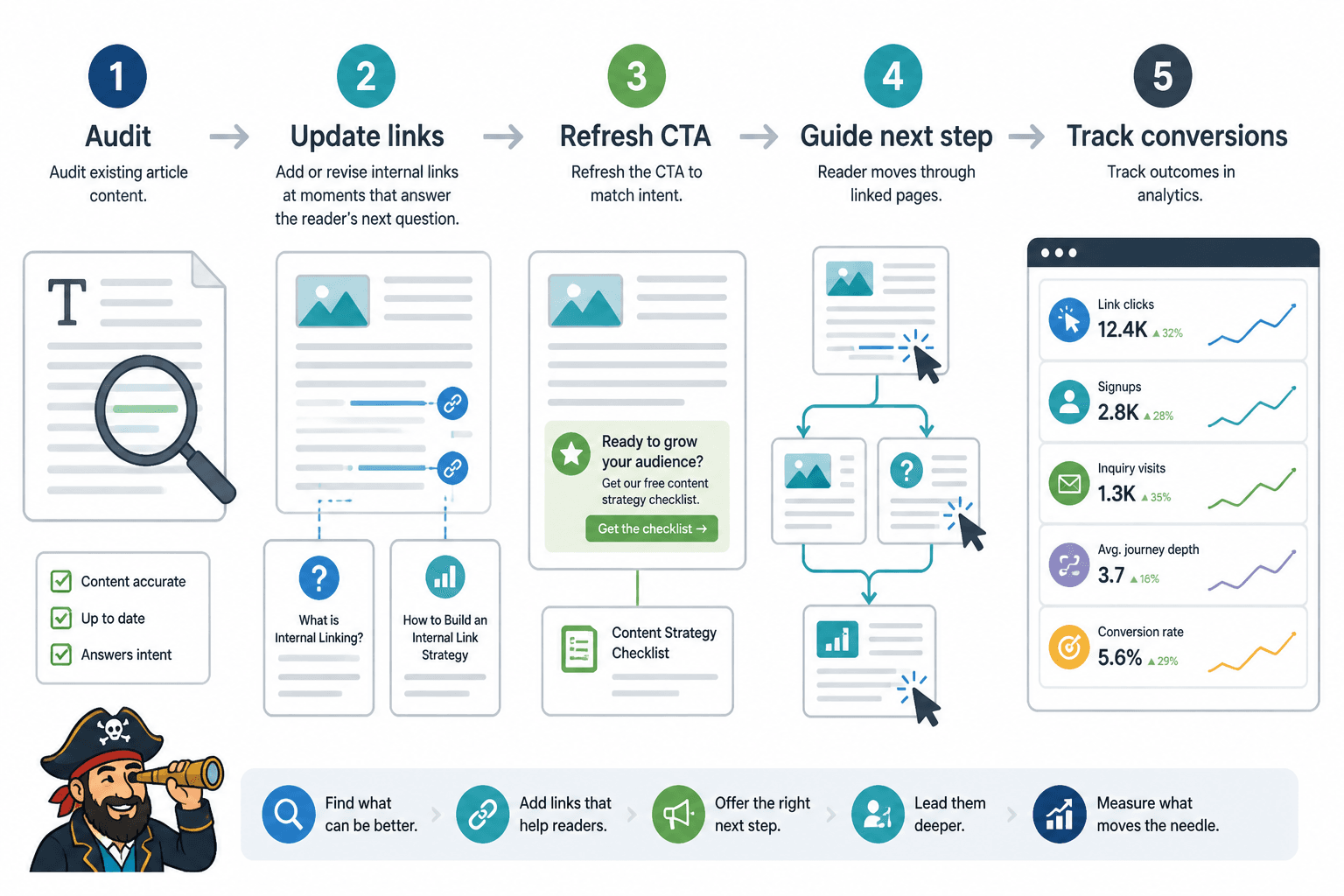
You do not need a giant content system to make this work. You need a repeatable sequence.
- Pick one page with traffic or strong relevance. Start where attention already exists.
- Check the current intent. Ask what the reader likely wants now, not when the post was first published.
- Update the article for clarity and accuracy. Tighten weak sections, remove stale references, and improve the main answer.
- Identify the best next step. Choose the most natural destination: service page, lead magnet, newsletter, case study, or related post.
- Add 2 to 4 meaningful internal links. Use them to move the reader forward, not sideways for decoration.
- Refresh the CTA. Make sure the call to action matches the article’s intent and confidence level.
- Track the result. Watch clicks, signups, consultations, and downstream conversions, not just pageviews.
This is where many teams get lazy in a very expensive way. They update the body copy, toss in one generic CTA, and call it optimization. But the conversion gain usually comes from the path, not just the paragraph.
Where monetization usually goes wrong
Internal linking and updates stop working when the site starts behaving like it is trying too hard.
- Forcing every post toward a sale. Not every article is ready for a hard offer.
- Updating for keywords but not for reader usefulness. Search traffic is not the same thing as purchase intent.
- Linking to pages that do not match the moment. A beginner post should not jump to an advanced service page without a bridge.
- Adding links without improving the article. That is not strategy. That is decorative routing.
- Ignoring the offer page. A great internal link cannot fix a weak landing page or a confusing service page.
Trust is the hidden asset here. If the reader feels steered instead of helped, the click may happen once, but the relationship does not. And relationship value is where lead generation and sales tend to live.
A practical example of the path
Consider a blog post about fixing outdated content on a small business site. The updated version includes:
- a clearer explanation of why stale content loses trust,
- a link to a deeper article on internal linking structure,
- a link to a checklist or template for content audits, and
- a CTA for an editorial review or strategy call.
That path works because each step lowers uncertainty. The reader learns something, gets a useful next step, sees proof of process, and then reaches the offer after the page has already earned the right to ask.
That is the basic conversion logic: not pressure, but progression.
Use the parent guide and sibling pieces as support, not clutter
If you are building this cluster into a more useful system, the parent guide on internal linking and updating should anchor the topic. From there, this page can point readers to the more tactical pieces when they need them:
- how to write better internal linking and updating
- best internal linking and updating ideas and examples for creators
- best AI tools for internal linking and updating
- best funnel ideas to pair with internal linking and updating
- how to monetize internal linking and updating without wrecking trust
That cluster gives readers different entry points without making every page do the same job twice. A rare miracle in content strategy.
Bottom line
Internal linking and content updates can drive more leads or sales, but only if they are used as a single system. First make the page more useful. Then connect it to the next best step. Then measure whether the path actually moved readers closer to action.
That is the whole game: better content, better pathing, better conversion. The rest is just rearranging deck chairs with SEO vocabulary.