
Most people treat a blog rewrite like housekeeping.
Update a few stats. Fix some headers. Maybe make the intro less dusty. Then hit publish and hope traffic turns into something useful.
That hope is doing a lot of work.
The real opportunity in blog rewrites and refreshes is not just better rankings, cleaner writing, or lower bounce. It is conversion. If you are already revisiting old content, you have the perfect excuse to pair that improved article with a smarter next step.
That is where the best funnel ideas to pair with blog rewrites and refreshes come in. Not bloated funnels. Not six-email labyrinths built by someone who thinks every reader wants to be “nurtured” into submission. Just clean paths that turn refreshed attention into subscribers, conversations, leads, and sales.
This article will show you which funnel types actually fit blog refreshes, how to match them to different article intents, and where people usually mess this up by stuffing a random CTA under a newly polished post and calling it strategy.
If you are already updating content, you are halfway there. The rest is making sure the article leads somewhere useful.
To see how this fits into the wider strategy, open the parent guide.
Why blog rewrites and refreshes are such good funnel opportunities
A refreshed article has one big advantage over a brand-new post: it already has context.
You know what topic it covers. You can usually see what kind of search intent brought people there. You can spot where the article is too broad, too thin, or too passive. And once you tighten it up, you have a much clearer shot at offering the reader the next logical move.
That is what a good funnel is here. Not a manipulative machine. Just a sequence that makes sense.
Reader lands on updated article. Reader gets value. Reader sees a relevant next step. Reader takes it because the offer matches the problem they already care about.
Simple. Very few people do it well.
One reason is that they think the article and the funnel are separate jobs. They are not. A refreshed article is often the top or middle of a funnel already. You just need to stop acting like every piece of content should point to the same newsletter, generic contact page, or vague “work with me” button.
If you want stronger blog refreshes overall, it helps to understand the broader system too. This piece pairs well with blog SEO writing, the larger blog article systems category, and the main guide on blog rewrites and refreshes.
The rule before any funnel: match the next step to the article’s job
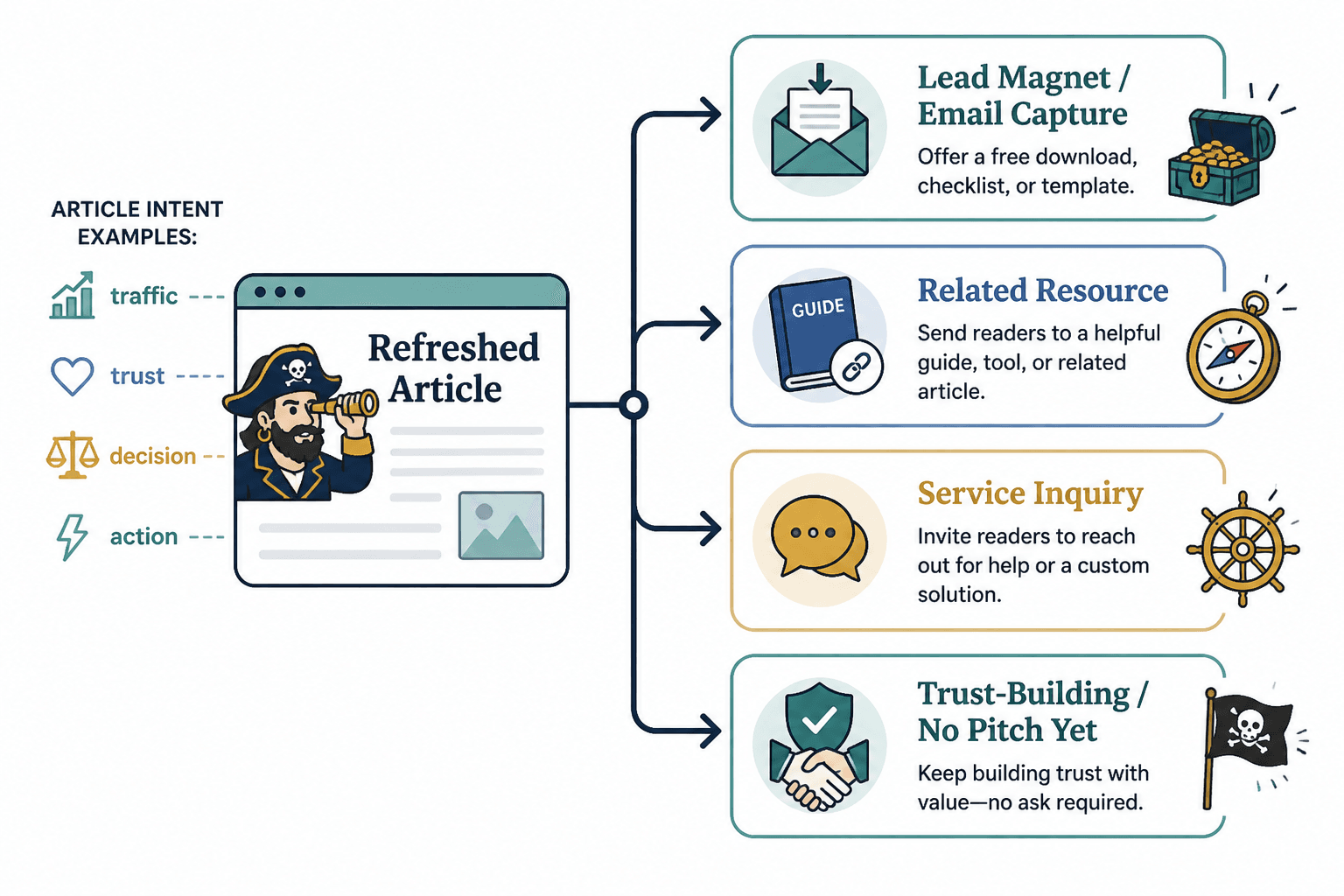
Before picking a funnel, figure out what the refreshed post is actually doing.
Not every article should push for the same conversion. Some articles are best for email capture. Some should lead to a low-friction service inquiry. Some should move readers into a related resource. Some are better used to build trust before any pitch shows up at all.
A decent shortcut is to sort refreshed posts into four jobs:
- Traffic posts: broad, search-friendly, often top-of-funnel
- Trust posts: more opinionated, more specific, often showing expertise
- Decision posts: comparison, process, tools, pricing, examples, implementation
- Conversion posts: case-study-adjacent, service-focused, or highly pain-aware
If you pair the wrong funnel with the wrong article, conversion gets weird fast.
- A broad educational post with a hard sales CTA feels premature
- A bottom-of-funnel article with only a soft newsletter offer wastes buying intent
- A tactical post with no lead capture misses people who want the checklist version
- A high-trust article that jumps straight into a generic freebie weakens its authority
The best funnel ideas to pair with blog rewrites and refreshes are not universal. They are contextual.
Best funnel ideas to pair with blog rewrites and refreshes
Here are the funnel setups that usually make the most sense, especially for creators, coaches, consultants, solo founders, and service-based personal brands.
1. Refreshed blog post → content upgrade → email sequence
This is the classic for a reason. It works when the upgrade is tightly tied to the article.
If you refresh a post called “How to Rewrite Your About Page,” the upgrade should not be some random audience-growth PDF from another solar system. It should be a checklist, template, swipe file, worksheet, or short prompt pack that helps the reader do the exact thing the article covers.
Best for:
- Search-driven posts
- Educational how-to posts
- Template-heavy articles
- Posts attracting early-stage readers
Good examples:
- Article: blog headline refresh tips → Upgrade: 25 headline rewrite prompts
- Article: homepage messaging refresh → Upgrade: homepage wireframe template
- Article: outdated blog CTA fixes → Upgrade: CTA examples sheet
The follow-up email sequence does not need to be a Broadway production. Three to five emails is plenty if they are useful.
- Email 1: deliver the resource
- Email 2: show how to use it well
- Email 3: share a common mistake or example
- Email 4: introduce your related service or paid offer softly
What people get wrong: they offer a generic lead magnet because it already exists. That saves time, sure. It also usually lowers conversions because the reader came for one thing and got handed another.
2. Refreshed blog post → related article cluster → offer page
Not every reader should be asked for an email immediately. Sometimes the better move is to deepen trust first.
This funnel works well when you refresh a strategic article and want readers to keep moving through your site. Think of it as a mini authority path: one useful post leads naturally to the next, which then points to a relevant offer.
For example, someone reading about blog rewrites may also need examples, tools, and monetization ideas. That sequence builds confidence far better than one article followed by “Book a discovery call” like a stranger proposing marriage in aisle seven.
A clean version of this path might look like this:
- Refreshed educational article
- Internal link to examples article
- Internal link to tools/templates article
- Internal link to leads/sales article
- Offer CTA for audit, service, or consulting
For this topic, the path is especially natural through blog rewrites and refreshes ideas and examples for creators, templates and tools for blog rewrites and refreshes, and how to turn blog rewrites and refreshes into more leads or sales.
Best for:
- Sites with a growing content library
- Readers who need more trust before converting
- Consultants and experts selling higher-ticket services
- Articles where search intent is informational but commercially adjacent
3. Refreshed blog post → audit CTA → consultation or service inquiry
This is one of the strongest funnels for service businesses, and somehow people still bury it under weak buttons like “Contact me to learn more.”
If you refresh a post around fixing, improving, updating, optimizing, rewriting, repositioning, or cleaning up content, a diagnostic offer often fits beautifully. The article teaches the reader what is wrong. The CTA offers help applying it to their situation.
Examples:
- “Want a second set of eyes on your top three outdated blog posts? Book a content refresh audit.”
- “If your old articles get traffic but not leads, I offer rewrite reviews for service businesses.”
- “Need help turning refreshed posts into lead paths? Apply for a funnel and content audit.”
Best for:
- Decision-stage articles
- Articles about fixing underperforming assets
- Posts read by businesses with active pain and budget
- Consultants, strategists, copywriters, SEO writers, and content marketers
The key is to keep the offer specific. “Work with me” is vague. “Get a 60-minute blog refresh audit with rewrite priorities and CTA recommendations” is legible.
4. Refreshed blog post → newsletter signup → recurring trust funnel
This works best when your newsletter is actually a good product and not a dusty attic for leftover thoughts.
If you consistently publish useful insights on content strategy, SEO, messaging, or creator growth, a refreshed article can easily feed the newsletter. But the signup pitch needs to be specific. Readers should know what they are getting and why it is worth their inbox space.
Weak version:
Subscribe for updates.
Stronger version:
Get weekly content strategy notes on what to fix, cut, and improve so your articles earn more trust and better leads.
Best for:
- Broad and evergreen posts
- Readers who are interested but not ready to buy
- Creators building long-term trust
- Brands with a strong email rhythm already in place
This is often a better fit than a generic lead magnet when your brand voice and thinking are the product.
5. Refreshed blog post → low-ticket product → upsell path
If you sell templates, workshops, mini-courses, audits, prompt packs, or toolkits, refreshed articles can feed those offers nicely.
This works especially well when the post solves the “what” and “why,” while the paid product speeds up the “how.”
For example:
- Article explains how to refresh underperforming blog posts
- Paid product offers a refresh workflow, prompts, templates, and tracking sheet
- Upsell offers implementation help or a done-for-you service
Best for:
- Audience with strong DIY intent
- Creators with digital products
- Educational niches where templates save time
- Posts with clear process value
The caution here is obvious: if the article gives almost nothing and the CTA screams “buy the real answer,” readers will smell the trick immediately. Give enough value that the paid offer feels like acceleration, not hostage negotiation.
6. Refreshed blog post → case study or proof page → application CTA
Some refreshed posts attract readers who already know they have the problem. They do not need more theory. They need confidence that you can solve it.
That is where a proof-first funnel helps. Instead of sending them straight from educational post to sales page, send them to a case study, teardown, portfolio example, or results page. Then ask for the application or inquiry.
Best for:
- Service businesses with proof
- High-consideration offers
- Topics tied to revenue, traffic, positioning, or conversion outcomes
- Readers who need reassurance more than education
This is underrated because people love skipping straight to the pitch. Proof tends to help more.
7. Refreshed blog post → quiz, assessment, or self-diagnosis → segmented follow-up
This one is more advanced, but very useful when the topic branches into multiple reader types.
Say you refresh an article on improving old blog content. Some readers are solo creators. Some are agency owners. Some are in-house marketers. Some need SEO help. Some need conversion help. One generic CTA will fit all of them badly.
A short self-assessment can segment those readers into more relevant follow-up paths.
Examples:
- “What is actually hurting your old blog posts most?”
- “Are your articles underperforming because of traffic, trust, or conversion?”
- “Which blog refresh strategy fits your stage?”
Best for:
- Broad topics with different user needs
- Businesses with multiple offers
- Email funnels that branch well by segment
- Brands with enough volume to justify the extra setup
Do not build this just because quizzes sound clever. Build it when segmentation actually improves relevance.
How to choose the right funnel for each refreshed article
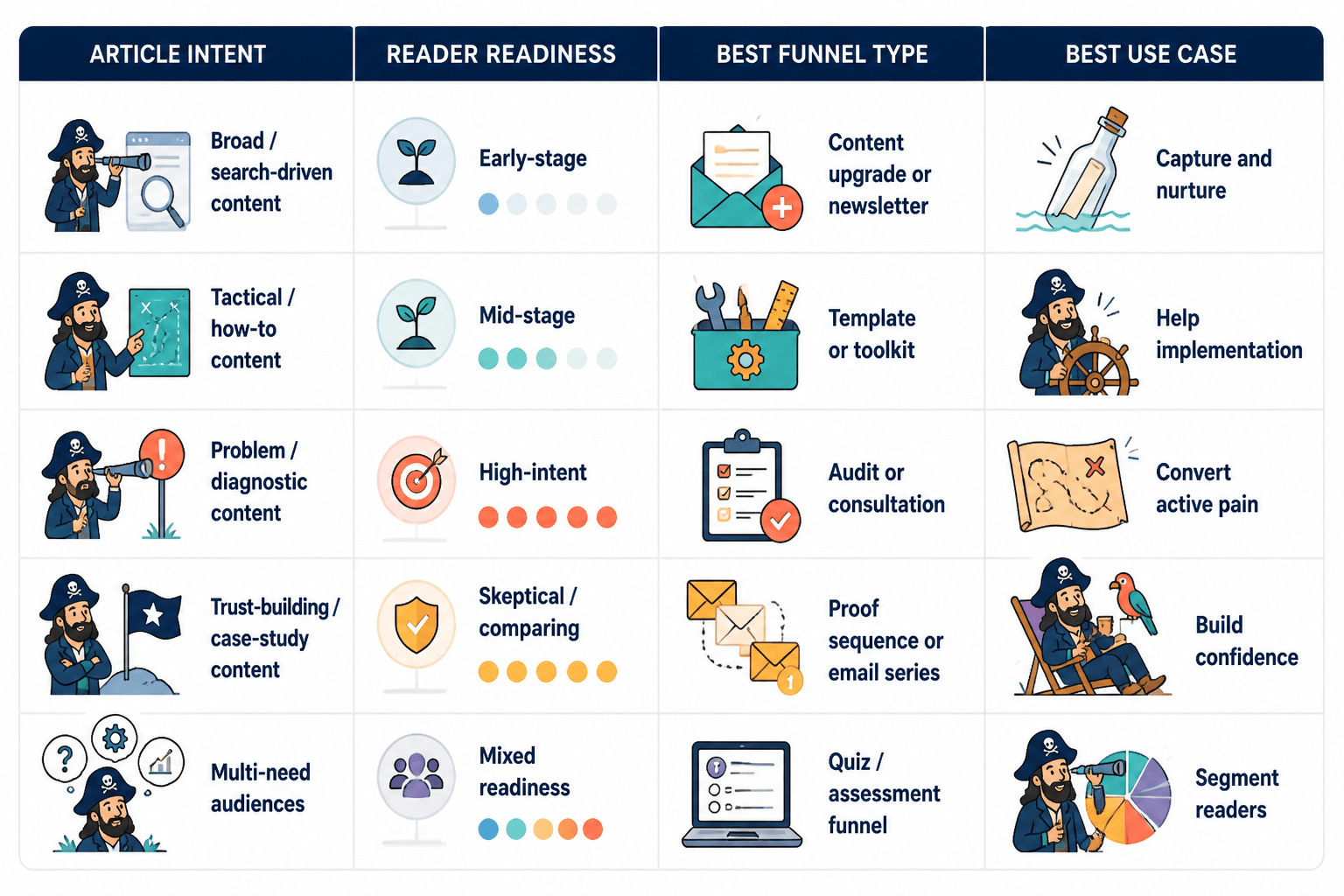
If you have a pile of old posts to update, use this quick filter before assigning any CTA.
| Ask this | If the answer is yes | Best funnel fit |
|---|---|---|
| Is the article broad and search-driven? | Reader is likely early-stage | Content upgrade or newsletter |
| Is the article tactical and implementation-heavy? | Reader wants help doing it | Template, toolkit, or low-ticket product |
| Is the article about fixing a visible business problem? | Reader may have active pain | Audit or consultation CTA |
| Is trust the real bottleneck? | Reader needs proof first | Related articles or case study path |
| Does the topic apply differently to different readers? | One CTA would be too generic | Assessment or segmented funnel |
Another useful question: what would a sensible human want next after reading this?
That sounds obvious, but it knocks out a lot of bad funnel decisions. If the next step feels abrupt, self-serving, or oddly disconnected, it probably is.
Where to place funnel elements inside a refreshed blog post
Good funnel pairing is not just about what you offer. It is also about where you offer it.
Most people only add a CTA at the bottom. That is fine for some readers. It misses others who are ready earlier, and it ignores the fact that different sections can support different micro-conversions.
Useful placement options:
- Intro area: light contextual mention if the offer is tightly relevant
- Mid-article: content upgrade after a valuable section
- After a checklist or framework: template, worksheet, or resource CTA
- After proof or examples: audit or service CTA
- End of article: main conversion ask
You do not need five CTAs fighting in a trench coat. Usually one primary CTA and one lighter secondary path is enough.
A simple model looks like this:
- Primary CTA: the main next step for most readers
- Secondary CTA: a lower-friction option for readers not ready yet
Example:
- Primary: book a blog refresh audit
- Secondary: get the refresh checklist
Funnel mistakes people make after refreshing blog content
This is where a lot of otherwise solid content work quietly falls apart.
Using the same CTA on every post
It is easier, yes. It is also lazy. Different posts attract different levels of intent. Treating all traffic the same usually lowers conversions across the board.
Offering something broader than the article itself
If the post is specific and the offer is generic, relevance drops. Readers do not want to mentally bridge that gap for you.
Pitching too hard on top-of-funnel posts
A freshly updated educational post is often not the place for a heavy sales close unless the topic already carries buying intent. Earn a little trust first.
Refreshing the article but not the CTA
This one is weirdly common. People improve the post but leave an old, bland, irrelevant CTA attached to it like a forgotten office keycard. Update the conversion path too.
No proof near a high-friction ask
If you want a reader to inquire, book, or buy, give them a reason to believe you can help. That could be examples, outcomes, a process breakdown, or a case-study path.
Ignoring small-audience advantages
If your traffic is modest, you do not need a giant funnel stack. You need a relevant one. A smaller audience of the right readers can convert very well when the article, CTA, and offer line up. If that is your stage, read blog rewrites and refreshes for creators with small audiences. It is a better model than copying someone with a giant list and a bigger ad budget.
A practical funnel map for different blog refresh scenarios
Here is a cleaner way to think about matching refresh types to funnel ideas.
The bigger point is simple: clearer structure and clearer writing make the piece more useful. That is usually what makes the ending land better too.