
If you have a small audience, publishing more blog posts is not always the smartest move. Sometimes the better move is fixing the posts you already have.
That is the whole case for blog rewrites and refreshes for creators with small audiences. You do not have endless traffic. You do not have a giant email list ready to forgive mediocre structure, weak hooks, vague positioning, or sleepy intros. Every post has to work harder. Which means old posts with decent bones are often worth more than another rushed draft nobody asked for.
A lot of creators treat rewriting like failure. It is not. It is editing with better judgment. It is taking something half-useful and making it pull its weight.
Here is how to refresh your blog content so it gets clearer, sharper, more useful, and more likely to attract the right readers, even if your audience is still small enough to fit inside a mildly disappointing webinar room.
For the main guide behind this topic, visit the parent guide.
Why rewrites matter more when your audience is small
Big sites can get away with waste. Small creators usually cannot.
If you have low traffic, every article has three jobs: attract the right person, prove you know what you are talking about, and move that person toward some next step. When a post fails one of those jobs, it is not just “suboptimal.” It is quietly making your whole blog look less useful than it should.
This is why blog rewrites and refreshes for creators with small audiences are not just an SEO chore. They are a leverage play. You already spent time researching, outlining, drafting, formatting, and publishing. A strong rewrite lets you keep the useful core while removing the parts that make readers bounce, skim, or forget you five minutes later.
And no, this does not mean changing a date, swapping two subheads, and calling it “updated for 2026.” That is not a refresh. That is administrative cosplay.
What actually counts as a blog refresh
Not every update needs a full rewrite. Sometimes a post needs structural surgery. Sometimes it just needs better packaging.
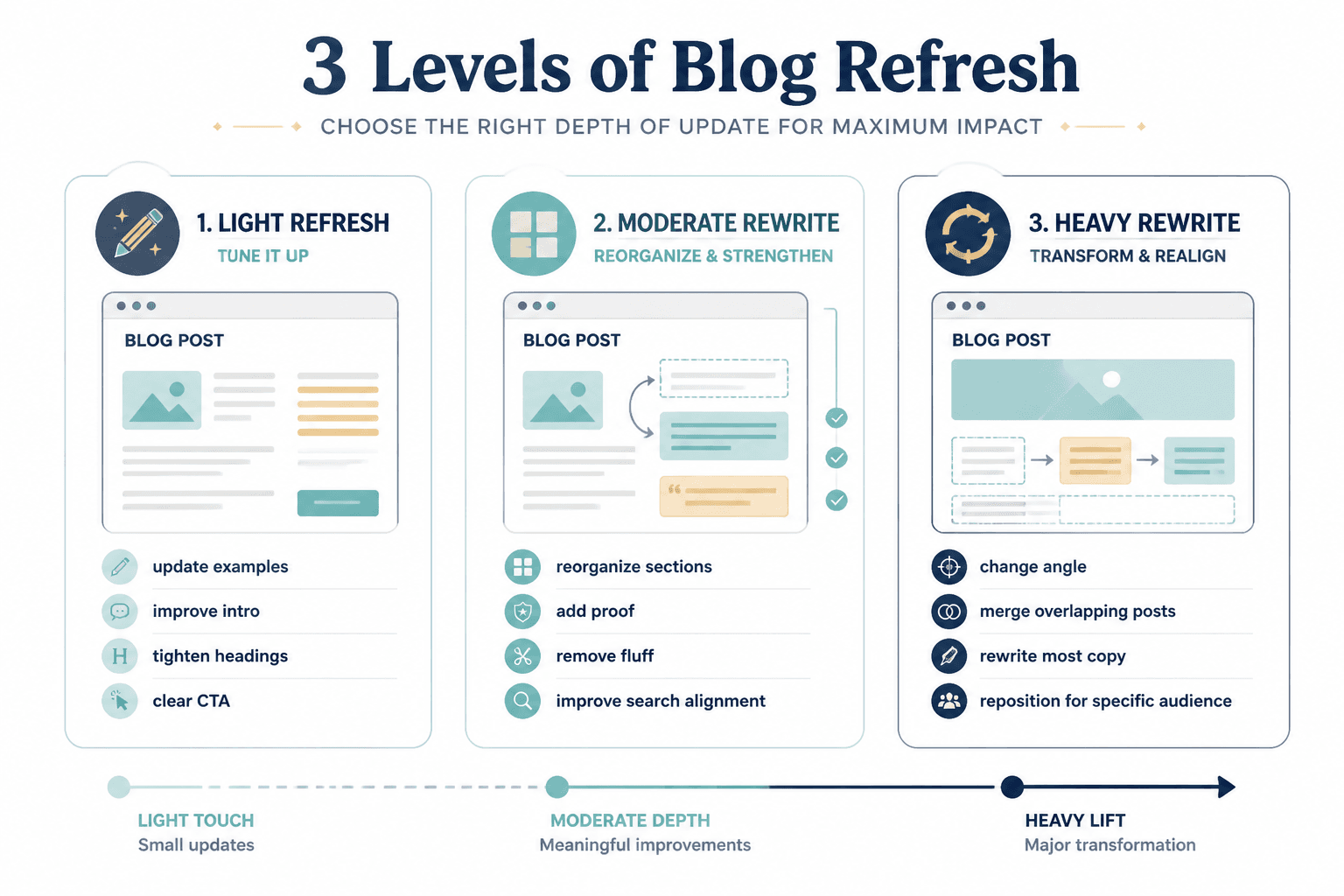
- Light refresh: update examples, improve intro, tighten headings, add clearer CTA, fix outdated phrasing
- Moderate rewrite: reorganize sections, sharpen argument, add proof, remove fluff, improve search alignment
- Heavy rewrite: change angle, merge overlapping posts, rewrite most of the copy, reposition for a more specific audience
The trick is knowing which level a post needs. A lot of creators over-edit the wrong articles and ignore the ones that are quietly closest to becoming useful assets.
Which blog posts are actually worth rewriting
Do not refresh everything. That is how you burn a week “optimizing” posts that were never good ideas in the first place.
Start with posts that already show some sign of life or strategic value. For small creators, the best rewrite candidates usually fall into a few categories.
1. Posts that get some traffic but do not convert
If people are landing on a post but not clicking further, subscribing, replying, or booking, the problem is often not traffic. It is weak positioning inside the article.
Maybe the post teaches something useful but never shows why you are worth following. Maybe the CTA is limp. Maybe the article solves a tiny problem but never connects that problem to a bigger outcome.
2. Posts with a good idea and bad execution
You know these ones. The premise is solid. The draft is not. Maybe it rambles. Maybe the headline is vague. Maybe it starts with three paragraphs of throat-clearing before anything useful happens.
Those are often your best rewrite opportunities because the strategic thinking is already there. The writing just needs to stop getting in its own way.
3. Posts targeting topics you still want to be known for
If a topic fits your positioning, offer, or expertise, it is probably worth improving. Small creators do not need more random content. They need tighter clusters around topics that build authority and trust.
That might mean updating a weak article so it better supports your broader content system. If you are building out your blog strategy, it helps to connect posts naturally to related pieces like blog SEO writing, your blog article systems, and the broader hub on blog rewrites and refreshes.
4. Posts that are accurate enough to save, but too weak to rank or persuade
A lot of creator blogs are full of posts that are technically fine and strategically forgettable. They do not say anything wrong. They just do not say anything strongly, clearly, or specifically enough to matter.
These are ideal for refreshes. You are not rescuing a disaster. You are turning “fine” into “actually useful.” That is a much better use of time than endlessly producing new beige content.
A simple rewrite audit for small creators
Before touching the draft, audit the article using five questions.
- Does this post target a topic my ideal reader actually cares about?
- Is the angle specific enough to feel relevant?
- Does the intro earn attention fast?
- Does the body say anything concrete, useful, or persuasive?
- Is there a clear next step for the right reader?
If the answer is “sort of” across the board, you probably need more than a cosmetic update.
And this is where creators with small audiences need to be a little more ruthless. You do not need posts that are mildly informative to everybody. You need articles that make the right person think, “Finally, someone explained this properly.”
How to rewrite a blog post without turning it into a brand new mess
Rewriting works best when you follow a sequence. Otherwise you end up polishing sentences in a post whose core angle still does not work.
Step 1: Find the real point of the article
Most weak posts are trying to say three things at once. Pick one.
Ask yourself: what is the clearest useful takeaway this reader should leave with? If you cannot answer that in one sentence, the reader definitely cannot either.
A rewrite usually gets better when the article gets narrower, not broader.
Step 2: Rewrite the intro before the middle
The opening does a lot of heavy lifting. If it is vague, slow, or stuffed with generic context, readers leave before your best point appears.
A stronger intro usually does one or more of these:
- calls out the mistake
- names the problem behind the problem
- shows who the article is for
- promises a practical payoff
- cuts straight past the warm-up nonsense
Weak intro: “Blogging is an important part of online marketing for creators in today’s digital world.”
Better intro: “If your blog gets polite little traffic bumps but never turns readers into subscribers, clients, or remembered experts, the issue may not be volume. It may be that your older posts are doing a bad job of selling your thinking.”
Step 3: Cut anything that sounds broad, obvious, or padded
This is where a lot of word count dies, and frankly, good. If a sentence could be pasted into 4,000 other articles on the internet without anyone noticing, it probably should not survive the rewrite.
Cut:
- generic definitions
- repetitive transitions
- “it is important to note” fluff
- basic advice your audience already knows
- fake authority phrases that say nothing
Keep the parts that show your judgment. Readers can get generic information anywhere. They come back for clarity, taste, and useful specificity.
Step 4: Add examples that make the advice usable
A lot of creator blog posts fail because they explain principles without showing what those principles look like in practice.
If you are saying “be more specific,” show the before and after. If you are saying “tighten your CTA,” write the weak version and the stronger version. If you are saying “improve article structure,” show a better flow.
Useful beats abstract every time.
Step 5: Rebuild the structure around reader intent
Most refreshes improve when the article gets reorganized around the actual questions readers have, not around the order you happened to think of things while drafting.
Good subheads act like tiny promises. They make scanning easier, improve readability, and help search engines understand the page without turning the article into robotic keyword confetti.
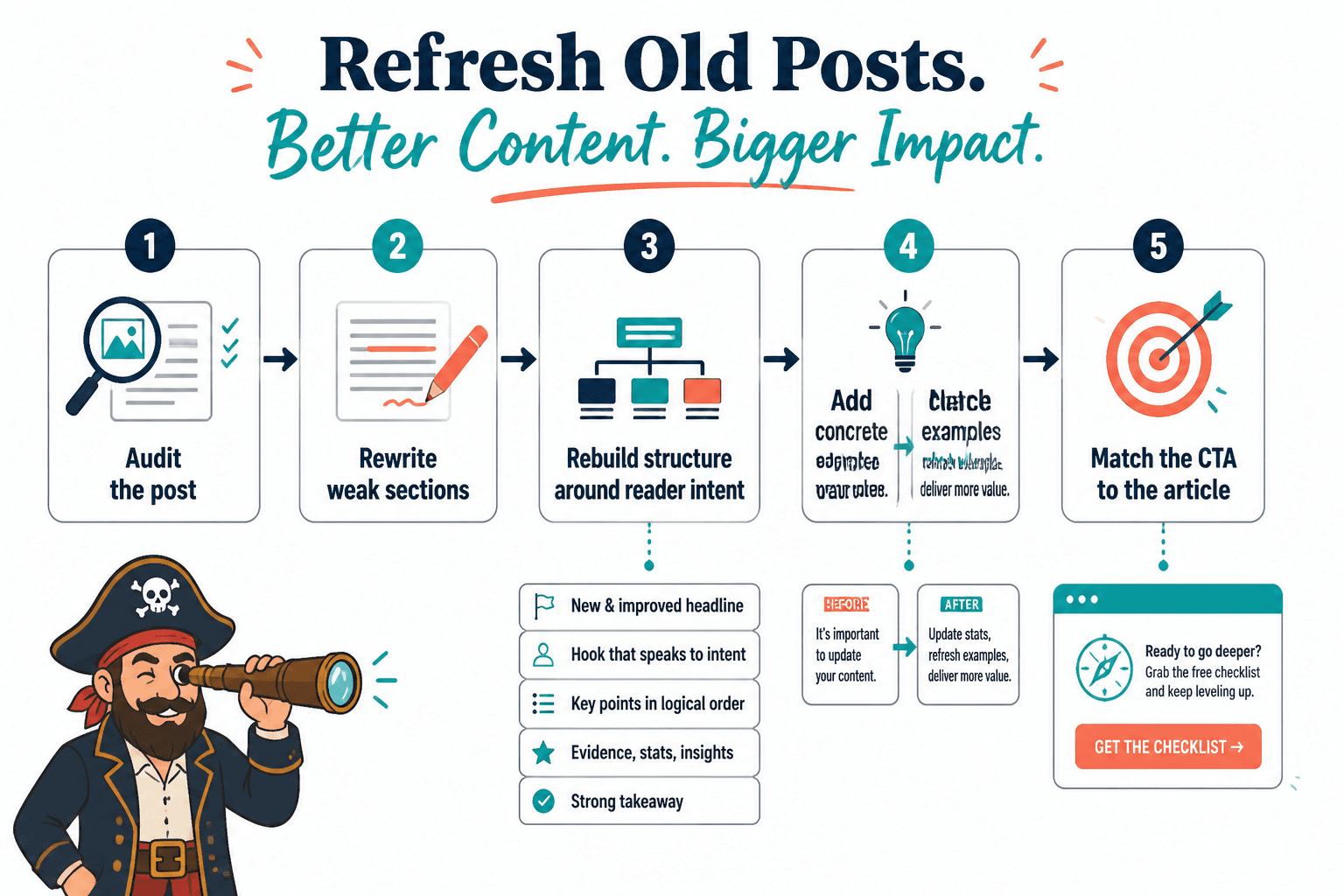
Step 6: Upgrade the CTA so it fits the article
A weak call to action ruins a surprising number of otherwise decent posts.
If the article helps the reader diagnose a problem, the CTA can point them to a deeper guide. If the article builds trust around your expertise, the CTA can invite them to a related service, consultation, resource, or next article.
What you should not do is staple “book a call” onto everything like a panicked intern.
For example, if this article helps someone improve underperforming content, a useful next step could be a deeper piece like this guide for creators who want better results, a tactical resource like hook rewrite templates for busy creators, or a conversion-focused follow-up on turning blog rewrites and refreshes into more leads or sales.
What to fix first in underperforming blog posts
If you do not have much time, start with the elements that usually create the biggest gains.
| Element | Common problem | Better move |
|---|---|---|
| Title | Too broad or bland | Make the payoff and audience clearer |
| Intro | Slow and generic | Lead with the real problem or tension |
| Subheads | Disorganized or vague | Use reader-focused sections with clear intent |
| Examples | Too abstract | Add rewrites, scenarios, or concrete use cases |
| CTA | Weak or unrelated | Match the next step to reader readiness |
| Positioning | No clear audience fit | Name who the advice is for and why it matters |
This table is not glamorous, but it is useful. Which already puts it ahead of half the internet.
Mistakes creators with small audiences make when refreshing content
Rewriting only for search and forgetting trust
Yes, search matters. No, your article should not read like it was assembled by a plugin wearing a tie.
If your refresh improves keyword alignment but removes personality, clarity, or conviction, that is not a win. For small creators especially, the blog has to do more than attract clicks. It has to build confidence in your point of view.
Keeping weak sections because “I already wrote them”
Sunk cost is not a content strategy.
If a section is repetitive, irrelevant, or there only because you wanted the article to feel longer, cut it. Readers are not impressed by endurance.
Refreshing posts that never had strategic value
Some posts are not hidden gems. They are just old. There is a difference.
If the topic no longer fits your audience, your offer, or the type of authority you want to build, let it go. A small audience grows faster when your content gets tighter, not more bloated.
Changing words without improving the idea
A refresh is not just sentence swapping. If the angle is weak, no amount of line editing will save it.
Sometimes the smarter move is to reposition the whole article around a stronger idea, a clearer audience, or a more specific promise.
How often should you refresh blog posts?
There is no sacred schedule. Refresh based on opportunity, not content superstition.
Good times to revisit a post:
- it gets traffic but weak engagement or conversions
- your positioning has changed
- the examples or tools are dated
- you have a stronger take on the topic now
- the article fits a content cluster you are actively building
- you want to link it into newer posts and offers
For many creators, a quarterly review of core posts is enough. Not every article needs babysitting. But your important ones should not be left to fossilize.
A practical refresh workflow you can actually reuse
If you want this to become part of your content system rather than a random cleanup spree, use a repeatable process.
- List your existing blog posts
- Mark which ones still fit your audience and offers
- Check which posts have traffic, backlinks, conversions, or strategic relevance
- Pick 3 to 5 high-potential posts
- Audit title, intro, structure, examples, CTA, and internal links
- Choose light, moderate, or heavy refresh
- Republish or update with stronger formatting and cleaner copy
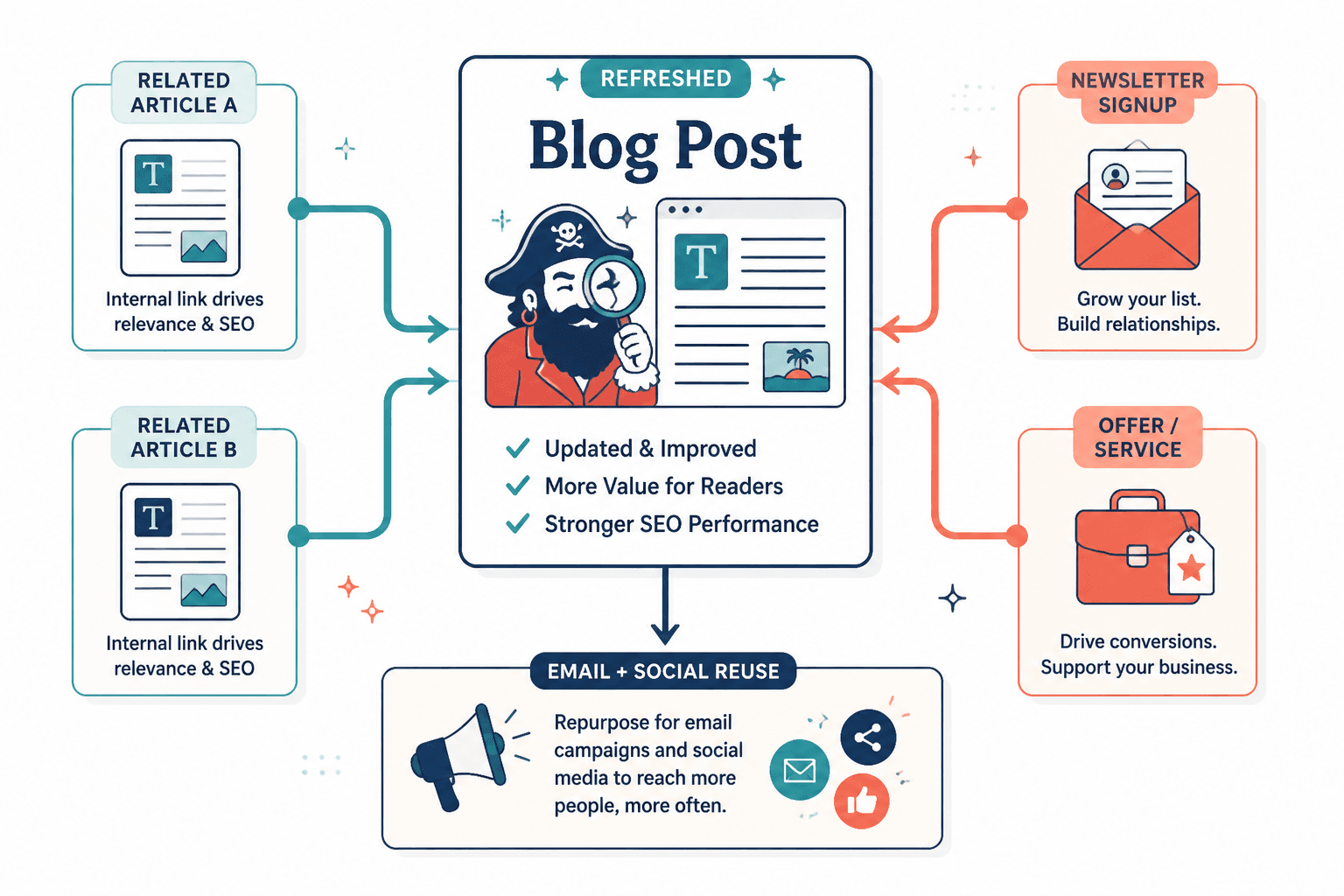
- Link refreshed posts to related content so they actually work together
- Reuse the refreshed article in email, social posts, or lead generation content
This matters because one good refresh can do more than improve one page. It can support your whole blog architecture, strengthen your topic authority, and create better paths into offers and newsletter signups.
If you want examples of stronger refresh angles, it is worth pairing this with blog rewrites and refreshes ideas and examples for creators.
How rewrites help small creators get better leads, not just better pages
This part gets missed all the time.
Better blog posts do not just look nicer. They improve the path between attention and action. For creators with small audiences, that path matters more because you do not have endless top-of-funnel volume to compensate for weak conversion.
A sharper article can:
- qualify readers faster
- show clearer expertise
- create stronger internal journeys through your site
- build trust before the pitch
- make your offers feel like a logical next step instead of a weird ambush
That is why blog rewrites and refreshes for creators with small audiences often have more business value than people expect. The upside is not only “maybe better rankings.” It is also better reader experience, stronger authority, and cleaner conversion paths.
Quick FAQ
Should I rewrite old blog posts or write new ones?
Do both, but rewrite first if the old post targets a topic you still care about and already has some strategic value.
How do I know if a post needs a refresh or a full rewrite?
If the core idea is good and the execution is weak, refresh it. If the angle, audience fit, and structure are off, rewrite it heavily.
Can small blogs benefit from content refreshes even without much traffic?
Yes. Refreshes help with clarity, positioning, internal linking, trust, and conversions, not just traffic.
What is the first thing I should fix in an old post?
Usually the intro, title, and CTA. Those three often do the most damage when they are weak.
Refresh the posts that deserve to keep working
Blog rewrites and refreshes for creators with small audiences are not about polishing everything you have ever published. They are about identifying the posts with real potential and making them useful enough to earn attention, trust, and action.
If your audience is small, that is not a reason to lower the bar. It is a reason to raise it. You need fewer forgettable posts, fewer vague articles, fewer “good enough” drafts hanging around your site like expired conference snacks.
Pick one post that still matters. Tighten the angle. Rewrite the opening. Improve the structure. Add real examples. Give readers a next step that makes sense. Then do it again with the next one worth saving.
That is how a small blog starts acting like a serious asset instead of a storage unit for unfinished thinking.
The bigger point is simple: clearer structure and clearer writing make the piece more useful. That is usually what makes the ending land better too.