
A draft sits open in one tab, three half-finished notes sit in another, and the blog post itself is doing that charming modern trick where it looks “almost done” while quietly being wrong. The headline is fine, the intro is mush, the subheads are decorative, and the whole thing feels like it was written by committee after a long lunch. This is where examples help: they make the fix visible instead of theoretical.
If you are deciding whether to rewrite a post, refresh it, or leave it alone, start with the job the page is supposed to do now. For the bigger framework, see the blog rewrites and refreshes guide. For a fast decision tree, this post keeps things practical.
What a rewrite or refresh is actually for
A blog rewrite changes the substance, structure, or angle of a post so it works better than the version you already have. A refresh updates the page without rebuilding it from scratch. The goal is not “new for the sake of new.” The goal is clearer, more useful, more current, and more likely to earn the click, the read, or the lead.
- Rewrite when the point is fuzzy, the structure is broken, or the post misses what readers need.
- Refresh when the post is basically right but needs updated details, cleaner wording, or better distribution inside the page.
- Merge when two weak posts are covering the same ground and neither deserves to live alone.
- Leave it alone when the post is already doing its job and the “fix” would be vanity editing.
That distinction matters because not every stale post needs a dramatic rebuild. Some need a new spine. Some need a new coat of paint. Some need to be escorted out of the building.
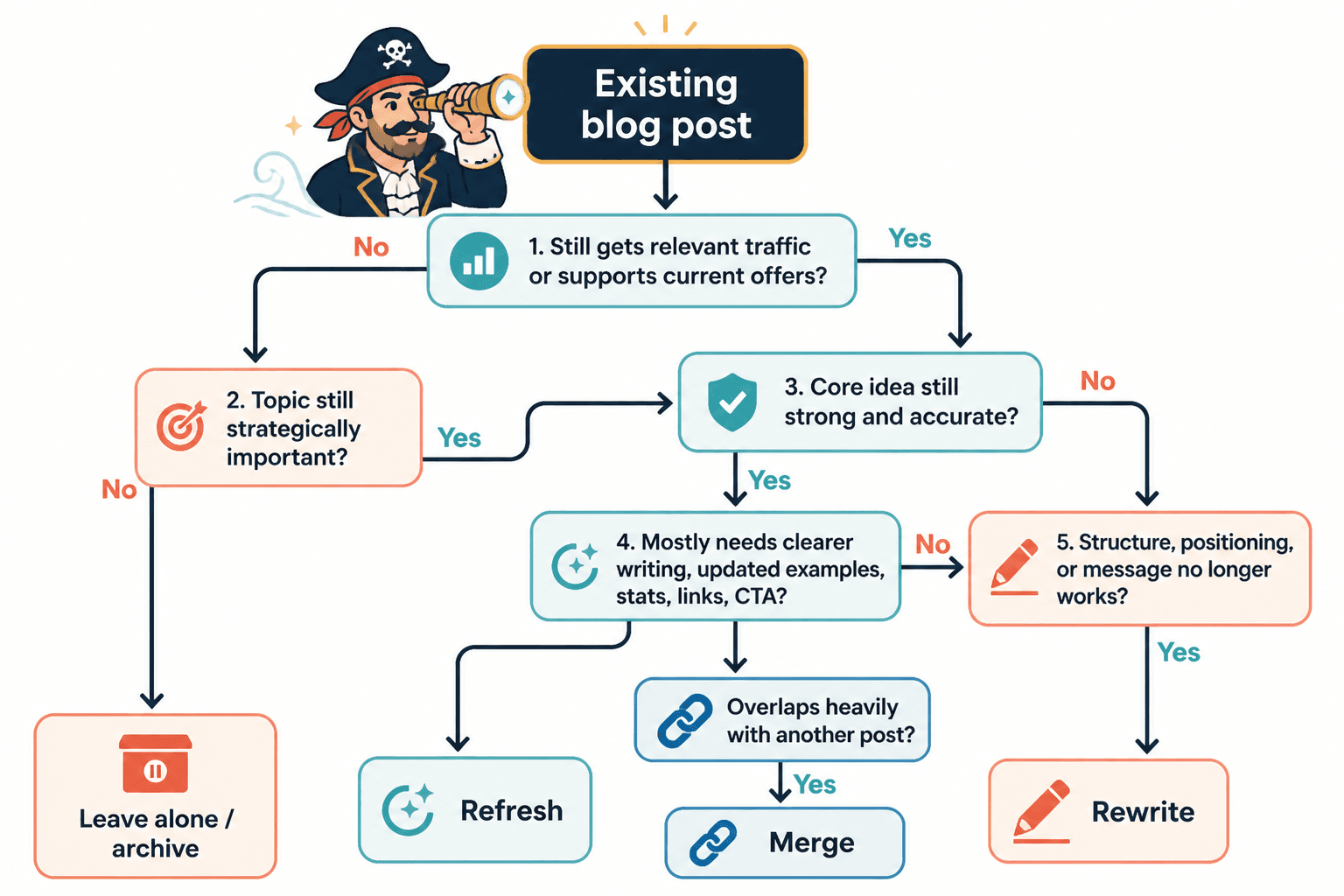
Quick triage: decide what kind of change the post needs
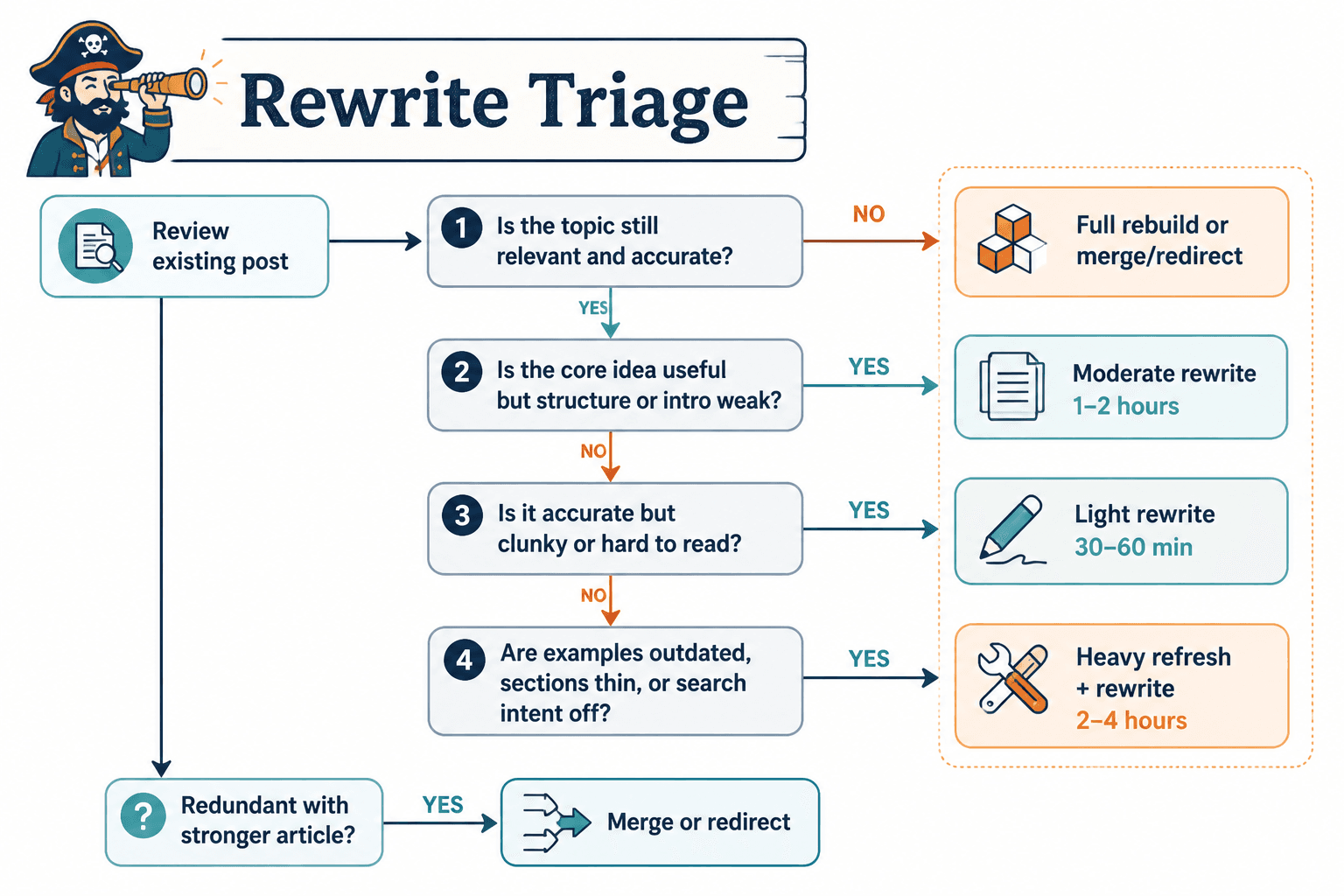
Use the page itself to make the decision. Read the title, the intro, the first three subheads, and the conclusion. Then ask four questions:
- Is the post solving a real reader problem?
- Does the intro get to the point fast enough?
- Can someone scan the headings and actually use the article?
- Has the advice aged out, or is it just wordy?
If the answer to most of those is “not really,” you probably need a rewrite. If the answer is “yes, but the dates, examples, or references are stale,” a refresh is enough.
For a more checklist-driven version of this step, use the blog rewrite checklist examples alongside the parent system.
Blog rewrite examples by problem type
1. The intro says everything except the point
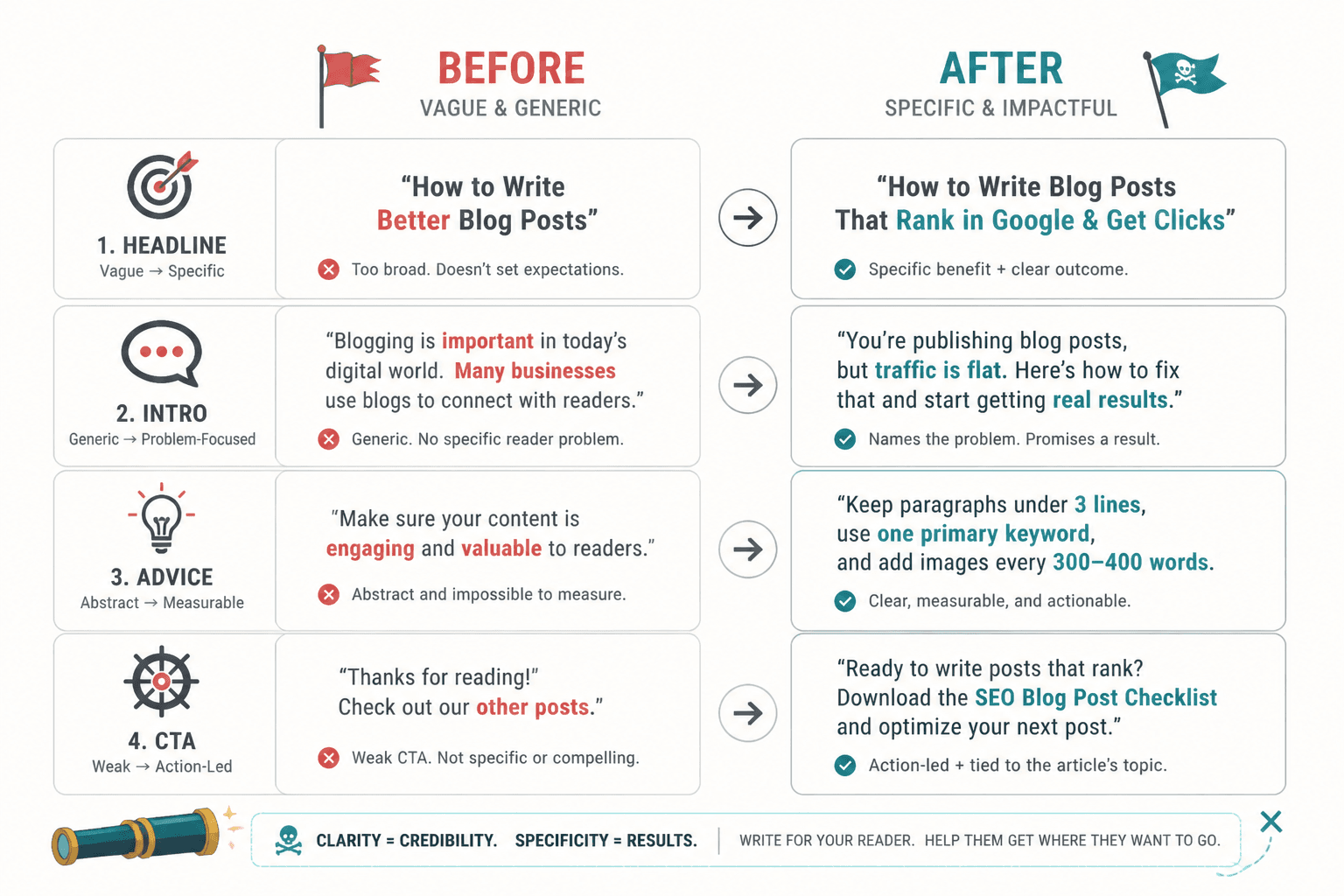
Before: “Creating content consistently is important in today’s fast-moving digital landscape, and many creators want to improve their results without starting over from scratch.”
After: “If a blog post is vague in the first 80 words, readers usually leave before the useful part shows up. Rewrite the opening so it states the problem, the payoff, and the reason to keep reading.”
The second version does three useful things: it names the problem, it hints at the fix, and it stops acting like a grant proposal.
2. The article is too broad to help anyone
Before: “There are many ways to improve your blog content and make it more effective for different audiences.”
After: “A post about blog rewrites works better when it focuses on one outcome: clearer structure, a stronger hook, better evidence, or a cleaner path to conversion.”
Broad posts sound safe. Specific posts are useful. Specific usually wins.
3. The section repeats the heading in paragraph form
Before: “One important thing to consider is your structure. Structure matters because it helps readers understand the structure of your content.”
After: “Structure matters because it tells readers where they are and what comes next. If every section says the same thing in a slightly different costume, cut one and strengthen the rest.”
This is where rewrites often pay off fastest. Remove the echo, keep the meaning, and suddenly the page sounds like it was written on purpose.
4. The post has advice, but no proof
Before: “Adding examples can improve engagement and make your content better.”
After: “Add one concrete example per major point so readers can see the change, not just agree with the theory.”
If the article is teaching a rewrite process, it needs to show the before-and-after logic. Otherwise it is just a lecture with a nicer font.
5. The conclusion ends like a shrug
Before: “In conclusion, rewriting your blog posts can be helpful in many cases.”
After: “The best rewrites do one thing clearly: they make the post easier to understand, easier to trust, and easier to act on.”
End with a decision, not a polite fade-out.
Blog refresh examples by problem type
1. The post is mostly right, but the title and intro are stale
Refresh the title if the angle still fits but the wording feels dated or vague. Then tighten the intro so it reflects the current search intent and the current reader pain.
Refresh example: change “How to Improve Your Blog in 2024” into a more durable, outcome-based title that still matches the article’s actual promise. Then remove the year-specific filler from the opening paragraph.
2. The advice still works, but the examples are old
Keep the core teaching. Replace generic examples with current, realistic ones that match how creators actually publish now. That might mean updating references to content systems, SEO expectations, or workflow tools.
When possible, swap vague examples for mini-scenarios that show the rewrite in context:
- a creator updating an evergreen post with a better hook
- a consultant narrowing a broad explainer into one service-related angle
- a blogger replacing fluffy advice with a practical checklist
3. The headings need a cleaner path
A refresh does not always mean rewriting every line. Sometimes the best upgrade is structural: reorder headings, remove duplication, and make each section answer one question.
Good refreshes reduce friction. Readers should not have to solve the outline before they can read the post.
4. The article needs stronger internal linking
A refreshed post should fit into the site, not float around like an isolated memo. Add natural links where they help readers move to the next step.
Useful companions include:
- the parent guide to blog rewrites and refreshes
- hook rewrite templates
- rewrite checklist examples
- AI tools for blog rewrites and refreshes
- turning rewrites into leads or sales
Fast templates creators can adapt
These are not magic lines. They are reusable shapes for making a rewrite or refresh clearer.
Template 1: the point-first rewrite
Use when: the intro is vague or slow.
Formula: “This post now does [specific job] so readers can [specific outcome].”
Example: “This post now shows how to rewrite weak blog sections so readers can understand the point faster and stay on the page longer.”
Template 2: the refresh-without-rebuild
Use when: the article is solid but stale.
Formula: “The core advice stays the same, but [current detail/example/link] needs updating.”
Example: “The core advice stays the same, but the examples, subheads, and supporting links need updating so the post reflects how creators publish now.”
Template 3: the stronger section opener
Use when: a section drifts into filler.
Formula: “The real issue is [problem], not [surface symptom].”
Example: “The real issue is not that the post is short. The real issue is that the short version does not answer the reader’s question cleanly.”
Template 4: the proof-addition rewrite
Use when: the post sounds general.
Formula: “Instead of saying [abstract claim], show [specific example, contrast, or step].”
Example: “Instead of saying the intro should be better, show a before-and-after version with the filler removed and the point moved to the top.”
Template 5: the tidy conclusion
Use when: the ending trails off.
Formula: “The next move is [action], because [reason].”
Example: “The next move is to tighten the first third of the post, because that is where most weak rewrites either win or waste everyone’s time.”
Mini checklist before you republish
- Does the title match the actual promise of the article?
- Does the intro reach the point quickly?
- Do the headings follow a useful logic?
- Did you remove repeated or filler sentences?
- Did you add examples, proof, or contrast where needed?
- Did you update links, dates, or references where they mattered?
- Did you connect the post to the rest of the site with natural internal links?
If you want a more operational version of this process, the checklist companion on the site is the right next stop. If you want a stronger hook specifically, use the hook templates guide before you touch the rest of the article.
When examples do the real work
The point of rewrite and refresh examples is not to make the page look smarter. It is to make the decision obvious. A good example shows what changed, why it changed, and what the reader gets now that they did not get before.
That is the whole game: not newer for vanity, not longer for optics, not fancier for the portfolio. Just clearer, sharper, and more useful. A page that can do that is no longer a draft with lipstick on it. It is a page worth publishing.
Next: read the parent guide, then use the rewrite checklist examples and hook templates to turn one weak section into a better page.