
Most Facebook long-form posts do not flop because they are too long. They flop because they take 11 paragraphs to say one mildly annoyed thing.
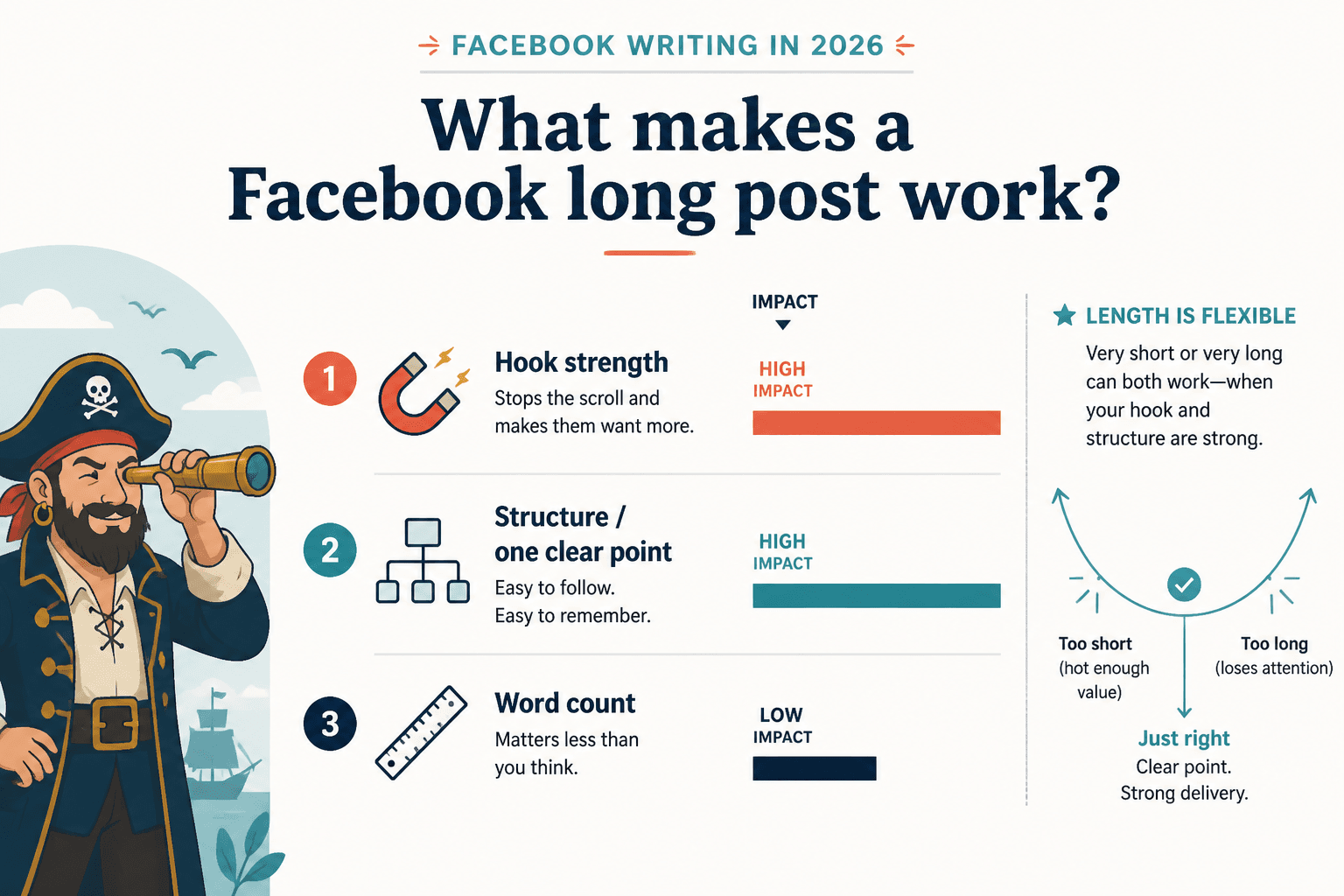
That is the real answer hiding underneath the question, How Long Should Facebook Long-Form & Rants Be in 2026? People keep hunting for a magic word count when the actual issue is usually shape, pacing, and whether the post earns its length.
If your rant rambles, people bail. If your long-form post has tension, movement, and a point worth following, people will absolutely read more than the internet allegedly allows. Facebook is still one of the better places for personality-heavy, opinion-led writing that sounds like a person and not a content machine with a Canva subscription.
So here is the useful version: how to think about ideal length, what different lengths do well, when to stop, and how to make a Facebook long-form post feel worth reading instead of emotionally trapped.
For the main guide behind this topic, visit the parent guide.
There is no perfect length, but there is a useful range
For most creators, consultants, coaches, and personal brands, Facebook long-form and rants tend to work best in these rough ranges:
- 200–400 words: short opinion post, light rant, quick lesson, conversational provocation
- 400–800 words: strong default range for most Facebook long-form posts
- 800–1,300 words: deeper story, stronger argument, more layered rant, nuanced breakdown
- 1,300+ words: only when the story, tension, and payoff genuinely justify it
If you want the shortest honest answer, 400 to 800 words is usually the sweet spot for Facebook long-form and rants in 2026.
That range gives you enough room to say something real, build momentum, and land a point without testing your reader’s patience for sport.
But useful ranges are not laws. A sharp 230-word post can hit hard. A 1,100-word rant can do numbers if it has a real arc. A 700-word post can still die quietly if it opens with throat-clearing and then jogs in circles.
Length is not the strategy. It is the container.
What should decide the length of a Facebook long-form post?
Use the post’s job to decide the length, not a random rule from someone screenshotting their analytics like they cracked the Rosetta Stone.
Here are the things that should actually determine how long your Facebook long-form or rant should be.
1. The complexity of the idea
Some points are naturally short. If your argument is basically “people are overcomplicating this,” then write the post like you mean it and keep moving.
Other points need setup, contrast, examples, and a turn. If you are dismantling bad advice, telling a story with a lesson, or making a more nuanced case, trying to cram it into 180 words often makes it weaker, not stronger.
2. The strength of the hook
The stronger the opening, the more length you can get away with.
If your first line creates tension, curiosity, recognition, or friction, people will give you more runway. If your first line sounds like “Just sharing a few thoughts on this…” then honestly, they owe you nothing.
If openings are your weak spot, read how to start Facebook long-form and rants without a weak opening. It matters more than shaving 150 words off the middle.
3. The amount of proof or texture needed
A bold opinion with no support can work if it is witty, timely, or emotionally true. But if you want the post to build trust, not just reactions, you usually need a little more than a hot take and a prayer.
Examples, specifics, mini-scenes, direct observations, and concrete consequences all add length. Good. They also make the post feel real.
4. The goal of the post
Are you trying to start conversation? Build authority? Tell a story people remember? Shift how your audience thinks about a problem? Move people to your offer or profile?
Different goals tolerate different lengths.
| Post goal | Usually works best |
|---|---|
| Quick engagement and comments | 200–500 words |
| Opinion-led authority post | 400–800 words |
| Story with lesson | 600–1,000 words |
| Full rant with argument and payoff | 700–1,300 words |
| Soft conversion to DM, offer, or resource | 300–700 words |
5. Your audience’s relationship with you
Cold audiences need clearer, tighter writing. Warmer audiences will follow you further, especially if they already know your voice and care what you think.
This is why some people can post 1,400 words about an industry annoyance and get a flood of comments, while someone else writes 600 words and hears only the distant hum of the algorithm not caring. It is not just length. It is trust, recognition, and relevance.
That is also why it helps to understand the broader social media writing context and the more specific Facebook writing context instead of treating every post like an isolated word-count experiment.
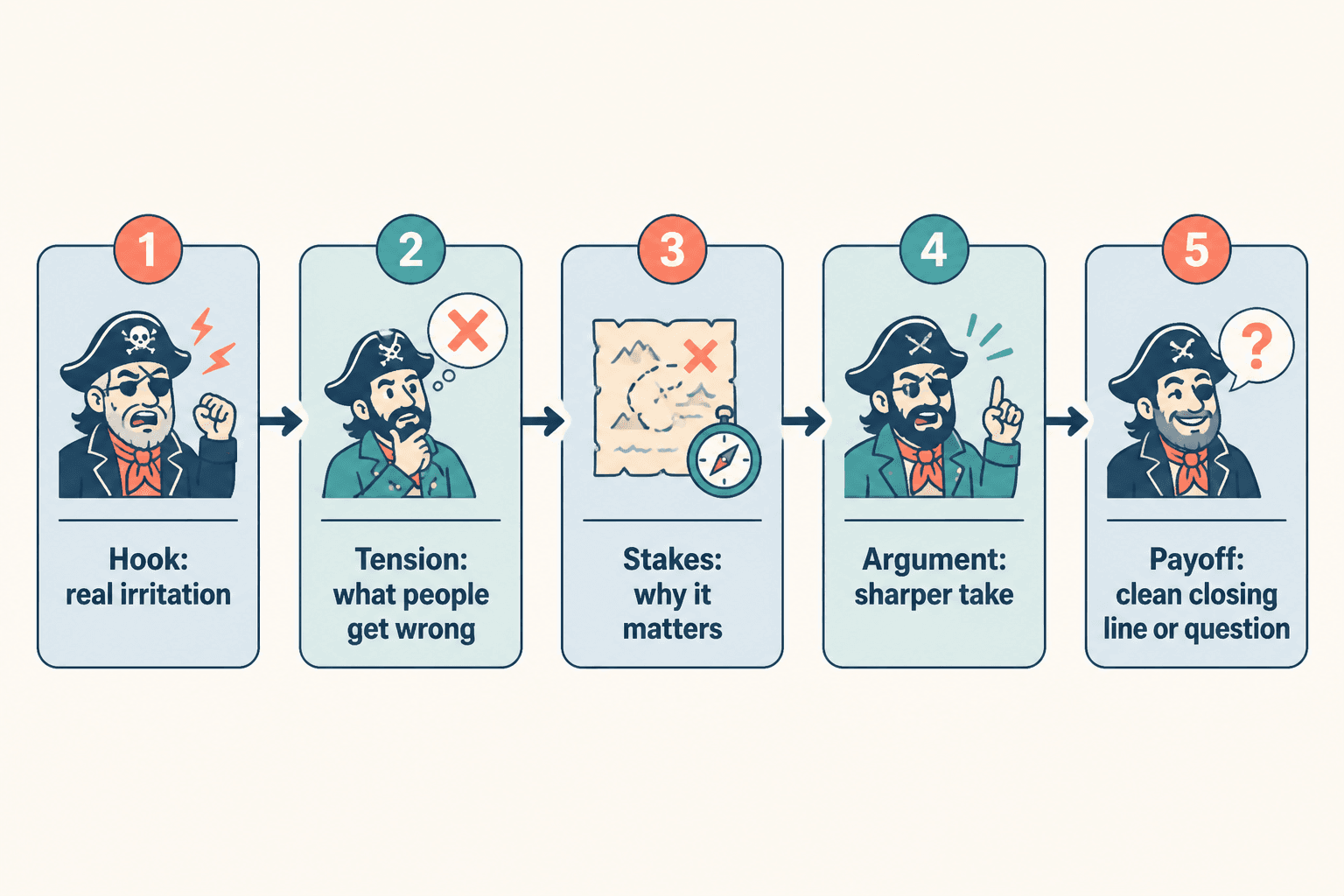
For Facebook rants, length should follow structure
A good rant is not random frustration typed at speed.
It has shape. There is a trigger, a tension, an argument, and a landing. Without that, it is just a mood with line breaks.
The easiest way to control rant length is to use a simple structure:
- Open with the real irritation
Say the thing plainly. No warm-up lap. - Name what people keep getting wrong
Show the bad assumption, bad behavior, or bad advice. - Explain why it matters
What does this mess up? Trust? Sales? Clarity? Sanity? - Offer the sharper take
Give people a better way to think about it. - End with a clean line or question
Leave them with a point, not residue.
When a rant follows that flow, you can often say something substantial in 500 to 900 words without it feeling long. When it does not, even 300 words can feel like being cornered at a networking event by someone with a grievance and no editing instinct.
How to tell if your post is too long
Do not ask, “Is this over 800 words?” Ask, “Did I repeat myself because I no longer trusted the point?”
Here are the usual signs your Facebook long-form post is too long:
- You make the same argument three different ways
- You explain the obvious after the reader already got it
- You add side points that belong in another post
- The emotional peak happens halfway through, then the post keeps going
- Your ending restates the middle instead of landing something sharper
- You started with one point and somehow picked up four passengers
One of the most common problems in Facebook long-form writing is not length itself. It is post drift. You begin with a clear frustration, then wander into context, then caveats, then another mini-lesson, then a soft pitch, then a summary nobody asked for.
That is how a solid 450-word post becomes a bloated 1,000-word one.
How to tell if your post is too short
Yes, this happens too. Some people cut too aggressively and end up posting a skeleton.
Your rant or long-form post is probably too short if:
- The reader can not tell what triggered the opinion
- The post states a claim but gives no example, proof, or explanation
- The emotional turn happens too fast to feel earned
- The ending sounds bigger than the body supported
- You are relying on vibe to carry the whole thing
Short is not automatically strong. A short post with no specificity is just underwritten.
Facebook rewards posts that feel worth responding to. That usually means enough detail to make the opinion feel grounded, not just dramatic.
Recommended lengths by Facebook post type
If you want practical guidance, use this as your cheat sheet.
| Type of Facebook post | Recommended length | Why it works |
|---|---|---|
| Quick opinion post | 200–350 words | Fast, clear, easy to react to |
| Conversational lesson post | 300–600 words | Enough room for one useful point and a takeaway |
| Personal story with business lesson | 500–900 words | Needs setup, scene, and payoff |
| Focused rant | 500–900 words | Best balance of energy and readability |
| Layered argument or industry critique | 800–1,300 words | Allows nuance if the structure is clean |
| Mini essay with CTA | 400–700 words | Keeps the point strong without exhausting the reader before the ask |
If you regularly post above 1,300 words, do it on purpose. That length can work, but it demands pacing, insight, and a reason to exist. “I had more thoughts” is not a reason. It is a warning sign.
What matters more than word count
If you obsess over exact length, you will miss the much bigger levers.
Opening strength
The first line has one job: make the right person keep reading.
A strong Facebook rant opening usually does one of these:
- Calls out a frustrating pattern
- Starts with a sharp opinion
- Names a thing people quietly know is true
- Creates social or emotional tension
Weak opening: “I have been thinking a lot lately about how people approach content.”
Stronger opening: “A lot of Facebook rants are not bold. They are just badly edited complaints.”
Pacing
Long-form on Facebook needs rhythm. Short paragraphs help. So does contrast. So do sentences that occasionally snap instead of meander.
You are not writing a whitepaper. You are writing something a real person might continue reading while interrupted by notifications, comments, and their aunt posting about ceramic chickens.
Specificity
Specific posts feel shorter because they are easier to follow.
“People need to be more authentic” is vague and exhausting.
“If every vulnerable post somehow circles back to your booking link, people notice” is specific and easier to react to.
One clear point
One post. One main point. You can have supporting ideas, but the reader should not need a map.
Most long Facebook posts get weaker because they try to cover too much. If you find yourself teaching three lessons, split it. That is not restraint. That is content supply.
For more on writing posts with actual shape, this guide on how to write better Facebook long-form and rants will help.
A simple editing test for Facebook long-form and rants
Before you publish, run the post through this quick test:
The bigger point is simple: clearer structure and clearer writing make the piece more useful. That is usually what makes the ending land better too.