Most weak LinkedIn posts are not suffering from a lack of words. They are suffering from a lack of point.
That is why short LinkedIn hooks and tighter formatting often beat longer ones. Not because short is magically better. Not because the algorithm supposedly rewards tiny posts written by sleep-deprived haiku merchants. Short wins when it gets to something clear, specific, and worth reading before the reader scrolls past and forgets you exist.
When short LinkedIn hooks & formatting beat long ones, they do it for a simple reason: they reduce friction. They make the post easier to notice, easier to understand, and easier to keep reading. And on LinkedIn, that matters more than people want to admit.
This is not an argument for making every post tiny. Some ideas need room. Some stories need pacing. Some proof needs context. But a lot of creators, consultants, coaches, and founders are writing long when they should be writing sharp. They confuse more lines with more authority. Usually, it just creates more places for attention to die.
Here’s how to tell when short hooks and cleaner formatting will outperform the long version, what people keep getting wrong, and how to tighten your posts without making them bland.
For the main guide behind this topic, visit the parent guide.
Why short LinkedIn hooks work so well
A short hook works when it creates immediate clarity or tension.
That’s it. No mystery. No secret pattern. No need to cosplay as a cryptic thought leader.
People scanning LinkedIn are moving fast. They are not sitting down with tea, ready to savor your opening paragraph like it is literary nonfiction. They are checking in between meetings, procrastinating during work they do not want to do, or looking for something useful enough to justify staying on the platform for another minute.
A short hook helps because it can do one of three things quickly:
- State a sharp opinion
- Name a problem the reader recognizes
- Create curiosity with a specific contrast or surprise
Good examples:
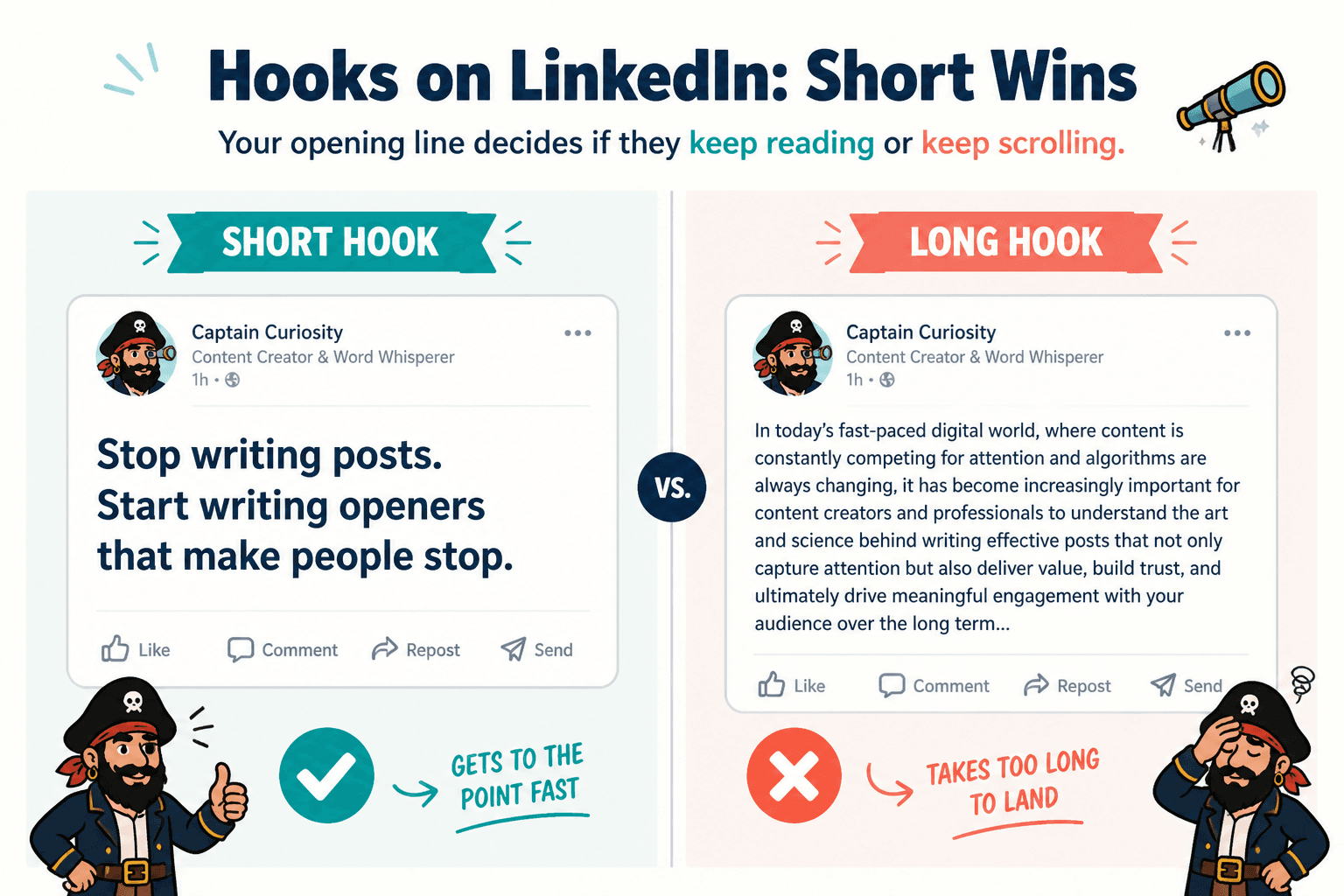
- Your LinkedIn posts are not too short. They are too vague.
- Most consultants do not need better content. They need better positioning.
- This post got leads with 63 words.
- The hook was fine. The formatting killed it.
These are short, but they are not empty. They point somewhere. That is the whole job.
Compare that with the kind of longer hook people write when they are trying very hard to sound thoughtful:
I used to think writing on LinkedIn was mostly about consistency and showing up, but after reflecting on the posts that performed best for me over the last few months, I realized there was something much deeper happening around how ideas are structured and presented.
That is a warm bath of nothing. It takes forever to arrive at a point, and most readers will not wait around for the reveal.
If you want more tactical help on that front, this guide on how to write better LinkedIn hooks and formatting pairs well with this one.
When short LinkedIn hooks & formatting beat long ones
Short usually wins in a few specific situations. If you know these, you stop stuffing every post with setup and start matching the structure to the idea.
1. When the idea is already simple
If your core point can be understood in one sentence, your hook should not need four.
Example:
- Simple idea: Most people bury their best insight in line six.
- Better short hook: Your best line should not be hiding in paragraph two.
Dragging out a simple point does not make it richer. It just makes the reader work harder to find it.
2. When the reader already knows the context
You do not need a long runway for familiar topics. If your audience already understands the world you are talking about, skip the orientation speech.
For example, if you write for consultants about LinkedIn content, you do not need to begin with a mini essay about how attention is competitive online. They know. We all know. Move on.
Short hooks do better when they assume a baseline of reader awareness and get straight to the useful angle.
3. When you are making one clear argument
Short formatting shines when your post is built around a single punchy claim.
Example structure:
- Sharp opening line
- Quick explanation
- One example or proof point
- Simple takeaway or CTA
That kind of post does not need a dramatic intro, three side notes, and a philosophical ending. It needs spine.
4. When scannability matters more than nuance
Some posts are for depth. Others are for stopping the scroll, landing a useful point, and earning enough trust for someone to check your profile or read more later.
If the goal is quick attention and clean retention, shorter blocks of text usually help. Not because readers are incapable of reading. Because they are evaluating whether your post deserves reading at all.
5. When your formatting is doing half the work
Formatting is not decoration. It controls pace.
A short hook plus clean line breaks can create momentum fast. A long hook plus dense formatting can make even a decent idea feel heavy. People often blame the hook when the real issue is that the post looks annoying to read.
And yes, giant walls of text still lose people. This is not controversial. It is just apparently easy to forget when someone gets emotional near the keyboard.
What short formatting does better than long formatting
Short formatting is not just “use fewer words.” It is about visual ease, reading rhythm, and controlling how the post unfolds.
Done well, it gives your post three advantages.
It lowers the effort to start reading
The first job of formatting is making the post feel readable. If the opening looks dense, overly dramatic, or strangely chopped up, readers bounce before they even judge the idea.
Good short formatting often means:
- 1 to 3 sentence paragraphs
- Clean line breaks around important points
- No giant blocks unless the story truly earns them
- No fake suspense spacing every single sentence
It makes key lines easier to notice
A strong line buried inside a cluttered post gets wasted. Shorter formatting gives important phrases room.
For example, this lands better:
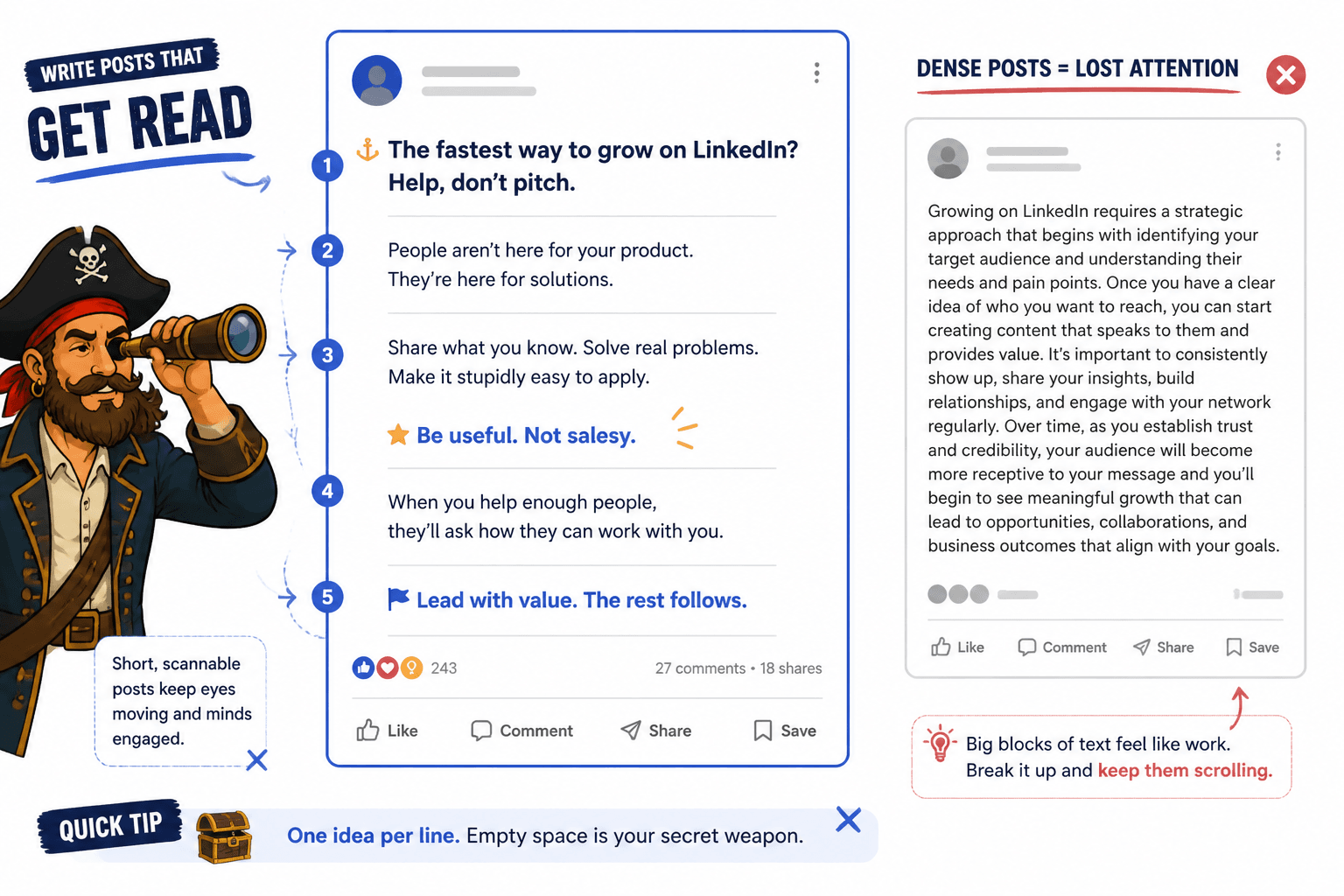
Your hook is not weak because it is short.
It is weak because it says nothing.
Than this:
Your hook is not necessarily weak because it is short, but in many cases it can feel weak when the brevity causes the writer to strip out the meaningful detail, whereas the real issue is often that it does not actually say anything memorable or useful.
Same idea. One has shape. One has administrative overhead.
It keeps momentum alive
LinkedIn posts often die from drag. Too much setup. Too much repeating. Too many lines that are technically fine but emotionally skippable.
Short formatting keeps the reader moving. That matters because once momentum breaks, people leave. They do not announce it. They just vanish.
If you want more examples of formats that hold attention, see these LinkedIn hooks and formatting ideas and examples for creators.
When longer hooks and formatting still make sense
Short is not automatically better. It is just easier to execute well when the idea supports it.
Longer hooks or expanded formatting can work when:
- You are telling a story with actual tension
- You need context before the point makes sense
- You are handling a nuanced argument that would feel sloppy if compressed
- You have proof, specifics, or examples worth staying for
- Your audience expects depth and you can maintain pace
The issue is not length. It is unnecessary length.
A longer hook earns its place when every line increases interest, clarity, or tension. If the first four lines could disappear without hurting the post, they should.
This is where a lot of people get trapped. They think they are being thoughtful, but really they are throat-clearing in public.
If you are unsure how much is too much, this related piece on how long LinkedIn hooks and formatting should be can help you calibrate.
How to tell if your hook should be shorter
Use this quick test. Your hook probably needs trimming if it does any of the following:
- Takes more than two lines to reveal the point
- Starts with reflection instead of relevance
- Uses vague setup like “I have been thinking a lot about…”
- Sounds polished but says little
- Needs the reader’s patience before it earns their attention
Here are a few before-and-after rewrites.
Rewrite 1
Before: Over the past few months, I have spent a lot of time analyzing why certain LinkedIn posts seem to perform better than others, and I think one of the biggest reasons comes down to how they are opened.
After: Most LinkedIn posts lose attention in the first line.
The second version gets to the thing. Fast.
Rewrite 2
Before: I used to believe that longer posts were always more valuable because they gave me more room to explain the nuance behind my ideas, but lately I have started to see that shorter formats can sometimes create more impact.
After: More words do not make a post more valuable.
Cleaner. Stronger. Much less desperate to be admired for having thoughts.
Rewrite 3
Before: There is something important that many creators and professionals may not fully understand when it comes to formatting their LinkedIn posts for better readability and engagement.
After: Bad formatting kills good LinkedIn posts.
You can find more examples like this in how to rewrite boring LinkedIn hooks and formatting.
A practical structure for sharper short LinkedIn posts
If you want short posts that do not feel flimsy, use this structure:
- Hook: one sharp line
- Point: explain what you mean in one to three lines
- Proof: example, observation, result, or contrast
- Takeaway: what the reader should understand or do next
- CTA: optional, light, and relevant
Example:
Your hook is not the place to warm up.
It is the place to make the reader care.
If your first line needs three more lines to become interesting, it is not a hook. It is a preamble.
Tighten the opening. Then earn the longer explanation below it.
That structure works because each part does a job. Nothing is there just to sound “content-ish.”
Common mistakes people make when trying to go shorter
Plenty of people hear “shorter is better” and immediately ruin their posts in new ways. Efficient.
They confuse short with vague
The bigger point is simple: clearer structure and clearer writing make the piece more useful. That is usually what makes the ending land better too.
The bigger point is simple: clearer structure and clearer writing make the piece more useful. That is usually what makes the ending land better too.