Most LinkedIn posts do not flop because the insight is bad. They flop because the first line is sleepy, vague, or trying way too hard to sound important.
If you are a busy creator, you do not need 47 complicated hook formulas and a sacred posting ritual involving coffee, metrics, and mild panic. You need a small set of first-line hooks that are fast to use, easy to adapt, and strong enough to earn the next line.
That is what this article is for. These simple LinkedIn first-line hook templates for busy creators will help you write sharper openings, format them properly, and stop leading with lines that politely ask to be ignored.
If you want a broader foundation first, it helps to read the main LinkedIn hooks and formatting guide alongside this. And if you want more platform-specific writing help beyond LinkedIn, the wider social media writing section is worth bookmarking, awkward URL and all.
To see how this fits into the wider strategy, open the parent guide.
What a LinkedIn first line actually needs to do
A first line does not need to be clever. It does not need to be dramatic. It definitely does not need to sound like a rejected keynote opener.
It needs to do one of these things quickly:
- Make a relevant promise
- Name a problem the right people recognize
- Create useful curiosity
- Deliver a sharp opinion
- Show contrast
- Signal that something practical is coming
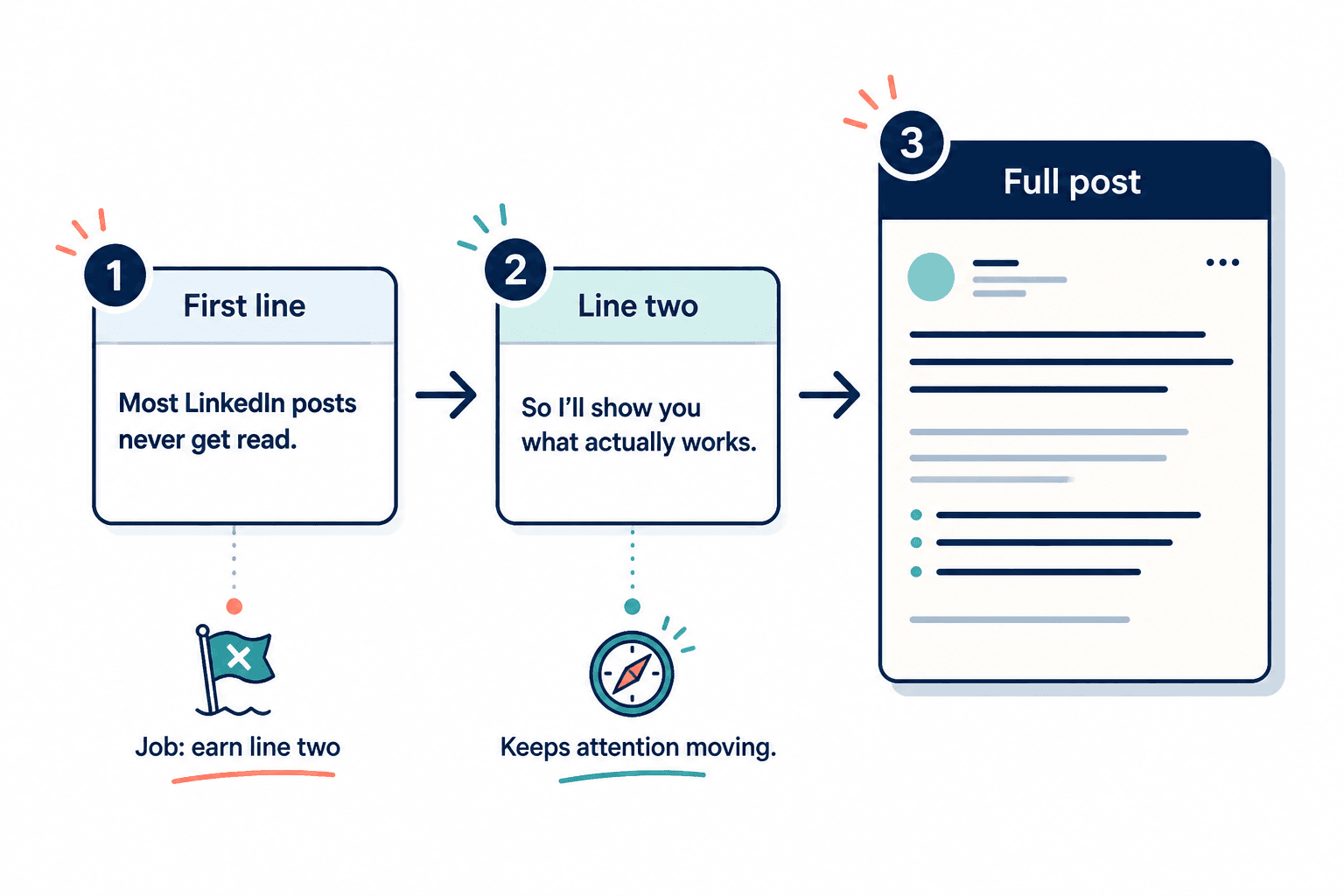
That is it. The job of the first line is not to win an award. The job is to earn line two.
Busy creators often overcomplicate this because they think the hook has to carry the whole post. It does not. It just has to open the door. The rest of the post still needs a point, some structure, and a reason to exist. But if the first line is weak, most people never meet the good part.
Why most LinkedIn hooks fail
Bad hooks usually fail in one of four ways.
- They are too vague: “A few thoughts on personal branding.”
- They are too familiar: “Here’s what nobody tells you about success.”
- They are too self-centered: “I’m excited to share…”
- They are too padded: “Over the last few years, I’ve been reflecting deeply on…”
None of those lines gives the reader a real reason to stop. They are not specific, useful, or tense enough. They sound like throat-clearing. LinkedIn has plenty of that already.
If your opening could be swapped into a hundred other posts without anyone noticing, it is probably too generic. Strong hooks feel attached to a real idea. Weak hooks feel factory-made.
7 simple LinkedIn first-line hook templates for busy creators
These are not magic. They are practical. Use them as starting points, not copy-paste wallpaper.
1. The blunt problem hook
Best when your audience is making a common mistake and you want to get straight to it.
[Audience] are still [doing wrong thing] and it is killing [result].
Examples:
- Coaches are still writing LinkedIn posts like mini brochures, and it is killing replies.
- Most consultants are burying their best idea in line six.
- Creators keep posting “valuable content” that says absolutely nothing specific.
Why it works: it names a mistake fast and creates tension without fake drama.
2. The sharp opinion hook
Best when you have a clear point of view and enough substance to back it up.
[Common belief] is overrated.
You do not need [popular thing] to get [result].
Examples:
- “Just be authentic” is terrible LinkedIn advice.
- You do not need longer posts to sound smarter.
- Polished writing is overrated if your idea has no edge.
This one works because contrast creates curiosity. Just make sure the post earns the opinion. A hot take with no substance is just content cosplay.
3. The useful promise hook
Best when the post is tactical and you want the reader to know exactly what they are getting.
Use this if you want to [specific result] without [annoying downside].
A simple way to [result]:
Examples:
- Use this if you want your LinkedIn posts to sound sharper without sounding try-hard.
- A simple way to write stronger post openings:
- Use this format if your posts are useful but still getting polite silence.
This works well for busy creators because it gets to the point. No mystery novel intro required.
4. The “stop doing this” hook
Best when your audience needs a correction more than inspiration.
Stop [common behavior].
Please stop writing [type of bad content].
Examples:
- Stop opening LinkedIn posts with “I’m humbled to announce.”
- Please stop writing first lines that sound like workshop leftovers.
- Stop trying to sound wise before you say something useful.
Used well, this feels crisp. Used badly, it feels smug. So back it up with a practical fix, not just a public sigh.
5. The contrast hook
Best when the post explains the difference between what people assume works and what actually works.
[Thing people think matters] matters less than [thing that actually matters].
The problem is not [obvious thing]. It is [real thing].
Examples:
- Your LinkedIn post does not need better formatting first. It needs a clearer point.
- The problem is not that your hook is too short. It is that it says nothing.
- Consistency matters less than recognizability for most small creators.
Contrast is strong because it creates a little mental friction. The reader thinks, hang on, is that true? Then they keep reading.
6. The mini-proof hook
Best when you have a real result, observation, or pattern to share without turning the post into a humblebrag parade.
After [doing thing] for [time or volume], here is what keeps working:
I reviewed [number] of [thing], and the same problem kept showing up:
Examples:
- I reviewed 50 creator bios, and the same problem kept showing up:
- After writing LinkedIn posts for busy experts, here is what keeps working:
- I rewrote three post openings this morning. All three had the same issue.
This works because it signals experience and usefulness without chest-thumping. It says, I have seen this enough times to be worth hearing.
7. The direct-reader hook
Best when you know exactly who the post is for.
If you are a [specific audience] and your [content/result] feels [pain point], read this.
Examples:
- If you are a consultant whose LinkedIn posts sound smart but go nowhere, read this.
- If you are a creator with no time for fancy content systems, use this hook formula.
- If you are posting regularly and still not attracting the right clients, start here.
This one filters the audience on purpose. Good. Not every post should be for everybody. That is how you end up sounding like office oatmeal.
How to format first-line hooks so people actually read them
Formatting will not save a bad hook, but it can absolutely help a good one land.
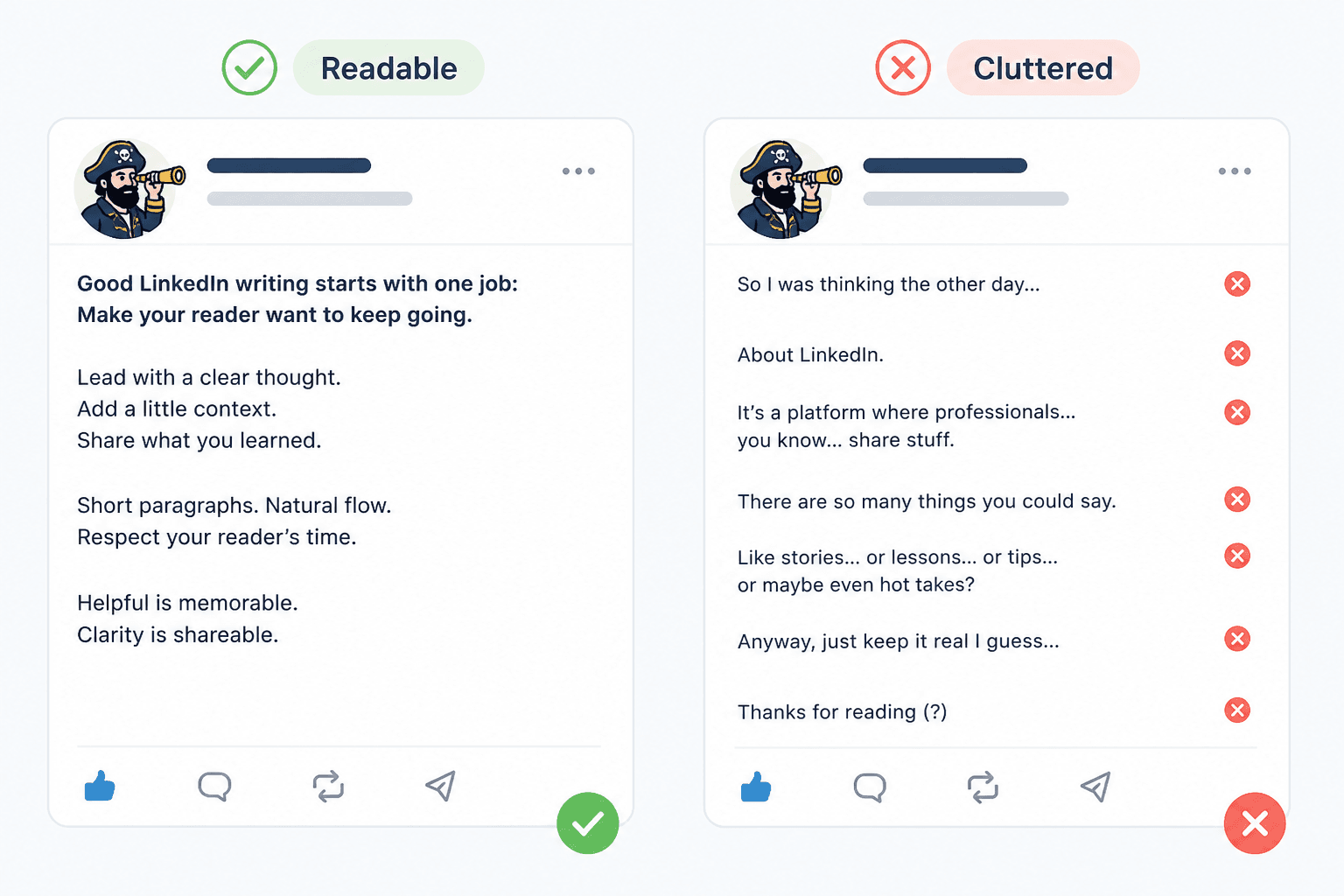
On LinkedIn, the first line should feel clean, readable, and complete. Not bloated. Not broken into five tiny fragments for no reason. Not padded with emojis trying to direct traffic.
Do this
- Keep the first line punchy and self-contained
- Use plain language
- Make one idea obvious immediately
- Use line breaks in the body to keep the post scannable
- Follow the hook with a second line that deepens the tension or promise
Not this
- Breaking every three words onto a new line
- Opening with a vague emotional teaser
- Stuffing the first line with multiple ideas
- Using “…” as a personality trait
- Writing a hook that only makes sense after six more lines
A lot of creators confuse dramatic spacing with strong writing. They are not the same thing. If your hook only feels interesting because it is dangling over six empty line breaks, it probably is not interesting enough yet.
For more examples of what strong formatting looks like in practice, see these LinkedIn hooks and formatting ideas and examples and these scroll-stopper examples creators can adapt fast.
Before-and-after hook rewrites
Sometimes the fastest way to improve is to see what changed.
| Weak first line | Stronger rewrite |
|---|---|
| I wanted to share a few thoughts on LinkedIn content. | Most LinkedIn content is not underperforming because of the algorithm. |
| Here’s what nobody tells you about building a personal brand. | Personal branding advice gets weird fast when nobody defines the audience. |
| I’m excited to announce a new framework I’ve been using. | A simple framework for writing faster LinkedIn posts: |
| Over the years, I’ve learned many lessons about writing online. | Writing online gets easier when you stop opening with context nobody asked for. |
| Authenticity matters more than ever. | “Be authentic” is lazy advice if you still sound generic. |
Notice what improves in the rewrites:
- The point appears faster
- The wording is more specific
- The reader gets tension or payoff immediately
- The line sounds like a real opinion, not a workshop handout
A quick 10-minute workflow for busy creators
If you do not have time to “craft magnetic hooks” every day, good. You do not need to. Use a simple process instead.
- Write the real point of the post in one sentence.
What are you actually trying to say? - Choose the best hook type.
Problem, opinion, promise, contrast, correction, proof, or direct-reader. - Draft 3 first lines.
Do not overthink. Just write three variations fast. - Cut the vaguest one.
If it could fit any post, delete it. - Pick the line with the clearest tension or payoff.
- Write a second line that supports it.
The second line should add context, not restart the post. - Format the rest for readability.
Short paragraphs. Clean spacing. No dramatic wheezing.
This takes less time than staring at the blinking cursor while trying to invent genius on command. Systems beat mood. Annoying, but true.
Simple plug-and-play hook templates by post type
Different posts need different openings. A lesson post does not need the same first line as a client-attracting opinion post.
The bigger point is simple: clearer structure and clearer writing make the piece more useful. That is usually what makes the ending land better too.