
Most LinkedIn posts do not flop because the writer lacks expertise. They flop because the first line is weak, the formatting is annoying, and the whole thing reads like it was approved by a committee that hates clarity.
That is the real job of hooks and formatting on LinkedIn. Not to be clever for five seconds. Not to manufacture fake suspense. Not to make every line look like it is hyperventilating. The job is to get the right person to start reading, keep reading, and actually understand your point before their attention wanders off to somebody posting “10 lessons from running a marathon and a startup.”
This LinkedIn Hooks & Formatting Guide for Creators Who Want Better Results will help you write first lines that earn attention without sounding gimmicky, format posts so they are easier to read, and avoid the very common habits that make smart people look weirdly robotic online. If your posts are useful but underperforming, the packaging is probably the problem.
And yes, packaging matters. Great ideas hidden inside dull openings and messy formatting do not get bonus points for purity.
To see how this fits into the wider strategy, open the parent guide.
Why LinkedIn hooks matter more than most people think
People like to say “just write good content.” Lovely sentiment. Useless in practice.
On LinkedIn, your first line does three jobs fast:
- It tells the reader what kind of post this is
- It signals whether the post is worth their attention
- It creates enough tension, relevance, or clarity to earn the next line
If that first line is vague, generic, self-congratulatory, or padded with throat-clearing, the rest of the post barely matters. People do not politely continue because your third paragraph gets better. They leave.
A strong hook does not need to be dramatic. It needs to be clear, specific, and connected to something your reader actually cares about.
Most bad hooks do not fail because they are too short. They fail because they say absolutely nothing with confidence.
If you want a broader foundation for platform-specific writing, it also helps to explore the wider social media writing guidance and the full LinkedIn hooks and formatting hub, especially if you are building a repeatable posting system rather than fixing one post at a time.

What a strong LinkedIn hook actually does
A good hook usually does one of these things well:
- Calls out a painful mistake: “Your LinkedIn posts are probably too polished to feel trustworthy.”
- Names a useful tension: “The more expert you are, the easier it is to write unreadable posts.”
- Promises a practical payoff: “Three formatting fixes made my posts easier to read in under five minutes.”
- Challenges lazy advice: “You do not need a stronger personal brand. You need clearer first lines.”
- Uses specific contrast: “I stopped writing thoughtful LinkedIn posts. I started writing readable ones.”
Notice what these are not doing. They are not teasing with fake mystery. They are not saying “here’s what nobody tells you.” They are not warming up for six lines before making a point. They get to it.
The best hooks usually combine three ingredients
- Relevance: this is about something the reader already wants to improve
- Specificity: it points to a concrete problem, shift, or result
- Tension: it creates enough contrast or friction to make the next line feel earned
You do not need all three at maximum volume. In fact, that is where people get corny. You just need enough of each to make the post feel alive.
The LinkedIn hooks that usually underperform
Here are some of the first-line habits that quietly kill good posts.
1. The fake wisdom opener
Weak: “Success is not about working harder. It is about working smarter.”
This says nothing. It sounds like a motivational poster trying to invoice someone.
Stronger: “Most consultants do not need more content. They need content that makes their expertise easier to trust.”
2. The vague confession opener
Weak: “I used to think LinkedIn was all about consistency.”
Used badly, this structure sounds borrowed. It creates weak tension because the audience has seen it a thousand times.
Stronger: “I posted consistently for months. The posts improved only when I stopped hiding the point in paragraph four.”
3. The announcement opener
Weak: “I’m excited to announce that I’ve launched my new newsletter.”
You may be excited. The reader is not there yet.
Stronger: “Most newsletters fail before issue three because the writer has no clear content promise.”
4. The abstract opener
Weak: “Authenticity matters more than ever.”
“More than ever” is one of those phrases that should really be made to explain itself.
Stronger: “On LinkedIn, polished writing often gets polite approval and zero trust.”
5. The dramatic bait opener
Weak: “I nearly quit content forever.”
If the rest of the post is about low impressions for a week, people feel manipulated. Fair enough.
Stronger: “My content problem was not motivation. It was that every post sounded professionally edible and instantly forgettable.”
How to write better LinkedIn first-line hooks
If you want a reliable method, stop trying to write a “good hook.” Start by identifying the sharpest part of your point.
Ask:
- What is the real problem here?
- What does the reader keep getting wrong?
- What belief am I challenging?
- What practical payoff can I promise honestly?
- What specific tension makes this interesting?
Then build the first line around that, not around a generic content pattern you copied from someone posting daily productivity sermons.
Five reliable hook formats
These work because they create clarity and tension without sounding cheap.
- The mistake hook: “Most LinkedIn posts fail in the first line, not the final CTA.”
- The contrast hook: “Readable posts beat impressive posts more often than people want to admit.”
- The proof-led hook: “The simplest formatting change I made doubled how many people actually read to the end.”
- The opinion hook: “If your LinkedIn post needs eight lines to become interesting, it probably is not.”
- The how-to hook: “Here is how to make a LinkedIn post easier to read in under three minutes.”
A simple hook-building formula
Use this when your brain goes blank:
[Audience problem] + [unexpected truth] + [specific angle]
For example:
- “Creators do not usually struggle because they lack ideas. They struggle because the first line buries the useful part.”
- “Consultants are often one rewrite away from a much better LinkedIn post, but they keep polishing the wrong sentence.”
- “If your content is useful but gets ignored, the issue may be formatting, not expertise.”
If you want more ready-to-use structures, a companion piece on simple LinkedIn first-line hook templates for busy creators is worth bookmarking.
Formatting rules that make LinkedIn posts easier to read
Good formatting does not rescue a bad idea. But bad formatting can absolutely sabotage a good one.
LinkedIn formatting should reduce friction. That is it. Your post should feel easy to enter, easy to scan, and easy to follow.
Use short paragraphs
On LinkedIn, giant blocks of text feel heavier than they are. Most creators do better with one to three sentences per paragraph, often just one.
This does not mean every sentence deserves its own lonely line. It means visual density matters. Readers need breathing room.
Break on meaning, not randomly
Some people format like this:
I had a realization.
About content.
And business.
And life.
Please do not.
Line breaks should support rhythm and emphasis. They should not make the post feel like it is climbing stairs in dress shoes.
A better approach is to break when:
- You are shifting to a new point
- You want to emphasize a key sentence
- You are moving from problem to example
- You are introducing a list or takeaway
Front-load the point
LinkedIn rewards posts that get somewhere quickly. Do not spend six lines warming up. If your insight is “most expert content is too abstract to convert,” say that early. Then support it.
Writers often hide their best line because they are trying to sound thoughtful. In practice, that usually makes them sound hesitant.
Use lists when they help, not as a personality
Bullets and numbered points are useful when the idea actually has parts, steps, or examples. They are not required in every post. Some points land better as a short argument or a compact story.
This matters because LinkedIn writing gets painfully formulaic when every post becomes:
- Hook
- Mini story
- Three lessons
- CTA asking strangers to agree
That structure is not evil. It is just wildly overused.
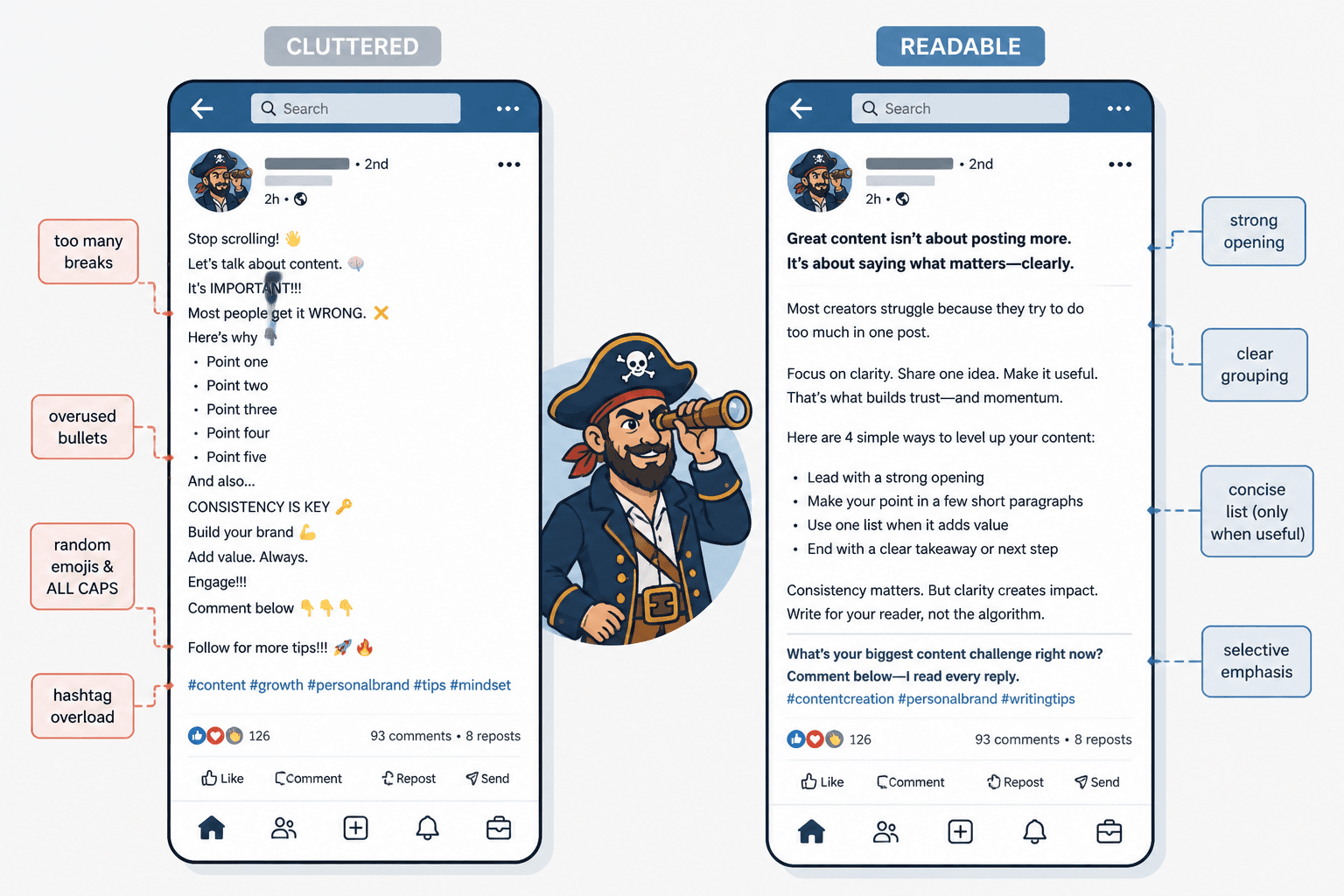
Keep emphasis rare
Too much emphasis kills emphasis.
If every line is short, dramatic, isolated, and “powerful,” none of it lands. Same goes for overusing emojis, all caps, or constant one-line paragraph punches. Use contrast with restraint.
Before-and-after examples of LinkedIn hooks and formatting
Here is where the difference becomes obvious.
Example 1: Generic expertise post
Before
Over the years, I have learned many valuable lessons about content creation and personal branding.
One of the biggest things I have learned is that consistency and authenticity are incredibly important.
Here are three lessons I think everyone should know.
After
Most “authentic” LinkedIn content is still too vague to build trust.
Being real is not the same as being clear.
If readers cannot tell what you do, who you help, or why your advice works, the post may feel personal but it still will not convert.
Three ways to fix that:
- Name the specific audience
- Use one concrete example
- State the practical takeaway before the reader gets bored
Why the rewrite works: it starts with tension, clarifies the point fast, and gives the list a reason to exist.
Example 2: Overly polished founder post
Before
I’m excited to share a reflection from my journey as a founder.
Building a business has taught me that resilience, leadership, and vision matter more than ever.
After
Founders often confuse polished updates with persuasive content.
Your network does not need another vague reflection about resilience.
They need a sharp lesson, a clear point of view, or a useful behind-the-scenes detail they can actually apply.
Why the rewrite works: it says something readers can disagree with, understand, and use.
Example 3: Better formatting without changing the core idea
Before
Writing on LinkedIn can be challenging for many creators because there is a lot of pressure to be insightful, professional, and consistent, which often leads to overthinking, and overthinking tends to create posts that are less clear and less engaging than they could be if the writer had simply focused on making one useful point in a readable format.
After
LinkedIn gets harder the moment you try to sound impressive.
Creators overthink the tone.
Then they overpack the post.
Then the whole thing becomes harder to read than it needed to be.
A simpler goal works better:
- Make one useful point
- Say it early
- Format it so a busy person can actually finish it
Same idea. Much better delivery.
If you want more swipes and rewrites, see best LinkedIn hooks and formatting ideas and examples for creators.
How to match formatting to the kind of LinkedIn post you are writing
Not every post needs the same shape. This is where a lot of creators get stiff. They find one template that worked once, then force every idea through it like it is a legal requirement.
For opinion posts
- Lead with the opinion clearly
- Use short paragraphs
- Add one or two supporting examples
- End with a clean takeaway or question
These work best when they are sharp, not bloated.
For educational posts
- Hook with the problem or mistake
- Use a list, steps, or a mini framework
- Keep the examples concrete
- Finish with a practical next move
This format suits creators, coaches, and consultants especially well because it turns expertise into something immediately useful.
For story-based posts
- Start with the tension, not your life story
- Keep chronology under control
- Move to the lesson before patience runs out
- Avoid fake vulnerability written purely for reach
A good story post earns the lesson. A bad one is just a diary entry wearing a CTA.
For proof posts
- Lead with the result or useful finding
- Show the method briefly
- Explain why it worked
- Keep the bragging level low enough to remain tolerable
Proof builds trust when it helps the reader think better, not when it is just a polished humblebrag.
Common LinkedIn formatting mistakes creators should stop making
- Burying the point: the key takeaway arrives too late
- Formatting every sentence separately: reads like drama, not clarity
- Writing giant text blocks: visually exhausting on mobile
- Using empty hooks: curiosity with no actual substance
- Stacking clichés: authenticity, consistency, value, mindset, growth
- Copying influencer cadence: sounds borrowed because it is
- Ending with weak engagement bait: “Thoughts?” is not a strategy
One of the easiest improvements you can make is to read your draft and delete the first two lines if they only exist to “set up” the point. In many cases, your real opening is line three.
Another good test: if you can swap your first line into ten other posts and it still fits, it is too generic.
A quick editing checklist for stronger LinkedIn hooks and formatting
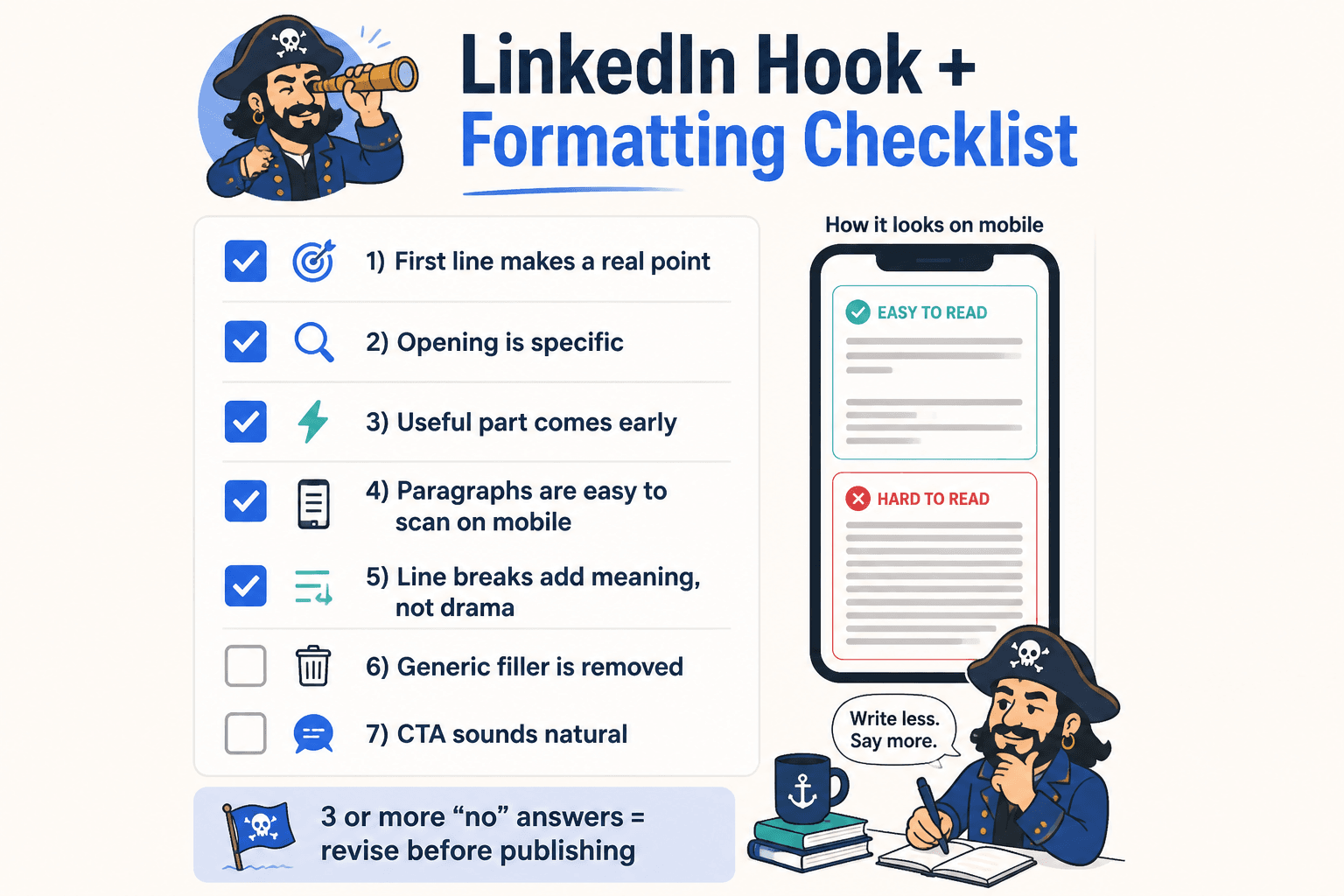
Before you publish, check this:
- Does the first line make a real point, not just start a topic?
- Is the opening specific enough to attract the right reader?
- Did you get to the useful part early?
- Are the paragraphs easy to scan on mobile?
- Did you break lines for meaning instead of theatrics?
- Did you remove generic phrases and abstract filler?
- Does the CTA sound natural instead of needy?
If the answer to three or more is no, the post probably needs another pass.
What creators with small audiences should do differently
If your audience is still small, this matters even more.
Big creators can get away with weaker hooks because people already know them. Small creators do not have that luxury. Your first line and formatting have to do more work because you are still earning attention from scratch.
That does not mean becoming louder, more dramatic, or more “controversial.” It means becoming more specific and more readable.
For smaller audiences, good LinkedIn hooks usually work best when they:
- Target a clear problem for a clear type of person
- Sound useful immediately
- Avoid vague personal-brand fluff
- Use proof, examples, or practical detail
- Invite trust before asking for action
The bigger point is simple: clearer structure and clearer writing make the piece more useful. That is usually what makes the ending land better too.