
Most creator email sequences sound bad for one of two reasons: they either try too hard to sell, or they try so hard not to sell that they become a fog machine of “just checking in” nothingness.
That is the real problem behind How to Write Creator Email Sequences Without Sounding Salesy or Robotic. It is not just about tone. It is about structure, intent, and knowing how to move someone forward without sounding like a checkout page learned to type.
If your emails feel stiff, over-polished, weirdly needy, or like they were assembled from funnel scraps in 2019, you do not need more “high-converting swipe copy.” You need a better way to write like a person with a brain, a point of view, and something worth offering.
Here’s how to build creator email sequences that feel human, earn trust, and still lead somewhere useful.
If you want the bigger picture, start with the parent guide.
Why creator email sequences go bad so fast
Email sequences usually get robotic when the writer is copying a format instead of communicating a thought.
You can see it instantly. The subject line is fake-curious. The opening is stiff. The email says “I wanted to reach out” like a nervous intern. Then somewhere around paragraph three, the whole thing lurches into a pitch that clearly arrived in a different Uber.
And the salesy version is not much better. It overuses urgency, overexplains the offer, and treats trust like a speed bump. Every email feels like it is trying to close the deal before the reader even remembers signing up.
The fix is not “be more authentic.” That advice has ruined enough inboxes already.
The fix is to make each email do one job, sound like a person, and create momentum instead of pressure.
What a good creator email sequence actually does
A strong sequence does not just “nurture leads.” That phrase has been drained of meaning.
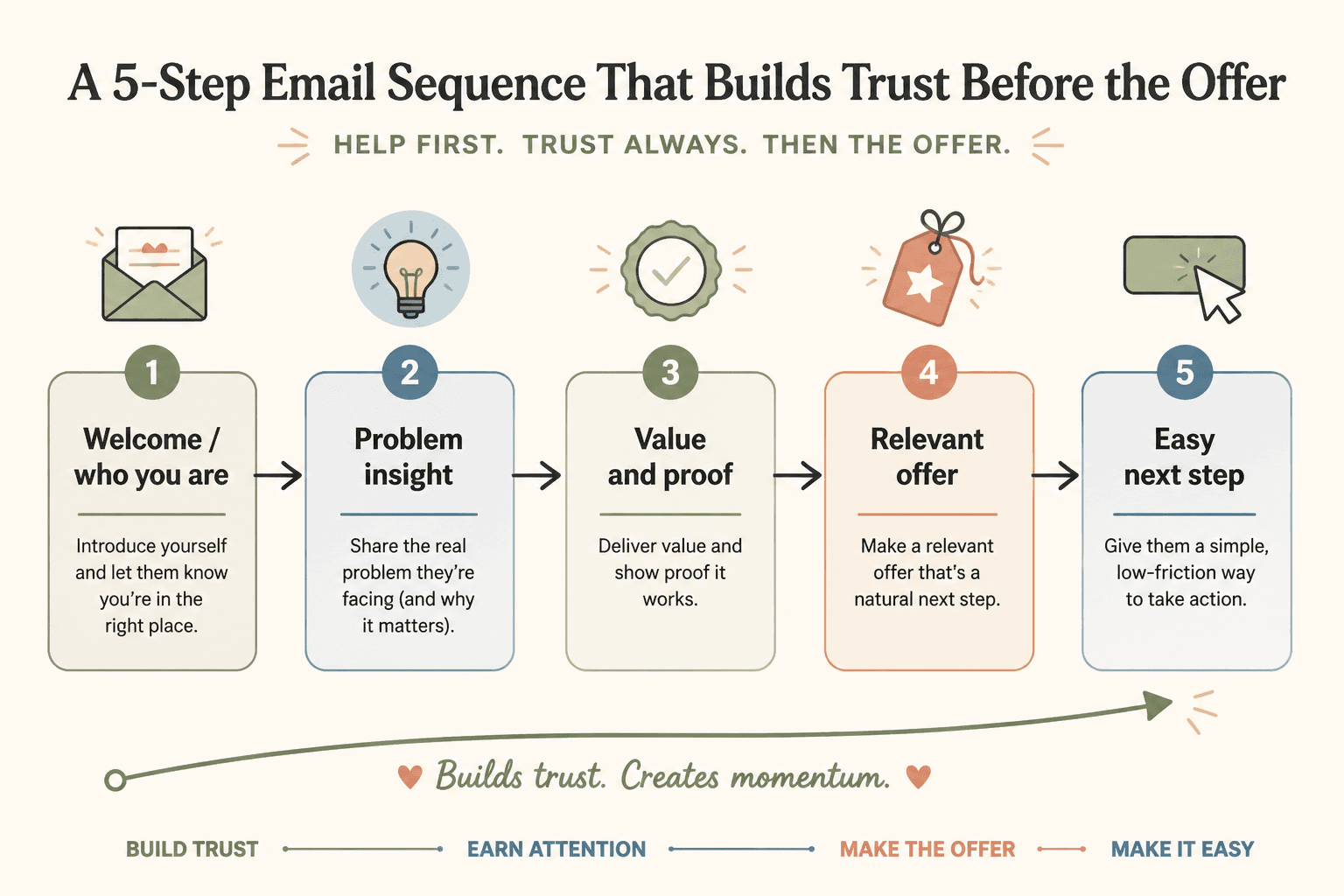
A good sequence helps a reader move through a few simple stages:
- Understand who you are and what you help with
- Care about the problem you solve
- Trust your thinking
- See your offer as relevant, not random
- Take a next step without feeling cornered
That is it. Not magic. Not persuasion theater. Just a clear path.
If you want a broader foundation for planning sequence structure, it helps to start with the core ideas in email newsletter writing, then go deeper into creator email systems and creator email sequences.
Start with sequence intent, not email count
One of the easiest ways to make a sequence robotic is to start by asking, “Should this be five emails or seven?”
That is the wrong first question. Length is a delivery detail. Intent comes first.
Before you write anything, decide:
- Who is this sequence for?
- Why did they join?
- What problem or desire brought them in?
- What do they need to understand before they are ready for the next step?
- What is the next step?
If someone downloaded a free content planner, they do not need the same sequence as someone joined a waitlist for coaching. Different entry points create different expectations. Ignore that, and your emails immediately start sounding generic.
A sequence should feel like a continuation of the moment that got the subscriber there in the first place.
A simple sequence planning framework
- Email 1: Deliver the thing and set the tone
- Email 2: Clarify the problem or opportunity
- Email 3: Teach something useful and specific
- Email 4: Show proof, perspective, or contrast
- Email 5: Present the next step naturally
- Email 6+: Handle objections, deepen trust, or reframe the offer
You do not need all of these every time. But you do need progression.
Write each email like it has one clear job
Bad sequences often try to do four things at once. Deliver value. Tell a story. Build authority. Make an offer. Handle objections. Be warm. Be persuasive. Be charming. Be concise. By the end, the email says everything and lands nowhere.
One email, one main job. That simple rule makes your writing cleaner fast.
Examples:
- If the job is welcome, stop overselling and orient the reader.
- If the job is teaching, do not bury the lesson under your life story.
- If the job is reframing a problem, make the argument clearly.
- If the job is making an offer, stop pretending the email is “just one quick tip.”
Readers can feel when an email knows what it is trying to do. They can also feel when it is wandering around in loafers, hoping conversion will happen by accident.
How to sound human instead of robotic
Robotic writing usually is not caused by automation. It is caused by distance. The writer is standing too far away from the reader, using “professional” language that no actual person would say out loud.
To sound more human, do these things:
- Use the words your audience actually uses
- Write like you are explaining something clearly, not performing expertise
- Prefer specific observations over polished abstractions
- Cut filler phrases that add formality without meaning
- Let some sentences be short and direct
Here are a few common robotic lines and better rewrites.
| Robotic version | Better version |
|---|---|
| I wanted to reach out and share a few insights with you today. | I want to show you the mistake that is making this harder than it needs to be. |
| As you may know, consistency is important in content creation. | Most people do not need more consistency first. They need a clearer angle. |
| I am excited to announce that enrollment is now open. | Enrollment is open. If you want help fixing this with me, here’s what it looks like. |
| This offer is designed to help entrepreneurs unlock growth. | This is for creators who are getting attention but not enough replies, leads, or sales from it. |
The point is not to become casual for the sake of it. The point is to become readable.
How to sell in email without sounding salesy
People sound salesy when they push before they have earned relevance.
A clean pitch inside a trusted sequence rarely feels offensive. A clumsy pitch dropped into an undercooked sequence feels gross immediately. Same offer. Different timing and framing.
To make your emails sell without getting weird about it:
- Talk about the reader’s situation before your offer
- Show why the problem matters now
- Make your offer feel like a logical next step, not a plot twist
- Use plain language instead of hype language
- Be direct about what the offer is and who it is for
- Do not fake urgency if there is none
There is nothing wrong with selling. The problem is when the email suddenly shifts into infomercial mode and starts shouting benefits like it is trying to win an auction.
A simple sales email shape that still sounds normal
- Open with a problem, pattern, or question the reader recognizes
- Explain what is usually going wrong
- Offer a useful insight or reframe
- Introduce your offer as the practical next step
- Tell them what to do next, clearly
Example:
A lot of creators do not have an email problem. They have a trust and clarity problem. Their sequence sounds fine, but it does not move anyone closer to action.
That is exactly what I help fix inside [offer]. We tighten the message, clean up the structure, and turn the sequence into something that actually leads somewhere.
If that is the part you are stuck on, you can check it out here.
That sells. It just does not put on a fake mustache and call itself “value-first nurturing.”
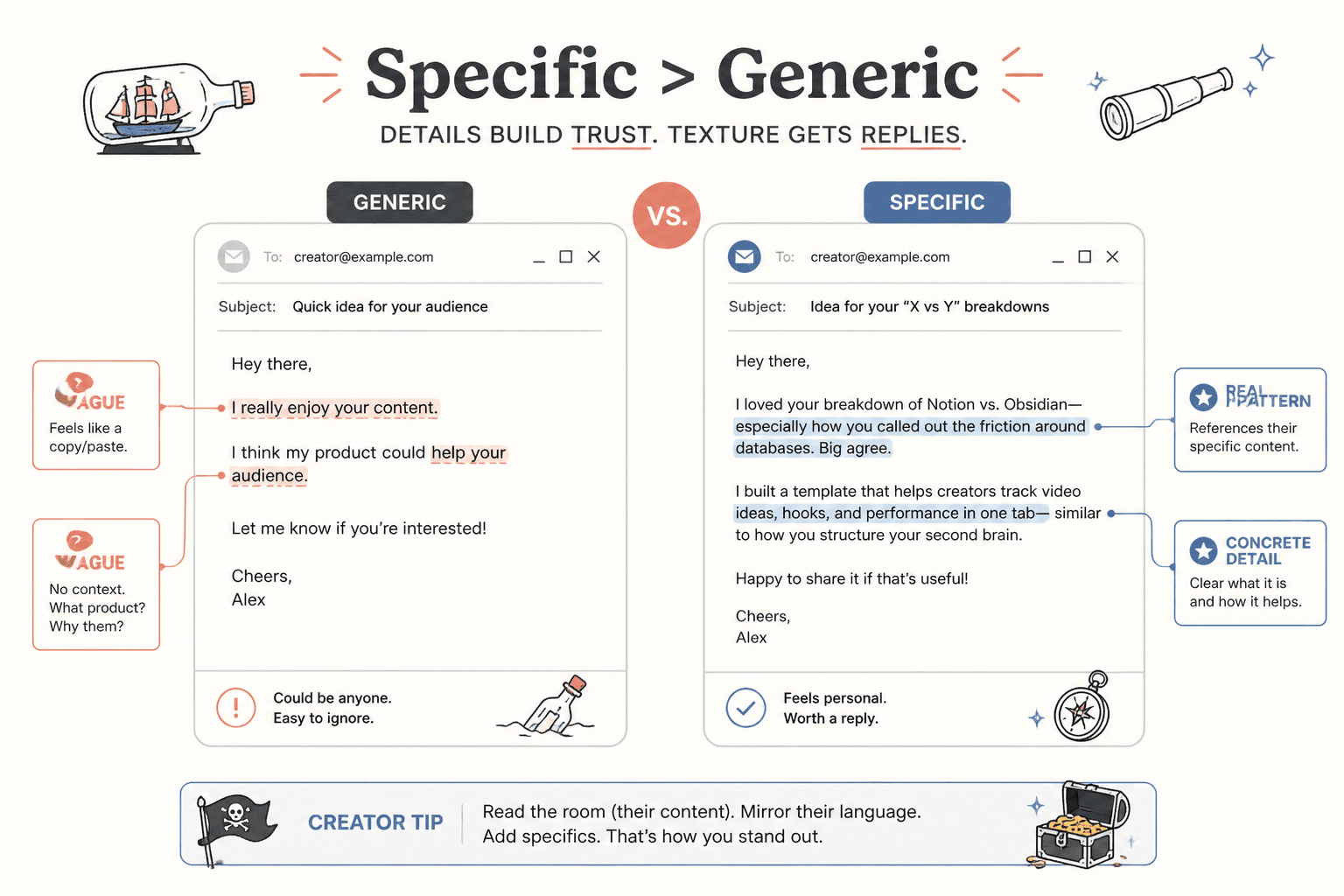
Use specificity or prepare to sound generic
Generic email writing is one of the fastest roads to robotic email writing.
When you say things like “grow your business,” “connect with your audience,” or “show up consistently,” the reader has to do too much interpretation work. Those phrases are not wrong. They are just mushy.
Specificity gives your emails texture and credibility. It makes your writing feel observed instead of assembled.
Compare these:
- Generic: Many creators struggle with email marketing.
- Specific: A lot of creators can write a solid newsletter, then completely lose the plot when they try to build a welcome or sales sequence.
- Generic: You need a strategy that builds trust.
- Specific: If every email jumps straight from tip to pitch, people stop believing you are there to help and start bracing for the link.
Specificity does not mean adding fluff. It means naming the real pattern.
Stop overusing templates without judgment
Templates are useful. Blindly using them is how you end up sounding like every other creator selling a “simple framework” from a beach photo.
A template should give you shape, not identity. It should help you move faster, not flatten your voice.
If you use templates, customize these parts every time:
- The actual problem language
- The examples you use
- The tone of the CTA
- The transitions between ideas
- The level of directness based on audience awareness
If you want help tightening weak sequence drafts, this guide on how to rewrite boring creator email sequences is a useful next read.
A practical 5-email creator sequence that does not feel stiff
Here is a basic sequence structure you can adapt for many creator businesses, especially if you sell coaching, consulting, freelance services, digital products, or education.
Email 1: Welcome and orientation
Goal: Deliver what they signed up for and make a solid first impression.
Include:
- The promised resource or reason they joined
- A quick explanation of what to expect next
- A simple line about who you help and how
- An optional low-friction reply prompt
Do not cram your entire backstory in here. Nobody joined your list hoping for a memoir in the loading dock.
Email 2: Name the real problem
Goal: Show that you understand the issue beneath the surface problem.
This email often works well when it challenges a common bad assumption. That is how you earn attention and authority without sounding puffed up.
Email 3: Teach something concrete
Goal: Give the reader an actual win.
This could be a framework, checklist, rewrite example, or short process. Not vague encouragement. Useful specifics.
If you need better ways to shape these teaching emails, see how to write better creator email sequences.
Email 4: Build trust with proof or perspective
Goal: Reduce doubt.
This is where you can use a client pattern, a behind-the-scenes lesson, a common mistake you keep seeing, or a before-and-after example. You are helping the reader believe change is possible and that you are not guessing.
Email 5: Make the offer feel earned
Goal: Show the next step clearly.
By now the offer should make sense. You have done the setup. So do not get coy. Say what it is, who it is for, what it helps with, and what to do next.
If your openings are flat, this article on how to start creator email sequences without a weak opening can help fix the front half of the problem.
How to make your CTA feel natural, not needy
Many creator emails sound salesy because the CTA sounds weirdly desperate or overproduced.
You do not need:
- Seven exclamation marks
- A countdown voice
- “Spots are filling fast” if they are not
- A fake casual pivot like “oh, by the way” when half the email was clearly building to the pitch
You need a CTA that matches the email.
Here are a few cleaner CTA styles:
- Direct: If you want help building this into your own sequence, you can book here.
- Soft: If you want the full breakdown, I put it here.
- Selective: This is for creators who already have an offer and want better conversion from email.
- Reply-based: If you want me to send the framework, reply with “sequence” and I’ll send it over.
The best CTA tone depends on the relationship. Colder audiences usually need more context. Warmer audiences can handle more directness. But in both cases, clarity beats cleverness.
Keep the sequence cohesive from email to email
A sequence feels robotic when each email sounds like it was written by a different committee on a different Tuesday.
Cohesion matters more than people think. The voice, level of formality, pacing, and argument should feel connected across the sequence.
That does not mean every email needs to sound identical. It means the reader should not feel tonal whiplash.
Quick cohesion checklist:
The bigger point is simple: clearer structure and clearer writing make the piece more useful. That is usually what makes the ending land better too.