
Most creator email sequences do not lose people in email three or email five.
They lose them in the first few lines.
The opening is where readers decide if this sequence is worth their attention or just another automated “just checking in” parade wearing a friendly tone and saying absolutely nothing. If your intro feels vague, overly polished, too grateful, too formal, or weirdly desperate to be liked, people can feel it immediately.
If you want to know how to start creator email sequences without a weak opening, the fix is not “sound more exciting.” It is to sound more relevant, more intentional, and more specific right away.
This is where strong sequences separate themselves from inbox wallpaper. A good opening tells the reader what kind of email this is, why they should care, and what makes you worth listening to without turning into a TED Talk about your mission.
Here’s how to open your creator email sequences so people keep reading instead of politely ghosting after the preview text.
If you want the bigger picture, start with the parent guide.
Why most creator email sequence openings feel weak
Weak openings usually come from one of four bad instincts:
- Trying to sound professional instead of clear
- Trying to sound warm instead of useful
- Trying to cover too much too early
- Trying to sell before trust exists
That is how you get intros like:
Hi there, and welcome to my email community. I’m so excited to have you here. Over the next few days, I’ll be sharing some thoughts, tips, and resources to support you on your journey.
This sounds pleasant. It also sounds like 900 other email sequences that were generated in a soft beige fog.
The problem is not that it is friendly. The problem is that it gives the reader no reason to care. No tension. No specificity. No useful framing. No hint that the next email will be worth opening.
Your opening should do more than welcome people. It should orient them. It should make a quiet promise about the kind of value, tone, and clarity they can expect from you.
That matters even more in creator email systems, where trust is often the actual product before the offer ever shows up. If you need a broader strategy view, read this guide to creator email sequences and this practical guide for creators who want better results.
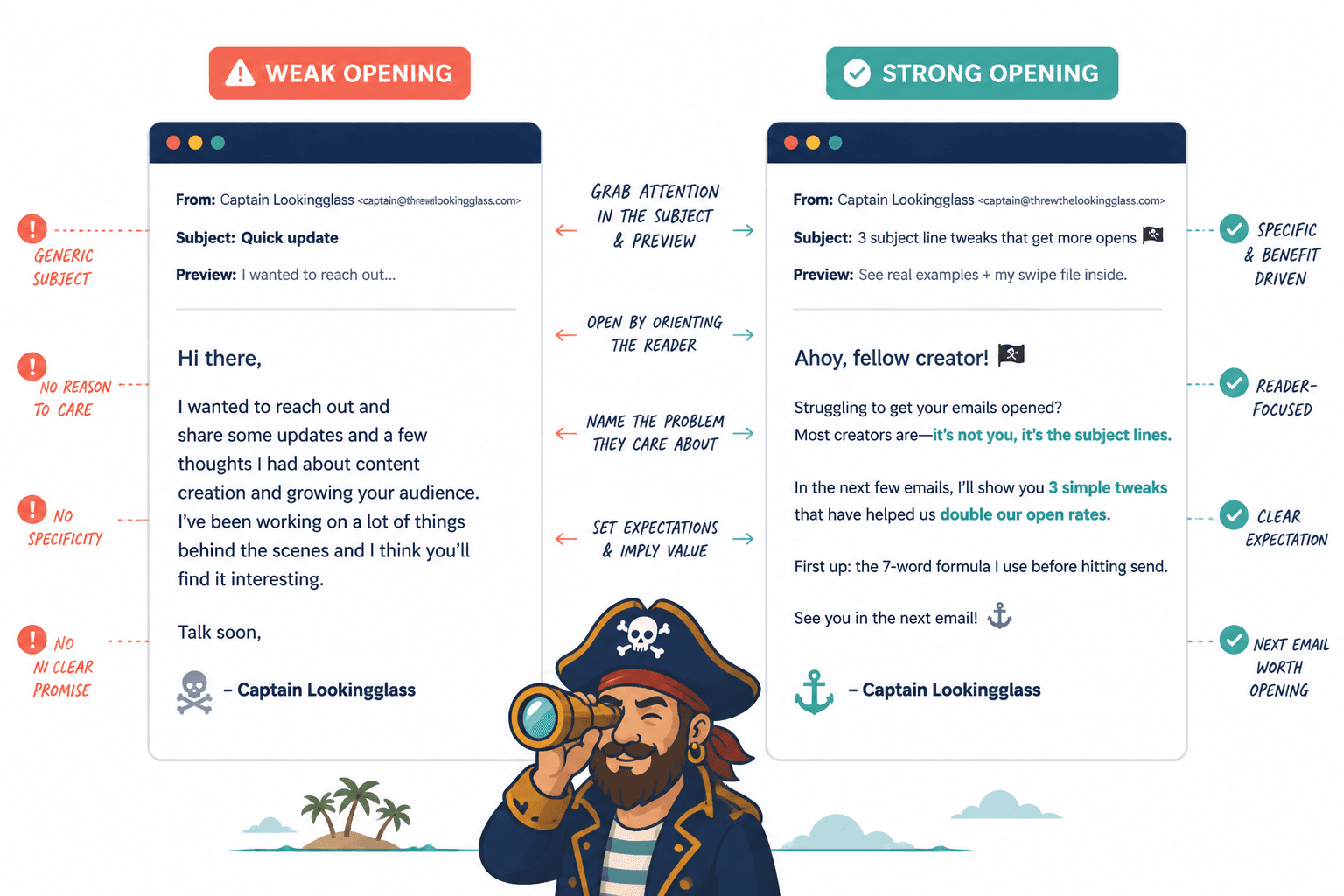
What a strong opening actually needs to do
A strong sequence opening does not need to be clever. It needs to do its job.
In most cases, that job is simple:
- Make the reader feel like they are in the right place
- Show you understand the problem or goal that brought them in
- Set expectations for what is coming next
- Establish a voice that feels human, not auto-buffed
- Create enough curiosity or relevance to earn the next open
That is it. Not a full autobiography. Not your whole philosophy. Not a nervous attempt to prove your kindness in 11 sentences.
Think of the opening as the first clean handshake. Confident. Useful. Not clingy.
The best openings usually do one thing well
Many creators weaken their intros by trying to combine welcome email, origin story, belief statement, pitch setup, free value dump, and mini manifesto into one bloated opener.
Pick one main angle first. Usually that angle is one of these:
- You signed up because you want a result
- You signed up because you have a problem
- You signed up because you are curious about my method
- You signed up because you want a specific resource or next step
Once you know that, the opening gets much easier to write.
How to start creator email sequences without a weak opening
Here is the practical framework.
1. Start with the reason they joined, not with yourself
If someone joined your sequence after downloading a lead magnet, subscribing through a landing page, clicking from a post, or opting in after a workshop, they already told you what they care about.
Use that.
Weak opening:
I wanted to take a moment to introduce myself and say thank you for being here.
Stronger opening:
You signed up because you want your content to bring in better leads without posting every day like a full-time influencer. Good. That is exactly what this sequence is built to help with.
The second version starts where the reader already is. It meets intent instead of performing politeness.
2. Name the problem with more accuracy than your competitors do
Specificity earns attention. Generic empathy does not.
Compare these:
- Generic: Building an online business can feel overwhelming.
- Specific: A lot of creators are putting out useful content, getting polite engagement, and still hearing crickets when it comes to leads.
The second line works because it sounds like someone who has actually seen the problem in the wild, not someone filling out a “pain point” box in a funnel template.
If you want stronger nurture writing overall, this article on improving nurture emails without sounding generic pairs nicely with this one.
3. Tell them what kind of sequence this is
Readers do better when they know what they just signed up for.
You do not need a legal disclaimer disguised as onboarding. Just a simple expectation setter:
- What will these emails help them do?
- What kind of advice or insight can they expect?
- How direct, tactical, personal, or strategic will it be?
- What happens after the sequence ends?
For example:
Over the next 5 emails, I’ll show you how to tighten your positioning, write clearer content, and turn that attention into better sales conversations without making every email sound like a launch countdown.
That line does three useful things: it sets scope, signals tone, and previews the payoff.
4. Use tension early
Good openings often contain contrast. Something is not working. Something is misunderstood. Something is being done badly by default.
This is where your opening starts to feel alive instead of administrative.
Examples:
- You do not need more content ideas. You need a tighter point of view.
- Most welcome sequences are too polite to be memorable.
- A lot of creators think their emails have a conversion problem when they really have an opening problem.
- If your first email sounds like everybody else’s, the rest of the sequence has to work much harder than it should.
Tension creates momentum. It gives the reader a reason to continue, because now there is something to resolve.
5. Earn curiosity without acting mysterious
You do not need fake intrigue. You do not need “what happened next shocked me” energy in your welcome email. But you do need enough forward pull that the next email feels worth opening.
Weak curiosity sounds like this:
I’ll be sharing something very important with you tomorrow, so stay tuned.
That is not curiosity. That is vague stalling.
Better:
Tomorrow I’ll show you the one mistake that makes smart creators sound forgettable in email, and how to fix it in about 10 minutes.
Now the reader knows what is coming, why it matters, and why to care.
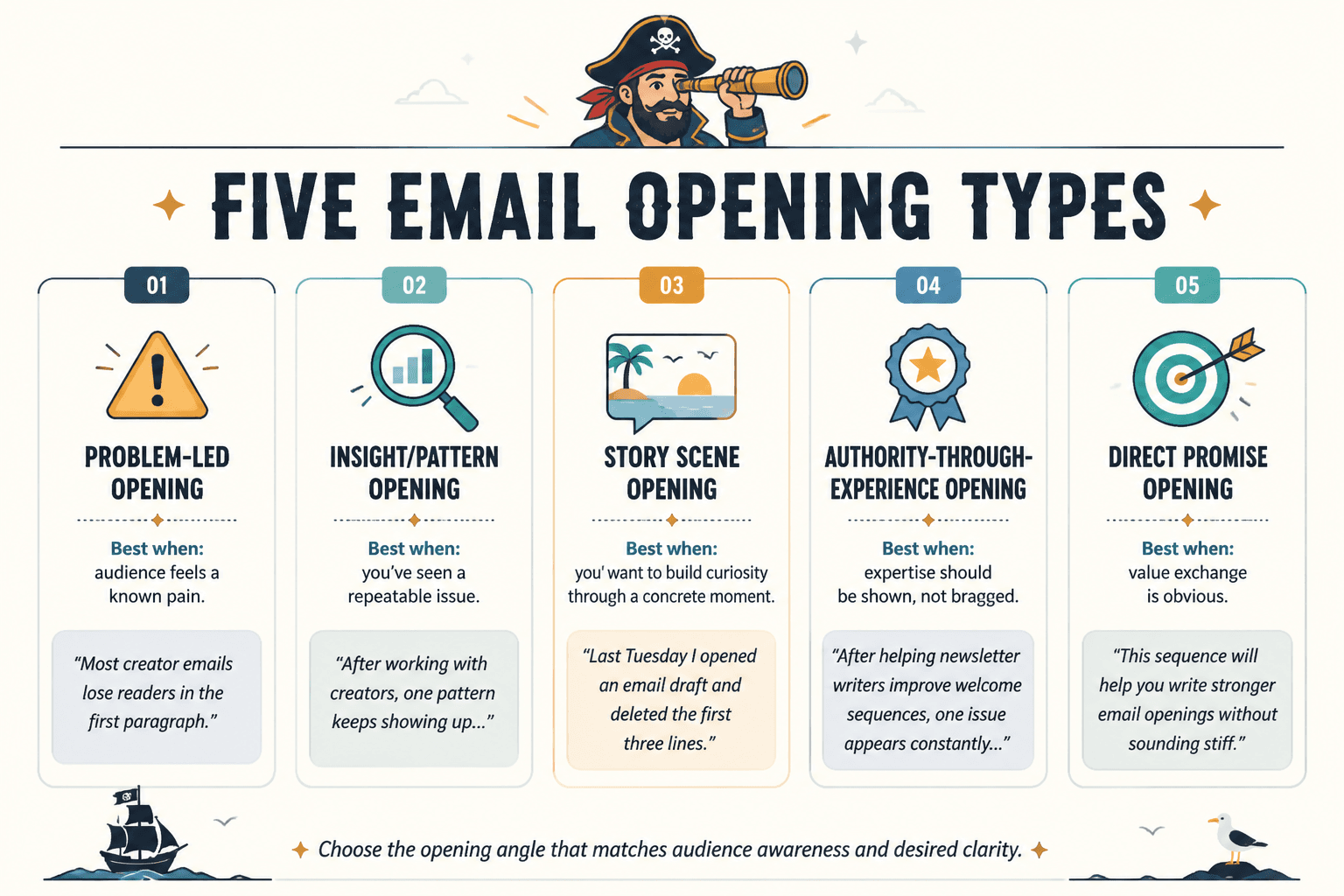
Five opening angles that work better than the usual “welcome” fluff
You do not need to invent a brand new structure every time. Most strong sequence openings use a handful of reliable angles.
1. The problem-first opening
Best when the subscriber joined because they want relief, clarity, or improvement.
Template:
If you’re dealing with [specific frustrating problem], you are not the only one. Most people try to fix it by [common wrong move], which usually makes it worse. Over the next few emails, I’ll show you a cleaner way to handle it.
Filled example:
If your emails get opens but almost no replies, clicks, or sales conversations, you are not the only one. Most creators try to fix that by writing longer, “more valuable” emails, which usually just creates more polite skimming. Over the next few emails, I’ll show you how to make your message clearer, sharper, and easier to act on.
2. The expectation-setting opening
Best when your sequence is tied to a lead magnet, challenge, onboarding experience, or mini-course.
You grabbed [resource], so here is what happens next. Over the next [number] emails, I’ll help you [result]. No daily essays. No motivational fog. Just the pieces that actually matter.
3. The myth-busting opening
Best when your audience believes something common but unhelpful.
A lot of creators think [common belief]. They’re usually wrong. The real issue is [better explanation], and that’s what this sequence is built to help you fix.
This one works nicely if your positioning depends on calling out lazy advice in your space.
4. The proof-backed opening
Best when trust needs a quick boost and you have relevant experience, results, or pattern recognition.
After working through [kind of problem] with [audience type], one pattern keeps showing up: [insight]. That is where we’re starting, because fixing that first makes everything else easier.
This is much stronger than listing credentials like a conference bio nobody asked for.
5. The direct promise opening
Best when the value exchange is clear and the audience already knows what they want.
This sequence is here to help you [specific result] without [specific frustration]. Today I want to start with the part most people get wrong first: [topic].
Simple. Clean. No foam.
Before-and-after rewrites of weak creator email openings
Let’s fix a few common offenders.
Rewrite 1: The overly grateful opening
Before:
Thanks so much for signing up. I’m honored to be in your inbox and can’t wait to share some value with you over the next few days.
After:
You signed up for practical help with your creator emails, so that’s what you’re getting. Over the next few messages, I’ll show you how to tighten your openings, make your nurture emails less forgettable, and write offers that do not sound like a funnel template got loose.
Why it works: it replaces emotional filler with useful orientation.
Rewrite 2: The vague inspirational opening
Before:
Email marketing is such a powerful way to connect with your audience and grow your brand in an authentic way.
After:
Email can do a lot for a creator business, but only if the message is clear enough to hold attention and specific enough to build trust. Most sequences fail long before the pitch because they open with filler. We’re fixing that first.
Why it works: it introduces tension and points at a real problem.
Rewrite 3: The biography dump
Before:
My name is Sarah, and I am a business coach, content strategist, podcast host, and founder who is passionate about helping women entrepreneurs step into alignment and success.
After:
If you are trying to grow a service business with content that sounds like you, not like a borrowed coach voice from 2021, you’re in the right sequence. I help creators and experts make their messaging clearer so their emails, posts, and offers actually pull their weight.
Why it works: it puts positioning in service of the reader, not your ego stack.
A simple structure for opening your first sequence email
If you want a repeatable formula, use this:
- Start with the reader’s reason for joining
- Name the problem, desire, or tension clearly
- Frame what this sequence will help them do
- Add a short credibility line if needed
- Preview what is coming next
- End with one light action, reply, click, or just keep an eye out
Here is that structure in action:
The bigger point is simple: clearer structure and clearer writing make the piece more useful. That is usually what makes the ending land better too.