
Most people do not wreck trust with offer messaging because they are too direct. They wreck it because they get weird the moment money enters the chat.
Suddenly the copy gets puffed up, vague, overpromised, and suspiciously polished. The positioning stops sounding like a real person with a useful offer and starts sounding like a funnel that learned three therapy words and a scarcity trick.
If you are trying to figure out how to monetize offer messaging & positioning without wrecking trust, that is the real job: make the value clearer, make the path to buying easier, and do it without making people feel handled.
This article will help you do exactly that. We’ll cover what trustworthy monetization actually looks like in your messaging, what to stop doing immediately, and how to position your offer so people can understand it, want it, and buy it without feeling pushed into a weird internet sales tunnel.
If you need the broader foundation first, start with offer messaging and positioning. If your current copy still sounds stiff or overproduced, this guide on writing it without sounding salesy or robotic will help.
If you want the bigger picture, start with the parent guide.
Monetization is not the problem. Mistrust is.
A lot of smart creators and consultants make this harder than it needs to be because they treat monetization like a moral risk. So they hide the offer, bury the CTA, soften every claim, and hope people somehow infer that there is a paid way to work together.
That does not build trust. It creates confusion.
On the other side, plenty of people swing too far the other way. They discover positioning, read six copywriting threads, and come back speaking in inflated promise language about transformation, frameworks, breakthroughs, and premium proximity. That also does not build trust. It just smells expensive and slippery.
Trustworthy monetization sits in the middle. Clear enough to sell. Honest enough to believe.
Your messaging should make buying feel easier, not make skepticism feel smarter.
What trustworthy offer messaging actually does
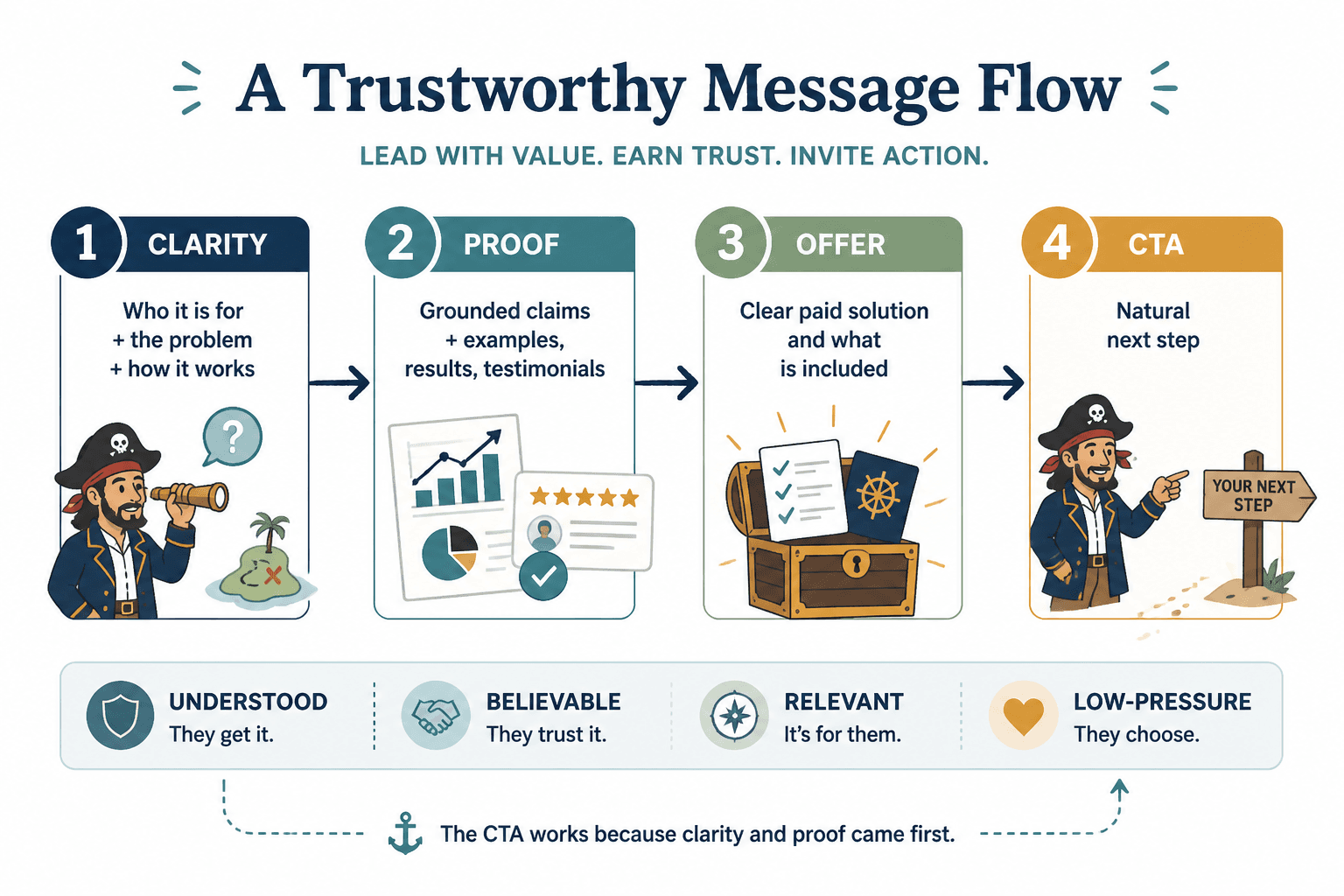
When your messaging and positioning are doing their job, a few things happen fast:
- People understand who the offer is for
- They understand the problem it solves
- They can tell how your approach works
- Your claims feel grounded, not inflated
- The next step feels natural, not forced
That is monetization without trust damage. Not soft-selling forever. Not pretending you are “just here to help” while quietly hoping someone asks for a Stripe link. And definitely not turning every paragraph into a pressure tactic.
If your messaging cannot carry commercial intent without getting awkward, your positioning probably is not clear enough yet. For that, these clarity fixes for personal brands are worth reading next.
How to monetize offer messaging & positioning without wrecking trust
There are a few principles that matter more than all the little copy tricks people love to obsess over.
1. Make the offer easier to understand before you make it easier to buy
A lot of conversion problems are not conversion problems. They are comprehension problems wearing nicer shoes.
If people do not quickly understand what you do, who it is for, and why this offer exists, then adding urgency, stronger CTAs, or sharper pricing language will not fix much. It just means you are pressing harder on a message that is still muddy.
Start here:
- What does the offer help someone do?
- Who specifically is it for?
- What kind of problem does it solve?
- What makes your approach different or more useful?
- What happens next if they want help?
If your messaging cannot answer those cleanly, trust starts leaking early. People do not like feeling confused right before being asked to buy something. Reasonable of them, frankly.
2. Sell the decision, not just the dream
Weak monetization copy usually sells outcomes in a floaty, abstract way. Better monetization copy helps someone make a sane buying decision.
That means you do not only talk about the end result. You also show what kind of person this is right for, what the process is like, what standards you work with, and what kind of expectations make sense.
Trust grows when buyers feel informed, not seduced.
Instead of this:
I help experts scale with magnetic messaging that converts effortlessly.
Try this:
I help coaches and consultants clarify their offer messaging so their website, content, and sales conversations lead to more qualified inquiries without sounding pushy or overpolished.
The second version is not trying to win a copywriting awards banquet. It is trying to be understood by an adult with a credit card.
3. Use proof that matches the promise
If your claim is modest, your proof can be light. If your claim is big, your proof had better show up wearing shoes.
One of the fastest ways to damage trust is to make a bold promise and support it with a vague testimonial, a generic client logo strip, or a sentence about passion and results. That is not proof. That is decorative confidence.
Better proof looks like this:
- Specific client outcomes with context
- Before-and-after messaging examples
- Case studies showing the problem, fix, and result
- Clear explanation of your method
- Relevant experience tied to the offer
You do not need to sound omnipotent. You need to sound credible.
If you want examples of stronger positioning language that still sounds human, these offer messaging and positioning examples can help.
4. Stop hiding the commercial intent
People can feel when you want the sale but are pretending not to. That coy “no pressure, just reaching out to connect and share value” energy is not trust-building. It is just indirect.
You can be honest about the fact that your content, site, or messaging leads somewhere paid. In fact, that usually feels cleaner.
For example:
- “If you want help tightening this on your site, you can book a strategy session.”
- “If your offer page still sounds vague, this is exactly what I help clients fix.”
- “If you want me to help you rewrite this with you, here’s the next step.”
Simple. Clear. Not needy. Not manipulative. Not dressed like a webinar from 2018.
5. Position the offer around fit, not pressure
Trust increases when people can see who the offer is for and who it is not for. That may sound counterintuitive if you are worried about losing leads, but broad, slippery messaging usually attracts more bad-fit leads and more hesitation from good ones.
Fit-based positioning sounds like this:
- Best for consultants with a proven offer who need sharper website messaging
- Not ideal if you are still changing your niche every ten minutes
- Works well for service businesses selling expertise, not low-ticket impulse offers
- Designed for people who want clearer conversion copy without using aggressive funnel tactics
This kind of language does two useful things at once: it qualifies the buyer and protects trust. It tells people you are not trying to force-fit everyone into your process.
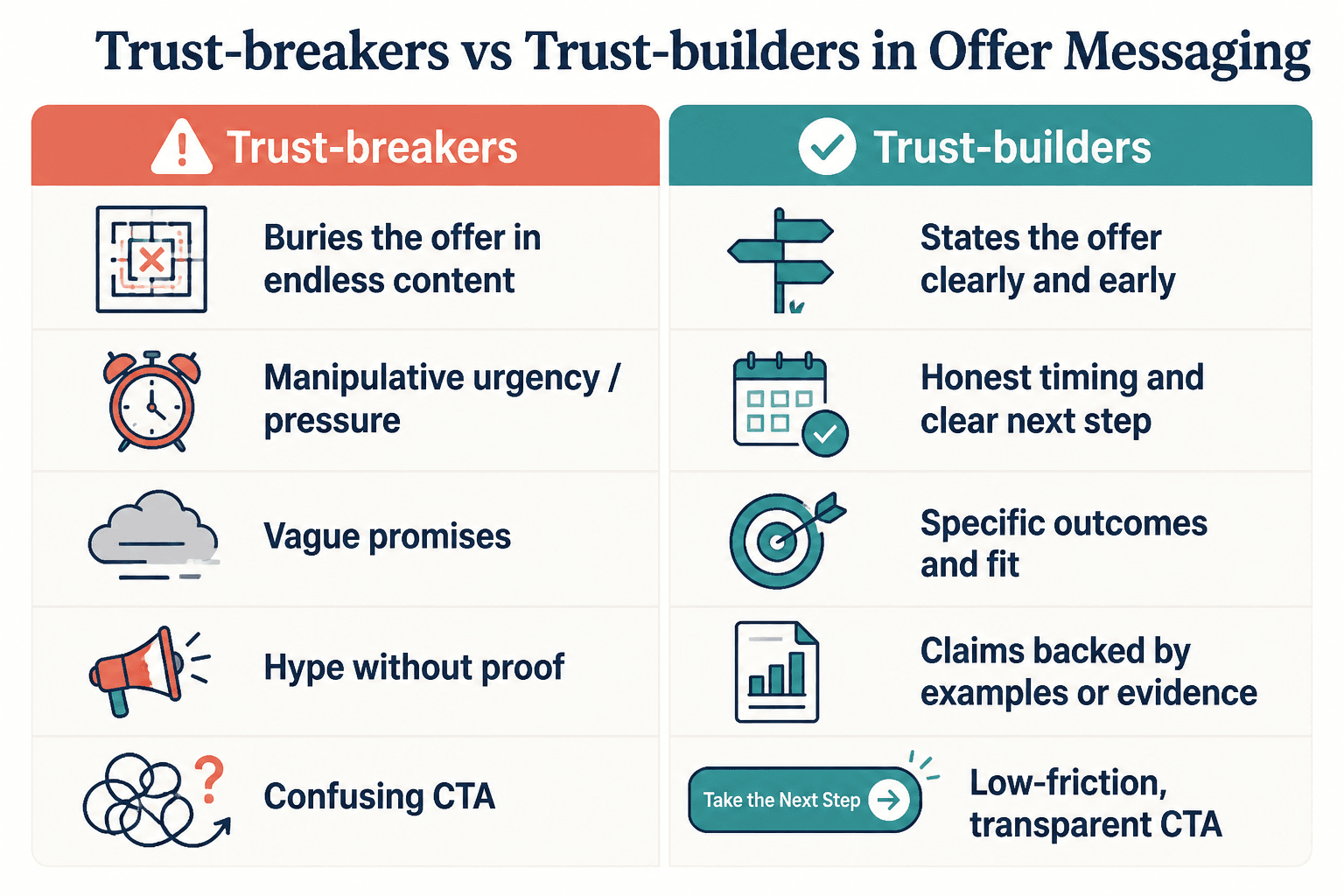
What usually wrecks trust in monetized messaging
Here are the repeat offenders.
Overpromising the outcome
If your messaging promises certainty, speed, ease, and transformation all at once, readers get suspicious fast. Especially if they are smart enough to know their business has variables, context, and inconvenient reality.
Strong copy can be persuasive without pretending every client gets the same shiny result in five days.
Using positioning language nobody talks like
Terms like “magnetic,” “aligned,” “high-level,” “authority-building,” and “premium” are not automatically bad. But they become trust killers when they replace concrete meaning.
If someone has to translate your copy back into normal language to understand what you do, the messaging is too foggy to sell well.
Leading with intensity before earning it
Not every page, post, or pitch needs emotional drama. Sometimes the fastest route to trust is simply being clear, useful, and specific. You do not need to act like reading your homepage is a spiritual intervention.
Burying the actual offer under content
Some people are so afraid of sounding salesy that they build twelve layers of value content and never get to the point. That does not make the buying experience generous. It makes it tiring.
Good trust means people can find the offer, understand it, and decide. They should not have to solve a maze to give you money.
If your goal is leads and sales specifically, read how to turn offer messaging and positioning into more leads or sales. It pairs nicely with this piece because clarity and monetization are close cousins.
A simple framework for monetizing your messaging cleanly
If you want a practical way to audit your current offer messaging, use this five-part structure:
- Problem: Name the issue your buyer already knows is costing them something.
- Fit: Clarify who the offer is for.
- Approach: Explain how you solve it in a way that feels distinct and understandable.
- Proof: Back up the promise with examples, outcomes, or credibility markers.
- Next step: Give a clear, low-friction CTA.
That is enough structure for most offers. You do not need seventeen persuasion layers and an FAQ that sounds like it was written by someone trying to negotiate with a hostage situation.
Example: weak version
I help visionary entrepreneurs step into their next level with messaging that aligns their brand with their mission and attracts soulmate clients.
The issue here is not that it sounds warm. It is that it says almost nothing. Who is it for? What problem is being solved? What kind of messaging? What does “next level” even mean other than “please imagine your own result and project it onto my sales page”?
Example: stronger version
I help coaches, consultants, and service-based personal brands clarify their offer messaging so their website and content attract better-fit leads, explain the value faster, and make sales conversations easier.
Still polished. Still marketable. But now it actually communicates something useful.
How to write CTAs that monetize without getting grabby
The CTA is often where trust goes to die.
People write a decent page, a solid post, or a credible offer description, then finish with a strange burst of funnel language that sounds imported from another personality.
A trustworthy CTA does three things:
- Matches the tone of the rest of the copy
- Feels proportional to the level of buyer intent
- Makes the next step obvious
Better CTA examples
- Book a consult if you want help tightening your offer messaging
- See how I help service brands improve their positioning
- Apply if you want strategic support rewriting your website copy
- Read the service details to see if this is the right fit
- Get in touch if your messaging is clear-ish but not converting
Notice what these do not do:
- Manufacture urgency out of nowhere
- Promise massive results in the button text
- Use fake softness to hide that a sale is being invited
Calm CTAs convert better than people think, especially for expertise-led offers where trust matters more than impulse.
Where to monetize your messaging without making every touchpoint a pitch
You do not need to cram selling language into every sentence. You do need a few clear commercial touchpoints.
Good places to monetize your positioning naturally:
- Your homepage headline and subhead
- Your services or offer page
- Your bio and profile description
- Your content CTA
- Your contact or booking page
- Your case studies and proof sections
That creates a clean path: someone finds you, understands what you do, sees evidence, and knows what to do next. No weird jump from “helpful thought leadership” to “buy my premium container now.”
If you want to browse related resources in this topic cluster, this broader website conversion copy section and the website core copy offer messaging positioning page are the logical next stops.
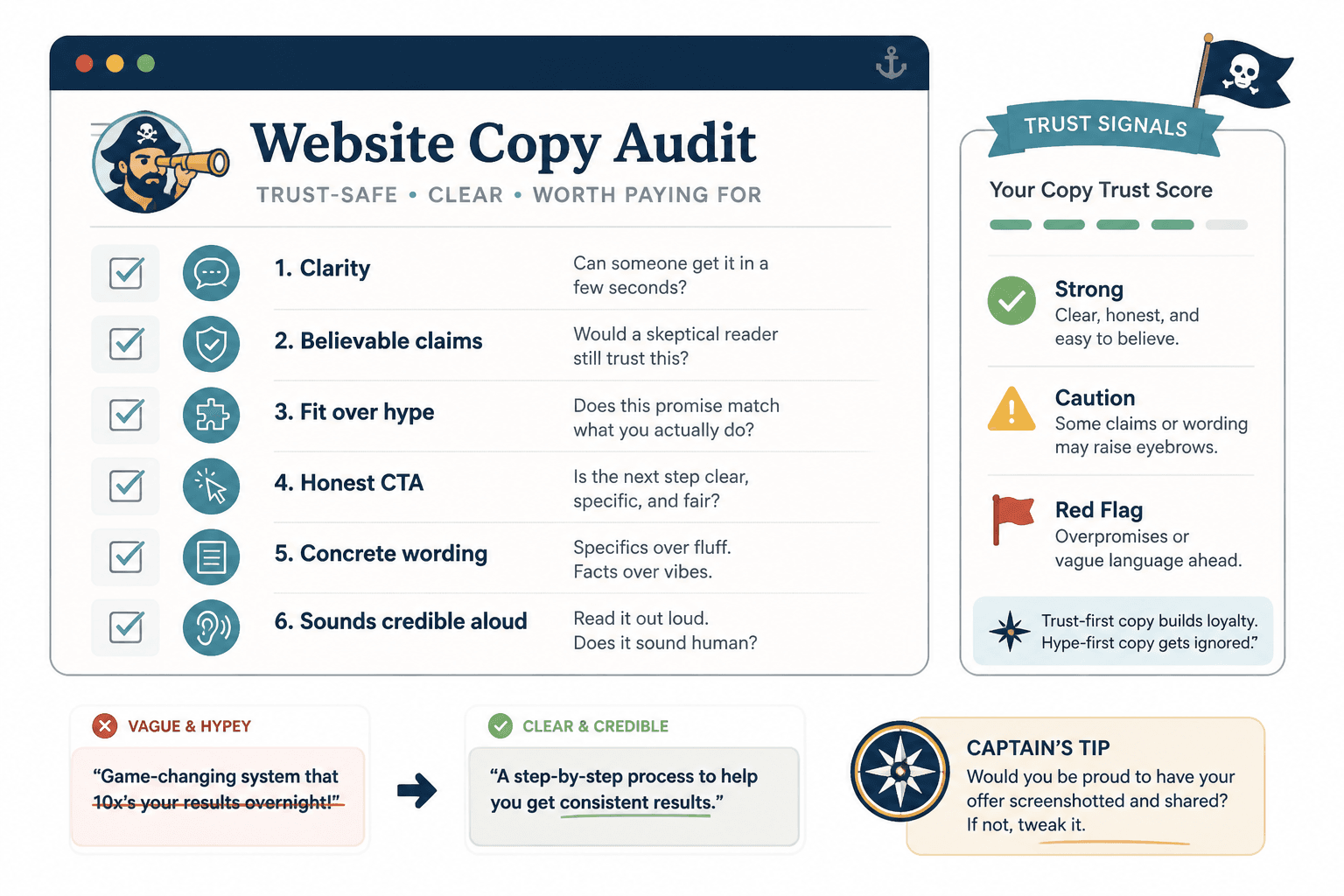
A quick self-check for trust-safe monetization
Ask these before publishing or rewriting your offer copy:
- Would a smart buyer understand what I actually sell within a few seconds?
- Do my claims sound believable for the level of proof I provide?
- Am I helping someone evaluate fit, or just trying to sound irresistible?
- Does the CTA feel natural, clear, and honest?
- Have I replaced vague hype words with concrete meaning?
- Would this still sound credible if read out loud in a normal conversation?
If you hesitate on more than one of those, the issue usually is not “conversion optimization.” It is trust friction caused by vague positioning, inflated language, or clumsy selling.
FAQ
Can offer messaging be direct without sounding pushy?
Yes. Direct is usually better. Pushy happens when the copy overreaches, pressures, or hides weak fit behind intensity.
Should I mention pricing in my messaging?
Sometimes. If pricing helps qualify buyers or reduce friction, it can build trust. If your offer needs context first, lead with clarity and fit before price.
What matters more: positioning or proof?
Positioning gets attention. Proof earns belief. You usually need both if the offer is not dirt cheap and obvious.
How do I know if my messaging sounds too salesy?
If it is vague, overpromised, emotionally overcooked, or weirdly polished compared with how you actually talk, that is usually the tell.
Clean monetization sounds like clarity with a spine
If you want to know how to monetize offer messaging & positioning without wrecking trust, the answer is not to hide the sale. It is to earn it more cleanly.
The bigger point is simple: clearer structure and clearer writing make the piece more useful. That is usually what makes the ending land better too.