
Most offer messaging problems are not really writing problems. They are thinking problems wearing decent copy.
People assume they need better words, better headlines, better hooks, maybe a shinier AI tool. Sometimes, sure. But usually the real issue is simpler: the offer is positioned vaguely, the message tries to say five things at once, and the page asks readers to connect dots they should never have been asked to connect.
If you are looking for the best messaging frameworks and CRO tools for Offer Messaging & Positioning, the useful question is not “what framework is popular?” It is “what helps me get clearer, more specific, more believable, and easier to say yes to?” That is the standard.
This guide will help you choose messaging frameworks that sharpen your offer instead of fluffing it up, plus CRO tools that show where your message is leaking trust, clarity, and conversions. Because “we help ambitious brands unlock growth” is not positioning. It is wallpaper.
For the main guide behind this topic, visit the parent guide.
What messaging frameworks are actually for
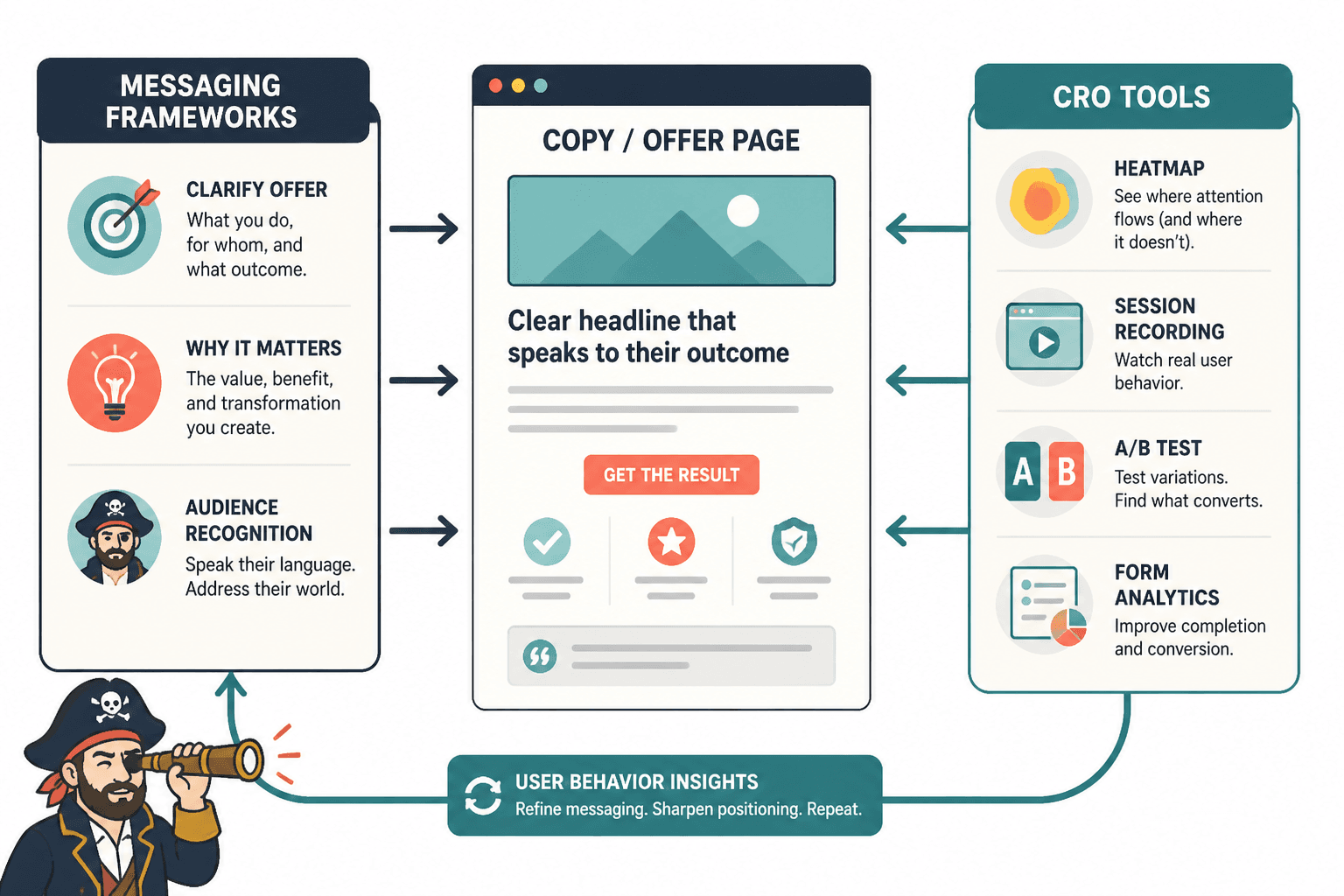
A good messaging framework does three jobs:
- It helps you clarify what you sell
- It helps you explain why it matters
- It helps your audience recognize themselves in the message fast
That is it. A framework is not there to make your copy sound more strategic in a Google Doc. It is there to reduce confusion and improve conversion.
The same goes for CRO tools. They are not magic conversion dust. They help you see where users hesitate, drop off, ignore key sections, or fail to understand what you thought was obvious.
Put those two together and you get something useful: stronger offer messaging, backed by actual behavior instead of vibes.
The best messaging frameworks for offer messaging and positioning
You do not need fifteen frameworks. You need a few that help you answer the right questions clearly. Here are the ones worth using most often.
1. Problem → Pain → Promise → Proof
This is one of the cleanest frameworks for service offers, coaching, consulting, and creator-led products.
- Problem: What is going wrong?
- Pain: Why does it matter emotionally, financially, or operationally?
- Promise: What better outcome do you help create?
- Proof: Why should anyone believe you?
It works because it forces you out of vague “I help” language and into the actual stakes. A lot of positioning dies because it jumps straight to the promise without earning belief.
Example:
Most coaches do not have a visibility problem. They have a clarity problem. Their content sounds decent, but prospects still do not understand what they do, who it is for, or why they should care. We help service-based creators turn fuzzy offers into clear messaging that earns trust faster and converts more profile visits into leads. That process has helped clients improve inquiry quality, sales-call fit, and website conversion without posting more.
That is much stronger than “We help experts scale with strategic messaging systems.” Which sounds important, but says almost nothing.
2. Audience → Problem → Outcome → Method
This framework is especially useful for homepages, service pages, LinkedIn profile summaries, and offer one-liners.
It answers four things quickly:
- Who is this for?
- What are they dealing with?
- What result do they want?
- How do you help?
Template:
I help [audience] who are struggling with [problem] get [outcome] through [method].
That template can be too plain if you leave it untouched, but it is excellent for finding the bones of your positioning.
Example:
I help creators and consultants whose offers sound smart but still do not convert turn their messaging into something clearer, sharper, and much easier to buy.
Simple. Useful. No fog machine required.
3. Jobs To Be Done
Jobs To Be Done is one of the best frameworks for offer messaging because it focuses on what the customer is actually trying to get done, not just what category your offer sits in.
People do not buy “copy strategy” because they love copy strategy. They buy it because they want things like:
- better-fit leads
- less confusion on their sales page
- higher conversion on traffic they already have
- messaging they can reuse across content, email, and sales calls
- an offer that stops sounding interchangeable
JTBD helps you uncover the progress they are trying to make. That matters because stronger positioning often comes from naming the real job better than everyone else does.
For example, your customer may not be hiring a messaging strategist to “improve website copy.” They are hiring one to “make this offer finally click with the right people so traffic stops going to waste.” Much more specific. Much more useful.
4. Before → After → Bridge
This one is great when your offer has a visible transformation and you need cleaner contrast.
- Before: Where is the customer now?
- After: Where do they want to be?
- Bridge: How do you get them there?
It is especially good for landing pages, webinar pages, creator products, and service offers that people struggle to visualize.
Example:
Right now, your offer page sounds polished but generic, and readers leave without seeing why your approach is different. After the messaging rebuild, they understand exactly who it is for, what problem it solves, and why your method is worth paying for. We bridge that gap through positioning research, message strategy, and conversion-focused page copy.
That is doing real work. It gives the reader a clear before-state, a believable after-state, and a practical bridge.
5. Features → Meaning → Outcome
This framework is underrated, especially for digital products, software, audits, packages, and structured services.
A lot of offers list what is included but never explain why it matters. Readers are left translating for themselves, which they often do not bother doing.
Use this:
- Feature: What is included?
- Meaning: Why does that matter?
- Outcome: What result does that support?
Example:
You get a full offer messaging map, including audience pain points, positioning angles, key objections, and homepage messaging. That means you are not guessing what to say across your website, emails, and sales assets. The result is faster content creation, clearer sales conversations, and a much stronger chance of converting cold traffic.
This is one of the easiest ways to stop sounding like a package menu and start sounding persuasive.
How to choose the right framework
You do not need to marry one framework forever. Pick the one that best fits the job.
| Use case | Best-fit framework |
|---|---|
| Homepage headline and intro | Audience → Problem → Outcome → Method |
| Service page messaging | Problem → Pain → Promise → Proof |
| Offer transformation | Before → After → Bridge |
| Customer research and positioning | Jobs To Be Done |
| Package or deliverables section | Features → Meaning → Outcome |
In practice, the best messaging usually blends a few frameworks. That is normal. You might use Jobs To Be Done to understand what the customer wants, Problem → Pain → Promise → Proof to shape the main copy, and Features → Meaning → Outcome to explain what is included.
If your message still sounds weak after using a framework, the problem is probably not the framework. It is that your inputs are too vague. “Small business owners who want to grow” is not a useful audience. “Better results” is not a compelling outcome. “Done-for-you support” is not a differentiator.
The best CRO tools for offer messaging and positioning
Now the useful part: the tools. Not because tools replace strategy, but because they show you what your elegant little message is failing to do in the wild.
Here are the CRO tool categories that matter most for offer messaging and positioning.
Heatmaps and click tracking tools
These show where people click, what they ignore, and how far they scroll. They are useful for spotting messaging friction fast.
What they help you learn:
- Whether visitors are seeing key offer sections
- Whether they are clicking things that are not clickable
- Whether your CTA placement makes sense
- Whether your page hierarchy is helping or hurting
If everybody drops off before your proof section, that is not just a design issue. It may mean your opening message is too weak to carry attention.
Session recording tools
Session recordings let you watch real visitor behavior. This is one of the fastest ways to stop guessing.
You may discover that users skim your page, bounce around trying to understand what the offer is, or hesitate at pricing because your positioning did not justify the value well enough. Painful, yes. Useful, also yes.
Watch for patterns, not one weird person doing something chaotic at 11:43 p.m.
On-page survey and feedback tools
If you want better messaging, ask better questions.
Short on-page surveys can help you uncover:
- What almost stopped someone from buying
- What felt unclear
- What convinced them
- What they thought your offer was before they understood it correctly
That last one is gold. Misunderstanding is a messaging problem, not just a UX problem.
Useful questions include:
- What nearly stopped you from taking the next step today?
- What felt unclear or missing on this page?
- What made this offer feel relevant to you?
- How would you describe this offer in your own words?
A/B testing tools
A/B testing is helpful, but people misuse it constantly.
Do not test tiny headline changes on weak traffic and pretend you are running a proper experiment. Test meaningful differences. Different value propositions. Different offer angles. Different proof blocks. Different CTA framing.
Good tests for positioning include:
- problem-led headline vs outcome-led headline
- specific niche positioning vs broader positioning
- process-focused copy vs result-focused copy
- proof near the top vs proof later on the page
Small wording changes can matter, but not before the big clarity issues are fixed.
Analytics and funnel tracking tools
You need a basic view of where traffic comes from, what pages convert, and where users drop out. Otherwise you are editing copy in the dark.
Analytics help connect messaging to outcomes:
- Which traffic sources bring the best-fit visitors
- Which pages have strong engagement but weak conversion
- Which offers attract clicks but not inquiries or sales
- Which funnels lose people before intent turns into action
If your content pulls in attention but your offer page fails, your top-of-funnel message and bottom-of-funnel message may not match. That happens a lot.
Form analytics and lead capture tools
Sometimes the offer is fine, but the final step creates friction.
Form analytics can show:
- which fields people abandon
- where hesitation increases
- whether your form asks for too much too soon
- whether the CTA framing matches buyer intent
If your page says “simple next step” and your form feels like a low-budget visa application, that is a conversion problem you invented.
A simple stack for creators, consultants, and service offers
You probably do not need an enterprise CRO stack with twelve dashboards and a project manager named Kyle explaining significance levels on a Tuesday. You need enough to make smarter messaging decisions.
A simple practical stack looks like this:
- One messaging framework for core positioning
- One customer-research method for gathering real language
- One heatmap or session recording tool
- One analytics setup for page and funnel performance
- One survey or feedback method for objections and clarity gaps
That is enough to improve most offer pages, service pages, product pages, and lead-gen funnels.
How to use messaging frameworks and CRO tools together
This is where people usually split into two bad camps.
One camp loves messaging frameworks and writes elegant positioning docs nobody reads. The other camp loves CRO tools and tests button colors while the offer still sounds like mush. Neither is especially impressive.
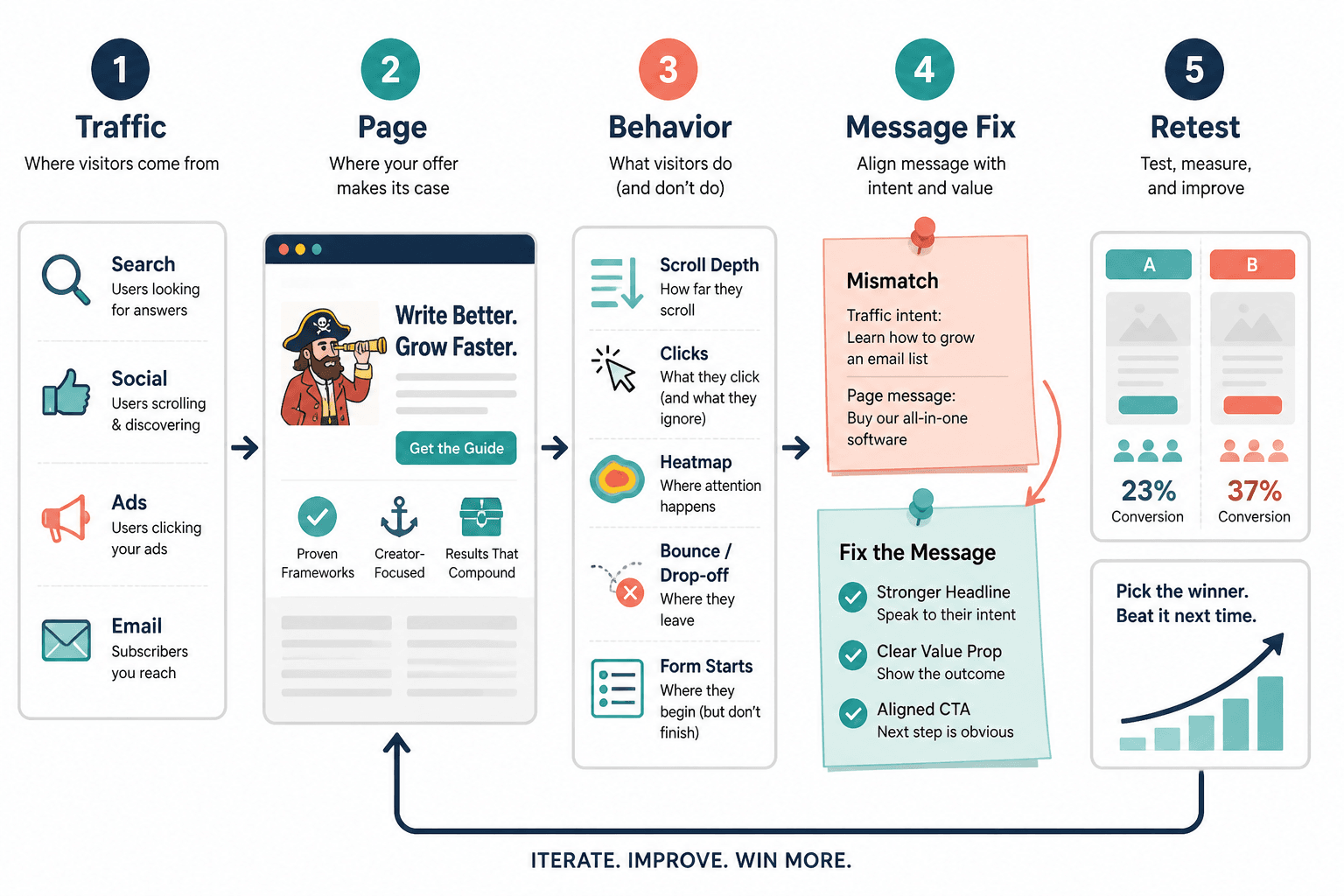
The better approach is simple:
- Clarify the offer. Use a framework to define audience, problem, outcome, method, proof, and differentiation.
- Write the page. Build the headline, subhead, body copy, proof, and CTA around that message.
- Watch behavior. Use heatmaps, recordings, analytics, and surveys to see where comprehension or trust breaks down.
- Fix the actual friction. Rewrite weak sections based on evidence, not ego.
- Retest. Compare changes and keep the stronger message.
That loop is where better positioning gets built in real life. Not in a Notion board with 47 sticky labels about brand essence.
Common mistakes when improving offer messaging and positioning
- Using frameworks as filler. A framework should sharpen your message, not make it more abstract.
- Confusing broad with clear. If your copy could apply to twenty other businesses, your positioning is weak.
- Relying on tools before fixing fundamentals. CRO tools help diagnose, but they cannot rescue a boring offer.
- Testing tiny details too early. Start with value proposition, not button shade debates.
- Ignoring proof. Positioning without evidence is just expensive wording.
- Forgetting the next step. Great messaging still needs a clean CTA and a low-friction path forward.
There is also a subtler mistake: copying messaging styles from brands with very different audience trust levels. Big brands can get away with vague slogans because people already know who they are. You usually cannot. Annoying, but true.
What to read next if you want to sharpen this faster
If you want to build stronger offer messaging and positioning without doing the usual vague-branding dance, these will help:
The bigger point is simple: clearer structure and clearer writing make the piece more useful. That is usually what makes the ending land better too.