
Most people do not have a sales page problem. They have a translation problem.
They have useful old content sitting around in blog posts, emails, social posts, client notes, webinars, FAQs, voice notes, workshop decks, and comment threads. Then when it is time to write a sales page, they ignore all of that and start fresh like they have been personally cursed by a blank document.
That is usually how you end up with sales pages full of vague promises, stiff copy, and claims that sound polished but weirdly unconvincing.
If you want to know how to turn old content into better sales pages, the move is not to recycle random paragraphs and hope for the best. It is to mine your old content for the parts that already contain trust, specificity, real objections, clear language, and buyer logic.
That is what makes a sales page better. Not more words. Better source material.
This article will show you how to pull the right material from your old content, reshape it into sales-page sections that actually convert, and avoid the lazy “repurposing” approach that just creates a longer, messier page no one wants to read.
If you want the bigger picture, start with the parent guide.
Why old content is usually better than writing from scratch
When you write from scratch, you tend to default to what sounds like sales copy.
When you pull from old content, you often find what buyers actually respond to:
- questions people keep asking
- phrases clients use to describe the problem
- stories that show the cost of staying stuck
- examples that prove your process works
- specific outcomes instead of inflated promises
- the exact wording that got replies, clicks, saves, or sales conversations
That matters because good sales pages are not built on “copywriting energy.” They are built on evidence.
Your old content is evidence. At least the good parts are. The trick is knowing what to keep, what to reshape, and what to throw in the bin without a funeral.
What kind of old content can become sales page material?
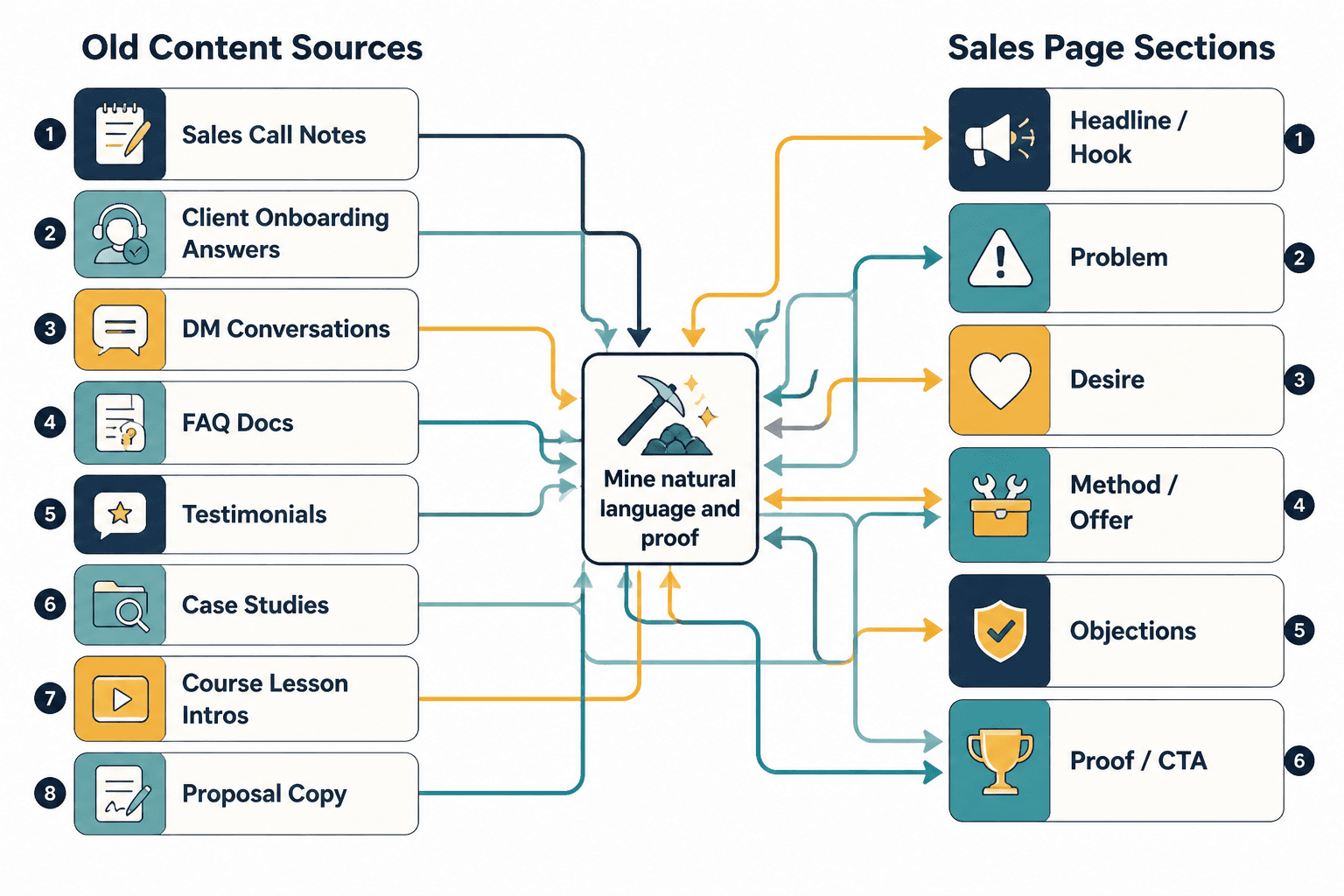
Almost anything, if it reveals how your audience thinks, what they want, why they hesitate, and what makes your offer different.
- blog posts
- newsletters
- LinkedIn posts
- X threads
- Instagram captions
- Facebook posts or comments
- podcast transcripts
- webinar scripts
- sales call notes
- client onboarding answers
- DM conversations
- FAQ docs
- testimonials
- case studies
- course lesson intros
- proposal copy
Some of those are especially useful because they contain natural language. And natural language is gold on sales pages. It sounds human. It sounds grounded. It sounds like someone actually understands the problem instead of just decorating it with marketing glitter.
For more help with the bigger structure behind these pages, it is worth reviewing sales pages as part of your overall conversion copy strategy, especially if your page has been trying to do five jobs badly instead of one job well.
Do not repurpose everything
This is where people get sloppy.
Old content is raw material, not a finished page. A good blog post can make a terrible sales page section if it explains too much, wanders around, or solves the whole problem before the offer even appears. A spicy social post can grab attention but be useless for conversion if it has no proof and no path forward.
So before you start collecting snippets, use this filter:
- Does this help me explain the problem clearly?
- Does this reveal what the buyer wants?
- Does this show why my approach works?
- Does this answer an objection?
- Does this provide proof?
- Does this create momentum toward action?
If the answer is no, it might still be good content. It just is not sales-page content.
How to turn old content into better sales pages, step by step
1. Start with the offer, not the archive
Before digging through your old material, get painfully clear on the offer the page needs to sell.
- What exactly is the offer?
- Who is it for?
- What specific result does it help them get?
- What makes this offer different from doing nothing, DIYing it, or hiring someone else?
- What action should the reader take next?
If you skip this, you will collect a pile of decent writing that has no job. That is how pages become “helpful” but not persuasive.
2. Pull your highest-signal content
Now go find old content that already got some kind of useful reaction.
Useful reaction does not always mean vanity metrics. A post with 19 likes and 4 buyer DMs is far more interesting than a post with 900 likes from people who were never going to buy anything from you.
- posts that sparked strong comments
- emails that got replies
- webinars where people stayed engaged
- FAQs that came up repeatedly
- call notes with recurring objections
- case study details people mentioned back to you later
You are looking for signal, not volume.
3. Sort what you find by sales page function
Once you have gathered your material, sort it into buckets based on what role it can play on the page.
| Sales page section | What to pull from old content |
|---|---|
| Headline and hook | strong post openings, sharp problem statements, repeated audience pain points |
| Problem section | posts, emails, or comments describing frustrations, mistakes, missed outcomes |
| Desired outcome | language about what buyers actually want, not just what they want to avoid |
| Offer explanation | teaching content, webinar segments, process posts, FAQ answers |
| Objection handling | sales call notes, DMs, replies, hesitations from leads |
| Proof | testimonials, case studies, screenshots, client wins, before-and-after examples |
| CTA | copy from high-performing close emails, booking prompts, signup messages |
This one step saves a ridiculous amount of time because it stops you from staring at old content like it is one giant blob of “maybe useful.”
4. Find the exact phrases worth stealing from yourself
Not every paragraph deserves to survive. But small pieces often do.
Look for:
- clear, plain-English problem descriptions
- specific examples
- tiny moments of contrast
- phrases clients repeat
- simple explanations of your method
- objection language in the buyer’s own words
- lines that create relief, clarity, or trust
For example, this blog sentence:
Most service providers do not need more traffic. They need a sales page that explains the offer in a way a tired buyer can understand in two minutes.
That could become:
Your offer probably does not need more hype. It needs a sales page that makes sense fast.
That is the job. Not copy-paste. Distill and sharpen.
5. Rewrite for conversion, not for publishing
Old content was created for a different context. A social post might be designed to start a conversation. A newsletter might be there to teach. A webinar might build trust over 40 minutes. A sales page has less patience to work with.
So when you bring old content over, rewrite it to fit what sales-page readers need:
- faster clarity
- stronger sequencing
- less meandering
- more direct relevance to the offer
- more buyer-centered framing
- cleaner calls to action
This is where a lot of repurposing advice falls apart. It acts like moving content is enough. It is not. Content has to be translated into a buying context.
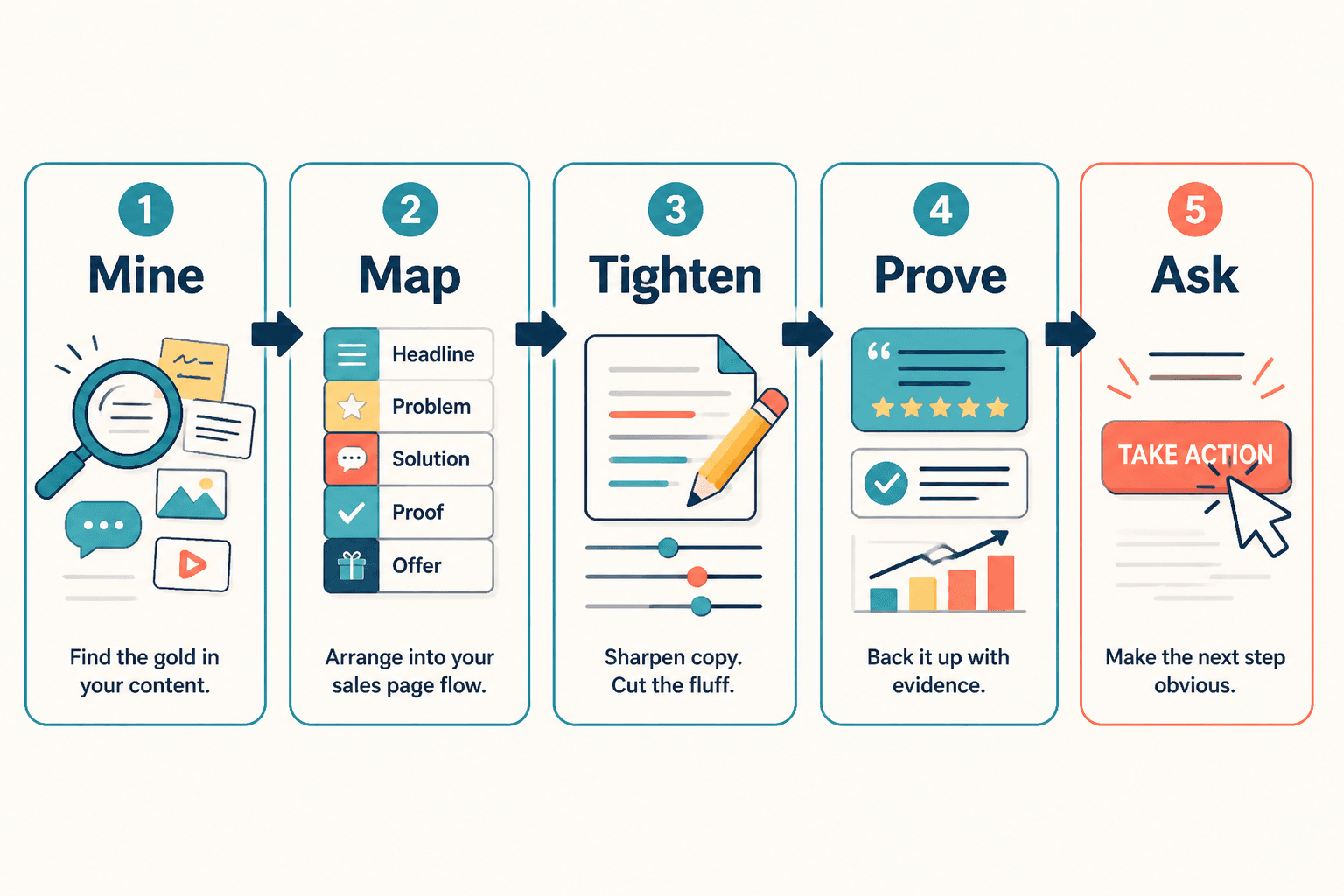
A simple framework: mine, map, tighten, prove, ask
If you want a cleaner process, use this five-part framework.
- Mine old content for useful language, questions, and proof.
- Map each piece to a sales page section.
- Tighten the wording so it is faster, clearer, and more persuasive.
- Prove your claims with examples, outcomes, or specifics.
- Ask for the next step with a CTA that is easy to act on.
Simple framework. Less glamorous than “secret high-converting copy matrix.” Much more useful.
What old content works best for each part of a sales page
For the headline and opening
Look for old content where you named the problem crisply or challenged a common assumption.
Great source material:
- strong LinkedIn post hooks
- email subject line ideas
- webinar opening questions
- mini-rants with a clear point
What you want here is tension and relevance, not cleverness for its own sake.
For the problem section
Use old content where you described the frustration in specific terms.
Good source material often includes things like:
- “I am getting traffic but no qualified leads”
- “People say my offer sounds interesting, then disappear”
- “My page explains everything but somehow says nothing”
That is stronger than generic fluff about “struggling to scale your impact,” which should really be escorted off the premises.
For the offer section
Use teaching content, workshop breakdowns, process outlines, or onboarding explanations.
These are often full of useful language because they explain how you work in practical terms. That is exactly what buyers need when they are deciding whether your offer feels solid or suspiciously floaty.
For objections and FAQs
Your best material here usually comes from real conversations, not polished content.
- DM questions
- sales call hesitations
- email replies
- client concerns before signing
If multiple people asked it, it belongs on the page somewhere.
For proof
Case studies, testimonials, screenshots, and before-and-after examples are obvious. But so are tiny details from old content that show expertise in action.
A line like “we rewrote the first three sections and booking conversions doubled over the next month” is doing much more work than “results-driven copy solutions for visionary founders.” One of those sounds real. The other sounds like it was printed on a tote bag at a conference no one enjoyed.
Before-and-after examples
Example 1: turning a blog paragraph into stronger sales copy
Old content:
A lot of business owners underestimate how much friction weak messaging creates. If the audience cannot understand what is being offered, they delay making a decision.
Sales page rewrite:
If people keep reading your page and not buying, the problem is often not price. It is friction. Your offer takes too long to understand, so the buyer delays, wanders off, and forgets you exist.
The second version is tighter, sharper, and written for a buying moment.
Example 2: turning FAQ material into objection handling
Old content:
People often ask whether they need a full rewrite or whether edits are enough. It depends on whether the offer is clear, the structure is working, and whether the current messaging reflects the actual audience.
Sales page rewrite:
Do you need a full rewrite? Not always. If your offer is solid and the page is just messy, strategic edits may be enough. But if the messaging is vague, the structure is dragging, or the page is talking to the wrong people, patching it will not save it.
Now it sounds like a buyer question being answered in real time, which is exactly what it should do.
Example 3: turning a social post into a CTA section
Old content:
A good sales page should remove confusion, build trust, and make the next step feel obvious.
Sales page rewrite:
If your current page is making people work too hard to understand the offer, this is the fix. You will leave with a clearer message, a stronger structure, and a page that makes the next step feel obvious. Here is how that turns into more leads or sales.
What to cut when repurposing old content
Some old content is useful but still needs aggressive trimming. Cut:
- long scene-setting intros
- tangents that were fine in a newsletter but not on a sales page
- platform-specific phrasing that does not belong on a website
- jokes that distract from the offer
- teachy sections that solve too much for free before the offer appears
- repetition that came from thread formatting or speech transcripts
- generic claims with no proof attached
The goal is not to preserve your old content. It is to use it well. Those are different jobs.
How to keep the page cohesive when the source material came from everywhere
The bigger point is simple: clearer structure and clearer writing make the piece more useful. That is usually what makes the ending land better too.