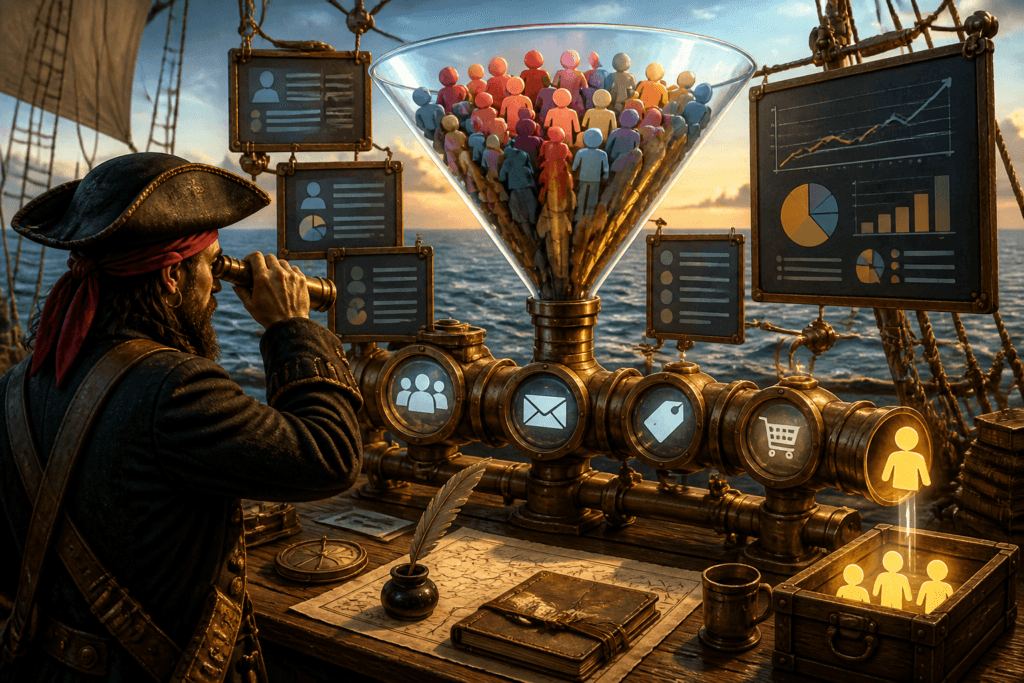
Most people do not need “the best funnel software.” They need a sane system that helps them move someone from “I saw your post” to “I might buy from you” without losing track of leads in a notes app, five spreadsheets, and a prayer.
That is the real job of the best CRM tools and funnel builders for Audience-to-Offer Journeys. Not flashy dashboards. Not 47 automations you will never touch. Not a funnel map that looks like it was designed by an octopus on espresso.
You need tools that help you capture attention, organize contacts, follow up properly, and guide people toward an offer without making your business feel like a weird internet vending machine.
This guide will help you choose the right mix of CRM tools and funnel builders based on how creators, coaches, consultants, solo founders, and personal brands actually sell. We will cover what each tool category is good at, what it is not good at, which setups make sense for different business models, and where people waste money on software that solves the wrong problem.
If you are still building your overall system, it is worth reading Audience-to-Offer Journeys first, because tools only help when the journey itself makes sense.
For the full path around this topic, head to the parent guide.
What these tools are actually supposed to do
An audience-to-offer journey is simple in principle:
- Someone finds you through content
- They get curious enough to click
- They join something, reply, book, or opt in
- You continue the conversation
- You make an offer that fits where they are
The tools should support that path. They should not become the main event.
A CRM helps you track people, conversations, stages, and follow-up. A funnel builder helps you create the actual journey pages and steps: landing pages, opt-ins, booking pages, checkout flows, nurture sequences, and simple automation.
Some tools try to do both. Sometimes that is useful. Sometimes it means they do both in a slightly mediocre way. Charming in theory. Expensive in practice.
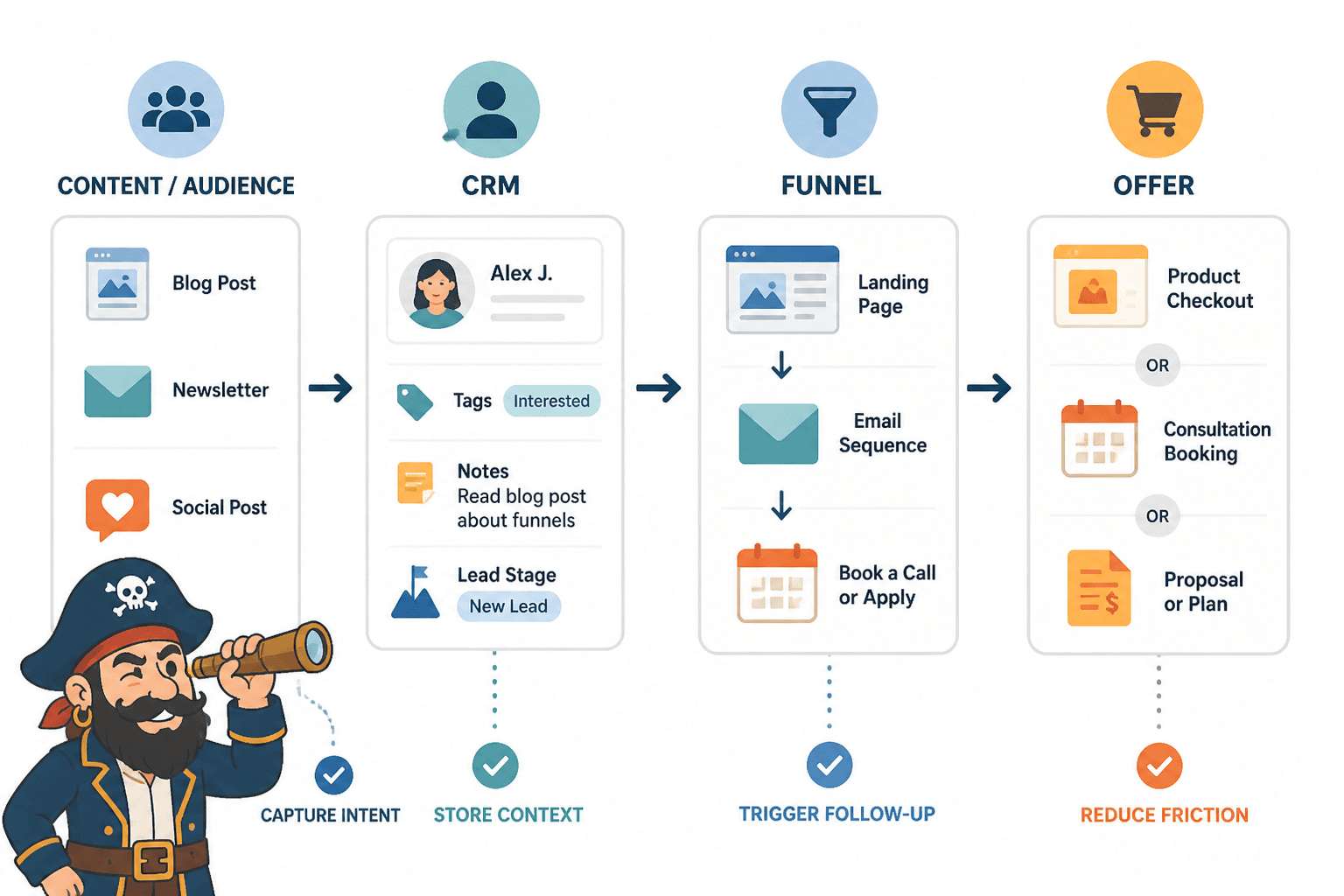
The best CRM tools and funnel builders for Audience-to-Offer Journeys usually do four things well:
- Capture intent: someone subscribes, books, applies, clicks, or replies
- Store context: where they came from, what they want, what they downloaded, what offer fits
- Trigger follow-up: email, task reminders, lead stages, or lightweight automation
- Reduce friction: fewer confusing steps between attention and action
If a tool does not help one of those things, it is probably not essential yet.
Start with the journey, not the software demo
Before picking a tool, define the journey you actually need.
A creator selling a $29 digital product does not need the same stack as a consultant selling a $5,000 advisory package. A coach booking discovery calls does not need the same CRM setup as a newsletter-first business nurturing subscribers for six weeks before a workshop launch.
So ask:
- What is the main offer?
- How do people usually become ready for it?
- Is the next step a click, an opt-in, a DM, an application, or a booking?
- Do you need direct sales pages, email nurture, appointment setting, pipeline tracking, or all of the above?
- How many leads are you realistically managing each month?
That will tell you a lot more than a giant “best software” list ever will.
If you want help mapping the path itself before choosing tools, pair this with best funnel ideas to pair with audience-to-offer journeys and best audience-to-offer journeys ideas and examples for creators.
The main tool categories that matter
1. Simple CRM tools
These are best when you need contact records, pipelines, notes, tags, tasks, and a clear view of who is warm, active, booked, won, lost, or asleep at the wheel.
Good for:
- Consultants
- Coaches
- Service providers
- Small B2B personal brands
- Creators with higher-ticket offers
Not enough on their own for:
- Complex page building
- Deep ecommerce
- Fancy front-end funnels
- Heavy email marketing if the CRM is weak there
If your sales process includes calls, applications, DMs, consults, or relationship-based selling, CRM matters more than the average creator blog will admit.
2. Funnel builders
These tools are best for creating landing pages, opt-in pages, checkout pages, upsells, lead magnets, webinar pages, and simple automated paths.
Good for:
- Digital products
- Lead generation pages
- Email list growth
- Simple sales flows
- Offer testing
Not enough on their own for:
- Nuanced lead tracking
- Longer sales cycles
- Relationship-heavy follow-up
- Detailed pipeline visibility
3. All-in-one platforms
These combine CRM, pages, email, automation, forms, appointments, and sometimes payments inside one system.
They can be great if you want less tool sprawl. They can also become mildly annoying if one weak feature drags the whole setup down.
Good for:
- Small teams
- Solo businesses that want one login
- People who need workable systems fast
- Businesses that value convenience over perfect specialization
Less ideal for:
- People with advanced customization needs
- Brands already invested in best-in-class separate tools
- Businesses with unusual workflows
4. Email-first tools with automation
Sometimes the best “funnel builder” for your business is really an email platform with forms, basic pages, automations, and segmentation.
This is especially true if your audience-to-offer journey is:
- Content
- Newsletter sign-up
- Nurture emails
- Offer email
- Booking or checkout
Simple does not mean weak. It means fewer places for people to disappear.
What to look for in the best CRM tools and funnel builders for Audience-to-Offer Journeys
Here are the features that matter more than shiny templates and dramatic promises.
Clear contact organization
You need tags, segments, custom fields, and notes that make sense. If a person downloaded your pricing guide, booked a call, clicked a workshop page, and replied to an email, you should be able to see that without forensic analysis.
Flexible pipeline or stage tracking
For higher-ticket offers, this matters a lot. You need to know who is new, qualified, booked, proposal sent, considering, closed, or not a fit.
Without stages, follow-up gets weirdly emotional. You “feel” busy but have no real system.
Simple page and form building
Your landing pages do not need cinematic effects. They need clarity, speed, and a clean next step. Forms should be easy to embed or share and easy to connect to your CRM or email system.
Email automation that is useful, not theatrical
You do not need 32-branch behavior logic just because the software can do it. Most creators and service businesses need:
- Welcome sequence
- Lead magnet delivery
- Nurture sequence
- Booking reminders
- Offer follow-up
- Re-engagement
That is already enough to make a meaningful difference.
Lead source visibility
You should be able to tell where people came from: LinkedIn post, article, lead magnet, webinar, booking page, or referral. Otherwise you cannot improve the journey because you cannot see which entry points are working.
Low friction for you
This one gets ignored because it is not sexy. A slightly less powerful tool you will actually use beats a “robust” monster you avoid touching for three weeks at a time.
Best tool setups by business type
Rather than pretending there is one perfect stack, here is the more honest answer.
| Business type | Best tool setup | Why it works |
|---|---|---|
| Coach or consultant selling calls or retainers | CRM-first setup with forms, scheduler, and simple landing pages | You need lead tracking and follow-up more than funnel theatrics |
| Creator selling digital products | Funnel builder plus email automation | You need clean pages, checkout flow, and nurture emails |
| Solo founder with newsletter-led sales | Email-first platform with basic CRM or tags | The list and the sequence matter more than a heavy pipeline |
| Service business with inbound leads from content | CRM plus booking and email follow-up | The key is moving warm leads toward a consult without dropping them |
| Small brand wanting one system | All-in-one platform | Less tool sprawl, simpler admin, faster implementation |
If you are still comparing process options, the broader monetization funnels and funnel systems path is useful context.
Tool categories worth considering
Since specific software changes constantly, and there is no point pretending one app will save your business, it is smarter to choose by category and use case.
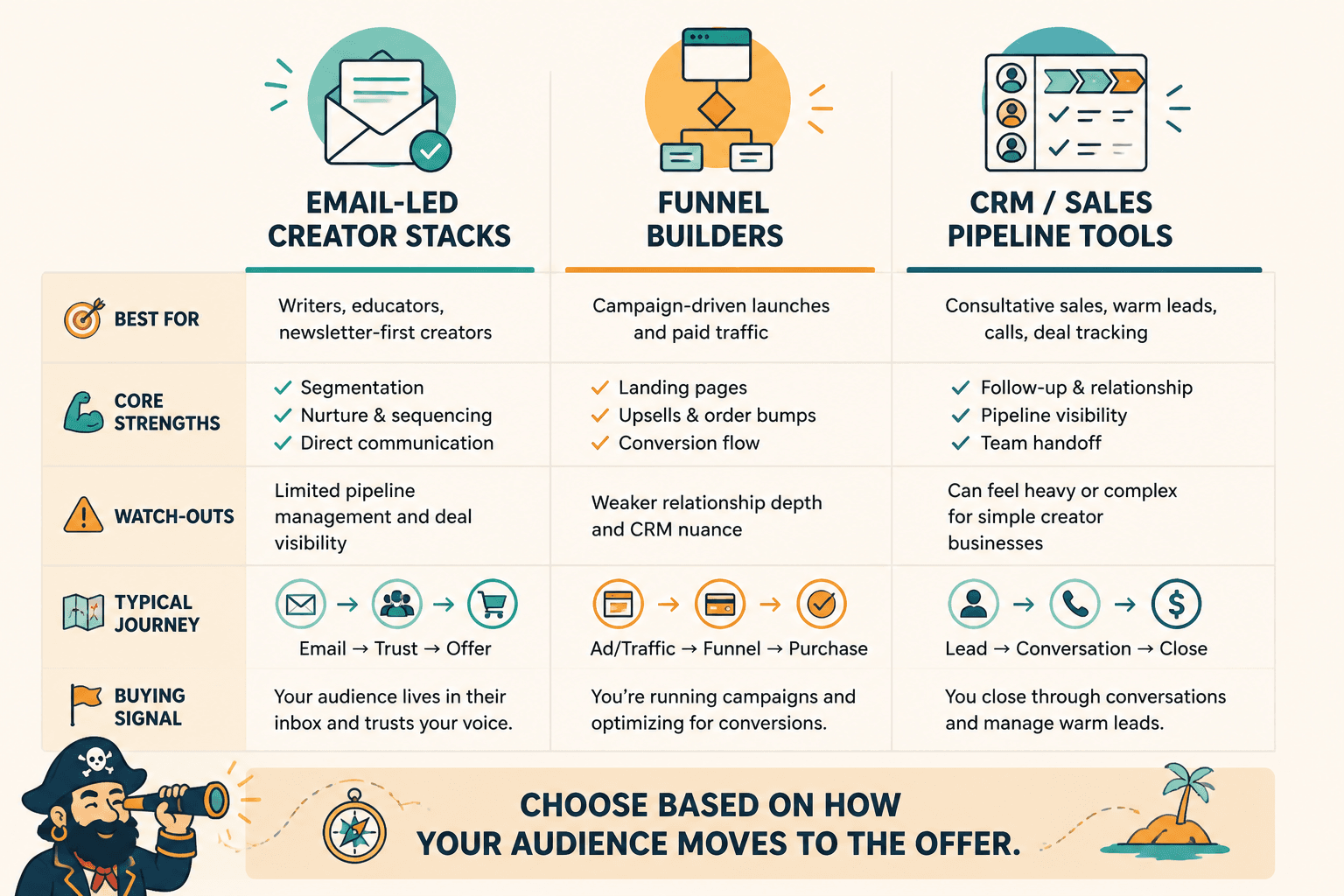
CRM-first platforms
Use these if your sales process involves conversation, qualification, and personal follow-up.
- Best for: coaches, consultants, agencies, B2B service providers
- Strengths: pipelines, notes, tasks, contact history, sales visibility
- Watch out for: weak page builders or clunky email design
A CRM-first setup is often the smartest move when each lead could be worth a lot. If one decent lead is worth thousands, tracking and follow-up discipline matter more than shaving three seconds off a landing page build.
Landing page and checkout funnel tools
Use these if your offer can be sold or qualified through a clean sequence of pages and emails.
- Best for: digital products, workshops, courses, lead magnets, low-ticket offers
- Strengths: fast page creation, offer testing, opt-in pages, checkout flow
- Watch out for: weak contact tracking once someone becomes more than a simple subscriber
These tools are useful when volume matters more than manual relationship management. But if you eventually upsell people into higher-ticket offers, make sure the contact data can move into something more CRM-like.
All-in-one marketing and sales systems
Use these if you want one place for forms, pages, email, appointment booking, basic CRM, and automations.
- Best for: solo founders, small teams, operators who want simplicity
- Strengths: centralization, fewer integrations, easier admin
- Watch out for: feature compromise and migrations later if you outgrow it
This is often the right answer for people who are allergic to tool chaos. Which, frankly, is a reasonable allergy.
Email-led creator stacks
Use these if your content feeds a newsletter and the newsletter drives the offer.
- Best for: writers, educators, personal brands, newsletter-first creators
- Strengths: segmentation, nurture, direct communication, simple forms and automations
- Watch out for: limited pipeline management for warm leads and sales calls
This setup works beautifully when your audience needs trust and repeated exposure more than a fancy front-end funnel. In a lot of creator businesses, the email relationship is the real funnel. Everything else is just a doorway.
What most people get wrong when choosing these tools
They buy for future complexity, not current reality
People love buying software for the seven-figure machine they imagine they will need later. Meanwhile, they currently have one lead magnet, one offer, and six warm contacts they still have not followed up with.
Choose for the next stage of growth, not the fantasy version of your business where you apparently run NASA.
They confuse automation with strategy
Automation can speed up a good journey. It cannot rescue a weak one.
If your content attracts the wrong people, your lead magnet is vague, your nurture sequence says nothing interesting, and your offer is poorly framed, then adding more automation is just efficient disappointment.
They ignore the follow-up layer
This is a common creator mistake. Someone joins the list, downloads the thing, books the call, or replies to the post, and then nothing happens because there is no system for what comes next.
The journey is not complete because a form submission happened. That is the beginning of the useful part.
They use too many tools too early
A landing page tool, separate form tool, separate scheduler, separate CRM, separate email system, separate automation layer, separate analytics dashboard. Very advanced. Very chaotic. Very good way to spend a Friday afternoon wondering why a form did not trigger anything.
Simpler stacks usually win until the business genuinely needs more specialization.
A practical way to choose your stack
If you are trying to narrow options fast, use this process.
Step 1: Define the primary conversion
What is the main action you want from warm audience members?
- Join the list
- Book a call
- Apply
- Buy a low-ticket offer
- Request pricing
- Reply for details
Your stack should make that action easy.
Step 2: Define what happens right after
Do they enter an email sequence? Create a pipeline record? Get a task assigned? See a checkout page? Book through a scheduler? This is where a lot of “funnel planning” suddenly becomes real.
Step 3: Choose the central system
Pick the one tool that will act as the source of truth.
- If sales are relationship-led, make it the CRM
- If sales are newsletter-led, make it the email platform
- If sales are page and checkout-led, make it the funnel platform
Everything else should support that core system, not fight it.
Step 4: Keep the first version embarrassingly simple
One landing page. One form. One welcome sequence. One booking path or one sales page. One CRM pipeline if needed.
You can always add complexity later. You usually should not.
Step 5: Measure friction, not just conversions
Pay attention to where people stall:
- They click but do not opt in
- They opt in but never book
- They book but do not show
- They apply but are not a fit
- They reply but vanish after one message
That tells you where your system or messaging needs work.
Recommended setups for common audience-to-offer journeys
Content to lead magnet to nurture to call
Best setup:
- Simple landing page builder
- Email automation platform
- CRM or pipeline for qualified leads
- Scheduler
This works well for coaches, consultants, and service providers. The lead magnet filters interest, the email sequence builds trust, and the CRM takes over once someone becomes sales-relevant.
Content to newsletter to workshop or offer
Best setup:
- Email-first platform
- Basic landing pages
- Checkout or registration page tool
- Light tagging or segmentation
This is common for writers, educators, and creator brands. Keep the system lean. The value is in consistent communication and well-timed offers, not elaborate funnel architecture.
Content to booking page to consult
Best setup:
- Simple booking page
- CRM with pipeline
- Reminder automation
- Follow-up email and task system
This is often enough for established consultants and freelancers. You may not need a classic “funnel builder” at all. You need strong content, a clear profile CTA, a clean booking path, and disciplined follow-up.
Content to low-ticket product to upsell
Best setup:
- Sales page and checkout funnel
- Email automation
- Customer tagging
- Upsell and post-purchase sequence
This works for digital products and productized education offers. Here, page flow and post-purchase automation matter more than heavy sales pipeline management.
For more plug-and-play resources, see best templates and tools for audience-to-offer journeys and best AI tools for audience-to-offer journeys.
What tools cannot do for you
This part matters because software marketing loves a miracle.
- It cannot fix vague positioning
- It cannot make boring content persuasive
- It cannot create trust from cold traffic by itself
- It cannot rescue an offer people do not really want
- It cannot write follow-up that sounds like you care if you clearly do not
The best CRM tools and funnel builders for Audience-to-Offer Journeys help good strategy work more consistently. They do not replace strategy, message, offer quality, or basic common sense.
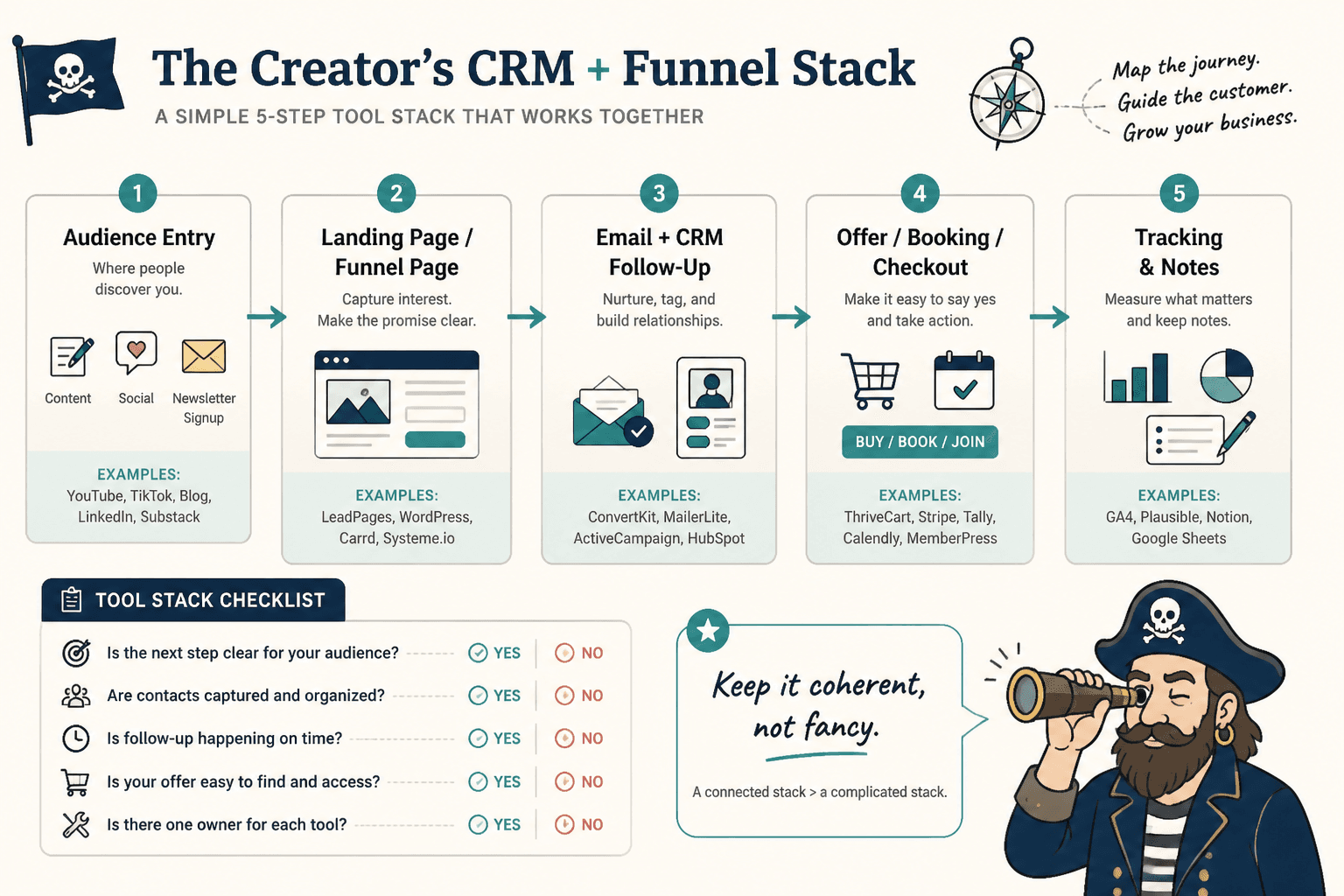
That is actually good news. It means you do not need the fanciest setup. You need a coherent one.
Keep your stack boring enough to run
There is a point where software becomes a procrastination hobby wearing a business hat.
If your audience-to-offer journey is clear, your next step is obvious, your contacts are organized, your follow-up happens on time, and your offer is easy to reach, you are already ahead of a surprising number of people with shinier setups.
So choose tools that fit your real process, not your aspirational software identity. Use a CRM when relationships and follow-up matter. Use a funnel builder when page flow and conversion path matter. Use an all-in-one if simplicity matters most. And if email is doing the heavy lifting, admit that and build around it.
Good systems are usually a little boring. That is fine. Boring systems tend to work. Chaotic “power stacks” tend to become expensive furniture.
FAQ
Do I need both a CRM and a funnel builder?
Not always. If your business is relationship-led, a CRM may matter more. If your business sells through pages and email, a funnel builder or email platform may be enough.
What is the best setup for coaches and consultants?
Usually a CRM-first setup with forms, scheduling, simple landing pages, and follow-up automation. You need lead tracking more than flashy funnel design.
What is the best setup for creators selling digital products?
A funnel builder plus email automation is often the cleanest option. You want easy page creation, checkout flow, and post-purchase follow-up.
The bigger point is simple: clearer structure and clearer writing make the piece more useful. That is usually what makes the ending land better too.