Most creator funnels do not fail because the landing page button is the wrong shade of blue. They fail because the funnel does not match the way the creator actually builds trust.
A lot of people bolt random funnel parts onto their content and hope it turns into revenue. A lead magnet here, a Calendly link there, an email sequence they barely remember writing, and suddenly the whole thing feels like a garage full of mismatched furniture. Technically, yes, it is all furniture. No, it does not make a good house.
The best funnel ideas to pair with creator funnels are the ones that fit your audience, your offer, and your content style. Not the ones that sound smartest on a marketing podcast. Not the ones built for VC-backed SaaS. And definitely not the ones that ask cold readers to make warm-buyer decisions.
This article will help you choose funnel pairings that actually make sense for creators, consultants, coaches, solo founders, and personal brands. You will see which funnel types fit which goals, where people overcomplicate things, and how to connect content, profile, lead capture, nurture, and sales without making your audience feel like they just wandered into a badly disguised trap.
If you need a broader foundation first, start with creator funnels guide for creators who want better results or the main creator funnels hub. If you want more examples after this, best creator funnels ideas and examples for creators is worth your time too.
For the main guide behind this topic, visit the parent guide.
What “pairing” means in creator funnels
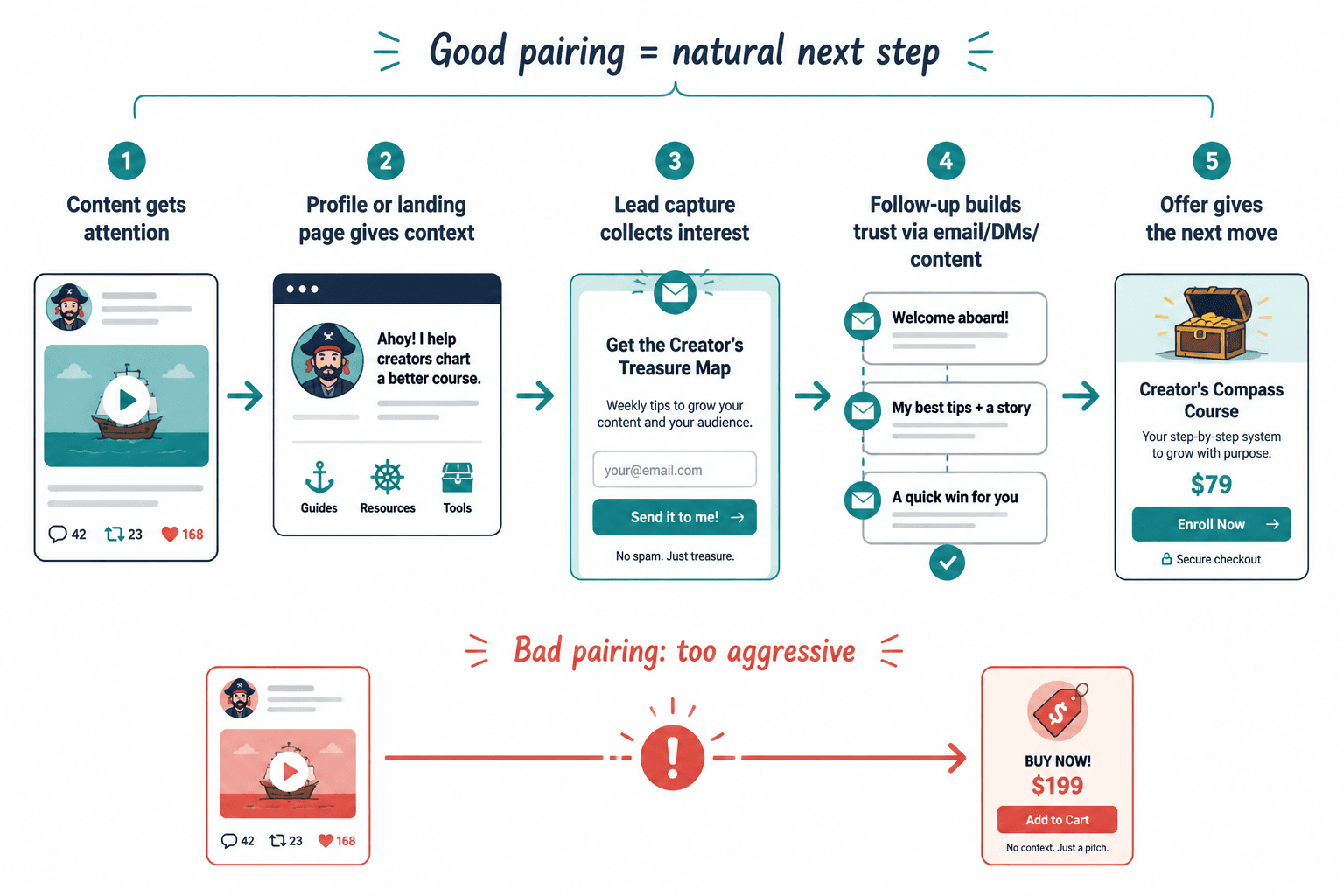
A creator funnel is rarely just one thing. It is usually a chain.
- Content gets attention
- A profile or page gives context
- A lead capture step collects interest
- Email, DMs, or follow-up content builds trust
- An offer gives people a next move
Pairing means choosing the right next step after attention. That is the piece people mess up all the time. They create solid content, then attach a funnel that feels too aggressive, too vague, too complicated, or too disconnected from what the audience actually wanted.
Good funnel pairing feels natural. The person reads the post, watches the video, or sees the thread and thinks, “Yep, that next step makes sense.” Bad funnel pairing feels like content was the free sample and the next click dropped them into a hostage situation.
The simplest rule: pair the funnel with buyer readiness
Before you choose any funnel idea, ask one question: how ready is this person to buy?
This matters more than funnel hacks, page builders, and whatever “tripwire” someone is trying to sell you. A person who just discovered you from one helpful post is usually not ready for the same next step as someone who has read your emails for three weeks and already knows what you do.
Here is the basic breakdown.
| Audience state | Best next step | Usually a bad next step |
|---|---|---|
| Cold attention | Lead magnet, newsletter, low-friction resource | Hard sales call |
| Warm interest | Case study, workshop, email series, soft application | Generic “book now” page with no context |
| High intent | Consultation, offer page, audit, direct purchase | Making them jump through five nurture steps first |
| Existing audience trust | Product launch, service pitch, webinar, offer sequence | Overexplaining basic credibility |
If your creator funnels feel clunky, this is usually the leak. You are asking for the wrong commitment at the wrong moment.
Best funnel ideas to pair with creator funnels by goal
The best funnel ideas to pair with creator funnels depend on what you are trying to get from the audience: leads, calls, sales, replies, email subscribers, or authority. Same creator. Different goal. Different funnel.
1. Content to newsletter funnel
This is one of the strongest pairings for creators who build trust through ideas. You post useful content, the audience likes your thinking, and the next step is simple: subscribe for more insight, examples, or deeper breakdowns.
Why it works: it is low-friction and trust-friendly. You are not asking strangers to marry you after one good carousel.
Best for:
- Writers
- Consultants
- Coaches
- B2B creators
- Personal brands with a clear point of view
Good pairing structure:
- Post or thread with a strong opinion or practical lesson
- Profile link to newsletter page
- Welcome sequence with 3 to 5 useful emails
- Soft CTA to service, product, or call
This works especially well when your content naturally leaves room for a deeper follow-up. If the post says, “Here is the core idea,” the email can say, “Here is how to actually use it.”
2. Content to lead magnet funnel
This is the classic one, and despite years of terrible PDFs, it still works when the resource solves a real problem fast.
The mistake is making the lead magnet too broad, too long, or too fluffy. A creator audience does not need another 27-page “ultimate guide” full of inflated subheadings and stock-photo ambition. They need something they can use today.
Best lead magnet formats for creators:
- Checklist
- Template pack
- Swipe file
- Mini framework
- Prompt set
- Audit sheet
- Short email course
Good pairing structure:
- Helpful post about a specific pain point
- CTA to a tightly related resource
- Simple landing page
- Nurture sequence that expands on the resource
- Offer CTA once trust is earned
If you need help building the actual assets, best templates and tools for creator funnels can help shorten the setup time without turning your funnel into generic sludge.
3. Content to booking page funnel
This is the direct route. It can work very well for consultants, coaches, strategists, and service providers, but only if the content already does a lot of the trust-building work.
If your audience is warm and your offer is clear, sending people straight from content to a booking page can be efficient. If your audience is cold, it often dies on impact.
Best for:
- Established personal brands
- Niche consultants
- High-ticket service providers
- Creators with clear problem-solution positioning
Make it work by adding context before the booking step:
- Case studies
- Short proof posts
- Clear “who this is for” language
- A service page that explains outcomes, not just calls itself premium
A booking page is not a funnel by itself. It is just a door. The content before it needs to make people want to walk through it.
4. Content to low-ticket product funnel
This pairing works well when your audience wants a quick win and your offer is easy to understand. Think templates, workshops, mini-courses, audits, resource packs, or a focused digital product.
It is often better than forcing every new subscriber into a long nurture sequence when the audience already has high intent. Sometimes people do not need six educational emails. They need the thing.
Good pairing structure:
- Post identifies a costly or annoying problem
- Product positioned as a shortcut or system
- Sales page stays tight and specific
- Post-purchase upsell or follow-up leads to bigger offer
This can also act as a trust filter. People who buy a small product are often more qualified for a larger offer later.
5. Content to webinar or workshop funnel
This is useful when your offer needs explanation, objection handling, or demonstration. It works well for teaching-based creators, especially when the audience benefits from seeing the method in action.
What it does well:
- Builds authority
- Gives proof through teaching
- Warms up skeptical buyers
- Creates a clear sales moment without making every post a pitch
What people do wrong: they turn the workshop into 45 minutes of filler and 10 minutes of awkward selling. That old formula is tired. Teach something useful, show the limitations of doing it alone, then present the offer cleanly.
6. Content to application funnel
This is a good fit for higher-ticket offers where you want some qualification before the sale. It works best when demand is real, your positioning is strong, and the audience already sees you as credible.
Use this for:
- Group programs
- Premium coaching
- Done-for-you services
- Retainers
- Strategy intensives
The application should not feel like a bureaucratic punishment. Ask only what helps you qualify, personalize, and close. Some creators act like they are vetting candidates for a secret society. Relax.
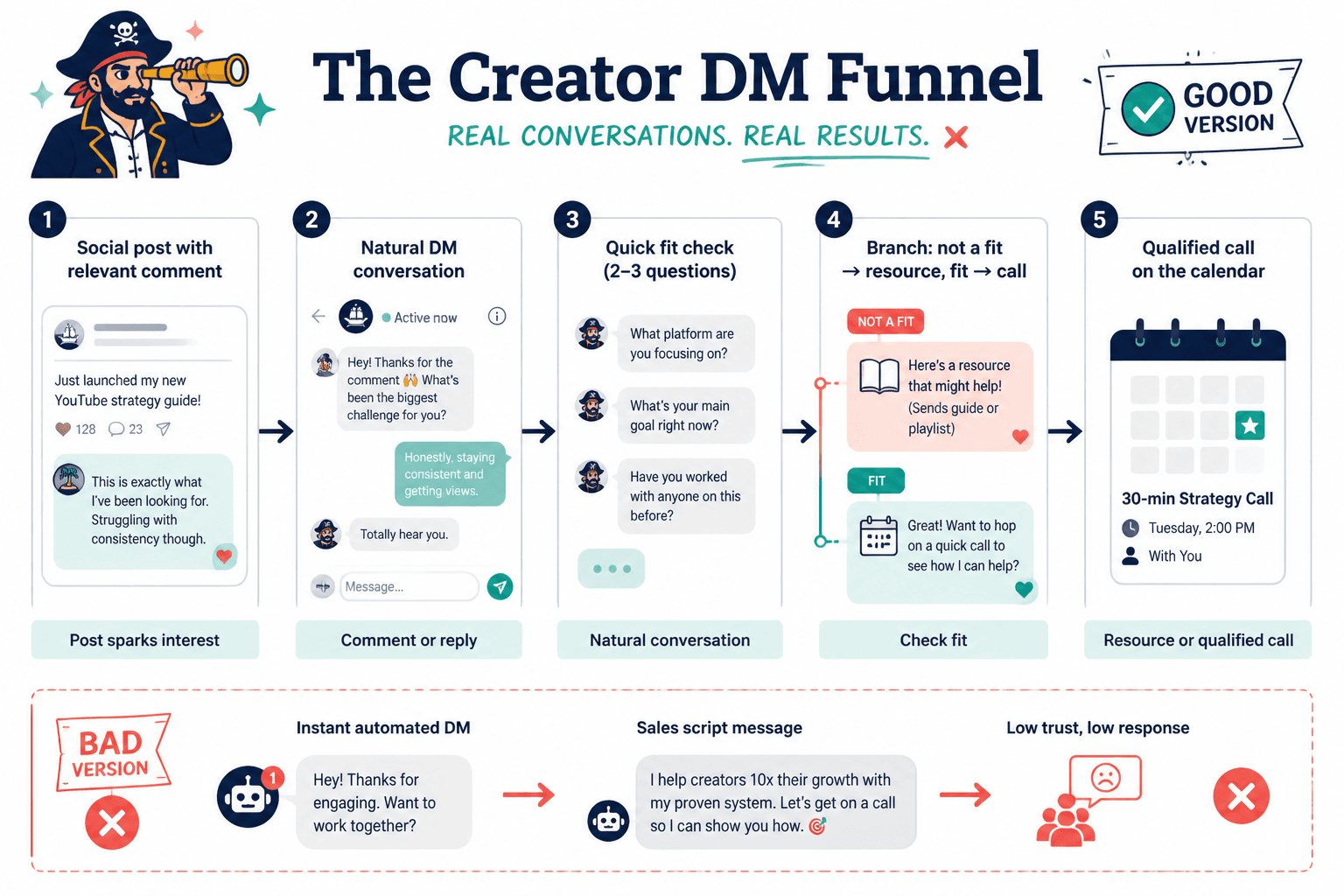
7. Content to DM conversation funnel
This can work beautifully when done like a human and terribly when done like a growth bro with a spreadsheet.
A DM funnel makes sense when the sale needs context, the audience is relatively small, or the creator’s business is built on relationships. It is especially useful for consultants, freelancers, and service businesses where one conversation can uncover fit fast.
Good version:
- Post sparks relevant interest
- Reader replies or comments
- You continue the conversation naturally
- If fit exists, you move to a resource, call, or offer
Bad version:
- “Comment GUIDE and I’ll DM you”
- Auto-message arrives instantly
- The message is a disguised sales script
- Trust evaporates in under 30 seconds
People are not allergic to DMs. They are allergic to being handled.
The best pairings by creator business model
Not every creator should use the same funnel stack. Business model matters.
For coaches
- Content to newsletter to consultation
- Content to workshop to program application
- Content to lead magnet to nurture to discovery call
Coaching usually needs trust, context, and fit. Cold audiences often need more than a booking link and a vague promise about transformation.
For consultants
- Content to case study to booking page
- Content to audit lead magnet to consultation
- Article to newsletter to service page
Consultants sell expertise and clarity. The funnel should prove those fast. Case studies and sharp problem framing usually outperform inspirational fluff by a mile.
For digital product creators
- Content to low-ticket product
- Content to free resource to tripwire product
- Newsletter to launch sequence to product sale
If the product solves an obvious problem, keep the path short. Too much nurture can lower momentum.
For service freelancers
- Content to portfolio or proof page to inquiry
- Content to DM conversation to proposal
- Content to mini audit resource to booked call
Freelancers often do better with targeted, high-relevance funnels than broad audience-building systems. You do not need 50,000 followers. You need the right 50 people seeing the right proof.
For personal brands selling mixed offers
- Content to newsletter as the central funnel
- Email segments based on interest
- Offers introduced based on behavior or topic
If you sell multiple things, the newsletter often becomes the best middle layer. Social content gets attention, email organizes intent, and the right offers can be introduced without confusing everyone up front.
How to choose the right funnel pairing without overthinking it
You do not need a whiteboard full of arrows to make this decision. Use this simple filter.
1. Start with the offer
What are you actually trying to sell?
- If it is expensive, trust needs to be higher.
- If it is simple and low-risk, the path can be shorter.
- If it needs explanation, use a funnel that teaches.
- If fit matters a lot, use qualification.
2. Look at the content type
Different content creates different kinds of intent.
- Opinion posts create curiosity and positioning
- How-to posts create practical interest
- Case studies create buying confidence
- Personal stories create emotional trust
- Threads and articles can pre-sell deeper offers
The next step should match the kind of trust the content created.
3. Measure audience warmth honestly
This is where creators lie to themselves. They think because a post got good engagement, people must be ready to buy. Not necessarily. A lot of engagement is curiosity, agreement, or polite applause. Buying intent is different.
If your audience is still mostly cold, use a softer funnel. If they already know your work, ask for a bigger step.
4. Reduce friction at the next step
Every extra field, page, click, and vague sentence lowers conversion. The best creator funnels are usually not the fanciest. They are the clearest.
That means:
- One clear next action
- Strong message match between post and page
- Minimal confusion
- Useful context before asking for commitment
A few creator funnel combinations that work unusually well
Some pairings keep showing up because they fit how creators actually earn trust.
Helpful post → niche lead magnet → short nurture → consultation
This is strong for service providers. The post brings in the right pain point, the resource deepens trust, and the email sequence prepares people for a call without forcing the pitch too early.
Sharp opinion post → newsletter → case study email → service offer
This works well for consultants and strategists. Opinion gets attention. Email proves depth. Case study creates confidence. Offer appears once the reader understands both your thinking and your results.
Problem-aware thread → low-ticket template → upsell to course or membership
Great for education-based creators. The audience already wants a shortcut, so selling the shortcut makes sense. Then the bigger offer can help with implementation or deeper mastery.
Story post → DM conversation → application
Useful when the buyer needs nuance, fit, or reassurance. Story creates trust, DM allows context, and the application adds qualification. Very good for coaching and premium services when used with restraint.
Evergreen article → newsletter or resource → offer page
This one is underrated. Articles attract intent differently than social posts. Readers often arrive through search with a defined problem, which means a related resource or offer can convert well if it fits tightly. If you are building authority over time, this is one of the saner systems to invest in.
For tools that help you build and manage these systems without losing the plot, see best funnel tools and website tools for creator funnels.
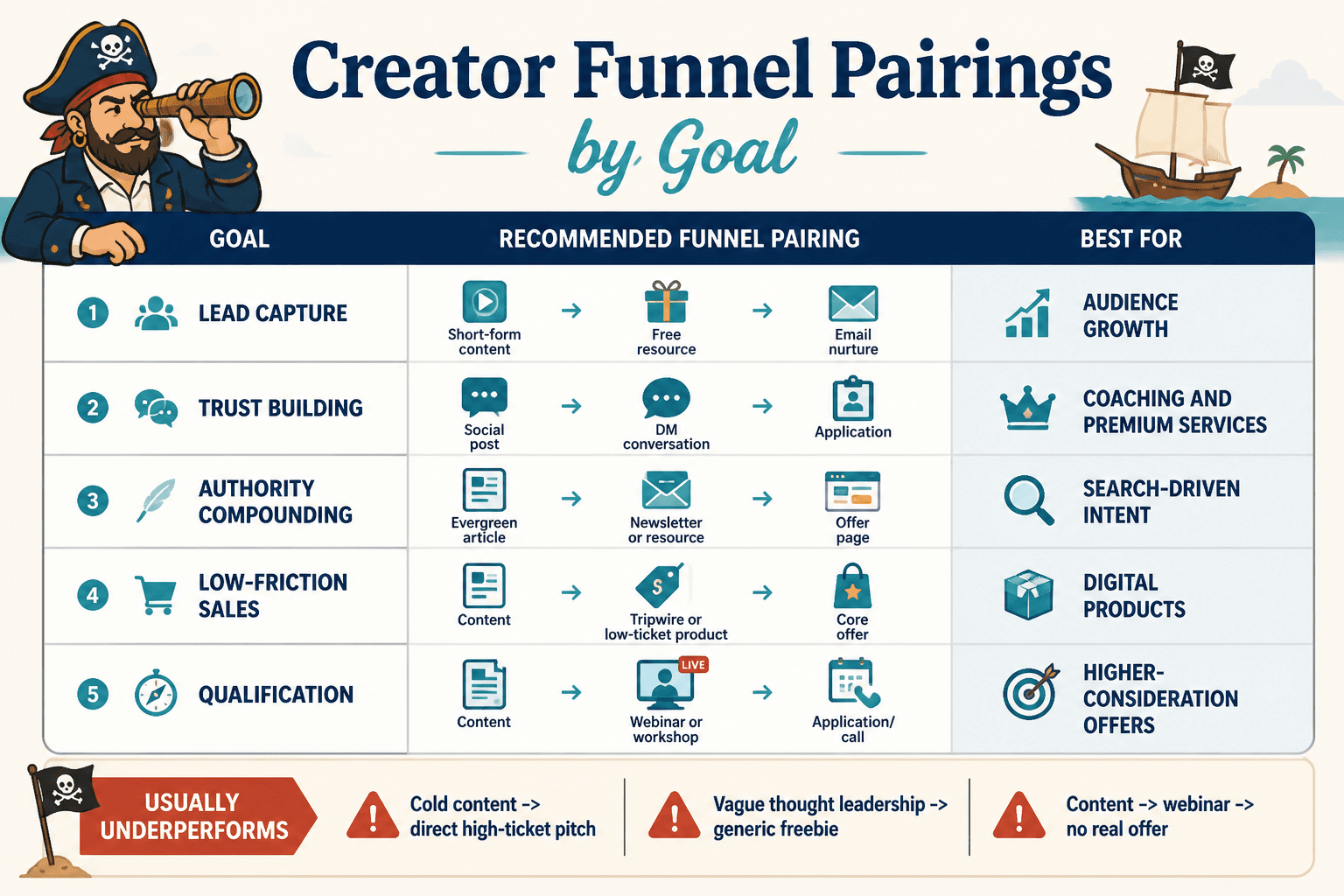
Common funnel pairings that sound smart but usually underperform
Cold content → direct high-ticket pitch
Sometimes this works if the pain is urgent and the creator is already well-known. Usually, it just feels premature.
Vague thought leadership → generic freebie
If the content is broad and the lead magnet is also broad, people have no reason to care. “Grow your brand” is not a funnel strategy. It is wallpaper.
Content → webinar → no real offer
This happens more than it should. The creator teaches a lot, gets praise, and then awkwardly says nothing specific at the end. Nice for ego. Not ideal for business.
Comment bait → auto-DM → hard close
This is one of the fastest ways to make your content feel transactional. It can also burn trust with people who might have bought later through a better path.
Long nurture sequence for an offer that should have been a direct sale
Not every product needs a five-email philosophical courtship. If the offer is clear and affordable, try a shorter path.
A practical way to build your funnel pairing this week
If you want to stop thinking about funnel architecture like it is a sacred geometry problem, do this instead.
- Pick one offer.
- Pick one audience problem tied directly to that offer.
- Create one content asset around that problem.
- Choose one next step that matches buyer readiness.
- Write one short follow-up sequence.
- Track where people drop off.
- Fix the weak step before adding new complexity.
That is enough to learn a lot. More than enough, honestly. Most creator funnels get worse when people add layers before they have evidence the basic path even works.
If you want a more complete map of categories and structures across this topic, the broader monetization funnels and funnel systems section connects well with this article too.
FAQ
What is the best funnel to start with as a creator?
A content-to-newsletter or content-to-lead-magnet funnel is usually the safest place to start. It is simple, trust-friendly, and useful for warming up future buyers.
Should creators send people straight to a sales page?
Sometimes, yes. It works best when the offer is low-friction or the audience is already warm. Cold audiences often need more context first.
Are DM funnels worth using?
Yes, if the conversation is real and the audience is relevant. No, if it is just automated comment bait wearing a fake smile.