
Most creator funnels do not fail because the tech is bad. They fail because the path is muddy, the copy is vague, and the creator keeps adding tools like that will somehow create strategy through osmosis.
If you are looking for the best templates and tools for creator funnels, what you probably actually need is a simpler system that helps people move from “this person seems smart” to “I trust them enough to subscribe, reply, book, or buy.” That is the job. Not building a 14-step automaton held together by panic and Zapier.
This guide will show you which funnel templates are worth using, which tool categories actually help, and how to match both to the kind of creator business you run. You will also get practical funnel templates you can steal, tweak, and use without turning your audience experience into a sad little obstacle course.
For the main guide behind this topic, visit the parent guide.
What a creator funnel actually needs
A creator funnel is not just “content plus a link in bio.” It is the path from attention to action.
That path usually includes a few basic pieces:
- A traffic source like LinkedIn, X, Facebook, articles, YouTube, podcast appearances, or search
- A next step such as a lead magnet, newsletter, free resource, waitlist, booking page, or low-ticket offer
- A trust layer like emails, case studies, examples, testimonials, or useful follow-up content
- A conversion point like a call, application, digital product, service page, cohort, or paid offer
That is it. The basics are not glamorous, which is probably why people keep trying to replace them with software.
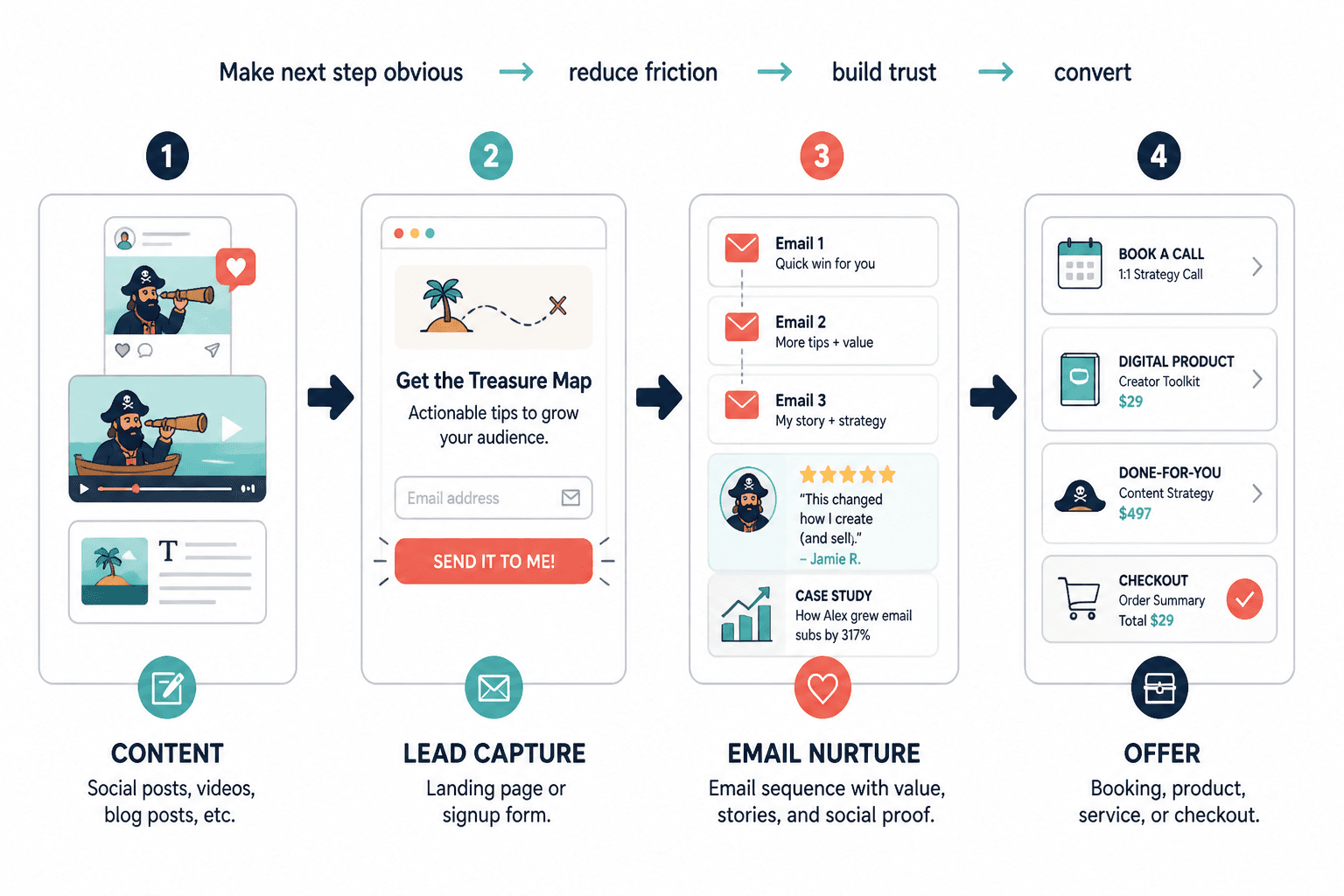
The best templates and tools for creator funnels help you do four things better:
- Make the next step obvious
- Reduce friction
- Capture interest without being annoying
- Nurture trust until someone is ready
If a tool does not improve one of those four things, it is probably productivity cosplay.
The smartest way to choose funnel templates
Before tools, start with the funnel shape. Too many creators pick software first, then cram their business into whatever the dashboard seems to prefer. That is backwards.
Choose your template based on three things:
- Your offer type: service, course, productized service, digital product, membership, workshop, consulting, or speaking
- Your audience temperature: cold, warm, or already familiar
- Your sales style: self-serve, soft nurture, consultative, or application-based
For example, if you sell consulting, your funnel probably does not need six post-purchase upsells and a countdown timer. You probably need stronger authority content, a clean lead capture path, and a booking process that does not feel like filing taxes.
If you sell a low-ticket digital product, you may need less nurturing and more clarity. The offer should make sense fast. People should be able to buy before they forget they were interested.
5 creator funnel templates that actually work
These are not the only funnel models. They are just the ones that tend to survive contact with reality.
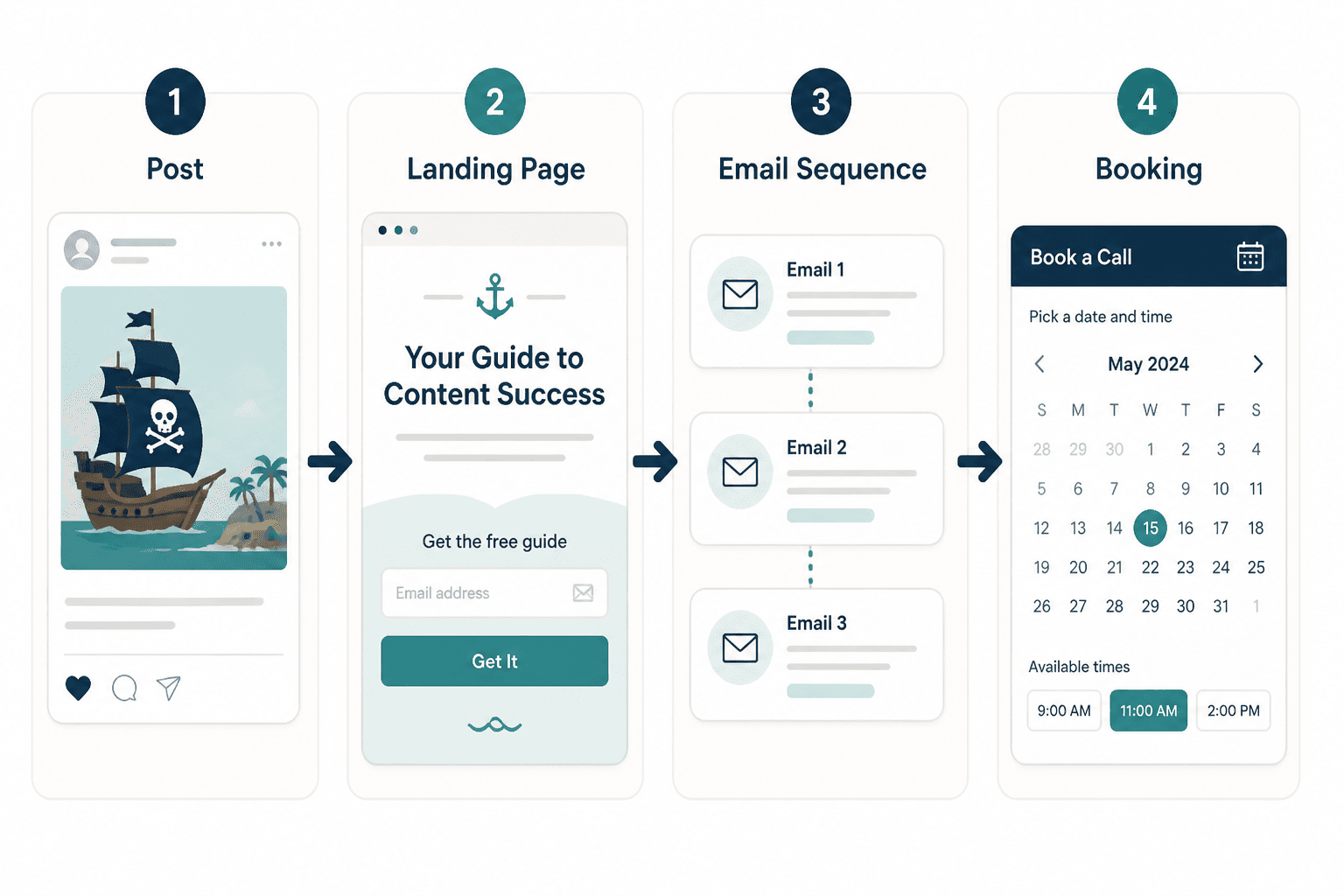
1. Content to lead magnet to email nurture to offer
This is the classic creator funnel for a reason. It works well for coaches, consultants, service providers, writers, educators, and niche creators with expertise people need to trust first.
- Post useful content
- Offer a relevant free resource
- Collect email signups
- Send a short nurture sequence
- Present a paid offer
Best for: expertise-led offers, warm lead generation, trust-heavy sales
Common mistake: the freebie attracts bargain hunters, not buyers, because it is too broad or too generic
If your lead magnet is called something like “The Ultimate Success Guide,” congratulations, you have built a nice little trap for people who enjoy downloading PDFs and changing nothing.
2. Content to newsletter to soft pitch
This is a great fit if you write often, think clearly, and do not want every call to action to sound like a low-budget infomercial. Instead of bribing people with a free download, you invite them into an ongoing stream of useful content.
- Create platform content
- Send readers to your newsletter
- Build trust over time
- Pitch when relevant
Best for: writers, creators with strong opinions, solo founders, consultants, audience-building
Common mistake: no clear offer path, so the newsletter becomes a nice little hobby with excellent open rates and no revenue
3. Content to booking page
This is the simple service funnel. It works when your audience already understands the problem and your content creates enough confidence for a conversation.
- Publish insight-driven content
- Direct readers to a call booking page
- Qualify with a short form
- Sell on the call or after it
Best for: consultants, coaches, strategists, freelancers, high-trust services
Common mistake: asking cold audiences to book before they know why you are worth speaking to
4. Content to low-ticket product to upsell
This is useful if you sell templates, prompt packs, mini-courses, audits, swipe files, or other quick-buy products. The goal is to turn attention into a smaller purchase, then offer a bigger next step.
- Create problem-aware content
- Send traffic to a low-ticket offer
- Deliver a quick win
- Upsell a larger product or service
Best for: digital creators, educators, productized services, product ladders
Common mistake: the low-ticket product is so cheap, vague, or flimsy that it lowers trust instead of raising it
5. Article or thread to case study to consultation
This one works especially well for B2B creators, ghostwriters, strategists, funnel builders, designers, and niche operators. You publish deeper authority content, connect it to proof, and then offer a next step.
- Write an article or thread on a specific problem
- Link to a related case study or proof asset
- Invite qualified people to inquire or book
Best for: authority-building, premium services, trust-sensitive markets
Common mistake: content is smart but detached from any actual commercial path
If you want more practical setups, examples, and working structures, read best creator funnels ideas and examples for creators and simple creator funnels offer paths templates for busy creators.
The best templates for each stage of a creator funnel
Templates are useful when they remove blank-page friction. They are not useful when they turn your brand into another copy-paste funnel wearing slightly different fonts.
Here are the most useful template types by funnel stage.
| Funnel stage | Best template type | What it should help you do |
|---|---|---|
| Top of funnel | Post and article CTA templates | Turn attention into a clear next step |
| Lead capture | Landing page templates | Explain the value fast and collect the signup |
| Nurture | Email sequence templates | Build trust without rambling for seven emails |
| Conversion | Sales page, booking page, or application templates | Move the right person to action |
| Follow-up | DM, email reply, and onboarding templates | Keep momentum without sounding canned |
1. CTA templates
These are underrated because everyone chases the hook and forgets the handoff. A great post with a weak CTA is like giving a strong talk and then walking into a hedge.
Useful CTA template structures:
- Problem to resource: “If you are dealing with X, I made Y to help.”
- Topic to next step: “If this is the part you are stuck on, start here.”
- Insight to offer: “If you want help applying this to your business, here is the next step.”
- Case study to consultation: “If you want this kind of outcome, book a call.”
2. Landing page templates
A good landing page template should give you a clear structure, not write fake persuasion sludge on your behalf.
Strong landing page sections usually include:
- A clear headline tied to one problem
- A short subhead that explains the result or value
- 3 to 5 bullets on what is inside
- Who it is for
- Why it is useful now
- A simple form or button
Weak landing pages usually fail because they ask the reader to decode the offer. Do not make people perform interpretive marketing just to decide if they should subscribe.
3. Email nurture templates
You do not need a 37-email sequence unless your business model is “send things until they block me.” Most creators need a short sequence that does three jobs:
- Deliver the promised thing
- Frame the problem in a sharper way
- Point toward the paid solution when appropriate
A practical 5-email nurture sequence template:
- Email 1: Deliver resource and set expectations
- Email 2: Explain a common mistake
- Email 3: Share a useful framework or example
- Email 4: Add proof, case study, or client pattern
- Email 5: Soft pitch the next step
4. Booking page templates
A booking page should not read like a mission statement had a baby with a vague brochure. It should quickly answer:
- Who this is for
- What the call is about
- What happens after booking
- Who should not book
This filters better leads and saves you from calls that should have remained emails.
5. Sales page templates
If you are selling a course, productized service, paid workshop, or digital resource, a sales page template can save time. Just make sure it supports clarity rather than forcing every offer through the same bro-funnel skeleton.
Good sections include:
- Problem-aware headline
- What the offer helps someone do
- What is included
- Who it is for and not for
- Proof or credibility
- Price and next step
- FAQ
The best tool categories for creator funnels
You do not need one perfect tool. You need a clean stack with as few moving parts as possible. Tool sprawl is one of the fastest ways to build a funnel you avoid touching because every update requires a minor spiritual crisis.
Here are the tool categories that matter most.
Landing page and website tools
These tools host opt-in pages, sales pages, and service pages. The best ones make it easy to publish clean pages fast, edit copy without friction, and connect forms to email tools.
Use them for:
- Lead magnet pages
- Sales pages
- Waitlists
- Bio-link pages
- Booking pages
Look for:
- Fast page editing
- Good mobile display
- Simple forms
- Email integrations
- Low friction publishing
For a deeper breakdown, see best funnel tools and website tools for creator funnels.
Email marketing tools
Email tools handle list growth, nurture sequences, broadcasts, segmentation, and automations. If your funnel includes trust-building, this category matters more than yet another social scheduler.
Use them for:
- Welcome sequences
- Nurture emails
- Launch emails
- Audience segmentation
- Automated follow-up
Look for:
- Easy automation setup
- Clean writing experience
- Tagging or segmentation
- Basic analytics
- Good deliverability reputation
Form and lead capture tools
Forms matter more than people think. A clunky form kills momentum. A smart one qualifies leads and makes follow-up easier.
Use them for:
- Lead magnet opt-ins
- Application forms
- Client intake
- Quiz funnels
- Waitlist collection
Look for:
- Custom fields
- Conditional logic if needed
- Easy embedding
- CRM or email integrations
- Low-friction user experience
Scheduling and booking tools
If your funnel ends in a consultation, demo, strategy call, or intro session, booking tools matter. The job is simple: reduce back-and-forth, set expectations, and make the appointment feel legitimate rather than improvised.
Use them for:
- Discovery calls
- Consultation bookings
- Paid session scheduling
- Application follow-ups
Look for:
- Calendar sync
- Reminder emails
- Intake questions
- Timezone handling
- Payment support if needed
CRM and pipeline tools
Once leads start coming in, you need a basic way to track who is interested, who replied, who booked, and who disappeared into the mist. This is not glamorous work, but it is the difference between “content is not converting” and “I forgot to follow up with six warm leads.”
Use them for:
- Lead tracking
- Pipeline stages
- Follow-up reminders
- Basic sales visibility
- Contact history
Look for:
- Simplicity
- Clear stages
- Manual notes
- Email integrations
- No enterprise nonsense you will never use
AI and writing tools
These are useful for speed, variation, cleanup, repurposing, and outlining. They are not useful as a substitute for positioning, judgment, or knowing what your audience actually needs.
Use them for:
- Landing page draft structures
- Email subject line variations
- CTA options
- Repurposing content into funnel assets
- Editing for clarity
Do not use them for:
- Inventing fake authority
- Writing your offer positioning from scratch
- Generating generic lead magnets nobody wants
- Replacing proof, taste, or customer insight
If that is the area you want help with, read best AI tools for creator funnels.
A simple creator funnel tool stack by business model
You do not need the same stack if you sell coaching as if you sell templates. Here is a practical way to think about it.
| Business model | Useful stack | Main goal |
|---|---|---|
| Coach or consultant | Content tool, landing page, email tool, booking tool, CRM | Turn attention into calls and qualified leads |
| Writer or newsletter creator | Content tool, newsletter platform, simple landing page, optional product checkout | Grow audience and monetize through email |
| Digital product creator | Content tool, sales page builder, checkout, email tool, basic upsell flow | Convert attention into low-friction purchases |
| Freelancer or service provider | Content tool, case study page, booking form, CRM, onboarding flow | Generate and manage warmer inbound leads |
| Educator or course creator | Landing page, email nurture, webinar or workshop flow, sales page, checkout | Build trust before larger conversions |
The more complex your funnel gets, the more important maintenance becomes. Keep that in mind before you build a machine you will resent by Thursday.
How to pick the right tool without wasting a week comparing dashboards
Most tool comparisons overcomplicate this. You are not selecting a life partner. You are choosing software that should quietly support a clear business process.
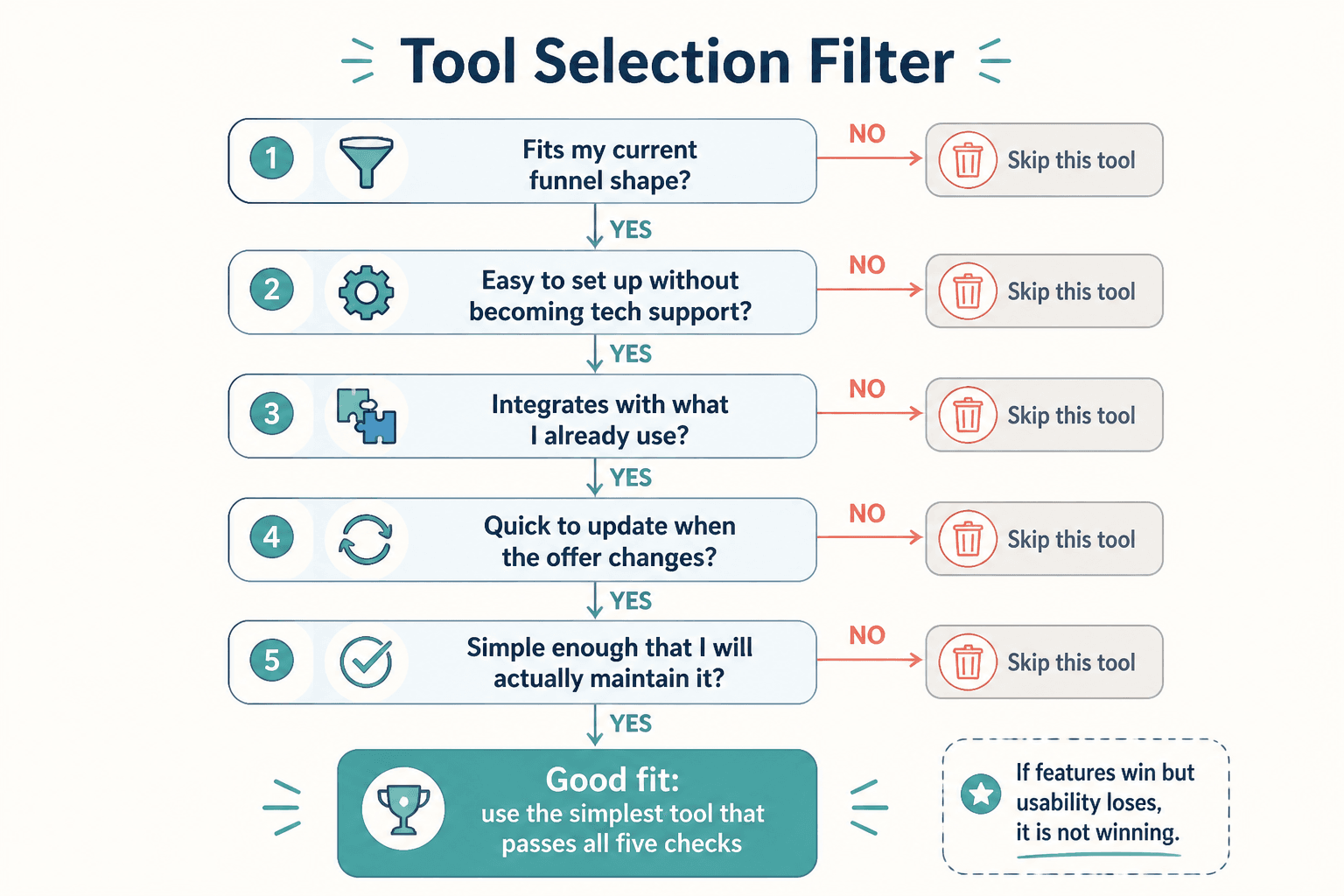
Use this filter:
- Does it fit my current funnel shape?
- Can I set it up without becoming tech support for my own business?
- Does it integrate with what I already use?
- Can I update it quickly when the offer changes?
- Is it simple enough that I will actually maintain it?
If a tool wins on features but loses on usability, it is not winning.
There is also a more uncomfortable truth here: a lot of creators keep switching tools because it feels more productive than fixing the messaging. New software is fun. Clarifying your offer is work. Unfortunately, the second one tends to make more money.
A plug-and-play funnel template you can adapt this week
If you want something practical, use this.
The authority lead funnel
- Traffic source: LinkedIn posts, X threads, articles, or Facebook posts
- CTA: invite readers to a specific free resource
- Landing page: one clear headline, 3 to 5 bullets, opt-in form
- Email sequence: 5 emails over 7 to 10 days
- Offer: consultation, audit, workshop, or service page
- Follow-up: CRM note, reply handling, booking flow
Example structure:
- Post: “Why most creator funnels stall after the first click”
- CTA: “I made a simple funnel map for creators who want a cleaner path from content to clients”
- Lead magnet: one-page creator funnel planner
- Email 1: send planner and explain how to use it
- Email 2: explain the biggest funnel leak
- Email 3: show a before-and-after example
- Email 4: share a short case study or client pattern
- Email 5: invite readers to book a funnel review
This is not fancy. That is part of the appeal.
Common mistakes when using templates and tools for creator funnels
- Using templates as strategy: a good template supports a strong idea. It cannot invent one.
- Adding too many steps: every extra click is a chance for someone to leave.
- Collecting leads with no follow-up plan: an opt-in without nurture is just digital hoarding.
- Sending all traffic to one generic page: different content angles often need different next steps.
- Buying tools before testing the offer: validate the path before you automate it.
- Ignoring the copy: funnel performance is often a messaging problem pretending to be a tooling problem.
That last one shows up constantly. Creators will spend hours comparing landing page builders while their headline still says almost nothing. If the promise is fuzzy, no button color on earth is rescuing it.
Where these tools fit into your bigger funnel system
The best templates and tools for creator funnels are only useful when they sit inside a clear system. Content brings people in. The profile or page gives them a next step. Email or proof deepens trust. The offer gives them a clean action. Then your backend helps you follow up without dropping warm leads on the floor.
If you want the broader structure behind all of this, start with the main creator funnels hub. You can also browse the larger monetization funnels and funnel systems collection if you are building the full path rather than just cleaning up one stage.
FAQ
What is the best funnel template for most creators?
Usually, content to lead magnet to email nurture to offer. It is flexible, trust-friendly, and works for many service and expertise-led businesses.
Do I need expensive tools to build a creator funnel?
No. A simple landing page tool, email tool, booking tool, and lightweight CRM are often enough.
Creator funnels get better when the path feels simpler and the writing makes each next step obvious. A cleaner message usually fixes more than extra funnel complexity ever will.