
Most lead magnets do not fail because the information is bad. They fail because the opening feels like a polite cough before nothing interesting happens.
You have probably seen the format. A vague welcome. A flat promise. A few lines about why this guide exists. Maybe a sentence about how “in a fast-changing world” people need better systems. By that point, the reader is already half gone, and this was supposed to be the thing that earned their email.
If you want to learn How to Start Lead Magnets Without a Weak Opening, the fix is not making the intro longer or sounding more professional. It is making the first few lines do real work. They need to prove relevance fast, show that you understand the problem, and create enough forward pull that the reader actually keeps going.
This is where a lot of otherwise smart creators, coaches, consultants, and founders trip over their own shoes. They put all the useful stuff in the middle, then stuff the opening with filler. Bad trade.
Here is how to open a lead magnet so it feels sharp, useful, and worth reading from line one.
If you want the bigger picture, start with the parent guide.
What a lead magnet opening is actually supposed to do
The opening of a lead magnet is not there to “set the stage” in the slow, padded way people often mean that. It has a much simpler job.
- Confirm the reader is in the right place
- Name the real problem clearly
- Make a specific promise about what they will get
- Create momentum into the next section
That is it. Not a memoir. Not a mission statement. Not a little TED Talk about the industry. Just enough context and tension to make the rest of the lead magnet easy to read.
A strong opening lowers friction. It tells the reader, “Yes, this was made for your exact mess, and no, I am not going to waste your time first.”
If your opening does not do that, the rest of the lead magnet has to work much harder than it should.
Why most lead magnet openings feel weak
Weak openings usually come from one of three habits.
1. They start too broad
Broad intros sound safe, but they kill urgency. If your lead magnet opens with something like “Content is important for any business today,” the reader has learned nothing except that you enjoy saying obvious things with a straight face.
2. They explain instead of engage
A lot of intros spend too much time explaining what the guide is, why it was created, or who it is for in a vague way. Useful later, maybe. Not first.
3. They sound like corporate wallpaper
The minute your opening starts sounding like it was approved by five cautious marketers and one exhausted intern, trust drops. Readers want competence, not brochure energy.
A weak opening does not feel calm and professional. It feels forgettable.
If you are creating lead magnets to support offers, funnels, or trust-building content, this matters more than people think. A better opening does not just improve the reading experience. It improves perceived value. And perceived value affects opt-ins, follow-through, and conversions down the line.
That is also why it helps to look at the full lead magnets strategy, not just the PDF itself. The opening is part of the sales mechanism, even if it is not doing the selling directly.
How to Start Lead Magnets Without a Weak Opening
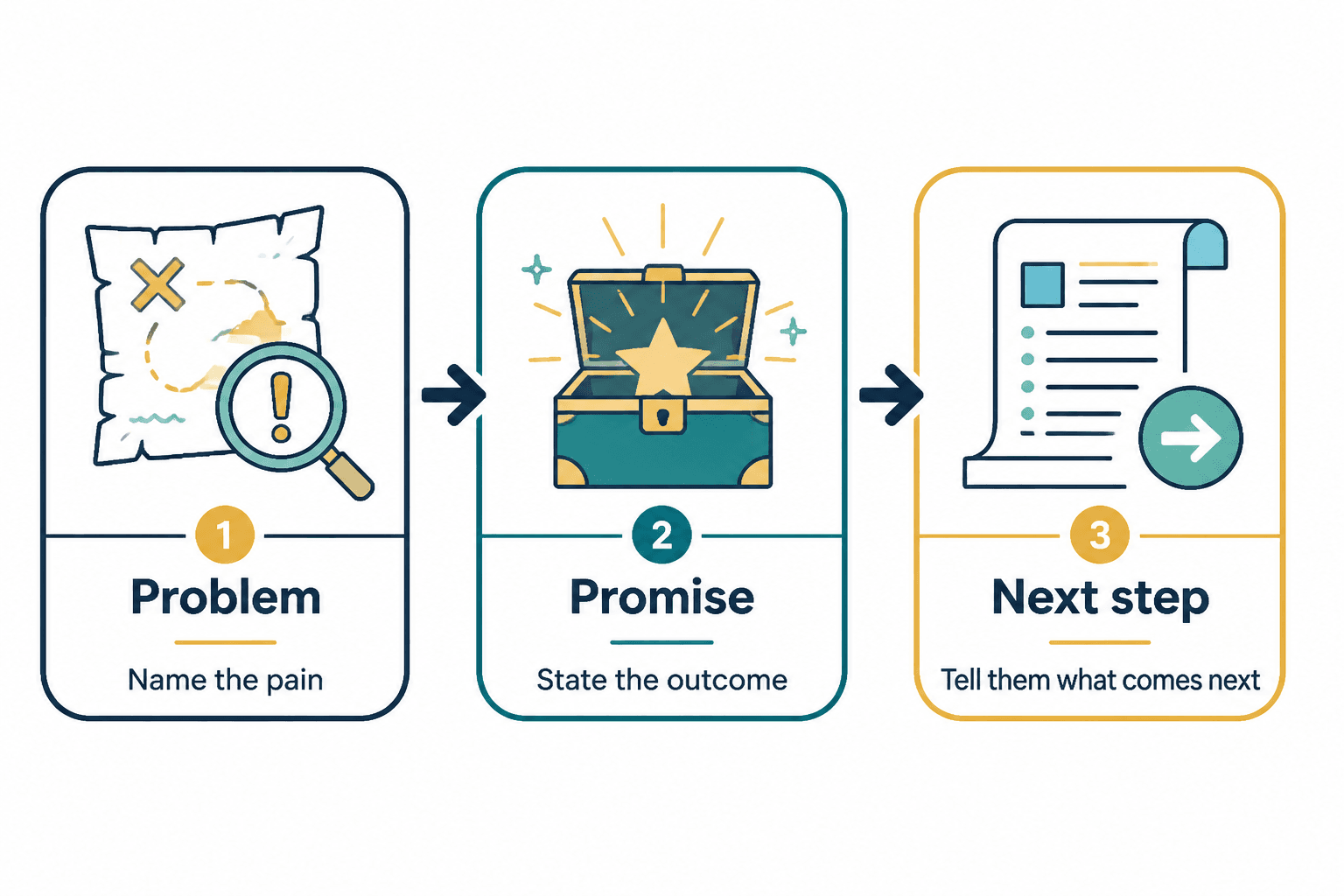
There is a simple structure that works across checklists, guides, mini playbooks, resource packs, swipe files, and short ebooks.
- Start with the specific problem
- Agitate it just enough to make it real
- Promise a useful outcome
- Tell the reader what they are about to get
- Move quickly into substance
You do not need all of that in ten lines of dramatic copy. Often you can do it in three short paragraphs.
Step 1: Start with the problem they already feel
The best openings begin where the reader already is, not where you want to begin talking.
Good example:
If your lead magnet gets downloaded but barely read, the problem probably is not the content. It is the first page. Weak openings make useful resources feel skippable before they have even started.
That works because it names a real issue fast. It is specific. It creates tension. It sounds like someone who has seen this problem in the wild, not someone writing filler to hit a page count.
Bad example:
Welcome to this guide on lead magnets. In this resource, we will explore the importance of creating compelling lead magnets for your audience.
That is not an opening. That is admin.
Step 2: Add tension, not drama
You do not need fake urgency. You do need a reason to care now.
Tension comes from consequences, friction, or wasted effort. It can sound like this:
- Your checklist might be useful, but if the first lines feel generic, people assume the rest will too.
- A soft intro can make a strong offer feel smaller than it is.
- If the opening does not earn trust quickly, your lead magnet becomes another download people “save for later” and never read.
Notice what is happening here. We are not yelling. We are just making the cost of a weak opening visible.
Step 3: Make a concrete promise
Once the problem is clear, tell the reader what this lead magnet will help them do.
Not:
This guide will help you level up your lead generation strategy.
Better:
In the next few pages, you will get a simple framework for writing lead magnet openings that sound specific, useful, and worth reading from the first sentence.
Specific beats impressive almost every time.
Step 4: Show the shape of what is coming
This is where you give the reader a clean map. Not a giant outline. Just enough to reduce uncertainty.
For example:
You will see the three opening mistakes that make lead magnets feel weak, a simple structure to replace them, and several before-and-after examples you can adapt for your own guide, checklist, or resource.
Now the reader knows what kind of value is ahead, which makes continuing feel easier.
Step 5: Get to the useful part quickly
If your opening is one full page of setup, it is too long.
Most lead magnets benefit from an intro that is tight and efficient. Enough to orient. Not enough to become the main event. If you want more help on the full build, this guide on how to write better lead magnets is a useful next step.
A simple opening formula that usually works
If you want a reusable format, use this:
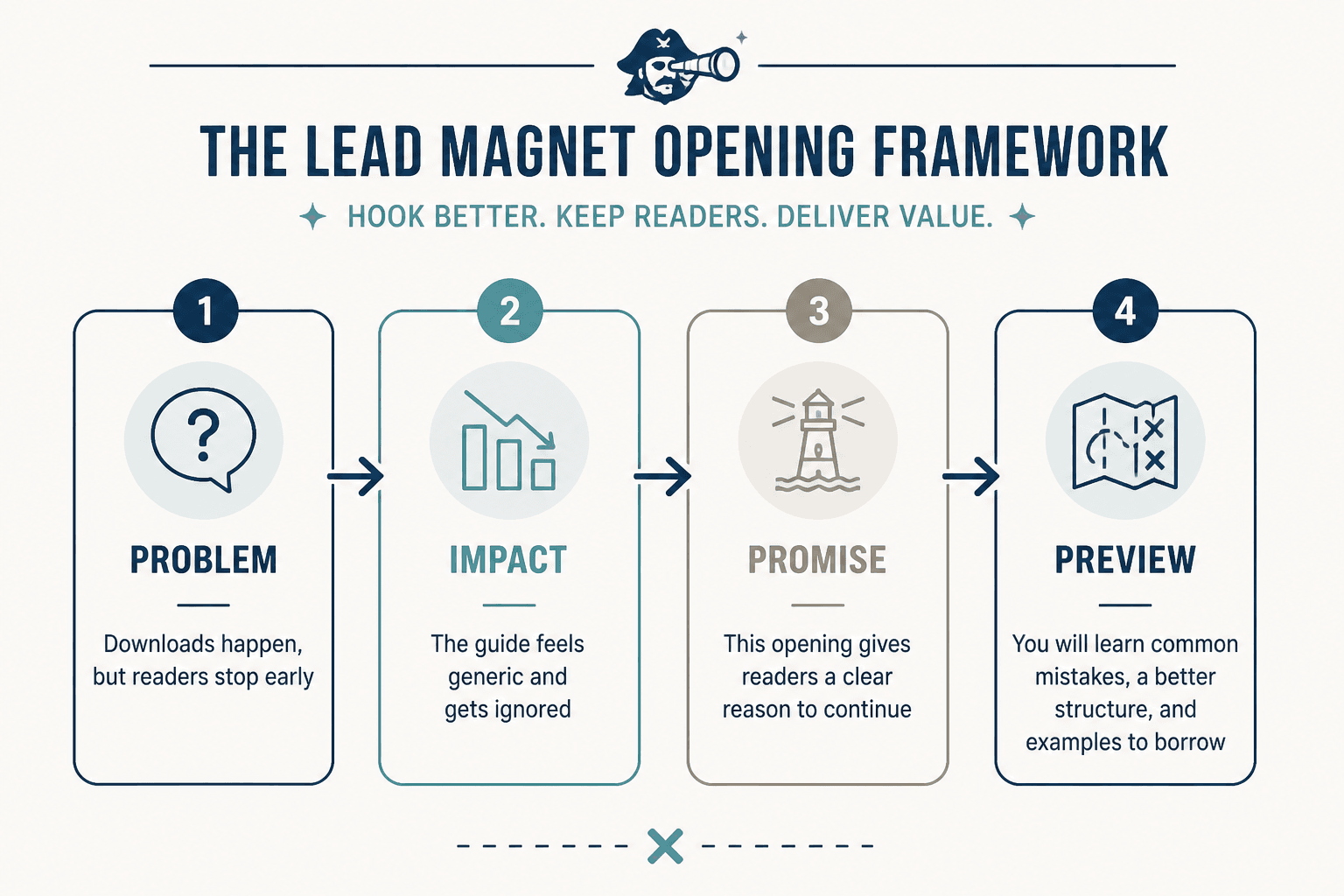
- Problem: Name what is going wrong
- Impact: Explain why it matters
- Promise: Say what this lead magnet will help them do
- Preview: Show what is inside
Here is the template:
If you are struggling with [specific problem], the issue is usually not [common assumption]. It is [actual issue]. That matters because [practical consequence]. In this guide, you will get [specific outcome] so you can [practical result]. Inside, I will show you [point 1], [point 2], and [point 3].
And here is a filled-in version:
If your lead magnet gets downloaded but ignored, the issue usually is not the topic. It is the opening. A weak first page makes the whole resource feel generic, even when the advice is solid. In this guide, you will get a simple way to open your lead magnet with more clarity and traction so readers actually keep going. Inside, I will show you the mistakes that make openings fall flat, a stronger structure to use instead, and examples you can borrow.
That is not fancy. It does not need to be. It works because it is clear, relevant, and moving.
Before-and-after rewrites for weak lead magnet openings
This is where the difference gets obvious fast.
Example 1: The vague welcome intro
Before
Welcome to this free guide on improving your content strategy. Content plays a major role in building an online brand, and this guide is designed to help you better understand how to create valuable content.
After
If you are posting regularly but getting polite silence, your content strategy probably does not need more effort. It needs better packaging and sharper positioning. This guide will show you how to make your content clearer, more relevant, and more likely to earn trust from the right people.
The rewrite starts with the pain the reader recognizes. Not a ceremonial welcome nobody asked for.
Example 2: The over-professional intro
Before
This ebook has been created to provide business owners with strategic insights into audience acquisition through lead generation assets.
After
Most lead magnets do not need more pages. They need a clearer job. This short guide will help you create a lead magnet people actually want because it solves one real problem instead of vaguely “providing value.”
The second version sounds like a human with a point. Huge improvement.
Example 3: The too-long setup
Before
Over the years, the digital marketplace has evolved significantly, creating both challenges and opportunities for business owners across industries. As competition continues to increase, it becomes ever more important to create resources that support lead generation and customer engagement.
After
If your lead magnet sounds like it could belong to anyone, it will probably convert like it belongs to no one. This guide will help you tighten the message, sharpen the promise, and make the resource feel immediately useful to the people you actually want to attract.
Shorter. Sharper. More useful. Less beige.
What to include in the first page of a lead magnet
If you want a practical checklist, here is what the first page usually needs after the title.
- A clear problem statement
- A sharp line about why that problem matters
- A specific promise
- A quick preview of what is inside
- A fast transition into the first useful section
What it usually does not need:
- A long personal introduction
- A mission paragraph about your business
- Three paragraphs of industry context
- Big claims with no specifics
- An “I am excited to share this with you” opener
If you are tempted to open with your credentials, pause. Authority matters, but in most lead magnets it works better after relevance is established. Readers care who you are more once they are convinced you understand their problem.
How long should the opening be?
Shorter than most people make it.
For many lead magnets, the opening can be 80 to 200 words and do the job well. If the asset is more strategic, more premium, or more complex, you may need a little more room. But the opening should still earn every line.
If you want deeper guidance on length across different resource types, this breakdown on how long lead magnets should be will help you avoid turning a useful freebie into a sleepy booklet.
Opening styles that work well for different lead magnet types
Checklist
Keep it tight. The opening should quickly explain what this checklist helps the reader avoid, fix, or complete.
If you are about to publish a lead magnet and want it to feel polished before it goes live, use this checklist to catch the gaps that make opt-ins feel weak, generic, or half-finished.
Guide or mini ebook
You can use a little more setup, but keep the focus on problem, promise, and direction.
Template or swipe file
The opening should frame the use case fast. Readers want to know when to use this, why it works, and how to adapt it.
These templates are for creators who know what they want to say but keep packaging it in a way that sounds flatter than the idea deserves.
Resource list or tool kit
Lead with curation value. Explain how this saves time, reduces confusion, or helps the reader avoid bad choices.
If you need inspiration for the asset itself before polishing the intro, these lead magnet ideas and examples for creators are a solid place to start.
Common mistakes that weaken the opening fast
Lead magnets work best when they solve one real problem cleanly and make the next step feel natural. The clearer the bridge from free value to real offer, the stronger the whole system gets.
Lead magnets work best when they solve one real problem cleanly and make the next step feel natural. The clearer the bridge from free value to real offer, the stronger the whole system gets.