
Most lead magnets are not underperforming because they are too short.
They are underperforming because they take too long to become useful.
That is the real question behind How Long Should Lead Magnets Be in 2026? Not “How many pages should this PDF be?” Not “What does the algorithm like?” Not “What length feels premium?” Just this: how fast can someone get a useful win, believe you know what you’re doing, and want the next step?
In 2026, attention is still fragmented, inboxes are still cluttered, and nobody is sitting there hoping your freebie turns into a surprise novella. People want useful, specific, quick-to-consume help. If your lead magnet is long, it needs to earn that length. If it is short, it needs to punch above its weight.
Here’s how to decide the right length for a lead magnet based on what it is supposed to do, who it is for, and how much friction your audience will tolerate before they quietly ghost you.
For the broader learning path, visit our parent guide.
How Long Should Lead Magnets Be in 2026? The short answer
Most lead magnets should be shorter than you think.
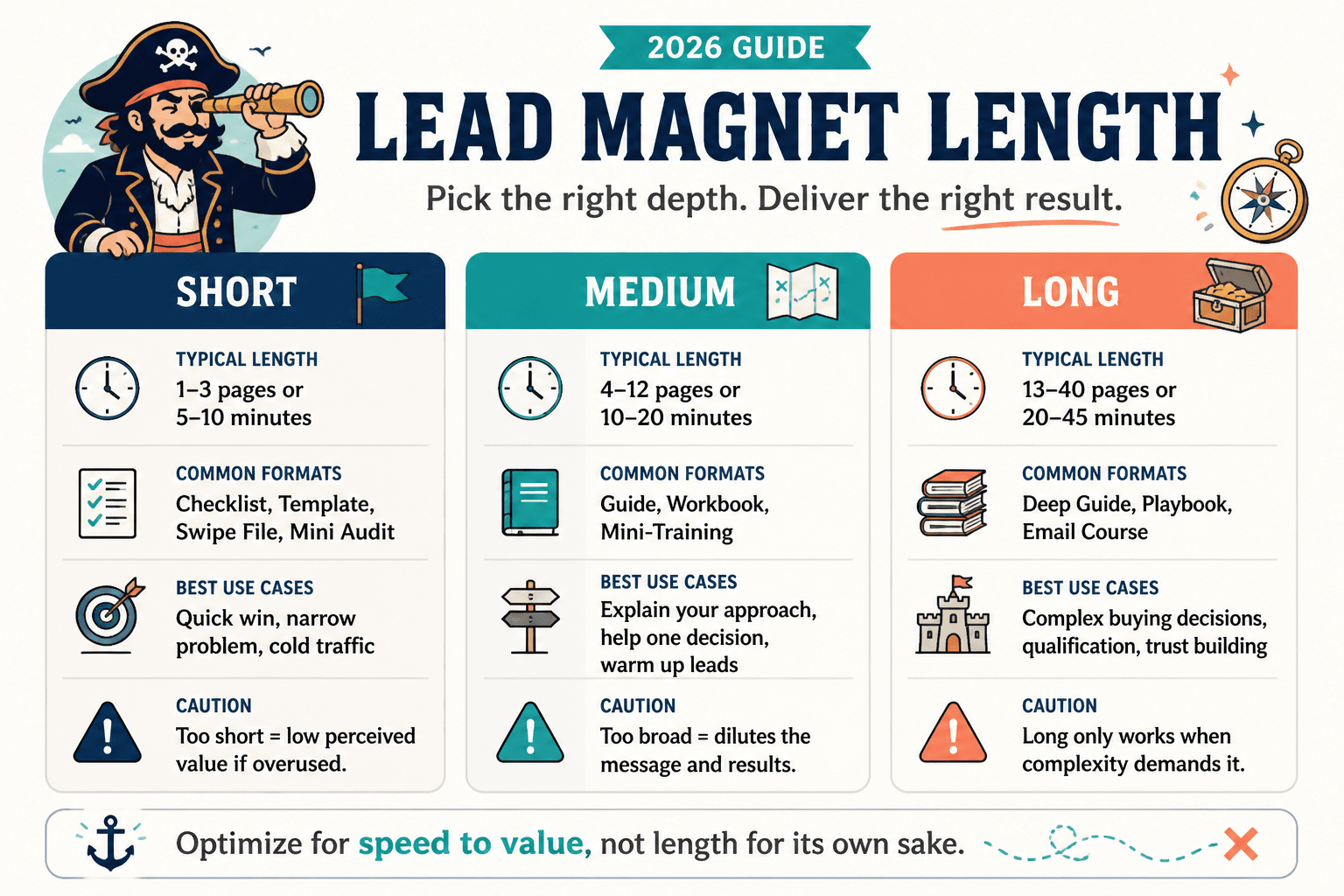
For most creators, coaches, consultants, and service businesses, the sweet spot is usually somewhere between 1 and 10 pages if it is a PDF, or 5 to 20 minutes if it is audio, video, or a mini-training.
That does not mean every lead magnet should fit into a tiny checklist. It means the best lead magnets are built for speed to value, not length for its own sake.
A strong lead magnet should do at least one of these things quickly:
- solve a narrow problem
- help the reader make one better decision
- give them a shortcut, template, or starting point
- show your expertise in a concrete way
- move them one step closer to buying
If it does that in 2 pages, great. If it needs 12, fine. If it needs 47, you are probably writing an ebook because it feels substantial, which is often code for “I am making this harder to use.”
The better question: what job is the lead magnet doing?
The right length depends on the job.
That sounds obvious, but a lot of people skip this and jump straight to format. They decide they want a guide, workbook, or video series before they have decided what the thing is meant to accomplish.
A lead magnet can do different jobs inside your funnel:
- capture an email from a cold visitor
- qualify a lead
- show your approach
- build trust before a call
- help someone self-identify as a fit
- create a quick win that naturally leads to your paid offer
Different jobs need different lengths.
Short lead magnets work best when the goal is quick conversion
If someone is just discovering you, shorter usually converts better. Less commitment. Less friction. Less “I’ll read this later,” which of course means never.
Good short lead magnets include:
- checklists
- cheat sheets
- one-page frameworks
- swipe files
- prompt packs
- templates
- short teardown examples
These work because they are immediately usable. A creator can open the file, steal the structure, and get moving. No warm bath of theory required.
Medium-length lead magnets work best when the reader needs context
Sometimes your audience does need explanation. If the problem is nuanced, the fix is not going to fit neatly on a one-pager.
This is where guides, mini-playbooks, and short workbooks shine. They are long enough to teach, but short enough to finish.
Think:
- 7-page lead generation playbook
- 10-page messaging workbook
- 12-page funnel planning guide
- 15-minute mini training with a worksheet
This is often the strongest range for service providers because it balances usefulness and consumption. It feels substantial without becoming homework.
Long lead magnets only work when the topic justifies them
Long lead magnets can still work in 2026. They are just easier to get wrong.
If you are offering a deep industry report, a detailed benchmark guide, a serious audit workbook, or a high-consideration buyer resource, more length can increase perceived value and trust. But only if every section earns its place.
Too many long lead magnets are basically blog posts in a trench coat.
They repeat obvious ideas, pad with filler, and bury the useful part on page 19 like it is some sort of reward for endurance. Your readers are not training for a content marathon.
Lead magnet length guidelines by format
There is no magic number, but there are practical ranges that tend to work.
| Format | Typical sweet spot | Best for |
|---|---|---|
| Checklist | 1–2 pages | Quick wins, easy opt-ins, action-focused topics |
| Cheat sheet | 1–3 pages | Reference material, frameworks, prompts, reminders |
| Template pack | 3–10 pages | Writers, creators, marketers, consultants |
| Guide or mini-playbook | 5–15 pages | Teaching a method, showing your process |
| Workbook | 5–20 pages | Interactive planning, self-assessment, audits |
| Email course | 3–7 emails | Nurture, onboarding, trust-building |
| Mini video training | 5–20 minutes | Demonstration, explanation, authority |
| Case study bundle | 3–8 pages | Proof, buyer confidence, service sales |
| Industry report | 10–30+ pages | B2B authority, research-driven lead generation |
These are guidelines, not commandments from the Funnel Mountain.
If your 2-page checklist changes how someone works tomorrow, it is long enough. If your 18-page guide still feels brisk because every page solves a real problem, it is also fine. Length is not the product. The result is.
What makes a lead magnet feel too long
People do not usually complain about length when the content is sharp. They complain when the effort-to-value ratio feels rude.
Your lead magnet starts feeling too long when it has any of these problems:
- the useful part comes too late
- it spends pages “setting up” obvious ideas
- it explains basic concepts the audience already knows
- it repeats the same point in three different outfits
- it reads like content written to look impressive rather than help
- it includes fluff pages, giant intros, or generic motivational filler
- it has no obvious path from insight to action
This is where a lot of lead magnets drift into beige sludge. They feel polished, but they are not useful enough, fast enough.
A smart reader will forgive depth. They will not forgive drag.
What makes a lead magnet feel short but valuable
Some of the best lead magnets are almost suspiciously short.
They work because they remove friction and create momentum. Instead of trying to prove how much you know, they help the reader do something useful right now.
A short lead magnet can feel high-value when it includes:
- a clear promise in the title
- one narrow problem
- specific examples
- templates or fill-in-the-blank structures
- before-and-after rewrites
- prioritized action steps
- a next step that naturally leads to your offer
For example, a 2-page guide called “5 DM scripts for reactivating cold leads without sounding desperate” can outperform a 24-page ebook called “The Ultimate Relationship-Based Sales System.” One gets used. The other gets downloaded and emotionally adopted into someone’s Documents folder.
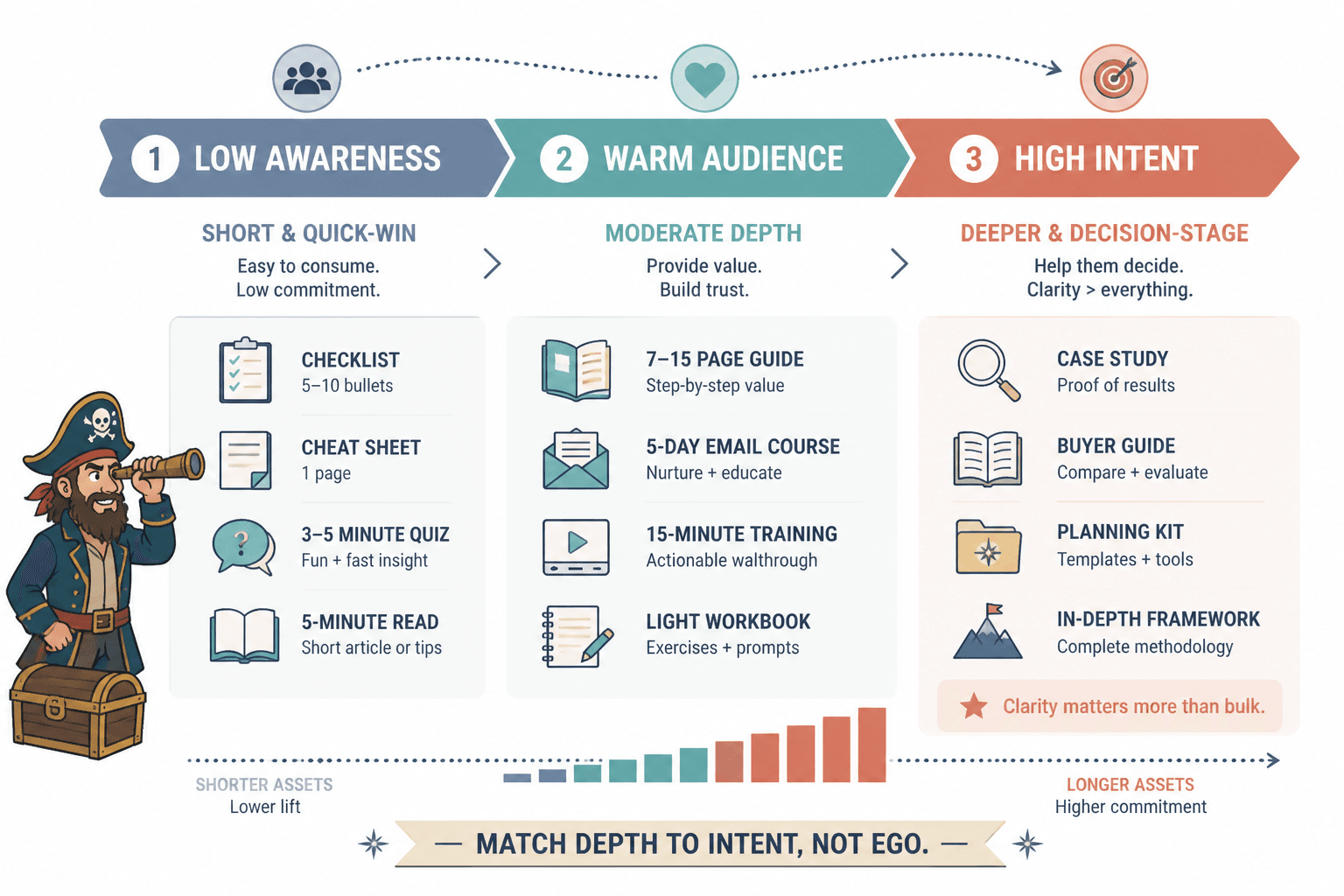
Choose length based on audience awareness and buying intent
One of the cleanest ways to decide lead magnet length is to look at how aware the reader already is.
Cold audience: keep it tight
If the person barely knows you, shorter is usually smarter. They are not ready to invest much time yet. You need a fast win, a clean idea, and minimal friction.
Good options:
- 1-page cheat sheet
- short checklist
- template bundle
- quick diagnostic
Warm audience: give more depth
If someone has seen your content, joined your newsletter, or followed you for a while, they will usually tolerate more depth. This is where a mini-guide or workshop can work beautifully.
Good options:
- 7- to 15-page guide
- 5-day email course
- 15-minute training
- light workbook
High-intent audience: depth can help close
If someone is actively considering your service or product, more detailed assets can help reduce risk and answer objections. This is where longer case studies, buyer guides, planning kits, and in-depth frameworks earn their keep.
But even here, clarity matters more than bulk. A buyer resource should feel clarifying, not exhausting.
The best lead magnets are designed for completion, not admiration
This part matters more than people think.
A lead magnet is not successful because it looks impressive on your side of the dashboard. It is successful because someone consumes it, gets value from it, and becomes more likely to trust you, reply to you, book with you, or buy from you.
That means completion matters. Use matters. Action matters.
When deciding length, ask:
- Can someone finish this in one sitting?
- Can they use it immediately?
- Does it solve one clear problem?
- Will it naturally lead them to the next step?
- Did I include anything just to make it feel more “premium”?
If you win on completion, you usually win on trust. And trust is what actually moves people through funnels, not decorative page counts.
How to decide the right lead magnet length for your business
If you want a practical way to choose, use this quick filter.
1. Start with the specific outcome
What should the person be able to do, understand, avoid, or decide after consuming it?
Be precise. “Understand content strategy” is too broad. “Write a stronger LinkedIn CTA this week” is much better.
2. Pick the smallest format that can deliver that outcome
This is where most people get it backward. They start big, then try to fill the space. Start small instead.
If a one-page template can do the job, do not force it into a 14-page guide because ebooks feel fancy.
3. Match depth to lead quality, not your ego
A detailed workbook might attract fewer signups but better leads. A cheat sheet might pull in more subscribers but with lower intent. Neither is inherently better. It depends on your funnel.
If you sell a high-ticket service, a more substantial lead magnet can help qualify people. If you need more top-of-funnel volume, shorter and simpler often wins.
4. Cut everything that delays usefulness
This includes:
- long introductions
- your life story
- generic industry observations
- three pages of mindset fluff
- repeated summaries of what is coming next
If the first truly useful thing happens halfway through, your lead magnet is too long, even if it is only 6 pages.
5. Test completion and next-step action
The best measure is not “Did they download it?” It is “Did they use it, and did it move them closer to the next step?”
Track signals like:
- reply rates
- link clicks after delivery
- bookings from follow-up emails
- questions people ask after consuming it
- qualitative feedback like “I used this today”
If nobody seems to finish it or reference it, the issue may not be your topic. It may be your format or length.
Common lead magnet length mistakes in 2026
- Making it long to justify the email opt-in. People do not need more pages. They need more relevance.
- Mistaking polish for value. A beautiful 22-page PDF full of fluff is still fluff in nicer shoes.
- Trying to teach everything. A lead magnet should open the loop toward your offer, not replace the offer.
- Using one format for every audience. Different traffic sources and funnel stages need different depth.
- Ignoring mobile consumption. If it is painful to read on a phone, expect a lot of optimistic downloads and very little action.
A simple rule of thumb for lead magnet length
If you want one clean rule, use this:
Your lead magnet should be as short as possible, and as long as necessary, to deliver one meaningful result fast.
Not one vague insight. Not one “aha” that goes nowhere. One meaningful result.
That is why some of the highest-performing lead magnets are simple things like scripts, scorecards, templates, planners, and mini-guides. They get to the point. They respect the reader’s time. They create momentum instead of making the reader feel like they just enrolled in a free semester.
If you are stuck, start here
For most creators and service businesses, this is a very safe starting point:
Lead magnets work best when they solve one real problem cleanly and make the next step feel natural. The clearer the bridge from free value to real offer, the stronger the whole system gets.