
Most LinkedIn posts do not sound robotic because the writer used AI. They sound robotic because they were written like a brochure with a pulse.
You can usually spot the problem fast. The post is polished, technically correct, and completely lifeless. It says things like “I’m passionate about helping businesses thrive” or “Here are 3 lessons from my entrepreneurial journey,” then quietly dies in public. Or worse, it slides into a pitch so fast the reader can practically hear the funnel creaking into place.
If you want to learn how to write LinkedIn posts without sounding salesy or robotic, the fix is not to become more casual for the sake of it. It is to become more specific, more human, and a lot less performative. Good LinkedIn posts do not read like they were approved by five stakeholders and a nervous intern. They sound like a smart person with a point.
Here’s how to make your posts sharper, more credible, and much less likely to feel like copy-and-paste thought leadership in a blazer.
To see how this fits into the wider strategy, open the parent guide.
Why LinkedIn posts sound salesy or robotic in the first place
Before fixing the writing, it helps to name what is actually going wrong.
Most stiff LinkedIn posts come from one of three habits:
- Trying to sound professional instead of clear
- Trying to sell before earning interest
- Copying “LinkedIn style” instead of writing like a real person
That is how you end up with posts full of vague praise, empty lessons, and strangely formal transitions. The writer is not expressing a real thought. They are performing what they think business content is supposed to sound like.
And yes, this gets worse when people use AI badly. Not because AI always ruins writing, but because it happily produces polished oatmeal if the input is weak. If your post starts with vague ideas, weak positioning, and fear of offending anyone, the draft will come out smooth, generic, and deeply forgettable.
The good news is that the solution is not complicated. You need stronger ideas, cleaner structure, and less corporate costume drama.
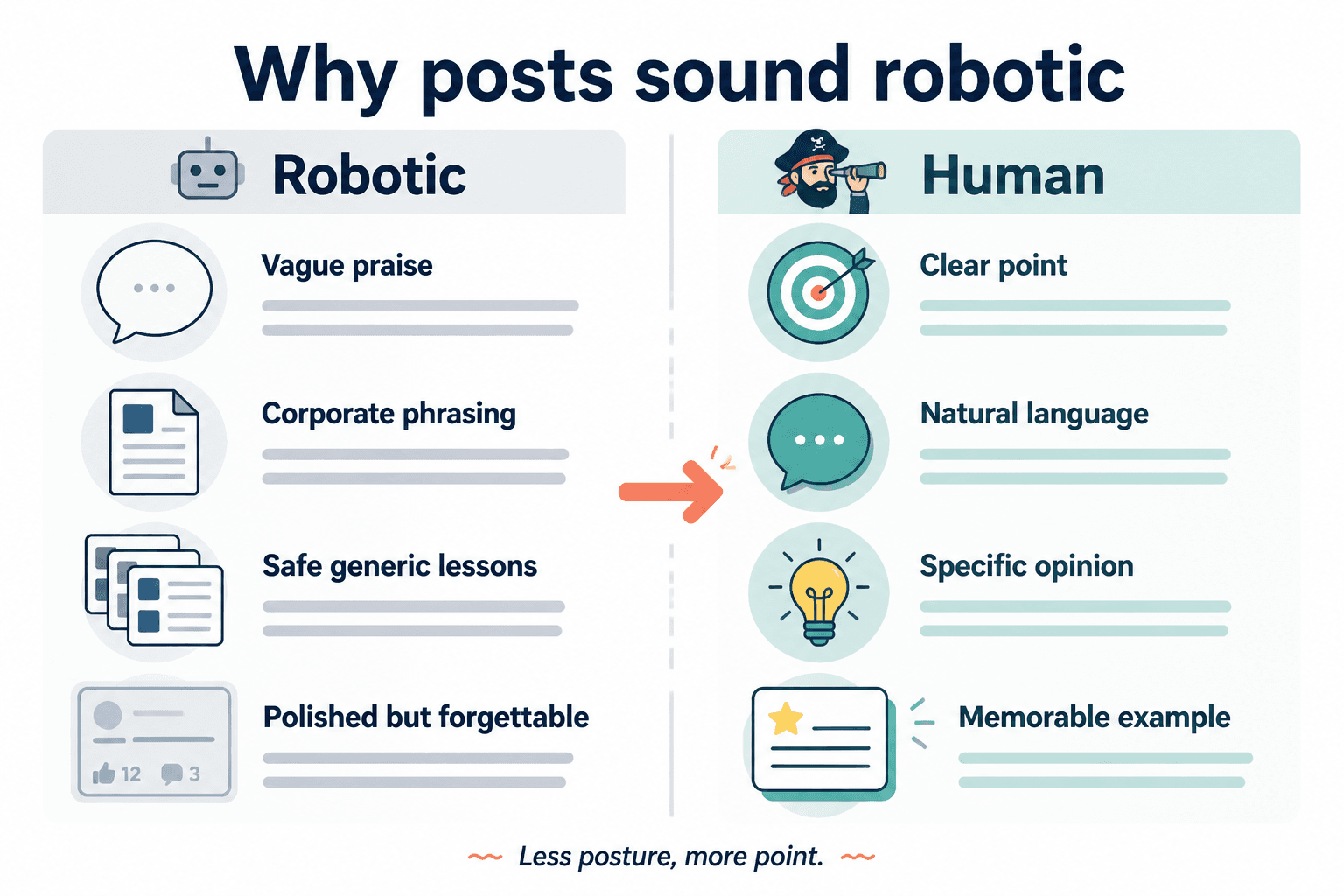
Start with a point, not a posture
A lot of LinkedIn posts open with posture. They are trying to sound wise, impressive, or inspirational before they have said anything useful.
That is where robotic tone starts. The writer is managing image instead of communicating an idea.
Compare these openings:
“I’m passionate about helping founders scale sustainably in a fast-changing market.”
“Most founders do not need more content. They need a clearer point of view and fewer vague posts trying to impress everyone.”
The second one sounds more human because it begins with an actual opinion. It gives the reader something to react to. It has shape. It sounds like somebody means it.
When you write a LinkedIn post, ask this before anything else:
- What is the actual point I’m making?
- What do I believe that people in my space often get wrong?
- What useful observation, lesson, mistake, or pattern can I explain clearly?
If you cannot answer that, the post is probably going to wander into cliché or promotion because there is nothing solid underneath it.
If your openings are weak, this guide on starting LinkedIn posts without a weak opening will help you fix that fast.
Write like a person with expertise, not a landing page
One of the easiest ways to stop sounding salesy is to stop writing like every sentence is trying to qualify a lead.
Landing pages have a job. Sales emails have a job. Your LinkedIn post also has a job, but that job is usually not “close the deal in 14 lines with a soft emotional hook.” It is more often one of these:
- Get attention from the right people
- Build credibility
- Show how you think
- Make your expertise easier to trust
- Create enough interest for the reader to check your profile or follow you
That means your post should sound like someone worth listening to, not someone inching toward a pitch with suspiciously moisturized hands.
Here is a simple test: if you remove your CTA, does the post still offer a complete, useful idea?
If the answer is no, it was probably just a promo post wearing a fake moustache.
What this looks like in practice
| Sounds salesy or robotic | Sounds human and credible |
|---|---|
| “I help purpose-driven founders unlock scalable growth through authentic content systems.” | “Most founder content fails for a boring reason: it says the right things in the same way everyone else says them.” |
| “Here are 5 tips to elevate your brand presence.” | “If your content sounds polished but nobody remembers it, your problem probably is not consistency. It is sameness.” |
| “DM me ‘GROWTH’ if you want to transform your visibility.” | “If you want help tightening your positioning, my profile has the details.” |
Use specifics because vague writing sounds fake fast
Specificity is one of the fastest ways to sound more human.
Robotic posts hide in abstraction. They talk about growth, impact, authenticity, leadership, value, transformation, alignment, and all the other words that manage to sound important while saying very little. Human posts use examples, detail, and contrast.
For example:
Vague: “Your brand voice matters.”
Specific: “If your post could be copied by a coach, recruiter, marketer, or SaaS founder without changing a word, you probably do not have a voice yet. You have a content template.”
That second version does more work. It creates a picture. It gives the reader something concrete to test. And it sounds like a real observation instead of a poster in a coworking space.
Specificity also helps your post avoid that strange “AI-ish” glaze people complain about. The more detail, examples, and genuine perspective you bring in, the less your writing sounds machine-smoothed.
Ways to add specificity quickly
- Name the exact mistake
- Use a real contrast instead of a vague claim
- Include a short example or rewrite
- Point to a pattern you have seen repeatedly
- Replace broad praise with something observable
If your draft feels bland, ask: “What would make this impossible to say in exactly the same way on 10,000 other LinkedIn posts?”
Cut the fake-thought-leader language
Some phrases instantly make a post sound borrowed.
Not because they are always wrong, but because they are overused to the point of meaninglessness. LinkedIn has a whole dialect of auto-serious business fog, and it is doing nobody any favors.
Here are some usual suspects:
- “I’m humbled and excited to announce…”
- “Here are 3 lessons from my journey…”
- “Leadership is not about titles…”
- “So many people needed to hear this…”
- “A quick reminder that…”
- “Authenticity is the key to success…”
You do not need to ban every common phrase forever. But if your draft is leaning on language people have seen a thousand times, the post will feel templated before the reader even reaches your point.
Instead of reaching for “thought leadership” wording, use language you would actually say to a smart client or colleague. Cleaner. Less inflated. More direct.
And no, sounding human does not mean stuffing your post with slang or trying to sound accidentally chaotic. It just means writing with normal rhythm, natural phrasing, and some adult confidence.
Stop pitching in the first breath
A post feels salesy when the reader can sense the agenda too early.
That does not mean you cannot sell on LinkedIn. You can. You should, sometimes. But if every post is arranged like a miniature funnel, people start reading defensively. They know what is coming. They are already reaching for the back button by paragraph two.
The fix is simple: lead with something worth reading on its own.
Give the idea first. Give the proof. Give the useful framing. Then, if there is a natural next step, mention it without acting like the whole post was secretly a trapdoor into your offer.
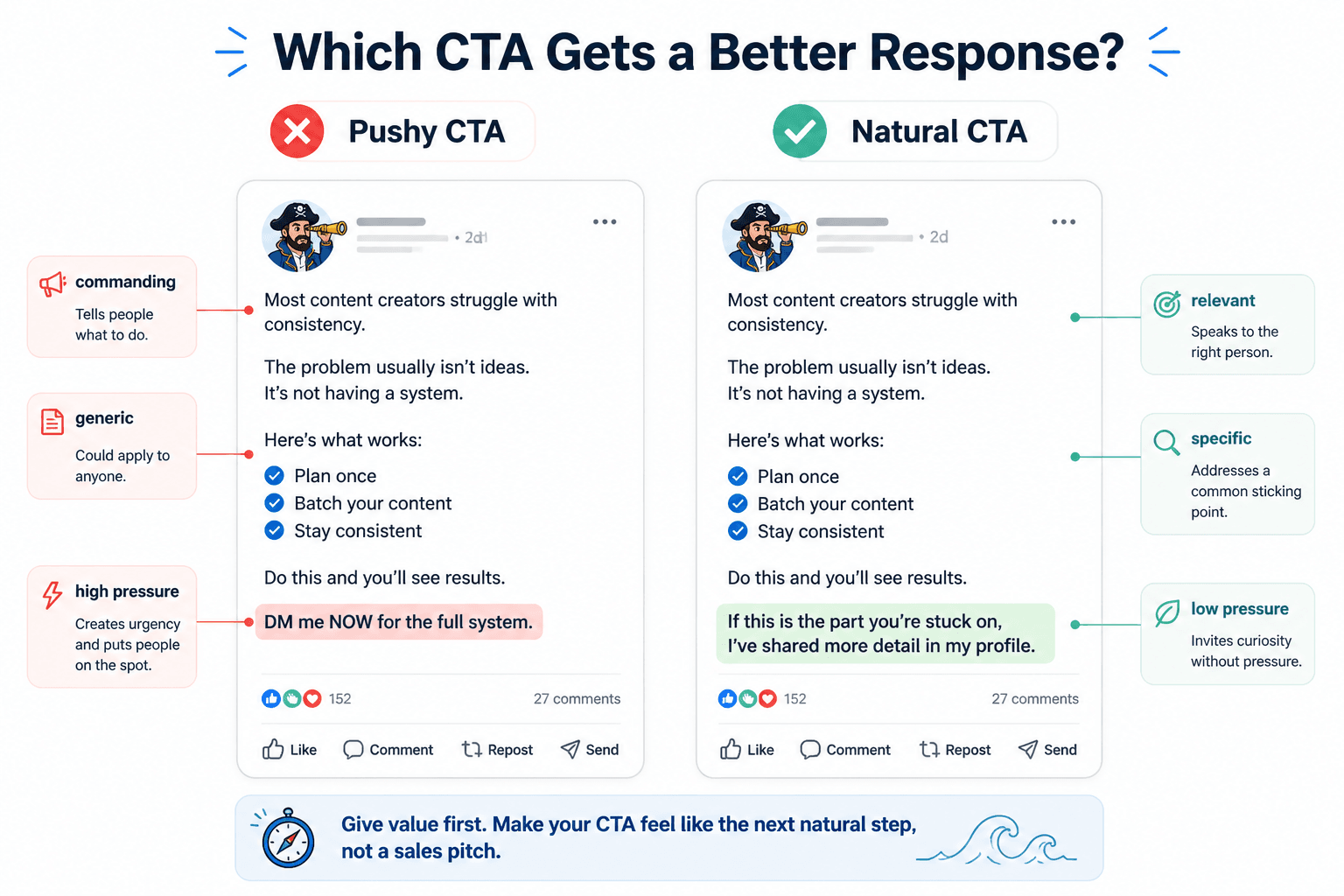
A better CTA style for LinkedIn posts
Bad CTAs often sound like this:
- “DM me ‘SUCCESS’ for the framework”
- “Follow me for more high-value insights”
- “Book a call if you’re ready to scale”
These are not illegal. They are just often lazy, overused, and badly matched to the post.
Stronger options:
- “If this is the part you’re struggling with, I’ve got more detail in my profile.”
- “I help clients fix this exact problem, so if you need that, you know where to find me.”
- “If you want more posts on sharper LinkedIn writing, follow along.”
- “Curious how this looks in practice? I’ve shared more examples here.”
Notice the difference. Less theater. Less command. More relevance.
If you want a stronger overall approach, check out how to write better LinkedIn posts and the broader LinkedIn posts hub.
Use structure that feels natural, not manufactured
A lot of robotic posts are not just a tone problem. They are a structure problem.
The writer follows a formula so rigidly that the post loses all flow. Hook. Contrived personal lesson. Numbered list. Sales line. Done. You can almost see the template underneath the words.
Templates are useful. Dead useful, actually. But they should support thinking, not replace it.
For LinkedIn, a simple structure usually works better than a hyper-engineered one:
- Open with a clear point or tension
- Explain the mistake, pattern, or lesson
- Add example, proof, or contrast
- End with a clean takeaway or next step
That gives you enough shape without making the post feel assembled from spare webinar parts.
Example structure
Opening: Most LinkedIn posts do not fail because the writer lacks expertise. They fail because the post sounds like it is trying to pass a professionalism exam.
Body: People swap clear opinions for safe language. They remove all edge, all detail, all rhythm, then wonder why nobody remembers the post.
Example: “I help brands build authentic engagement” says nothing. “I help consultants stop posting nice, forgettable advice and start publishing content that actually gets read” is better.
Ending: Before you publish your next post, cut one vague phrase, add one real example, and make the CTA sound like something a normal person would say.
Sound like yourself, but edited
There is bad advice floating around that says the fix for robotic writing is to “just write how you talk.” That is only half true.
If most people wrote exactly how they talk, LinkedIn would be full of circular rambles, filler phrases, and points that arrive three business days late.
The better rule is this: write like yourself after editing.
Keep your natural rhythm. Keep your opinions. Keep some personality. But trim the throat-clearing, sharpen the sentences, and remove anything that sounds like you borrowed a corporate voice for the afternoon.
That is where the good stuff lives. Not in hyper-polished “personal brand” language. In clear, edited, believable writing.
A quick self-edit checklist
The bigger point is simple: clearer structure and clearer writing make the piece more useful. That is usually what makes the ending land better too.
LinkedIn posts usually improve when the point gets clearer and the fluff gets shorter. Stronger usefulness tends to outperform polished vagueness.