
Most creator email sequences do not have a monetization problem. They have a trust problem wearing a sales hat.
The sequence starts off helpful enough. A welcome email. A useful tip. Maybe a personal note. Then by email three, things get weird. Suddenly the tone shifts, the urgency gets louder, and the whole thing starts sounding like a discount furniture store with a Kajabi account.
That is usually the moment people stop opening, stop clicking, or stay on the list while quietly deciding you are not for them.
If you want to know how to monetize creator email sequences without wrecking trust, the answer is not “sell less” or “never pitch.” That advice sounds noble and pays terribly. The real answer is to make the monetization feel like a logical extension of the value, not a betrayal of it.
This piece will show you how to do that. We will cover what breaks trust in email sequences, how to structure offers so they feel earned, and how to write sales emails that still sound like a human with standards. If your current sequence feels either too timid to sell or too eager to keep its dignity, this is for you.
If you want the broader foundation first, it helps to read the creator email sequences guide for creators who want better results alongside this. And if your writing already sounds suspiciously like a template got loose, you will probably also want how to write creator email sequences without sounding salesy or robotic.
If you want the bigger picture, start with the parent guide.
Why monetizing email sequences goes wrong so often
Email is intimate compared with most content channels. A social post gets skimmed in public. An email lands in a private inbox, next to client threads, notes from friends, receipts, and actual life. So when the tone turns manipulative, people feel it faster.
That is why monetization mistakes in email feel more expensive than monetization mistakes on social. You are not just missing a conversion. You are training readers to trust you less every time your sequence feels pushy, vague, or obviously engineered.
The usual mistakes are not subtle:
- Pitching before the reader understands why your offer matters
- Stuffing in fake urgency because you do not have a strong reason to buy
- Teaching one thing, then selling something unrelated
- Writing “value emails” that are really just throat-clearing before the pitch
- Acting like every subscriber is equally ready to buy right now
- Using copy that sounds imported from a bro-marketing bunker
None of that is fixed by softer language alone. You need a better sequence logic.
The core rule: monetize the next logical step
The cleanest way to monetize a creator email sequence without wrecking trust is simple: your offer should feel like the next sensible move for someone who benefited from the emails before it.
If your sequence teaches a consultant how to tighten their LinkedIn positioning, the offer should not suddenly be a generic mindset membership. If your emails help freelancers get more inbound leads, the paid step could be a workshop, template pack, audit, course, or service that helps them apply the exact thing you have been teaching.
Trust holds when the reader can say, “Yes, that tracks.” Trust wobbles when the monetization feels like a trap door.
A good email offer does not interrupt the conversation. It advances it.
That sounds obvious, but a lot of creators build sequences backwards. They start with the thing they want to sell, then try to bolt on enough “free value” to justify the ask. Readers can feel that. It has the same energy as someone asking how your week is going while already reaching for their pitch deck.
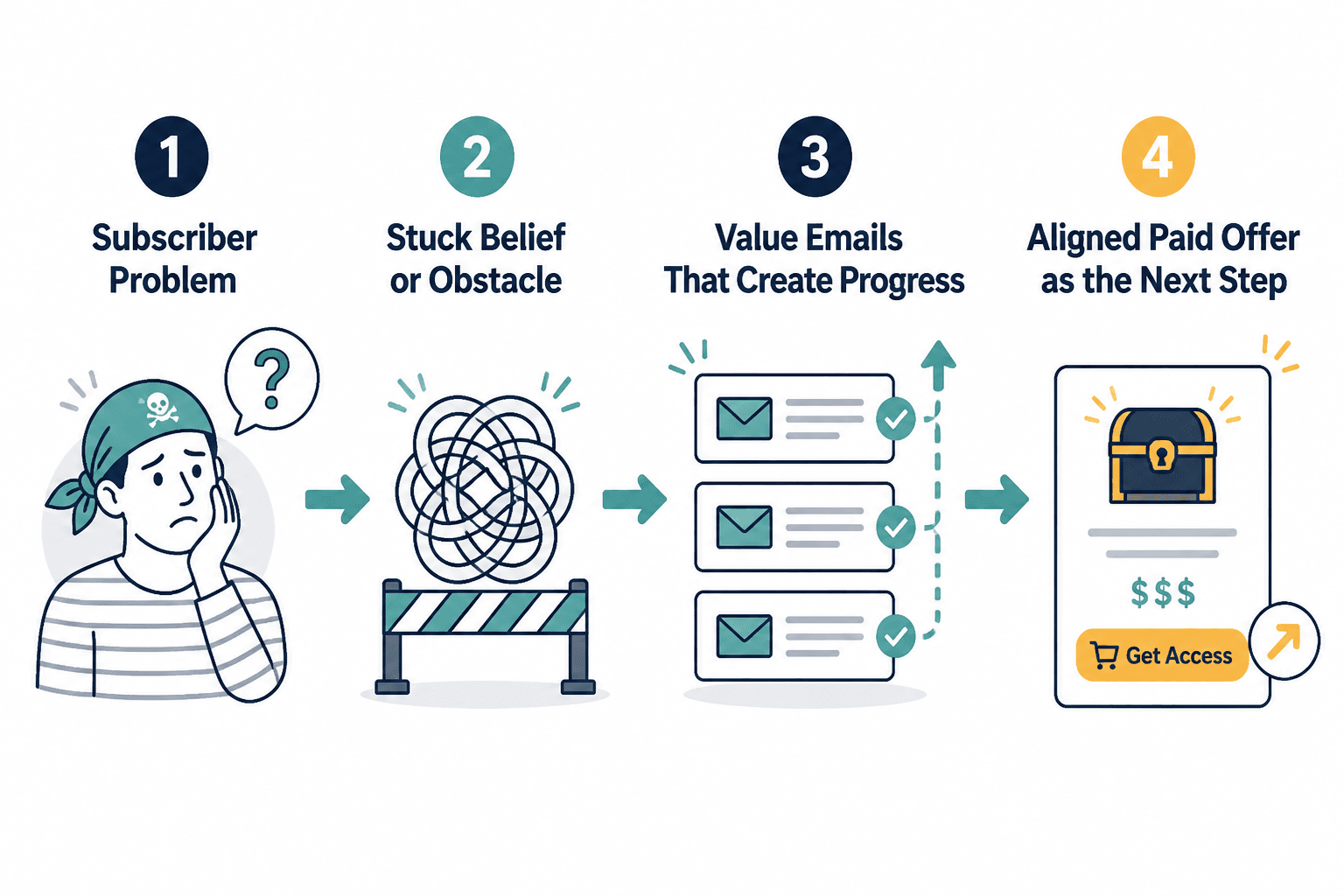
Instead, build from reader movement:
- What problem got them onto this list?
- What belief, mistake, or obstacle is keeping them stuck?
- What progress can your emails help them make?
- What paid next step helps them continue that progress faster or better?
That sequence logic matters more than clever copy.
What trust actually means in a monetized email sequence
Trust is not just “they like me.” It is more practical than that.
In email sequences, trust usually comes from four things:
- Relevance: your emails match why they subscribed
- Usefulness: your emails help them think better or act better
- Consistency: your tone, promise, and positioning do not swing wildly
- Integrity: your offer is presented honestly, without cheap pressure tactics
You do not need to become everyone’s inbox best friend. You do need to become predictably worth opening.
That is an important distinction because some creators avoid selling out of fear that monetization automatically damages trust. It does not. Irrelevant or clumsy monetization damages trust. Clear, well-timed, well-positioned offers often strengthen it because they prove you can take a reader from insight to action.
How to structure a sequence that sells without turning weird
There is no single perfect structure, but there is a reliable rhythm: earn attention, deepen relevance, create desire for progress, then present the offer as the practical next step.
A simple trust-first monetization structure
- Welcome and expectation-setting
Tell them what they signed up for, what kind of emails they will get, and what problem you help solve. - Quick win or useful reframe
Help them make a small improvement fast. This proves your stuff is not empty. - Deeper insight or common mistake
Show them why they are still stuck, or what they keep doing wrong. - Proof or practical example
Use a case study, before-and-after, client pattern, or detailed breakdown. - Offer email
Present the paid next step with clarity, context, and specificity. - Objection-handling follow-up
Answer the practical hesitation, not just “remind” them harder. - Final nudge
Use honest urgency if there is a real reason. If there is not, skip the fake countdown nonsense.
That structure works because it builds belief before asking for action. It does not assume trust. It earns it in sequence.
If you need help mapping the offer into a bigger conversion path, pair this with best funnel ideas to pair with creator email sequences and how to turn creator email sequences into more leads or sales.
What to sell in a creator email sequence
Some offers are much easier to monetize in email without feeling grimy. Usually, they have one thing in common: they solve the exact problem that attracted the subscriber in the first place.
| Sequence topic | Good monetization fit | Bad monetization fit |
|---|---|---|
| LinkedIn content tips | Post template pack, content workshop, profile audit, consulting offer | Random productivity app affiliate push |
| Email list growth | Lead magnet kit, funnel teardown, coaching, newsletter course | Unrelated personal finance product |
| Creator systems | Ops template bundle, setup service, workflow training | Generic business motivation membership |
| Brand positioning | Messaging sprint, bio audit, positioning framework | Completely separate low-ticket impulse buy |
You can absolutely sell affiliate products, sponsor placements, memberships, services, courses, templates, workshops, audits, digital products, or consultations in an email sequence. The question is not “Can I?” The question is “Does this make sense here?”
If the answer feels fuzzy, the reader will feel that too.
How to introduce the offer without sounding like a personality transplant
One of the fastest ways to wreck trust is tonal whiplash.
You sound normal for three emails. Then the pitch arrives and suddenly you are “thrilled to unveil” a “transformational opportunity” with “fast action bonuses” and “massive value.” Relax. You sell emails, not steak knives.
Your sales email should sound like you on purpose, just more focused. The shift should be in clarity, not personality.
A clean offer introduction formula
- Name the problem or goal they already care about
- Explain why free tips alone often do not solve it fully
- Present the offer as a more direct way to get the result
- Explain what it is, who it is for, and what happens next
- Add proof, specificity, or outcome framing
- Give a clear CTA
That formula works because it respects the reader’s context. You are not pretending the offer appeared by magic. You are connecting it to the conversation you have already been having.
Example: weak vs stronger offer transition
Weak:
“I’m excited to announce that my brand new program is now open. It is packed with value and designed to help you unlock your next level.”
Stronger:
“Over the last few emails, I have shown you how to tighten your creator positioning and make your content pull more weight. If you are reading this and thinking, ‘Yes, but I need help applying it to my business,’ that is exactly why I built this.”
The second version is not trying to cosplay a launch email. It is connecting dots.
Four ways to sell without draining goodwill
1. Sell with specificity, not hype
Vague sales language creates distrust because it asks readers to fill in the blanks with hope. Specificity creates trust because it reduces uncertainty.
Instead of saying:
- Get clarity
- Scale your business
- Transform your content
- Unlock growth
Say what actually happens:
- Rewrite your welcome sequence so more subscribers reply, click, and book
- Build a five-email nurture flow for your coaching offer
- Turn your loose content ideas into a repeatable weekly newsletter system
- Audit the drop-off points in your current sequence and fix them
Specific beats impressive almost every time.
2. Use proof that lowers risk
Proof does not need to mean giant revenue screenshots and suspiciously cinematic testimonials. In fact, for many creators, that stuff makes things worse.
Useful proof can look like:
- A before-and-after example from a client or student
- A short case study with the original problem and the result
- A breakdown of what changed in a sequence and why it worked better
- A sample lesson, framework, or template from the paid offer
- Your own demonstrated expertise in the emails leading up to the pitch
The goal is not to scream credibility. It is to remove doubt sensibly.
3. Make the CTA feel proportionate
Trust erodes when the ask feels too big for the amount of attention or belief you have earned.
If someone has just joined your list from a simple lead magnet, asking them immediately to buy a high-ticket service can work in rare cases, but usually it is a bit much. A lower-friction next step often performs better and feels better:
- Read the details
- Watch the walkthrough
- Book a fit call
- Reply with a question
- Check if this is right for you
A CTA does not need to bark. It needs to be clear.
4. Segment by readiness when you can
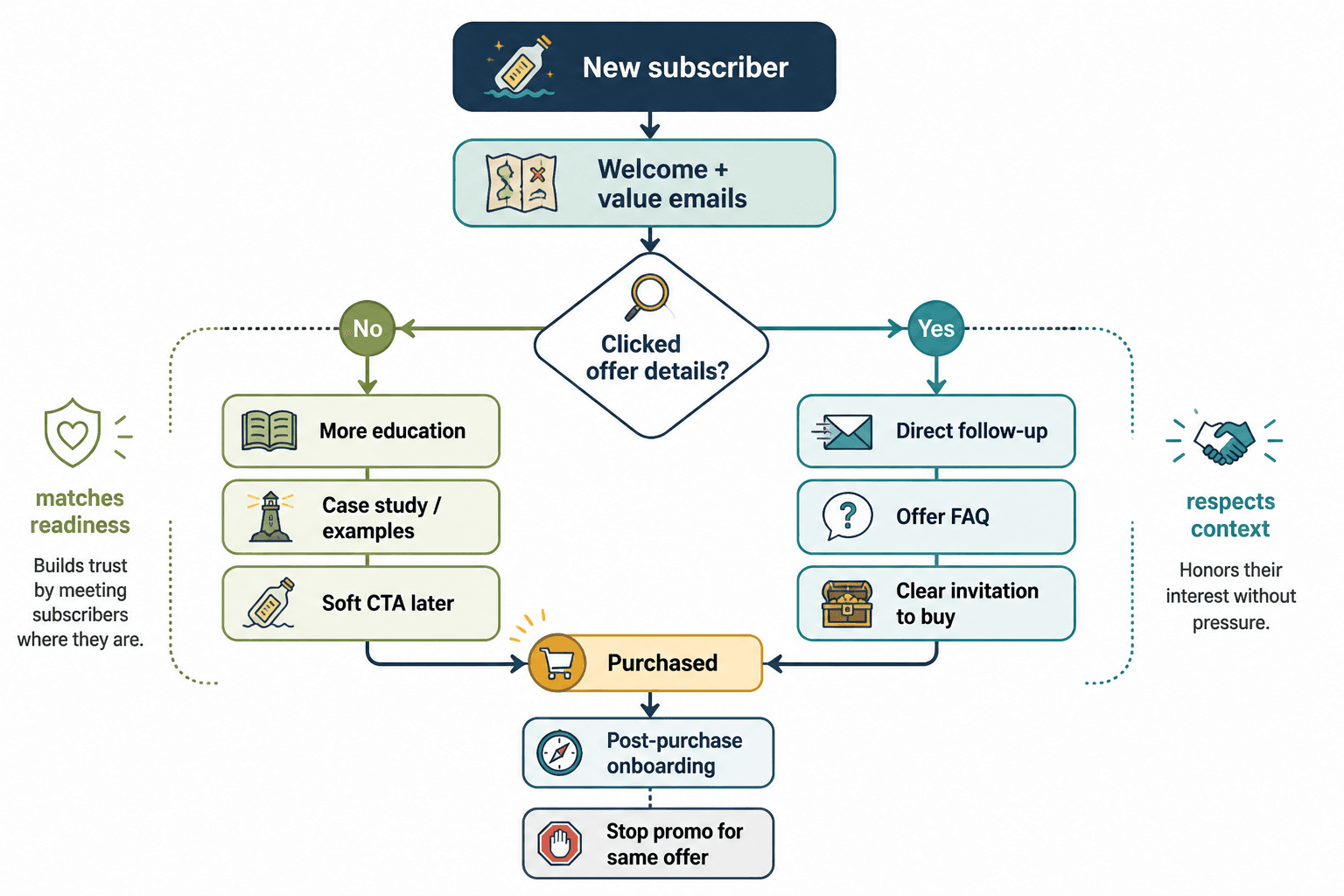
Not every subscriber is at the same stage. Some are curious. Some are warming up. Some are already comparing options. If your tooling allows simple tagging or branching, use it.
For example:
- People who click on offer details can receive a more direct follow-up
- People who do not click can stay in a nurture path with more education
- People who already bought should not keep getting “buy now” emails for the same thing, which should not need saying, yet here we are
Segmentation helps preserve trust because it respects context. It also saves you from sending the same blunt instrument to everyone.
How often should you pitch in an email sequence?
There is no holy ratio. “Give value for six emails, then pitch once” is the kind of neat little rule people love because it feels safe and measurable. It is also not reliable.
The better question is this: has the sequence earned the offer?
You can pitch early if:
- The subscriber opted in for something closely tied to the offer
- The problem is urgent and obvious
- The offer is a natural next step
- The email still gives useful context and clarity
You should wait longer if:
- The reader needs more education first
- The offer is higher ticket or more complex
- You have not yet shown enough proof or distinction
- The opt-in topic was broad but the offer is specific
What matters is not some moral spreadsheet of value versus pitch. What matters is whether the sales timing feels earned and relevant.
How to write monetized emails that still feel generous
This is where a lot of creators get tangled. They think if an email includes a sales link, it can no longer be useful. That is not true. A monetized email can still teach, clarify, challenge, or help the reader make a better decision.
Some of the best sales emails are generous in a very practical way. They do at least one of these things:
- Explain the real cause of the problem the offer solves
- Show the cost of staying stuck
- Clarify who the offer is and is not for
- Break down a process the paid offer helps implement
- Answer a common objection honestly
- Help the reader decide even if they do not buy now
That last point matters. Trust often grows when your sales emails sound like you care about fit, not just payment.
Example: a trust-preserving objection email
Instead of:
“Spots are filling fast. Do not miss your chance.”
Try:
“A fair question I keep hearing is whether this makes sense if your list is still small. Short answer: yes, if the issue is sequence quality, not just list size. No, if you still do not have a clear offer or audience. This program helps you improve the sequence. It does not magically fix a blurry business.”
That kind of honesty filters out bad-fit buyers and increases trust with the right ones. Strange how that works.
Common trust-killers in creator email monetization
If you want a quick way to audit your sequence, look for these first.
- Overpromising outcomes: If your offer cannot reasonably deliver the result as stated, your copy is doing damage.
- Manufactured urgency: Fake deadlines train readers to discount everything you say.
- Generic pain language: If every problem sounds like a webinar landing page from 2019, people stop believing you understand them.
- No bridge from free to paid: If the pitch feels disconnected from previous emails, conversions and trust both suffer.
- Too much pressure, too little clarity: Repeating “buy now” is not the same as making the decision easier.
- Hiding the offer details: If readers cannot tell what the thing is, who it is for, and what happens next, they will not feel reassured. They will feel wary.
A sequence does not need to be perfect. It does need to avoid the obvious credibility leaks.
A simple audit for how to monetize creator email sequences without wrecking trust
If you already have a sequence running, use this audit before rewriting everything from scratch.
- Check alignment: Does the offer match the opt-in topic and the emails before it?
- Check timing: Are you pitching before the reader has enough context or belief?
- Check usefulness: Do the pre-pitch emails actually help, or just stall?
- Check tone: Does the offer email sound like the same person wrote it?
- Check specificity: Is the offer concrete, or wrapped in vague promise language?
- Check proof: Is there enough evidence or example to lower risk?
- Check CTA friction: Is the next step clear and proportionate?
- Check integrity: Are you using any pressure tactic you would personally side-eye in someone else’s inbox?
That last question is underrated. If you would roll your eyes at it as a subscriber, maybe do not send it.
For broader sequence planning, you can also explore the creator email sequences section and the main email newsletter writing and creator email systems resources.
A practical mini-template for a trust-first sales sequence
The bigger point is simple: clearer structure and clearer writing make the piece more useful. That is usually what makes the ending land better too.
Email sequences work better when each message has one clear role and the progression feels natural. Better sequencing usually beats more aggressive copy.