A creator email sequence that gets opened but never moves anyone forward is expensive in the most annoying way possible: it burns trust, produces weak leads, and leaves sales looking harder than they should. You end up with busywork that feels like strategy because it lives in automation software. The business result is still the same: attention with no conversion.
The fix is not “add more emails” in the abstract. It is to make the sequence do a job. A good creator email sequence helps a subscriber understand why they signed up, what to trust, what to do next, and why your offer is the sensible next move. That is conversion work, not decorative emailing.
If you want the broader system behind this, the parent guide on creator email sequences covers the full stack. This article stays on the monetization side: how to turn that sequence into leads or sales without making it sound like it was written by a hungry robot in a blazer.
What a conversion-ready creator email sequence has to do
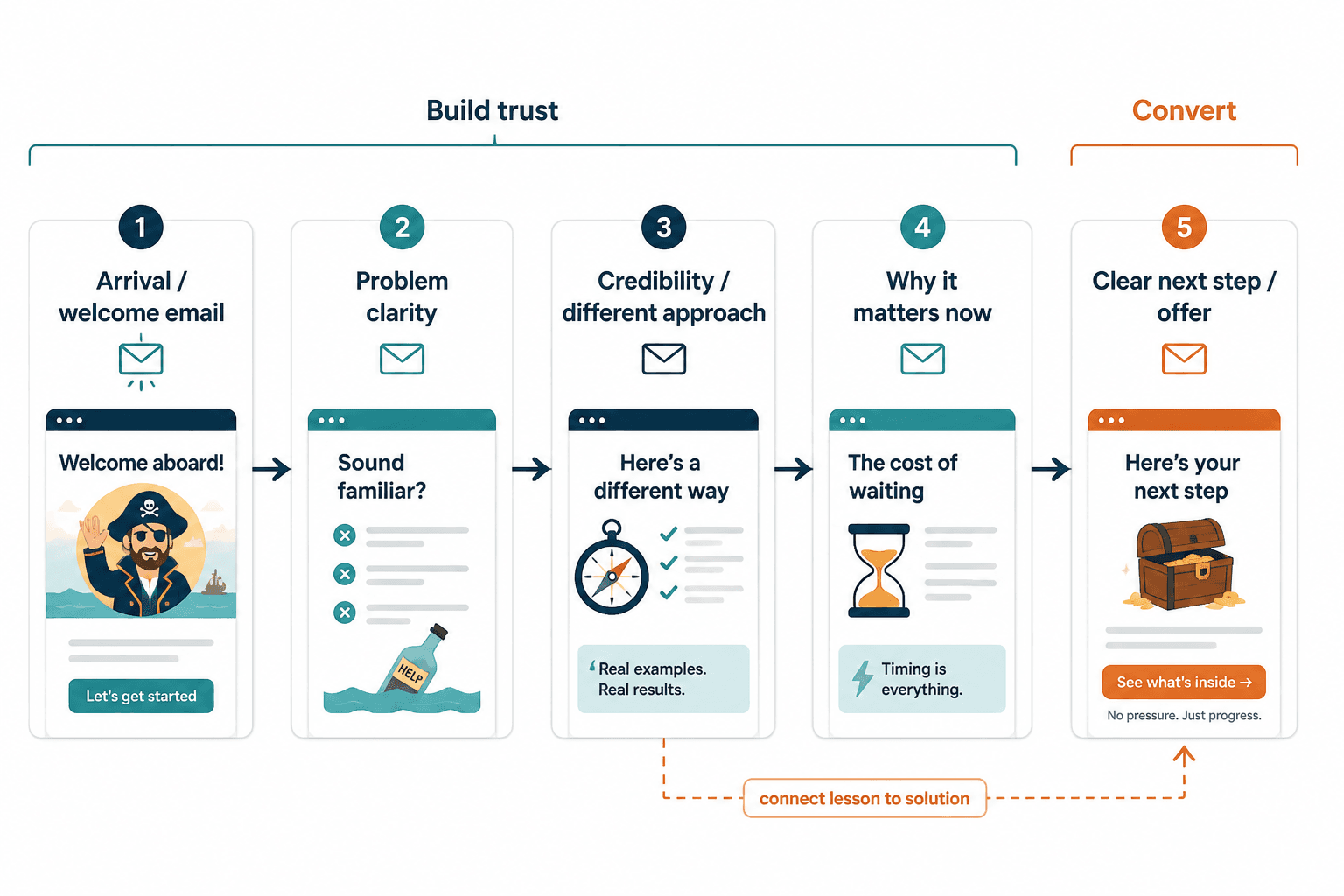
A sequence that converts is not just informative. It is directional. Each email should move the reader one step closer to a decision by answering a question they actually have at that point in the relationship.
- Why am I here? Confirm the signup promise.
- Why should I trust you? Show useful judgment, not just personality.
- Why does this offer fit me? Connect the offer to the subscriber’s stated or implied need.
- What happens if I act now? Reduce uncertainty and obvious friction.
That is the difference between a sequence and a sales page with extra steps. One guides. The other just hopes.
Start with the next logical step, not the biggest sale
The easiest mistake is to treat every sequence like it must end in the largest possible purchase. That usually creates awkward email pressure and weak response. Better conversion starts with the next logical step in the reader’s journey.
For one audience, the next step is a lead magnet. For another, it is a consultation. For another, it is a low-friction product or membership. The sequence works when the offer matches where the subscriber already is.
This is also why the funnel matters. The sequence does not operate alone; it sits inside a path that should make sense from first click to final action. If the path is fuzzy, the emails have to do too much heavy lifting.
Funnel options that pair well with creator email sequences
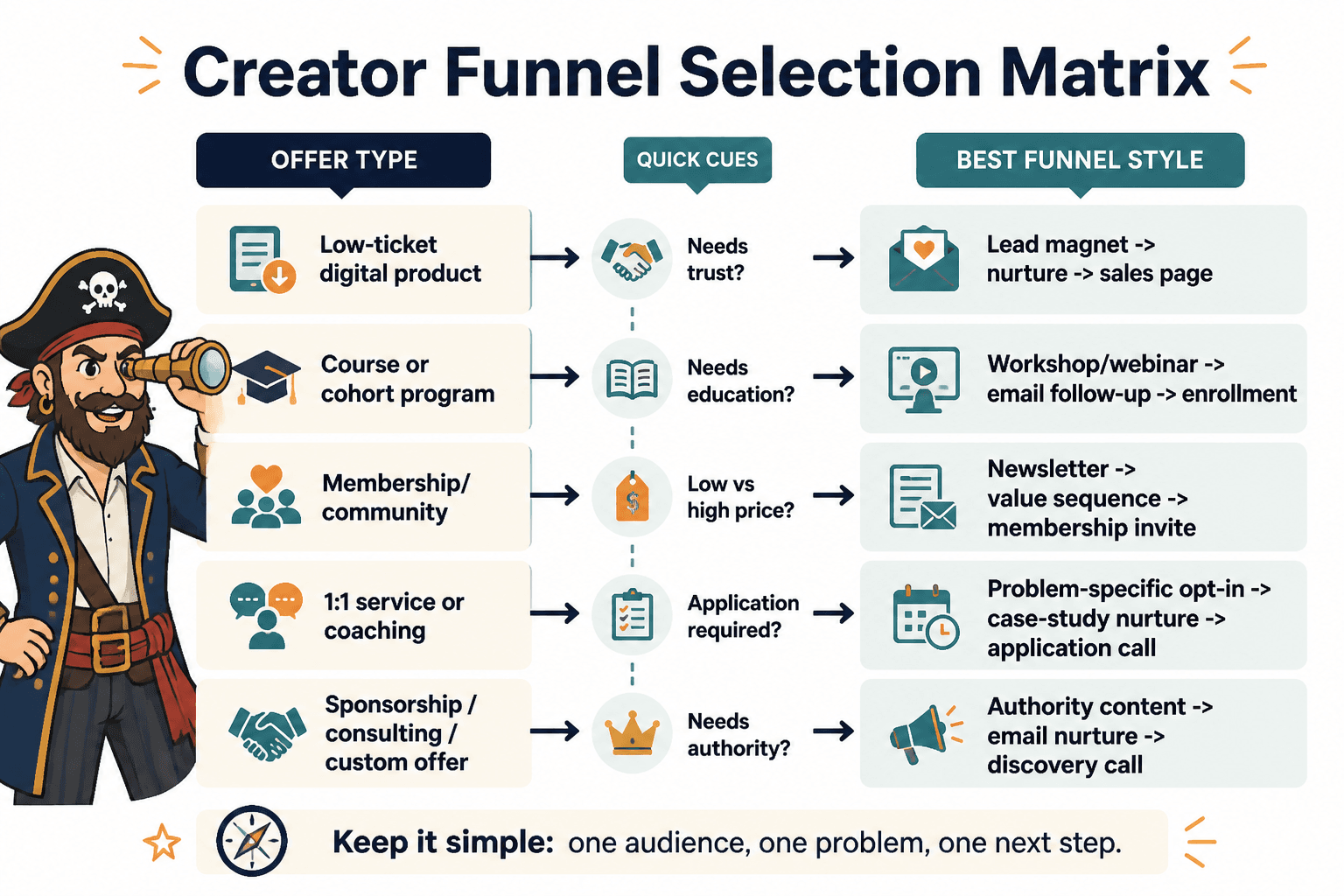
Different offers need different conversion paths. Here are the funnel shapes that tend to work best for creator businesses.
1. Content to lead magnet to welcome sequence to core offer
This is the cleanest starting point when you already have content that attracts the right audience. A useful article, video, or post sends readers to a focused lead magnet. The welcome sequence then warms them up and points them toward a core offer.
Use this when the offer needs a little context but not a full sales education campaign.
2. Content to newsletter signup to nurture sequence to soft conversion path
Some creators do better with a softer front door. Instead of pushing an immediate download, the content invites readers into the newsletter. The sequence then builds familiarity, proves competence, and introduces a paid path only after trust has had time to breathe.
This is useful when the audience is comparison-shopping or not quite ready to commit.
3. Free resource to educational sequence to consultation funnel
This works well for service-based offers and higher-ticket expertise. The free resource solves one narrow problem, the sequence expands the reader’s understanding, and the consultation invite feels like the obvious next step rather than a surprise ambush.
Use it when the sale requires diagnosis, customization, or a real conversation.
4. Mini-course funnel for expertise-heavy offers
A mini-course can function as both proof and pre-sell. It gives the audience a compact win while showing how you think. The sequence can then lead into a higher-value product, membership, or service.
This works especially well when buyers need to see your method before they believe it will work for them.
5. Case study funnel for skeptical buyers
When people are hesitant, proof beats polish. A case-study-led funnel can move readers from interest to evidence to decision. The sequence should show the problem, the before-and-after logic, and why the offer is a believable fix.
If your audience has seen too many shiny promises, this is the path that respects their skepticism instead of insulting it.
For more funnel patterns and examples, see Best Funnel Ideas to Pair With Creator Email Sequences.
Structure the sequence around trust, proof, and a clear offer
The strongest monetized sequences usually follow a simple logic:
- Trust – show you understand the reader’s situation.
- Relevance – make it obvious why the sequence matters now.
- Proof – explain how the solution works or show that it has worked.
- Offer – present the next step plainly.
- Friction reduction – answer the objections before they stall the decision.
You do not need every email to do every job. In fact, trying to cram all of this into one message usually makes the sequence feel like a pitch deck with a pulse. Spread the logic across the sequence so the reader can move without feeling pushed.
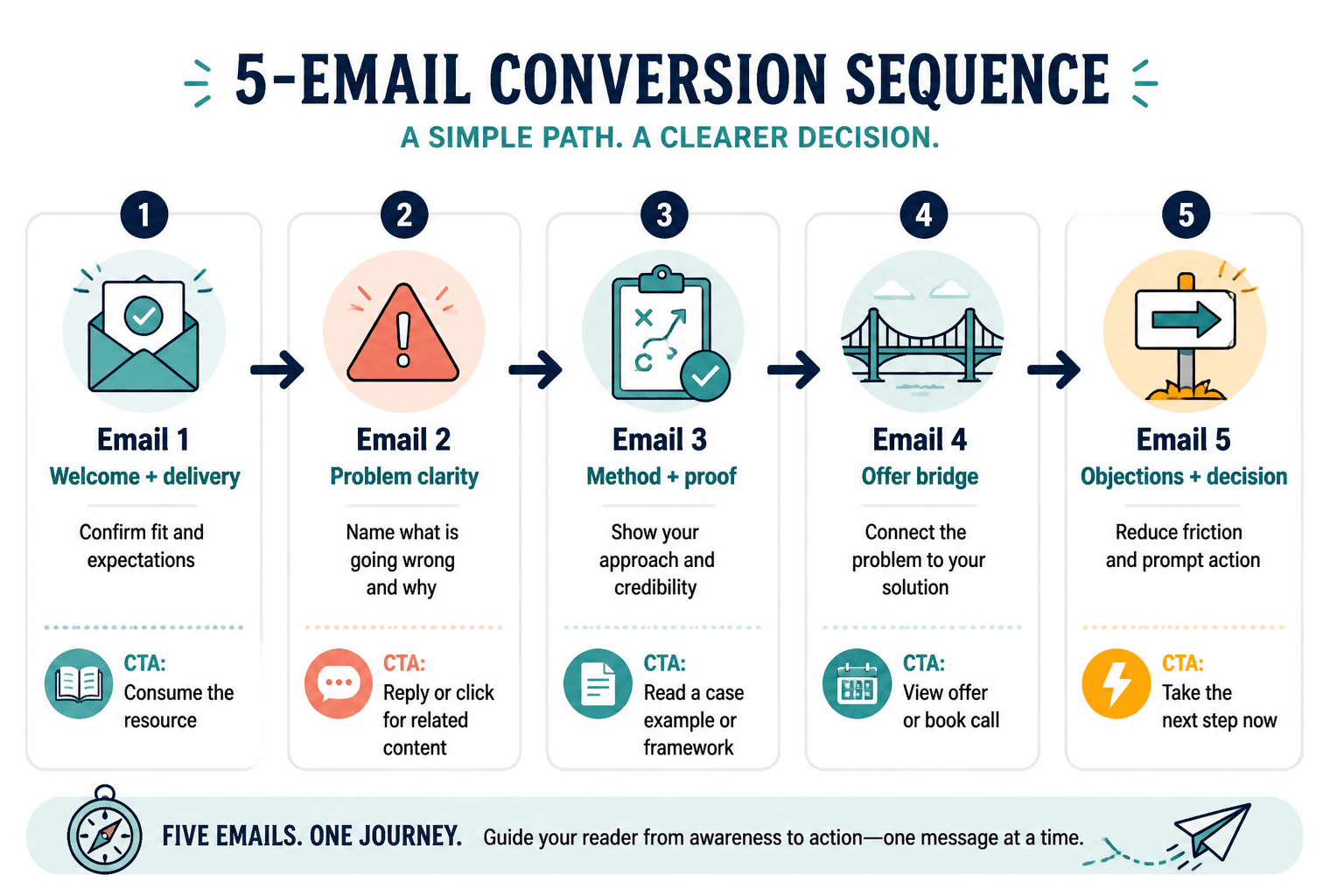
A simple five-email conversion sequence
- Email 1: confirm the signup and restate the problem.
- Email 2: give a useful insight or quick win.
- Email 3: show proof, an example, or a case pattern.
- Email 4: introduce the offer as the logical next step.
- Email 5: answer objections and give a clear decision point.
If you want the trust-first version of this approach in more detail, the companion article How to Monetize Creator Email Sequences Without Wrecking Trust goes deeper on the balance between usefulness and selling.
How to introduce the offer without sounding weird
The offer should arrive like a conclusion, not a plot twist. That means the transition has to feel earned.
A clean offer introduction usually does three things:
- names the problem the reader already recognizes;
- connects that problem to your method or solution;
- shows why the offer is the next sensible step.
One simple formula is:
You have been working through [problem]. The next step is [offer], because it helps you [specific outcome] without [common friction].
That is direct without being theatrical. Good. The internet has enough theatricality already.
What to sell in a creator email sequence
The right thing to sell depends on the audience and the stage of trust.
- Low-friction digital products for readers who want a quick, practical win.
- Memberships or subscriptions for ongoing value and continuity.
- Courses or mini-courses for structured learning.
- Consultations or audits for high-intent service buyers.
- Bundles or premium offers for readers who already trust your judgment.
The more complex the offer, the more sequence support it usually needs. Complexity is not a moral failing, but it does need a better runway.
Measure what the sequence actually changes
Open rate is useful, but it is not the business outcome. For conversion, track the metrics that show whether the sequence is moving people toward action.
- Click-through rate on the offer or next-step link
- Reply rate when replies are part of the funnel
- Lead-to-sale conversion rate
- Consultation booking rate
- Unsubscribe rate after the offer appears
If opens are fine but clicks are flat, the sequence is probably interesting but not directional. If clicks happen but sales do not, the offer, proof, or landing page needs work. Email does not get to shrug and blame the rest of the funnel forever.
For landing-page and conversion basics, Google’s helpful content guidance is still a useful sanity check: make the experience useful, clear, and built for people first.
Common mistakes that quietly kill conversion
1. Selling before trust has formed
If the sequence asks for money before it has earned attention, the reader feels the gap immediately. The fix is not more pressure. It is more relevance.
2. Explaining the offer in abstract language
“Transform your workflow” is not a reason to buy. Specific outcomes beat atmosphere.
3. Making every email a mini sales pitch
That usually trains the audience to skim. Use the sequence to build momentum, not to repeat the same request five times.
4. Hiding the next step
If the call to action is vague, the reader has to work too hard. Confused readers do not convert nearly as often as clear ones.
5. Forgetting the delivery path
The offer is not just what you sell. It is also how the reader moves from email to landing page to decision. The path should be smooth on both desktop and mobile.
If deliverability is part of the problem, Mailchimp’s email deliverability guide is a useful technical baseline. You can write a great sequence and still lose the game if it never lands properly.
A simple build order for turning a sequence into leads or sales
- Pick the next logical step for the audience.
- Choose the funnel shape that matches the offer.
- Write the sequence around trust, proof, and one clear offer.
- Place the CTA where it feels earned, not jammed in.
- Track clicks, replies, and conversions instead of flattering metrics alone.
- Refine the weak link: subject line, body copy, offer, or landing page.
If you need examples of sequence language rather than structure, the sibling article How to Write Better Creator Email Sequences is the better companion piece. If you want more format ideas, Best Creator Email Sequences Ideas and Examples for Creators covers the pattern side.
Wrap-up
A creator email sequence turns into more leads or sales when it stops acting like a content dump and starts acting like a guided path. The path should be simple: trust, relevance, proof, offer, decision. Get that right, and the sequence stops being a polite newsletter appendix and starts doing actual business work.
For the broader system, return to the creator email sequences parent guide. For adjacent strategy, the funnel and trust articles linked above will carry the next layer of the work.