
Most creators do one of two bad things with old blog content: they ignore it until it rots quietly in the corner, or they “update” it by changing three sentences and the year in the headline, then wonder why nothing improves.
A proper blog rewrites and refreshes guide for creators who want better results is not about cosmetic edits. It is about figuring out what the post was supposed to do, why it stopped doing that well, and how to make it useful, sharper, and more competitive without rewriting your whole site from scratch.
If you have blog posts that used to get traffic, never got enough traffic, almost rank, attract the wrong readers, or sound like a polite robot drafted them during a coffee shortage, this is the work that fixes that. Not glamorous. Very effective.
Here’s how to refresh old content in a way that actually improves search performance, reader trust, and conversion potential, without turning every update into a bloated content project. If you want the broader system behind this process, start with blog SEO writing, then explore the deeper content systems inside blog article systems and the main blog rewrites and refreshes hub.
For the main guide behind this topic, visit the parent guide.
What blog rewrites and refreshes are actually for
Refreshing a blog post is not the same as editing for typos. It is not the same as republishing old thoughts with a shinier intro either.
A useful refresh usually does one or more of these things:
- Improves the article’s chance of ranking for the right search intent
- Makes the piece clearer, more useful, and easier to scan
- Brings outdated examples, screenshots, tactics, or language up to date
- Fixes weak structure, weak hooks, and vague sections
- Improves internal linking and next-step CTAs
- Aligns the post with your current positioning, audience, and offers
Sometimes a refresh is light. Sometimes it is basically open-heart surgery with headings. The trick is knowing which kind of update the post needs before you start poking at paragraphs for two hours.
How to know which posts are worth refreshing
Not every old post deserves your attention. Some are salvageable. Some need a full rewrite. Some should be merged into a stronger article. Some should be left alone or deleted if they serve no strategic purpose.
Good candidates for a refresh usually look like this:
- They already get some impressions or traffic, but underperform in clicks or conversions
- They target topics still relevant to your business and audience
- They rank on page two or the lower half of page one
- The core idea is solid, but the writing, examples, or structure are weak
- The topic has evolved and your post has not
- The article has authority potential, but currently reads thin or generic
Weak candidates usually have one of these problems:
- The topic no longer matters to your audience
- The keyword intent is a bad fit for what you actually sell or teach
- The article is so thin that fixing it would take longer than starting over
- You have several overlapping posts cannibalizing each other
- The piece was built on a flimsy trend that no one cares about now
If you are dealing with a pile of old content and do not know where to begin, prioritize posts with proven demand and clear business relevance. Traffic is nice. Relevant traffic that can turn into trust, subscribers, leads, or buyers is nicer.
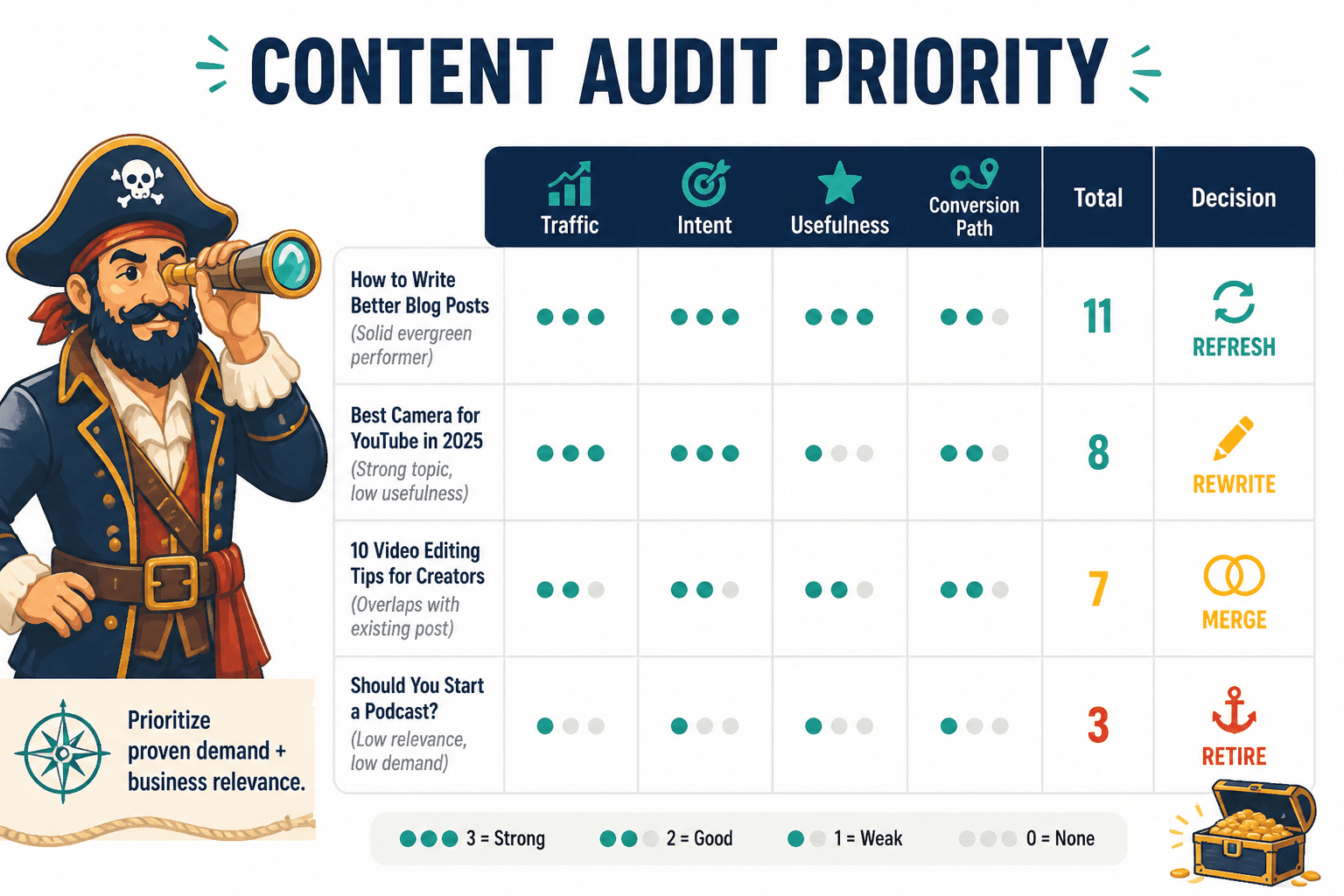
A simple 4-part framework for deciding the right kind of update
Before you rewrite anything, assess the post across four areas: traffic, intent, usefulness, and conversion path.
1. Traffic
Is the article getting impressions, clicks, backlinks, shares, or newsletter traffic? If yes, it has some momentum. That usually means refresh before replace.
2. Intent
Does the article match what the reader likely wants when they search that phrase? A lot of blog posts fail here. The creator writes what they want to say, not what the reader came to solve.
3. Usefulness
Is the content better than what already exists? Not “fine.” Better. More specific, clearer, more actionable, more current, more trustworthy. Beige competence does not win much.
4. Conversion path
If the article succeeds and attracts the right reader, what happens next? Is there a relevant internal link, CTA, offer, newsletter path, or related article? If not, the post may earn attention and still do very little for your business.
That framework helps you decide between four actions:
| Post condition | Best move |
|---|---|
| Solid base, outdated details, weak formatting | Refresh |
| Good topic, weak writing, wrong structure | Rewrite |
| Several overlapping weak posts | Merge and redirect |
| Irrelevant or low-value topic | Retire or noindex if appropriate |
The blog refresh process that actually improves results
If you want a repeatable process, use this. It is simple enough to run regularly and strong enough to produce meaningful gains over time.
Step 1: Recheck the search intent before touching the draft
Do not start by editing sentences. Start by asking what the reader really wants from this topic.
For example, if your post is about blog rewrites and refreshes, the reader probably does not want a poetic meditation on content maintenance. They want a practical method, decision criteria, examples, and maybe a checklist they can actually use this week.
If your current article is too broad, too fluffy, or aimed at the wrong level of reader, no amount of line editing will save it.
Step 2: Tighten the angle
Many old posts are not terrible. They are just mushy. The angle is vague. The audience is unclear. The promise is too broad. The article is trying to help everyone and ends up helping almost no one with any real force.
Tightening the angle can mean:
- Narrowing the audience
- Making the promise more specific
- Focusing on one problem instead of five
- Removing beginner filler if the reader wants advanced guidance
- Adding foundational clarity if the post assumed too much
A sharper angle often does more for performance than another 700 words of “helpful” padding.
Step 3: Rewrite the opening first
A weak intro quietly poisons the whole piece. If the opening rambles, states the obvious, or takes six paragraphs to admit the topic, readers bounce and search engines notice people are not exactly thrilled.
When refreshing an intro, aim for three things fast:
- Name the real problem
- Show the reader you understand the mistake or frustration
- Make a clear promise about what the article will help them do
Bad intro:
Blog content is an important part of any digital marketing strategy. Keeping your content updated helps maintain relevance and improve search engine optimization over time.
Better intro:
Most old blog posts do not need a tiny update. They need a better point, better structure, and less filler pretending to be value. If your content is aging badly, here is how to fix the pieces that can still pull traffic, trust, and leads.
That second version has a pulse. Helpful quality in writing.
Step 4: Cut what no longer earns its place
This is where a lot of creators get sentimental. They leave in outdated examples, generic definitions, bloated transitions, and entire sections that say almost nothing because “well, I already wrote it.”
That is not a content strategy. That is hoarding in paragraph form.
Cut:
- Throat-clearing intros
- Generic advice the reader already knows
- Repeated points in slightly different words
- Outdated screenshots and references
- Sections that do not support the search intent
- Overly broad tips with no examples or proof
Step 5: Add specifics, examples, and proof
Refreshing does not just mean cutting. It also means strengthening the article with details that make it more useful and more credible.
Add things like:
- Before-and-after rewrites
- Clearer step-by-step frameworks
- Examples for different creator types
- Updated terminology and current use cases
- Small checklists that help with implementation
- Stronger explanations where readers might get stuck
This is also the moment to improve the article for actual human reading. Better subheads. Cleaner formatting. Shorter paragraphs. More direct transitions. Less sludge.
For more hands-on tactics, pair this article with how to write better blog rewrites and refreshes and best blog rewrites and refreshes ideas and examples for creators.
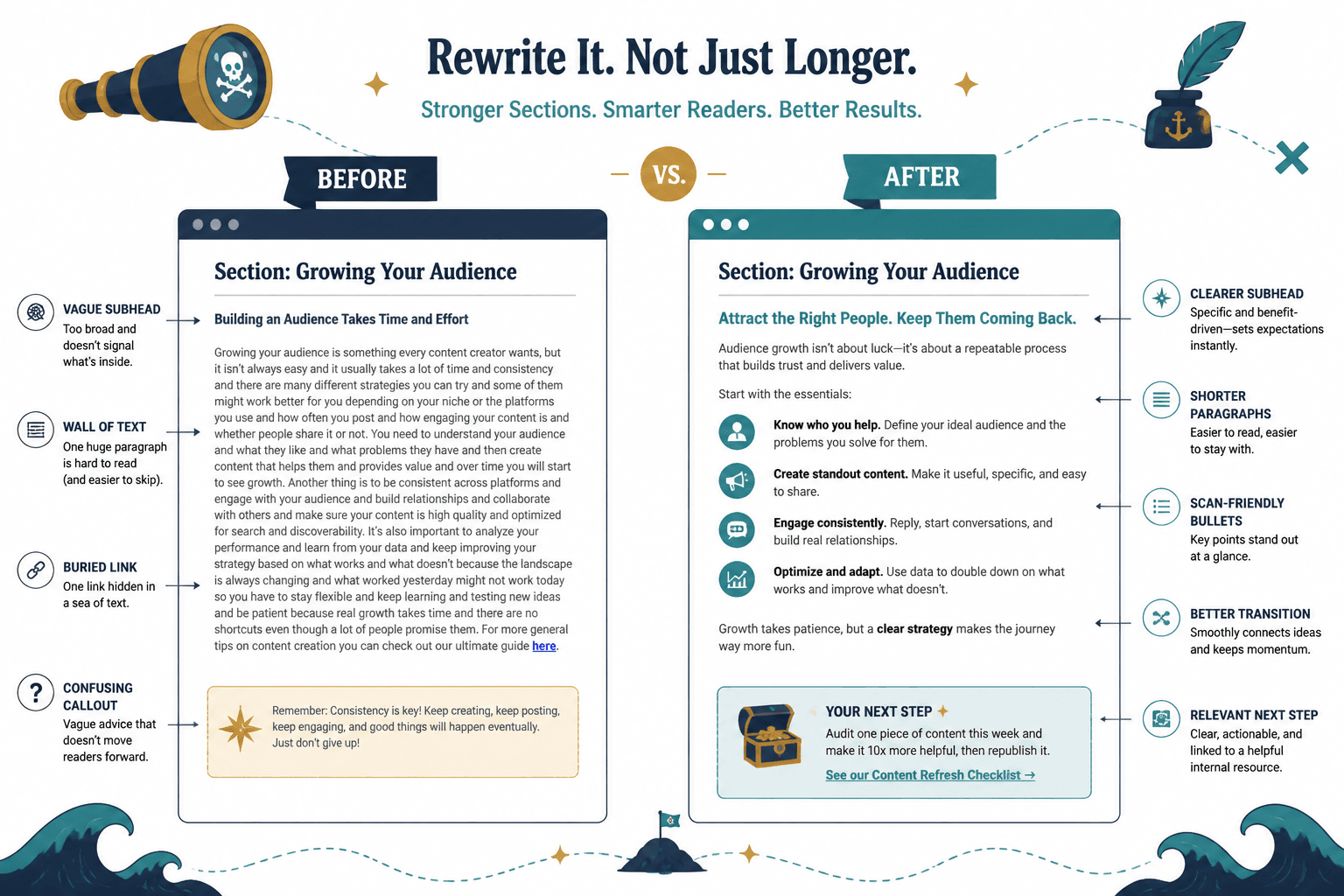
Step 6: Improve internal links and the next step
Old posts often leak value because they are isolated. They get a reader in, then shrug.
As you refresh, ask:
- What related article should this link to?
- What pillar page should support this topic?
- What should the reader do next if this article helps them?
- Is the CTA relevant to the reader’s stage of awareness?
For this topic, strong internal linking might point readers to how to turn old content into better blog rewrites and refreshes or, if they are growing from a smaller base, blog rewrites and refreshes for creators with small audiences.
Step 7: Update the publishing details carefully
If your site setup allows updated timestamps, use them honestly when the article has been meaningfully improved. Not because you changed a comma. Because the content is genuinely fresher, more useful, and more accurate now.
Also check:
- Title tag and headline clarity
- Meta description if you control it
- Image alt text where relevant
- Broken links
- On-page CTA alignment
- Redirects if URLs change during merges
What to rewrite first inside a weak blog post
If a post is underperforming, there is a rough order of operations that tends to work better than random editing.
- The title and intro — because weak framing kills attention fast
- The H2 structure — because messy structure makes good ideas harder to follow
- The sections with the highest intent value — the parts readers most came for
- The examples and proof — because specifics create trust
- The CTA and internal links — because attention without direction is wasted
Notice what is not first: polishing random sentences. Line edits matter, but they matter more after the article has a strong angle and structure. Editing weak strategy just gives you cleaner weak strategy.
Common refresh mistakes creators keep making
Changing words without changing the substance
If the article is vague, outdated, or poorly structured, swapping a few phrases around does not count as a useful refresh.
Adding more length instead of more value
Longer is not automatically better. Sometimes the right refresh removes 30 percent of the post and makes the remaining 70 percent hit harder.
Ignoring search intent drift
Topics change. Search results evolve. If the top-performing content now answers the question differently, your old framing may no longer fit what readers expect.
Keeping bad sections because they took time to write
No one reading your article knows how long that paragraph took. They only know whether it helps. Be ruthless.
Forgetting the business goal
A refreshed post should not just attract a pulse. It should attract the right reader and move them toward something relevant.
When a full rewrite is smarter than a refresh
Some posts are too far gone for touch-ups. That is fine. Full rewrites are often the better move when the original piece has a weak premise, bad keyword fit, poor structure, or a voice that sounds like it was assembled from six average marketing blogs and a tax form.
A full rewrite usually makes sense if:
- The topic still matters, but the article says very little well
- The search intent was misunderstood from the start
- The piece targets the wrong audience
- The original voice no longer matches your brand
- The content lacks enough depth to compete
- You would spend nearly as long patching it as rebuilding it
If that is your situation, do not cling to the old draft out of loyalty. Loyalty to bad content is a strange hobby.
How creators can use rewrites to improve conversions, not just traffic
This part gets missed a lot. A refresh is not just an SEO task. It is a conversion opportunity.
When you revisit an old article, you can improve how it supports your business by refining the path from reader interest to next action. That does not mean stuffing it with aggressive pitches. It means making the next step obvious and relevant.
Examples:
- An article about rewrites can lead to a content audit service, newsletter, or related guide
- A post for creators can point to templates, workshops, or strategy calls
- An educational article can link naturally to a deeper pillar page or resource hub
The best CTAs after a refresh usually feel like continuation, not interruption. The reader should think, “Yes, that helps,” not, “Ah, there it is, the funnel wearing a fake mustache.”
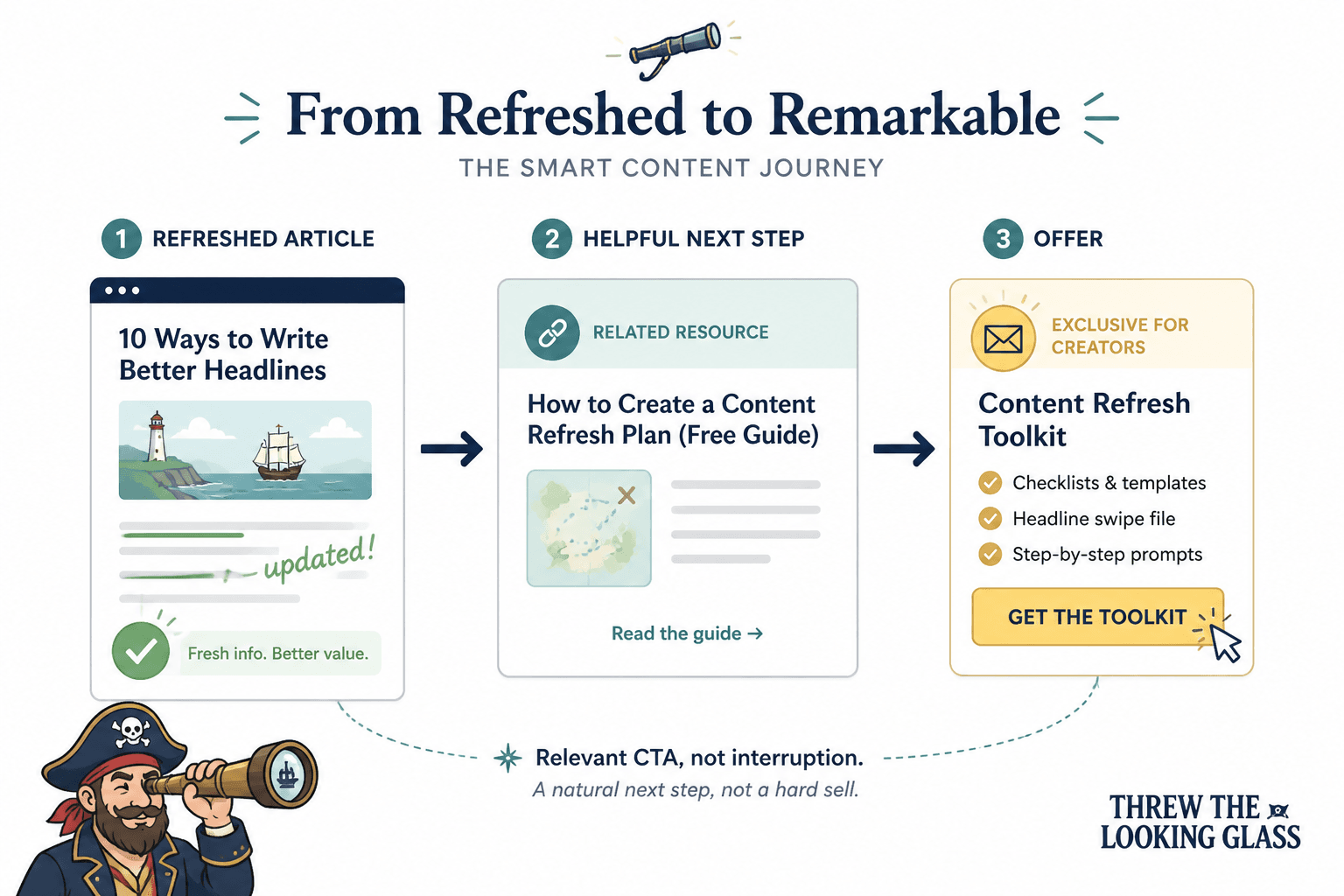
A practical refresh checklist you can use each time
- Confirm the topic still matters to your audience and business
- Recheck the search intent
- Decide: refresh, rewrite, merge, or retire
- Rewrite the intro if it is weak
- Tighten the title if needed
- Improve the H2 structure and flow
- Cut outdated, repetitive, or generic sections
- Add clearer examples, steps, and proof
- Update screenshots, references, and terminology
- Improve internal links
- Strengthen the CTA or next-step path
- Check formatting, readability, and scannability
- Review metadata and publishing details
- Track performance after the update
How often should you refresh old blog content?
There is no magic schedule because not all content ages at the same speed. Some posts can sit for a year and stay useful. Others start getting stale in a few months, especially if they cover tools, platform features, workflows, or examples that change quickly.
A practical rhythm looks like this:
- Quarterly review of your most important traffic and conversion posts
- Monthly spot-check of articles sitting just outside strong ranking positions
- Immediate updates for posts tied to outdated processes, screenshots, or recommendations
If your library is large, start with the content that has the highest upside. You do not need to refresh everything. You need to refresh the right things in the right order.
FAQ
Should I refresh a post or publish a new one on the same topic?
If the old post already has some relevance, impressions, or backlinks, refreshing is usually smarter. Publish a new one only if the angle or intent is meaningfully different.
How much should I change before calling it a refresh?
Enough that the article is genuinely more useful, current, and better aligned with reader intent. A few cosmetic edits do not count for much.
Can refreshing old content help SEO?
Yes, if the update improves usefulness, clarity, relevance, structure, and internal linking. Not if you just fluff the wording and hope for the best.
What if a post gets traffic but not leads?
Check audience fit, intent, and CTA alignment. The post may attract readers who were never a match for your offer, or it may simply fail to guide the right readers anywhere useful.
Should small creators bother with refreshes?
Absolutely. In many cases, improving existing content is a smarter use of time than endlessly publishing new posts no one finds. This is especially true if your library is small and each post needs to work harder.
Better results usually come from better judgment, not more content
The bigger point is simple: clearer structure and clearer writing make the piece more useful. That is usually what makes the ending land better too.
Better rewrites and refreshes make the article clearer, more current, and easier to act on. A sharper update usually beats a bigger but messier rewrite.