
Some homepages are too long because the business has a lot to say.
Most homepages are too long because nobody made a decision.
That is usually the real issue. Not ambition. Not depth. Not strategy. Just copy sprawl. One more section, one more proof block, one more vague promise about transformation, and suddenly the page reads like a brand workshop that got lost on its way to a website.
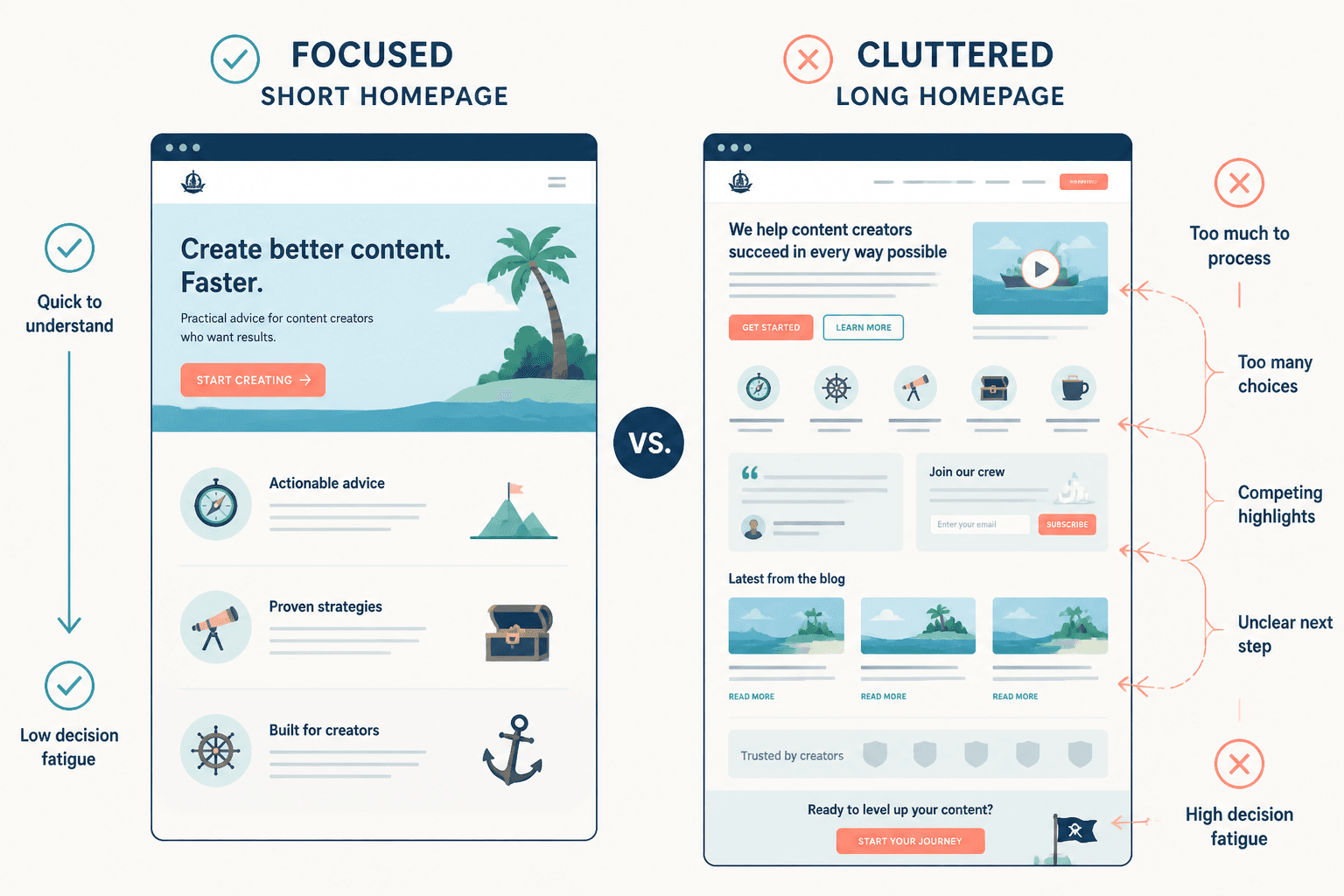
When short homepage copy beats long ones is not a mystery. Short wins when the visitor is clear, the offer is simple enough to grasp fast, and the page removes friction instead of adding more reading homework. Long pages are not automatically smarter. They are often just less edited.
If your homepage needs to help people quickly understand what you do, who it is for, and what to do next, shorter copy can outperform a longer page by a mile. Not because people have no attention span, but because they have standards. If they do not see relevance quickly, they are gone.
This article will help you figure out when short homepage copy is the better move, what kind of businesses benefit most from it, where people overstuff pages for no reason, and how to trim a homepage without turning it into a vague little minimalist poem.
For the full path around this topic, head to the parent guide.
Why short homepage copy sometimes converts better
Short copy works when speed matters more than persuasion layers.
That usually means the visitor is not looking for your life story, your six-part philosophy, or a scrolling obstacle course of “why us” blocks. They want a fast answer to a simple set of questions:
- What is this?
- Is it for me?
- Can I trust it?
- What should I do next?
If your homepage answers those four questions quickly and clearly, it often does not need much more.
Short pages also reduce a problem long pages create all the time: decision fatigue. Every extra section asks the visitor to keep caring. That is a terrible assumption. Visitors do not owe your homepage patience. Your homepage has to earn it.
A shorter page can also feel more confident. It suggests you know the core message, know the audience, and are not trying to compensate for weak positioning with a giant pile of paragraphs.
That last part matters more than people think. A lot of bloated homepage copy is really a positioning problem wearing a content problem costume.
When short homepage copy beats long ones
Short homepage copy tends to win in a few very specific situations. If you recognize your business here, your homepage may need less copy than you think.
1. Your offer is simple and easy to understand
If you offer one core service, one main product, or one obvious next step, a shorter homepage often makes more sense.
Examples:
- A copywriter who writes website copy for coaches
- A designer selling brand identity packages for small businesses
- A consultant booking strategy calls for one niche problem
- A creator driving people to one newsletter or one flagship offer
These businesses usually do not need ten homepage sections explaining the cosmos. They need a clear promise, some proof, and one strong CTA.
2. Your traffic is warm
If people are arriving from your content, email list, referrals, podcast appearances, or social profiles, they often already know enough about you to not need a giant homepage.
Warm traffic needs orientation more than seduction. They clicked because they already had interest. Now they want confirmation that they are in the right place.
In that case, short copy can work beautifully because it reduces friction between interest and action.
3. The homepage is a routing page, not the full sales argument
Sometimes the homepage is not meant to do all the heavy lifting. Its job is to direct people to the right next page.
For example, your homepage might point visitors toward:
- A services page
- A sales page
- A booking page
- A portfolio
- A newsletter landing page
- A case study library
When that is the goal, stuffing the homepage with every possible detail can actually reduce performance. You do not need the homepage to do every job badly. You need it to do its actual job well.
4. Mobile readability matters a lot
Long homepages can get painful on mobile fast. Endless scrolling, repetitive sections, bloated testimonials, giant blocks of text, and too many CTAs create a pretty miserable experience.
Shorter copy forces prioritization. That usually leads to better mobile UX, cleaner hierarchy, and stronger scannability. Not always. But often enough that it should be considered before you build a homepage the length of a minor Victorian novel.
5. Your category is already familiar
If people already understand what your type of business is, you may not need long explanatory copy.
A homepage for a business coach, therapist, photographer, designer, or fractional CMO still needs differentiation, but it usually does not need to explain the concept of coaching, therapy, photography, design, or marketing from scratch.
When the category is familiar, clarity and fit matter more than volume.
When long homepage copy still makes sense
Short is not automatically better. It is better when it is enough.
Longer homepage copy can make sense when:
- Your offer is unusual and needs explanation
- Your audience is skeptical and needs more proof
- You have multiple buyer types to guide
- The price point is high enough to justify more persuasion
- Your homepage is doing sales-page work because there is no separate sales page
- Your category is crowded and trust needs to be earned carefully
The key difference is that useful long copy earns its length. It adds clarity, proof, objection handling, and momentum. Bad long copy just repeats itself in slightly different business-casual wording.
If you are trying to decide on homepage length, this is the right question: does this section help a qualified visitor understand, trust, or act faster? If not, it is probably decorative copy. Decorative copy is very popular. It is also expensive.
For a broader look at this question, you can pair this with how long homepage copy should be in 2026.
The real reason many long homepages underperform
Most underperforming long homepages do not fail because they are long. They fail because they are bloated, repetitive, and badly ordered.
Here is what usually goes wrong:
- The hero section says almost nothing
- The next three sections say the same thing again with different adjectives
- The copy focuses on the brand instead of the visitor
- Proof shows up too late
- Every section tries to sound profound instead of useful
- There is no clear path to action
That kind of page does not need “better long-form copy.” It needs editing, structure, and a grown-up willingness to cut stuff.
Section order matters a lot here. If your page feels long, the problem may be structure as much as length. Read homepage copy section order mistakes that hurt performance if your page keeps dragging before it gets to anything convincing.
What a short homepage still needs to do
Short pages are not lazy pages. They still need to carry their weight.
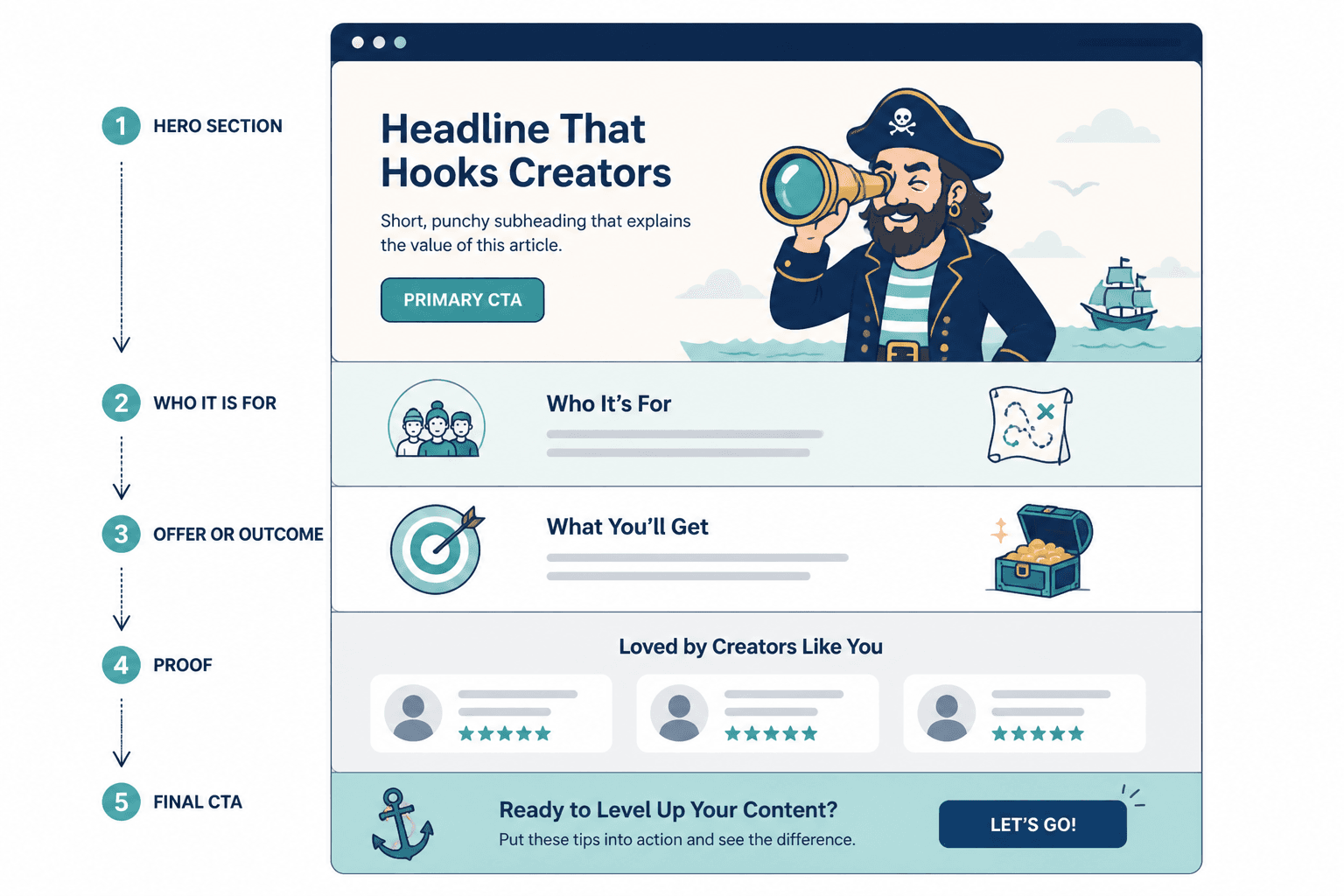
A high-performing short homepage usually needs these pieces:
- A sharp hero section
- A clear explanation of who it is for
- A concise description of the offer or outcome
- Some form of proof
- A simple, visible CTA
That can be enough. Not always, but often.
If your hero section is weak, though, the whole “short homepage” idea falls apart quickly. You can borrow structure ideas from these homepage hero section examples creators can adapt fast.
A practical structure for a shorter homepage
If you want the homepage leaner without making it empty, this structure works well for creators, consultants, coaches, service providers, and solo businesses.
Section 1: Hero
Say what you do, who it is for, and what happens next.
Example:
Website copy for coaches and consultants who are tired of sounding polished but forgettable.
Get homepage copy that makes people understand the offer fast and actually want to keep reading.
See homepage copy examples
Section 2: Who this is for
Help visitors identify themselves quickly.
Example:
This is for service businesses with solid expertise, messy messaging, and a homepage that currently sounds like it was approved by a committee of anxious tabs.
Section 3: Core value or offer snapshot
Explain what they get without turning it into a maze.
Example:
I write and refine homepage copy that clarifies your positioning, sharpens your message, and helps the right people move from “what exactly do you do?” to “where do I book?”
Section 4: Proof
Add one to three proof elements. Keep them relevant.
- Client result
- Short testimonial
- Notable experience
- Volume of projects completed
- Specific niche expertise
Example:
Used by coaches, consultants, and creator-led businesses that needed clearer messaging, stronger page flow, and fewer “looks nice, but I still do not get it” reactions.
Section 5: CTA
One next step. Not four.
Example:
Read the homepage copy guide or book a consult if you already know your homepage needs help.
What to cut if your homepage is too long
If you are editing a homepage down, start here.
Cut repeated claims
If three sections all say you care about results, clarity, transformation, or client success, pick the best one and delete the other two.
Cut generic philosophy paragraphs
Most homepage philosophy blocks are too abstract to convert and too self-important to be useful.
If it sounds like this, be suspicious:
We believe every brand has a story worth telling, and our mission is to empower meaningful transformation through authentic connection.
That is not homepage copy. That is scented candle language.
Cut weak testimonials
If a testimonial says you were amazing, professional, insightful, or a joy to work with, but gives no context or result, it is not helping much.
Use fewer, stronger proof points instead.
Cut overexplaining your process on the homepage
A simple process snapshot can help. A seven-stage methodology with proprietary naming and paragraph-long explanations usually belongs elsewhere.
Your homepage is not the place to show every thought you have ever had about your method.
Cut extra CTAs that compete
If you ask people to book a call, read the blog, join the newsletter, watch the video, download the lead magnet, and browse the case studies all from the same page, do not act surprised when they do nothing.
Pick the primary action. Support it with maybe one secondary route if necessary.
Short does not mean vague
This is where people mess it up.
They hear “short homepage copy” and strip the page down until it says almost nothing. A tiny headline. A soft subhead. A button that says Learn More. Beige minimalism. Very clean. Also useless.
Short homepage copy beats long ones when the short version is still specific. It still needs clear audience fit, outcome, relevance, and direction. You are not trying to be mysterious. You are trying to be easy to understand.
Compare these two examples.
| Weak short copy | Stronger short copy |
|---|---|
| Helping you elevate your brand | Homepage copy for consultants who need clearer messaging and more qualified leads |
| Thoughtful strategy for modern business | Brand and website strategy for small service businesses tired of vague positioning |
| Transform your online presence | Turn a confusing homepage into a clear sales path your visitors can follow in under 30 seconds |
Short works when it is compressed, not watered down.
How to decide if your homepage should be shorter
Use this quick test.
- Can a new visitor understand what you do within five seconds of landing?
- Does each section add something new?
- Is the main CTA obvious by the time someone reaches the middle of the page?
- Could two or three sections be moved to a services page, about page, or sales page?
- Does the page feel tighter after cutting 20 percent?
If the answer to several of those is no, then yes, your homepage probably wants a sharper edit.
The bigger point is simple: clearer structure and clearer writing make the piece more useful. That is usually what makes the ending land better too.