Most newsletter subject lines do not fail because they are too short, too long, or missing an emoji. They fail because they sound like admin. Or worse, they sound like someone trying very hard to sound like a marketer.
If your email is good but your open rate is dragging, the subject line is usually the first crime scene. Not because there is one magical formula, but because weak subject lines tend to be vague, overly polished, or painfully easy to ignore.
This guide will help you write newsletter subject line hook examples creators can adapt fast, without sounding clickbaity, desperate, or like you copied a template from a dusty funnel course. You will get practical hook types, examples, rewrites, and a simple way to match subject lines to the kind of email you are actually sending.
If you want a broader foundation first, start with email newsletter writing, then dig into newsletter writing and this deeper guide on newsletter subject lines.
For the full path around this topic, head to the parent guide.
What makes a newsletter subject line worth opening
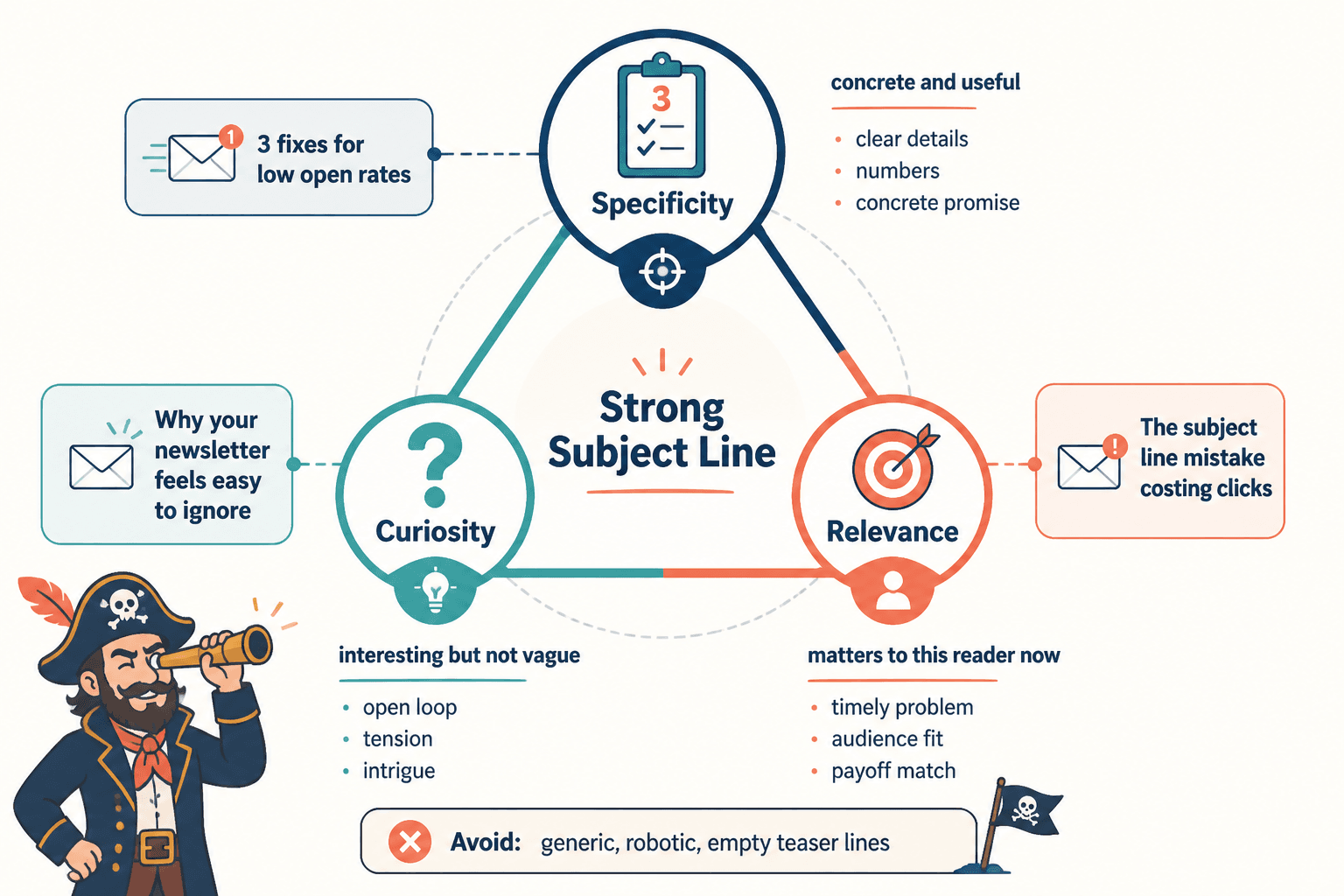
A good subject line does one job: it gives the right person a reason to care now.
That does not mean it has to be dramatic. It does not need to “hack attention.” It just needs enough specificity, tension, relevance, or curiosity to earn the click from someone who already loosely knows who you are.
For creators, coaches, consultants, and personal brands, the best hooks usually lean on one of these:
- A clear benefit
- An interesting tension or contrast
- A sharp opinion
- A useful specificity
- An unexpected confession or truth
- A timely problem the reader already feels
What usually does not work? Empty teaser lines. Overly corporate lines. Generic “weekly update” energy. And subject lines that sound like they were generated by a robot trying to sell a productivity PDF.
Put simply: if the subject line could belong to absolutely anyone, it will probably get opened by almost no one.
How to think about newsletter subject line hooks before you write one
Before examples, here is the part people skip: the subject line should match the email. Obvious, yes. Still ignored constantly.
If your email is a practical how-to, do not write a melodramatic teaser. If your email is a personal story with a business lesson, do not give it a dry “3 lessons from this week” label and wonder why nobody opens it. The hook should fit the payoff.
A quick way to decide your angle is to ask: what is the real reason someone should open this?
- Are they getting a useful idea?
- Are they seeing a mistake they might be making?
- Are they getting a shortcut, example, or framework?
- Are they getting your take on something they already care about?
- Are they getting a story with a clear payoff?
Once you know that, your hook gets easier. Faster too. Which is nice, because nobody wants to spend 45 minutes staring at one email subject line like it owes them rent.
7 newsletter subject line hook types creators can adapt fast
1. The specific benefit hook
This one works when the email teaches something practical or gives the reader a result they want.
Formula: how to get result without annoying thing
- Write subject lines people actually open
- How to make your newsletter less skimmable
- Get more replies without begging for them
- A simpler way to plan next month’s emails
- How to sound smarter in fewer words
Why it works: it is clear, useful, and grounded in a real outcome. It is not flashy, but it does not need to be. Clear beats clever most weeks.
2. The curiosity-with-boundaries hook
Curiosity works best when it hints at something specific instead of doing the newsletter version of “you will not believe what happened next.”
Formula: small mystery + clear context
- The email tweak that doubled replies
- I changed my CTA for this reason
- This content habit was quietly wasting my time
- The part of my newsletter I almost cut
- Why this simple subject line beat the clever one
The key is restraint. Good curiosity opens a loop. Bad curiosity sounds like a scammy thumbnail in inbox clothing.
3. The sharp opinion hook
If your email contains a strong take, say so. You do not need fake neutrality around ideas you clearly believe.
- Most newsletter intros are too slow
- You do not need a “value-packed” email
- Why clever subject lines often lose
- Weekly newsletters are overrated for some creators
- Stop writing emails like mini blog posts
This style works especially well for creators with a point of view. It can attract the right readers fast because it gives them a reason to recognize your angle before they open.
4. The problem-first hook
This works because readers often open emails that name the frustration already bouncing around in their head.
- Your emails are useful. So why are they ignored?
- Low open rates usually mean this
- If your newsletter feels flat, read this
- The reason your best ideas underperform in email
- Why nobody clicks your newsletter links
A problem-first hook is not about fearmongering. It is about relevance. You are showing the reader you understand the friction, not trying to manufacture a crisis.
5. The numbered specificity hook
Yes, numbers still work. No, they are not magic. They just help create shape and expectation.
- 5 subject line hooks worth stealing
- 3 ways to make your emails easier to open
- 7 newsletter mistakes I keep seeing
- 4 hooks I would use for this email
- 10 subject line examples you can adapt today
Use this when the content is genuinely structured. Do not slap a number on a rambling email and call it strategy.
6. The story-payoff hook
If your email starts with a story, the subject line should hint at the payoff, not just the setup.
- The client email I should have sent sooner
- What missing one newsletter taught me
- The tiny change that made my emails clearer
- I almost sent the wrong email
- What a bad subject line taught me about trust
Stories get opened when they feel like they lead somewhere useful. If it sounds like diary spam, people skip.
7. The direct audience hook
This one works well when your list serves a clear group and the email is tightly relevant to them.
- For creators stuck writing boring newsletters
- Coaches: your subject line might be the problem
- If you sell expertise, read this before your next send
- For consultants who want more email replies
- Personal brands: stop wasting your best ideas in weak subject lines
This is useful because it filters attention. It tells the right reader, “yes, this is for you,” without trying to please everyone in the list.
Newsletter subject line hook examples creators can adapt fast
Here is the practical part. Below are adaptable examples grouped by email type, because a subject line for a thought piece should not sound like one for a tactical checklist.
For useful teaching emails
- How to write a stronger email intro
- 3 ways to make your newsletter easier to skim
- A better CTA for low-pressure emails
- The simplest fix for weak subject lines
- How to make your newsletter sound less generic
- 5 hook ideas for your next send
For opinion emails
- Your newsletter does not need more personality
- Clever subject lines are often the wrong move
- Most creator newsletters need tighter editing
- Why “just be authentic” is useless writing advice
- Open rates can lie a little
- Stop trying to make every email feel important
For story-based emails
- The send I almost did not hit
- What one ignored email taught me
- I rewrote this subject line three times
- The boring draft that turned into a strong email
- Why this tiny inbox mistake mattered
- The lesson hiding in a low-open email
For promotional but trust-safe emails
- If you want help with your newsletter, this is for you
- A simple way to get better email feedback
- Want me to help fix your newsletter?
- I made this for creators who hate writing emails
- The offer behind my recent email advice
- If your newsletter is underperforming, I can help
Notice the pattern: these are not trying to outsmart the inbox. They are trying to be interesting to the right person. That is the actual job.
If you want more swipeable ideas, see best newsletter subject lines ideas and examples for creators and newsletter subject lines examples for coaches, consultants, and personal brands.
Before-and-after rewrites: from ignoreable to openable
Sometimes the easiest way to improve your subject lines is to look at what goes wrong in plain view. Here are a few common weak versions and stronger rewrites.
| Weak subject line | Better rewrite | Why it works better |
|---|---|---|
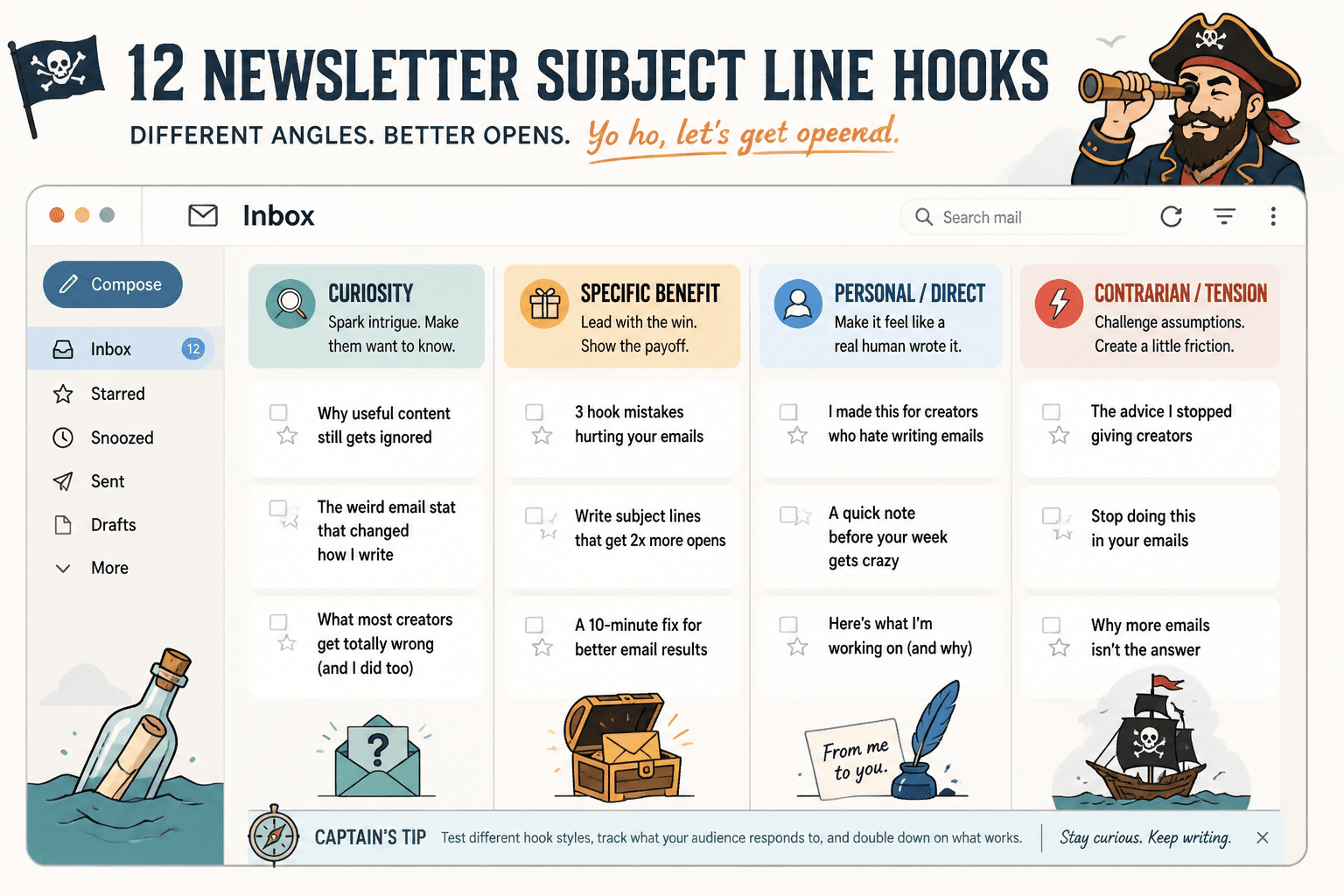
| Weekly Newsletter #18 | 3 hook mistakes hurting your emails | Gives a reason to care |
| Thoughts on content | Why useful content still gets ignored | Adds tension and specificity |
| A quick update | I changed how I write newsletter intros | Makes the update relevant |
| Some email tips | 5 email tweaks I would steal immediately | Sharper promise, stronger language |
| This week’s insights | The subject line problem most creators miss | Names a clear topic and problem |
The pattern is pretty consistent. The weak versions label the email. The stronger versions sell the open. Not in a sleazy way. Just in a competent one.
A fast formula for writing better subject lines in under 5 minutes
If you send newsletters regularly, you do not need a fresh act of genius every time. You need a repeatable way to get to something solid quickly.
- Write the actual point of the email in one plain sentence.
Example: This email explains why vague subject lines kill open rates. - Choose the angle.
Benefit, problem, opinion, curiosity, story, or specificity. - Draft 5 fast versions.
Do not judge yet. Speed helps. - Cut the weakest words.
Remove filler like “thoughts,” “update,” “insights,” “some,” “quick.” - Pick the one that feels most relevant, not most clever.
Here is that process in action.
Actual email point: This email shows creators how to make subject lines more specific.
Drafts:
How to write more specific subject lines
Your subject lines are probably too vague
3 ways to sharpen your newsletter hooks
The specificity fix your emails need
Why vague subject lines keep getting ignored
Any of those could work, depending on your brand voice and the content inside. The point is not to find “the best” line in some absolute sense. The point is to stop defaulting to lifeless subject lines that do your email no favors.
What creators keep getting wrong with subject lines
Trying to be mysterious instead of interesting
“You need to see this” is not a hook. It is an empty plate. Curiosity is useful when it points toward a real payoff or tension. It becomes annoying when it withholds the point and expects mystery alone to do the work.
The best open-rate hooks do not trick the reader. They frame the value in a way that makes opening the email feel worth it.