
Most weak newsletter subject lines do not fail because they are too short, too long, or missing an emoji. They fail because they are vague, bland, and scared to say anything specific.
If you are a coach, consultant, or personal brand, that matters more than people admit. Your emails are not competing against some abstract “inbox noise.” They are competing against client work, sales emails, Slack messages, calendar reminders, and 14 other newsletters promising “3 mindset shifts” nobody asked for.
So if you want better opens, better attention, and better trust, your subject line needs to do one simple job: make the right person think, that sounds relevant to me.
This guide gives you practical newsletter subject line examples for coaches, consultants, and personal brands, plus the patterns behind them so you can write your own without sounding like a copy-paste internet marketer in a fleece vest.
If you want the bigger-picture version first, start with this newsletter subject lines guide or browse more resources in email newsletter writing and newsletter writing.
For the full path around this topic, head to the parent guide.
What good subject lines actually do
A good subject line does not need to be clever. It needs to be clear, interesting, and appropriately specific.
That last part matters. Appropriately specific means specific enough to create curiosity, but not so stuffed with detail that it feels clunky. You are not writing a summary. You are opening a loop.
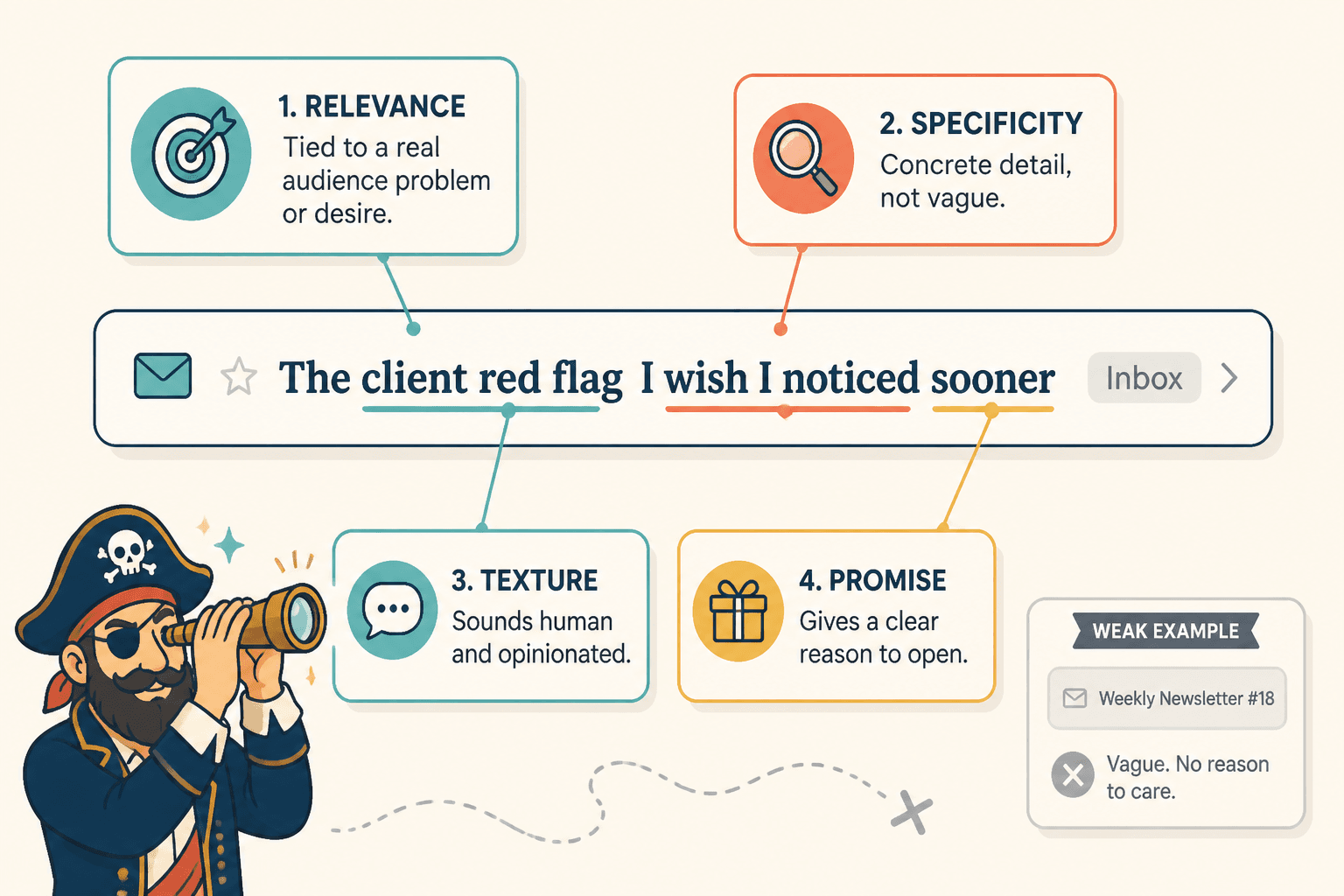
- Relevance: Is this about a problem, desire, or situation your audience actually cares about?
- Specificity: Does it hint at something concrete instead of vague self-improvement fog?
- Texture: Does it sound like a real person with a real point of view wrote it?
- Promise: Is there a clear reason to open?
That is why “Weekly Newsletter #18” is dead on arrival, and “The client red flag I wish I noticed sooner” has a shot.
People do not open because you sent an email. They open because the subject line gives them a reason.
The biggest subject line mistakes coaches and consultants keep making
Before we get into examples, let’s clean up the usual mess.
1. Trying to sound important instead of useful
Subject lines like “A transformational perspective for ambitious leaders” sound like they were generated by a panel of HR bots. Nobody knows what it means, so nobody cares.
2. Being too broad
“Thoughts on growth” is not a subject line. It is a shrug in text form.
3. Hiding the interesting part
A lot of people bury the point under a generic intro. If the real email is about the pricing mistake costing consultants leads, say that. Do not call it “This week’s insight.”
4. Using fake urgency
Unless something is actually urgent, stop yelling. “Last chance” works a lot better when it is true and not your fifth fake emergency this month.
5. Copying ecommerce email tactics badly
You are not trying to sell bath towels at 20% off. Personal-brand newsletters need trust, voice, and relevance more than hype. A coach or consultant can absolutely sell through email, but the subject line usually works better when it sounds credible, not gimmicky.
If your current subject lines feel soft or generic, this related piece will help: better newsletter subject lines: weak opener fixes for personal brands.
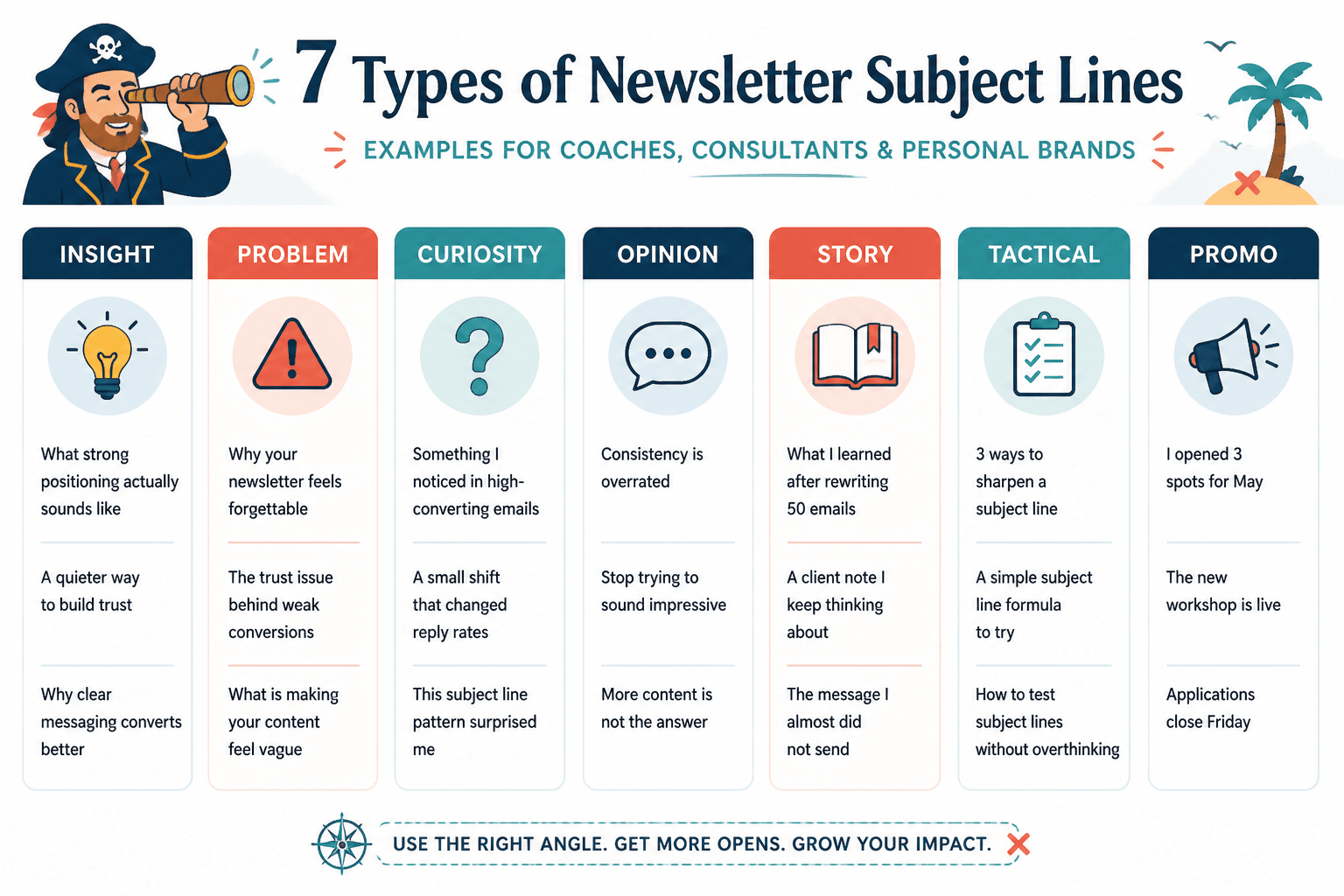
Newsletter subject line examples for coaches, consultants, and personal brands by type
Not every email has the same job. Some are there to teach. Some build authority. Some start conversations. Some sell. If you use the same kind of subject line for all of them, things get stale fast.
Here are useful categories you can rotate.
1. Insight-driven subject lines
These work well when you have a clear opinion, lesson, or observation that helps your audience think better.
- The real reason your content feels flat
- Why smart people still write weak offers
- The visibility problem is not what you think
- Most lead magnets fail for one boring reason
- The trust gap hiding in your marketing
- Why your audience says “interested” and does nothing
- The mistake behind a lot of “consistent” content
- What consultants keep overexplaining
These work because they imply a diagnosis. They suggest that there is a hidden problem worth understanding.
2. Problem-first subject lines
These are direct. They name the pain point right away. No ornament. No fake mystery.
- No replies to your newsletter?
- Your bio is probably costing you leads
- Posting regularly but getting ignored?
- Your sales emails sound too polished
- If your content is useful but forgettable, read this
- The quiet reason people do not trust your offer yet
- Why your newsletter gets polite opens and no action
- Audience growth without lead quality is a trap
These are especially useful for consultants and service providers because they connect quickly to business outcomes.
3. Curiosity with a point
Curiosity works when it is attached to something meaningful. It fails when it gets cute and empty.
- The sentence that made this offer stronger
- A small tweak that made the email much clearer
- The weirdly effective way to sound more credible
- The line I would cut from most landing pages
- One thing I notice in almost every weak pitch
- The fastest fix for an underperforming newsletter
- The simplest way to make your expertise sound sharper
- A surprisingly useful content filter
This is a good lane for personal brands with a stronger voice. Just do not drift into clickbait. “You won’t believe this one trick” needs to stay in the bin where it belongs.
4. Contrarian or opinion-led subject lines
These work when your audience respects your judgment and you have a real argument to make.
- Consistency is overrated if your message is weak
- You do not need more content ideas
- Most personal branding advice is too generic to help
- More polish is not fixing the trust problem
- Stop trying to sound premium in your copy
- Not every freebie should become a funnel
- Long newsletters are not the problem
- “Value-packed” is usually a red flag
A little edge is good. Manufactured edge is exhausting. If you take a stance, make sure the email actually earns it.
5. Personal or story-based subject lines
These can build intimacy and familiarity, especially for coaches and personal brands. But they still need a reason to matter to the reader.
- A client call I keep thinking about
- I changed my mind about this
- What I got wrong about audience trust
- A lesson from a messy launch
- The advice I would not give anymore
- A small mistake that taught me a lot
- I nearly sent the wrong email
- What a quiet week taught me about marketing
Notice these are not fake-vulnerable confessions. They hint at a story, but they also suggest a takeaway. That balance matters.
6. Tactical and how-to subject lines
If your audience likes practical, usable advice, these are dependable.
- How to make your offer easier to say yes to
- How to write a stronger CTA without sounding pushy
- How to fix a vague homepage headline
- How to make your newsletter more skimmable
- How to turn one idea into a week of content
- How to sound more specific in your copy
- How to stop burying the point in your emails
- How to position your expertise without rambling
They are not the sexiest format on earth, but they work because they are honest. And honest tends to age better than clever.
7. Promotion and sales subject lines that do not feel gross
Promotional subject lines do not need sequins. They need clarity, trust, and decent timing.
- I opened 3 spots for May
- Want help with your messaging?
- A simpler way to work together
- I made this to help with subject lines
- The new workshop is live
- If you want sharper content, this is for you
- Applications close Friday
- A note about the new offer
For more hook styles you can adapt quickly, see these newsletter subject line hook examples and these subject line ideas for creators.
Better subject line formulas you can actually reuse
You do not need 500 formulas. You need a few that are flexible enough to fit your voice and sharp enough to stay out of cringe territory.
Formula 1: The hidden problem
The [problem behind the problem]
- The trust issue behind weak conversions
- The positioning problem behind vague content
- The reason your newsletter feels forgettable
Formula 2: The opinion-led challenge
[Common belief] is overrated
Stop [common behavior]
- Consistency is overrated without clarity
- Stop writing for everyone
- Stop polishing weak ideas
Formula 3: The practical fix
How to [specific improvement]
- How to write a bio that gets more profile clicks
- How to make your emails feel more human
- How to sharpen a soft CTA
Formula 4: The intriguing observation
The [small thing] I keep noticing
One thing I notice in [context]
- The line I keep deleting from client copy
- One thing I notice in weak sales emails
- The pattern behind forgettable newsletters
Formula 5: The story with implied payoff
A [moment/situation] that taught me [lesson]
I changed my mind about [topic]
- A client question that changed how I write offers
- I changed my mind about long-form emails
- A launch mistake that clarified the message
The trick is not using formulas blindly. The trick is using them to frame a real idea faster.
Before-and-after rewrites
Sometimes the easiest way to improve your subject lines is to see what changed.
Rewrite 1
| Weak | Some thoughts on personal branding |
| Better | Most personal branding advice is too vague to use |
The second one has tension, specificity, and a clear point of view. The first one sounds like optional homework.
Rewrite 2
| Weak | Newsletter tips for this week |
| Better | Why your newsletter gets opened but not acted on |
The better version names a sharper problem. Opens are nice. Action is better.
One more rewrite pattern worth noticing
Strong subject lines for coaches, consultants, and personal brands usually trade vague ?helpful? language for sharper problems, cleaner outcomes, or a more specific point of view.