
Most Facebook long-form posts do not fail because they are too long. They fail because they read like someone glued a webinar pitch to a diary entry and then ran the whole thing through an AI politeness filter.
That is usually the real problem behind How to Write Facebook Long-Form & Rants Without Sounding Salesy or Robotic. People want to sound thoughtful, persuasive, and clear. Instead, they end up sounding like a brand intern trying to perform authenticity.
If you want your Facebook posts to feel human, hold attention, and still move people toward your work, you need better structure, better pacing, and a lot less canned “value.” A good rant is not random emotion. A good long-form post is not a stretched caption with a CTA stapled on at the end.
Here is how to write Facebook long-form posts and rants that sound like a real person with a point, not a content machine trying to simulate one.
For the main guide behind this topic, visit the parent guide.
Why Facebook long-form posts go bad so fast
Facebook is one of the few platforms where people will still read a longer post if it earns that attention. That “if” matters.
People do not keep reading because your post is long. They keep reading because it has movement. There is tension. There is a point. There is a voice. Something is unfolding.
Bad long-form posts usually break down in one of four ways:
- They start too softly and take forever to get anywhere
- They confuse “raw” with rambling
- They sound polished in that weird over-smoothed AI way
- They turn into a pitch long before they have earned trust
If your post feels robotic, it is often because every sentence sounds equally neat, equally correct, and equally dead. If it feels salesy, it is usually because the reader can sense you steering toward an offer before you have said anything worth caring about.
That is why Facebook long-form writing works best when it feels conversational, but not careless. Strong, but not stagey. Opinionated, but still readable.
What a good Facebook rant actually does
A good rant is not just complaining in public with line breaks.
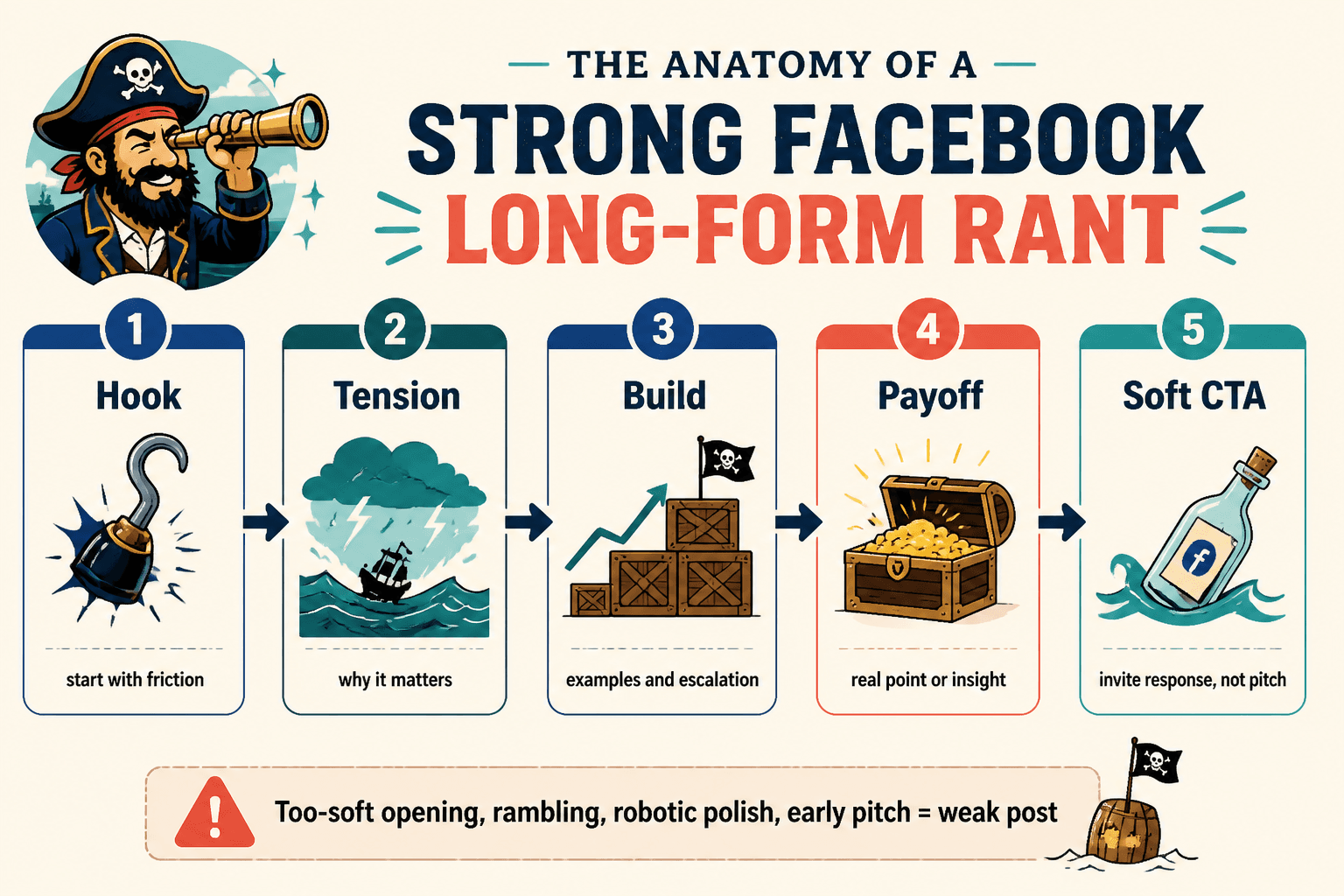
It has shape. It takes the reader somewhere. It starts with friction, sharpens the argument, adds proof or examples, and lands on something useful, memorable, or discussable. It can be funny, irritated, reflective, blunt, or intense. But it still needs control.
Think of a strong Facebook rant like this:
- Open with the thing that is bothering you or the mistaken idea you want to challenge
- Explain why it matters
- Show what people keep getting wrong
- Add examples, observations, or consequences
- Land on the real point
- End with a response-friendly takeaway, not a desperate pitch
That shape matters because readers need momentum. If you just spray irritation in every direction, it feels messy. If you over-explain every angle, it feels bloated. If you tie it all back to your offer too aggressively, it feels like the whole thing was bait.
And readers can smell bait. They may not articulate it, but they feel it.
How to sound human instead of robotic
Write like you speak when you are clear, not when you are rambling
“Write like you talk” is decent advice until people interpret it as “leave every thought half-cooked.” Natural writing is not sloppy writing. It is writing with rhythm, contrast, and actual personality.
If your post sounds robotic, check for these common problems:
- Every sentence is the same length
- You use too many abstract business words
- You smooth over all emotion and opinion
- You overuse transition phrases like “moreover,” “furthermore,” and “it is important to note”
- You sound like you are trying to be correct instead of trying to be understood
Human writing has texture. Some lines hit hard. Some explain. Some turn. Some poke. Some slow down because the idea needs room.
That does not mean adding fake quirks. It means stripping out language you would never say out loud and replacing it with clearer, sharper wording.
Use specific observations, not generic “value” language
Robotic posts often lean on broad, supposedly smart claims:
- Authenticity matters more than ever
- People buy from people they trust
- Consistency is key
- Your story is your superpower
None of those are technically false. They are also painfully unhelpful on their own.
What sounds human is specificity. Something observed. Something argued. Something with edges.
Weak: “Authenticity is what builds trust online.”
Stronger: “Most people are not struggling to sound authentic. They are struggling to say one clear thing without hiding behind seven vague ones.”
That second version has a point. It creates a little tension. It sounds like a person who has seen the problem up close.
Keep some friction in the writing
Over-polished writing often loses the tiny bits of friction that make it feel alive. Not chaos. Not sloppiness. Just enough edge to sound like there is a real mind behind the post.
That can mean:
- Asking a blunt question
- Using a short line after a longer paragraph
- Calling out a bad habit directly
- Admitting what annoys you
- Using contrast instead of corporate neutrality
Example:
“A lot of people say they want to sound more human on Facebook. What they actually want is to keep sounding polished while somehow also being relatable. That is usually the problem.”
That line has tension. It gives the reader something to react to. Facebook rewards that more than lifeless correctness ever will.
How to avoid sounding salesy in Facebook long-form posts
Salesy writing on Facebook usually is not about selling. It is about obvious intent. The reader feels managed.
You can absolutely write posts that support your business. You should. But the post needs to stand on its own first. If the only reason it exists is to warm people up for your offer, the reader can feel the manipulation in the walls.
Do not make the whole post a runway to your CTA
One of the easiest ways to sound salesy is writing every paragraph as if it is secretly marching toward “DM me if you want help.”
When that happens, the post loses honesty. The examples feel selected for persuasion, not truth. The frustration feels performed. Even the vulnerability starts to smell like strategy.
A better approach is simple:
- Make the post useful or interesting even if nobody buys anything
- Let the idea carry real value on its own
- Add a next step only if it fits naturally
The post should be complete before the CTA arrives.
Use soft CTAs that match the tone of the post
A rant does not need to end with funnel breath.
On Facebook, especially with longer posts, the best CTAs often feel like extensions of the conversation rather than sudden conversions. You are usually better off inviting discussion, offering a relevant next step, or lightly pointing to your work than dropping a hard pitch out of nowhere.
| Too salesy | Better |
|---|---|
| “If this resonates, DM me and let’s scale your business.” | “If this is something you are working on, I wrote more about it here: how to write better Facebook long-form and rants.” |
| “I help clients fix this every day. Message me now.” | “Curious how other people handle this. Do you prefer a hard opinion in posts, or a more story-led approach?” |
| “Comment YES and I’ll send details.” | “If your openings are the weak part, this may help: how to start Facebook long-form and rants without a weak opening.” |
Notice the difference. The better versions still create movement. They just do it without sounding like they were built in a lead-gen lab.
Do not tack your offer onto unrelated frustration
This one is common.
Someone writes 600 words complaining about fake authenticity, guru nonsense, shallow branding, or burnout culture. Fine. Then the last paragraph suddenly becomes “And that is why I am opening three spots for my coaching container.”
No. That is not a transition. That is an ambush.
If you want to mention an offer, it needs to connect honestly to the argument. The reader should feel, “That makes sense,” not “Ah, there it is.”
A practical structure for Facebook long-form posts and rants
If your longer Facebook posts keep turning mushy halfway through, structure is probably the missing piece. You do not need a rigid formula, but you do need a shape strong enough to carry a reader through more than a few paragraphs.
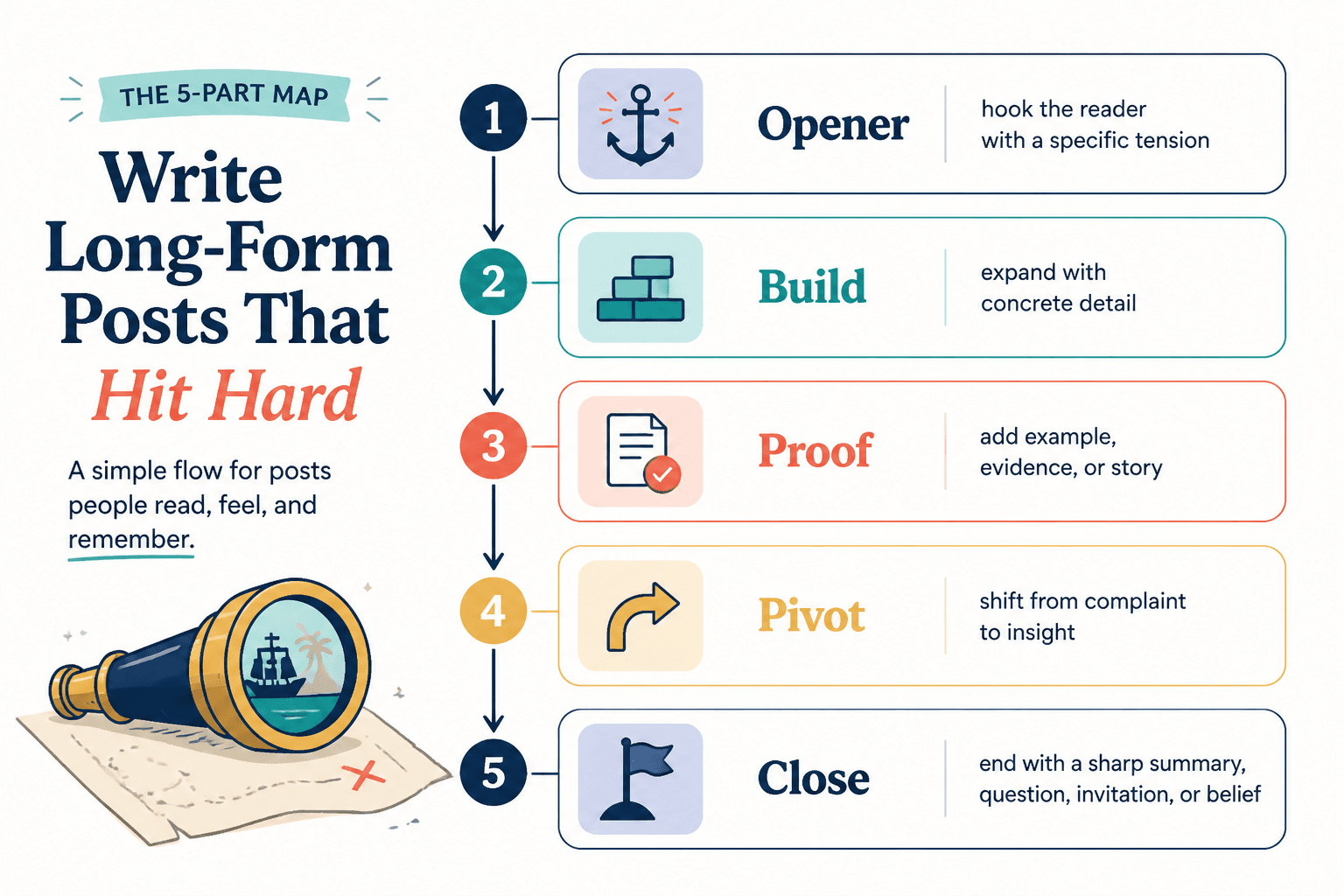
Here is a structure that works well for thoughtful rants, opinion posts, and longer reflective content.
1. Start with the sharpest version of the problem
Do not warm up for 150 words. Open with the thing.
“Most Facebook rants are unreadable for one simple reason: the writer is still figuring out their opinion in public.”
That is a start. It gives the post teeth immediately.
2. Build tension around why it matters
Now give the reader a reason to care. What is the cost of this mistake? What does it ruin? What does it reveal?
This is where you move from complaint to argument.
3. Add proof, examples, or patterns
Long-form writing gets stronger when the reader feels you are not just reacting. Show what this looks like in the wild. Mention the repeated behavior. Contrast bad and good versions. Name what people keep doing.
If you need help with the middle of the post, this is where a stronger structure can save you: how to improve Facebook long-form and rants rant structure without sounding generic.
4. Turn the post toward the real point
The best longer posts pivot at some point. They stop being only about what is wrong and become about what is true, useful, or worth doing instead.
This is the payoff. Without it, the post can feel like emotionally literate complaining.
5. End with a clean close
You do not need a motivational flourish. You need a proper landing.
Good endings for Facebook long-form posts include:
- A sharp summary line
- A question people actually want to answer
- A brief invitation to read something related
- A simple statement of what you believe
Before-and-after: making a robotic rant sound human
Here is a version that sounds stiff and salesy:
“I have been reflecting on the importance of authentic content creation. Many entrepreneurs are struggling because they are not communicating their value effectively. Storytelling, consistency, and strategic messaging are essential. If you are looking to elevate your brand voice and increase conversions, feel free to reach out to learn more about how I help clients do exactly that.”
Nothing there is criminal. It is just bland, generic, and painfully aware of itself.
Now a stronger version:
The bigger point is simple: clearer structure and clearer writing make the piece more useful. That is usually what makes the ending land better too.