
The bigger point is simple: clearer structure and clearer writing make the piece more useful. That is usually what makes the ending land better too.
Most boring Facebook long-form posts are not boring because they are long.
They are boring because they wander, explain too much too early, soften every opinion, and forget that a rant still needs a point. A lot of people call something a “rant” when it is really just three screens of mildly irritated journaling with no shape. That is not a rant. That is a scroll trap in the bad way.
If you want to know how to rewrite boring Facebook long-form & rants, the fix is usually not “make it shorter.” The fix is to make it sharper, clearer, more specific, and much more willing to say the real thing earlier.
Here’s how to take a flat, rambling Facebook post and turn it into something people actually read, react to, and remember without turning it into fake outrage or polished thought-leadership sludge.
Why most Facebook long-form posts go dull fast
Facebook long-form works best when it feels human, alive, and pointed. Not corporate. Not sterile. Not like you copied your LinkedIn post over and made it messier.
The usual problems are pretty consistent:
- The opening takes too long to get anywhere
- The writer keeps circling the point instead of stating it
- The story has details, but no tension
- The rant has emotion, but no structure
- The post sounds like a speech, not a conversation
- The ending fizzles into a vague life lesson or awkward pitch
And yes, sometimes the idea itself is just weak. That happens too. No rewrite can save a post that has nothing to say. But a lot of posts do have something worth saying. They are just buried under throat-clearing, repetition, and polite little hedges that suck the energy out of the thing.
If you want broader context on the format itself, this hub on Facebook long-form and rants is a useful place to start, and you can also browse the wider social media writing section for related strategy.
First, figure out what the post is actually trying to do
Before you rewrite anything, pin down the job of the post.
A good Facebook long-form post usually does one of these:
- Tells a story with a clear takeaway
- Makes an argument with a clear stance
- Calls out a bad habit, myth, or pattern
- Processes a tension your audience already feels
- Starts conversation around a specific idea
A bad rewrite often happens because the writer tries to make the post do all five at once. So the post starts as a personal story, turns into advice, becomes a mini manifesto, then ends with a sales nudge and a question nobody wants to answer. Pick a lane.
Try this sentence before you edit:
The real point of this post is: _____.
If you cannot finish that sentence in one clean line, the draft is probably still foggy.
That one line becomes your filter. Anything that does not support it gets cut, moved, or tightened.
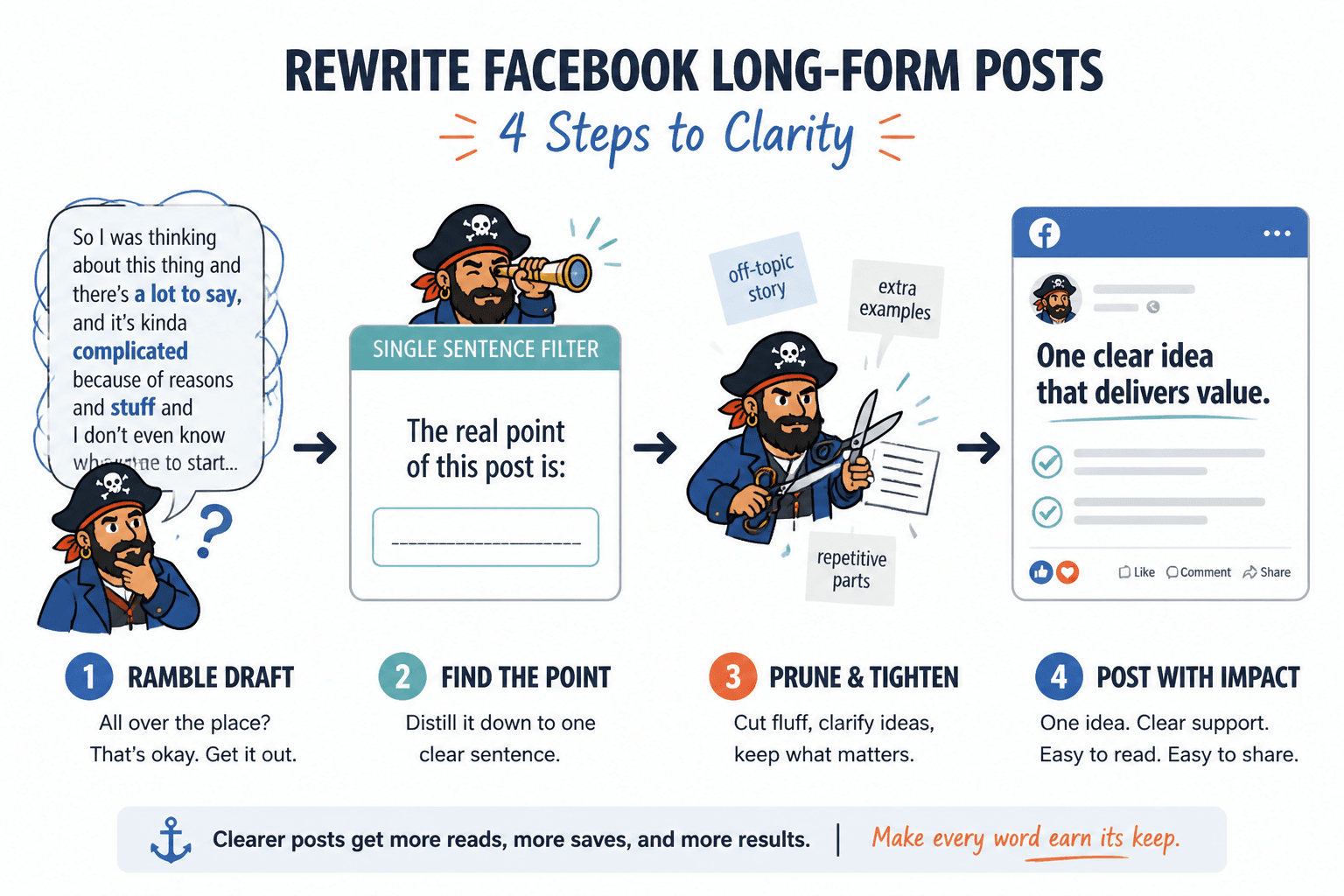
How to rewrite boring Facebook long-form & rants: the five-part cleanup process
You do not need a mystical writing ritual. You need a decent editing sequence.
1. Cut the warm-up
Most drafts begin too early. The writer is easing into the topic instead of leading.
Typical warm-up lines sound like this:
- “I have been thinking about this a lot lately…”
- “This may be an unpopular opinion, but…”
- “I do not usually post things like this, however…”
- “I am not sure who needs to hear this, but…”
Delete them. Almost always.
Your opening should introduce tension, not your internal permissions process.
Weak opening: I have been thinking a lot about how people show up online and how authenticity matters in business.
Better rewrite: A lot of “authentic” Facebook posts are just carefully styled vulnerability with a sales funnel hiding behind it.
See the difference? The second one has a pulse.
2. Find the live wire in the draft
Every decent rant has one sentence that actually means something. It is often buried halfway down the post, surrounded by mush.
Your job is to find that sentence and promote it.
Look for the line where the writer finally stops performing and says the real thing. That is usually your new opening or your core argument.
Buried line in the middle of a draft: The problem is not that people disagree with me. It is that they want every opinion softened until it says nothing.
That line should not be hiding in paragraph eight. Move it up. Build around it.
3. Give the post a shape
Long-form Facebook posts need movement. They do not need rigid essay formatting, but they do need progression.
A simple structure that works:
- Strong opening with tension or claim
- Expansion: what happened, what you noticed, or what people keep getting wrong
- Turn: the deeper point, contrast, or uncomfortable truth
- Payoff: what to do, what to stop doing, or what this means
- Ending: a clean final line or conversation-worthy question
That shape matters even more in rants. Otherwise, you are just swinging at the air.
If structure is your bigger issue, read how to improve Facebook long-form and rants rant structure without sounding generic. It pairs well with this rewrite process.
4. Replace vague emotion with specific friction
“I’m frustrated” is not interesting on its own. Frustration becomes interesting when readers can see what caused it.
So instead of writing:
I am tired of people being fake online.
Write:
I am tired of posts that pretend to confess something vulnerable, then pivot into “DM me if this resonates” like we are all too sleepy to notice.
Specificity makes the reader feel the point. Generic emotion just announces that one exists.
5. End before the post starts begging
One of the fastest ways to ruin a strong Facebook long-form post is to tack on a needy ending.
Common bad endings:
- “What do you think?” when nothing meaningful invites discussion
- “Agree?” after a half-baked opinion
- A sudden pitch that feels welded on
- A summary that repeats the post instead of landing it
Better endings usually do one of three things:
- Drop a final sharp line
- Invite a specific response
- Point to a practical next step
Weak ending: So yeah, just some thoughts. Let me know if you agree.
Better ending: If your post needs three disclaimers before the point, the problem is not bravery. It is clarity.
A before-and-after rewrite example
Here is a simplified example of what this looks like in practice.
Before:
I do not normally post things like this, but I have been reflecting lately on the online space and how a lot of people are showing up in ways that feel maybe not fully aligned. I think there is a lot of pressure to be visible and consistent and authentic and all of those things, and sometimes it just feels like people are doing what they think they should do instead of what feels real to them. I have noticed this a lot lately and I guess I just wanted to say that maybe we should all focus more on being ourselves and connecting with people in a more honest way.
It is not that being strategic is bad, but sometimes strategy can make people robotic, and that is something I have really been noticing. Anyway, just my thoughts for the day.
After:
A lot of people are not “building a personal brand.” They are slowly sanding off every sharp edge until they sound like an anxious content committee.
You can see it in the posts that all use the same soft opening, the same borrowed vulnerability, the same polished little lesson at the end.
It is not honesty. It is performance with better lighting.
Strategy is useful. Obviously. But the second your strategy makes you sound less specific, less alive, and less willing to say what you actually mean, it is not helping. It is flattening you.
If your content feels lifeless lately, do not ask how to sound more authentic.
Ask what truth you keep editing out because you are trying to sound acceptable to everyone.
The rewrite is better because it has tension, rhythm, contrast, and an actual stance. It also ends cleanly instead of shrinking into “just my thoughts.”
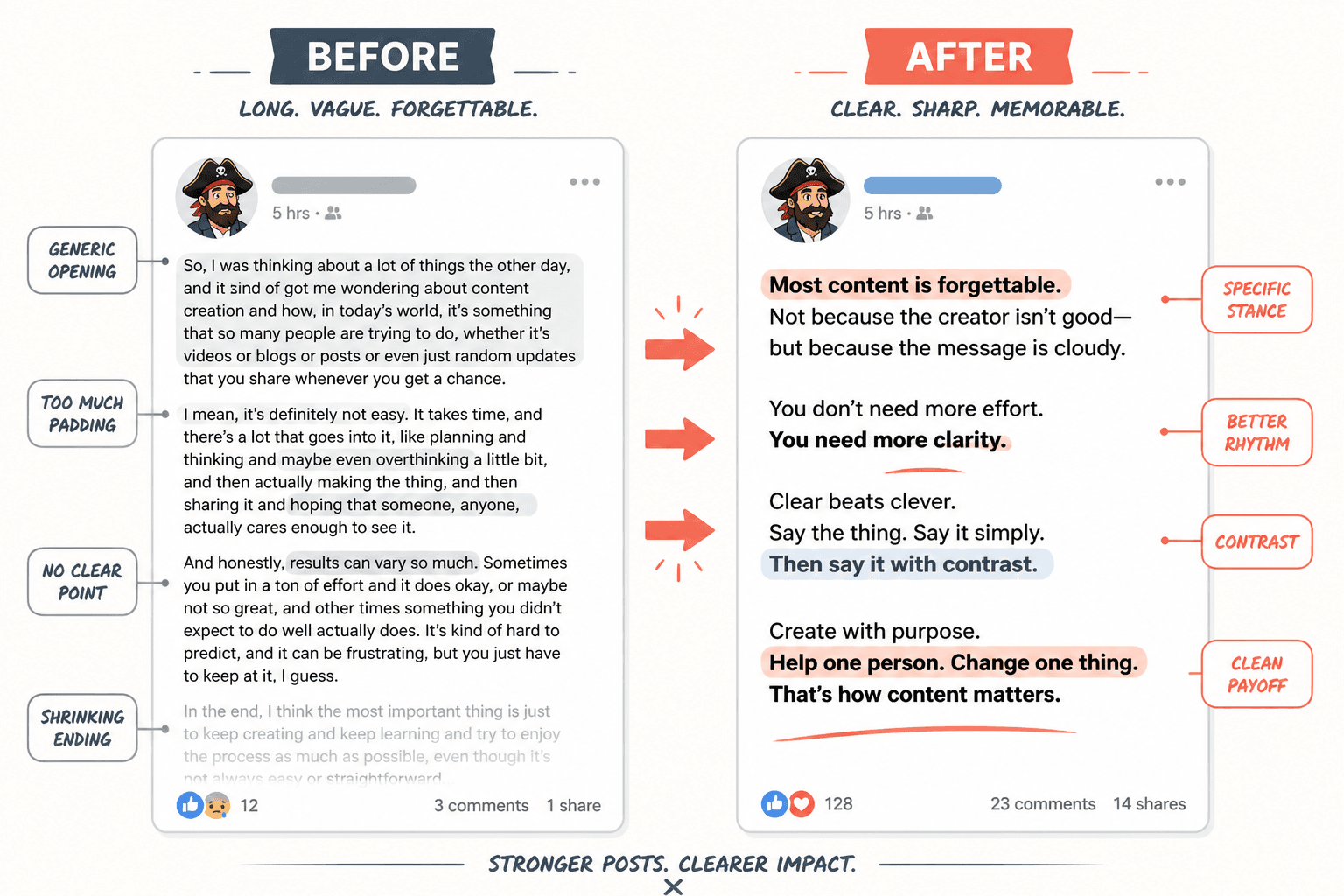
What a good Facebook rant actually needs
A good rant is not random anger typed with confidence.
It needs four things:
- A target: what exactly are you pushing against?
- A reason: why does this matter?
- A shape: how does the post build instead of ramble?
- A payoff: what should the reader understand, question, or do by the end?
Without those, the rant turns into emotional fog. Readers might sense you feel strongly. They still will not know why they should care.
This is the part a lot of writers resist, because structure sounds boring and rants feel spontaneous. Fair enough. But spontaneous is not the same as shapeless. The best long-form Facebook posts still feel natural while doing a very deliberate job underneath. That is why they hold attention.
If your openings are especially weak, go next to how to start Facebook long-form and rants without a weak opening. A boring start will sink the whole thing before your better middle even gets a chance.
Quick rewrite checklist for flat drafts
When a Facebook draft feels dull, run through this checklist:
- Can I state the main point in one sentence?
- Did I start too early?
- Is the strongest line buried in the middle?
- Did I use specific examples instead of vague frustration?
- Does each paragraph move the idea forward?
- Did I repeat the same point with slightly different wording?
- Is there an actual turn or payoff?
- Did I end strong instead of fading out?
If you answer “no” to more than two of those, you do not need tiny edits. You need a real rewrite.
What to cut mercilessly
Some phrases almost always make Facebook long-form weaker. Not because they are illegal. Just because they usually signal soft thinking or filler.
- “I just wanted to share…”
- “This may be controversial…”
- “Maybe it is just me…”
- “I do not know who needs to hear this…”
- “Here is your reminder…”
- “Just my opinion…”
- “What are your thoughts?” with no real prompt
Also cut repeated sentences that are doing the same job. Many boring long-form posts are basically one decent point said six ways. Keep the best version. Kill the rest.
And be careful with overexplaining. A lot of writers think clarity means exhausting the reader with every angle. It does not. Clarity means the point lands cleanly. Sometimes one sharp paragraph does more work than four obedient ones.
How to rewrite old Facebook posts into better long-form pieces
The bigger point is simple: clearer structure and clearer writing make the piece more useful. That is usually what makes the ending land better too.
Long-form Facebook writing works best when the opinion is clear, the structure holds, and the ending still points somewhere useful.