
Most tool reviews do not make affiliate revenue because they are not reviews. They are product pages wearing a fake mustache.
They list features. They repeat the landing page. They say a tool is “great for creators” or “powerful for teams” and then act surprised when nobody clicks, buys, or trusts the recommendation.
If you want to learn How to Turn Tool Reviews Into Affiliate Revenue, the job is not “mention your affiliate link more confidently.” The job is to make the review useful enough that the reader thinks, “Okay, this person actually helped me decide.” That is what gets the click. That is what gets the sale. And that is what keeps your content from smelling like commission breath.
This article will show you how to write tool reviews that earn trust first, then revenue. We’ll cover the review structure, what to include, where affiliate income actually comes from, how to connect reviews to a simple funnel, and what people keep doing wrong when they try to monetize review content.
For the main guide behind this topic, visit the parent guide.
Why most tool reviews make very little money
There are usually three problems.
- The review says what the tool does, but not who it is really for.
- The content sounds biased before the reader has any reason to trust you.
- The article gives no real buying help, so the reader leaves to research elsewhere.
Affiliate revenue does not come from “having a link.” It comes from reducing decision friction.
Your reader is usually trying to answer a very normal question:
- Is this worth the money?
- Will this actually fit my workflow?
- Is there a catch?
- What should I use instead if this is not right for me?
If your review does not answer those questions clearly, you are not helping the buyer move forward. You are just adding one more page to the pile.
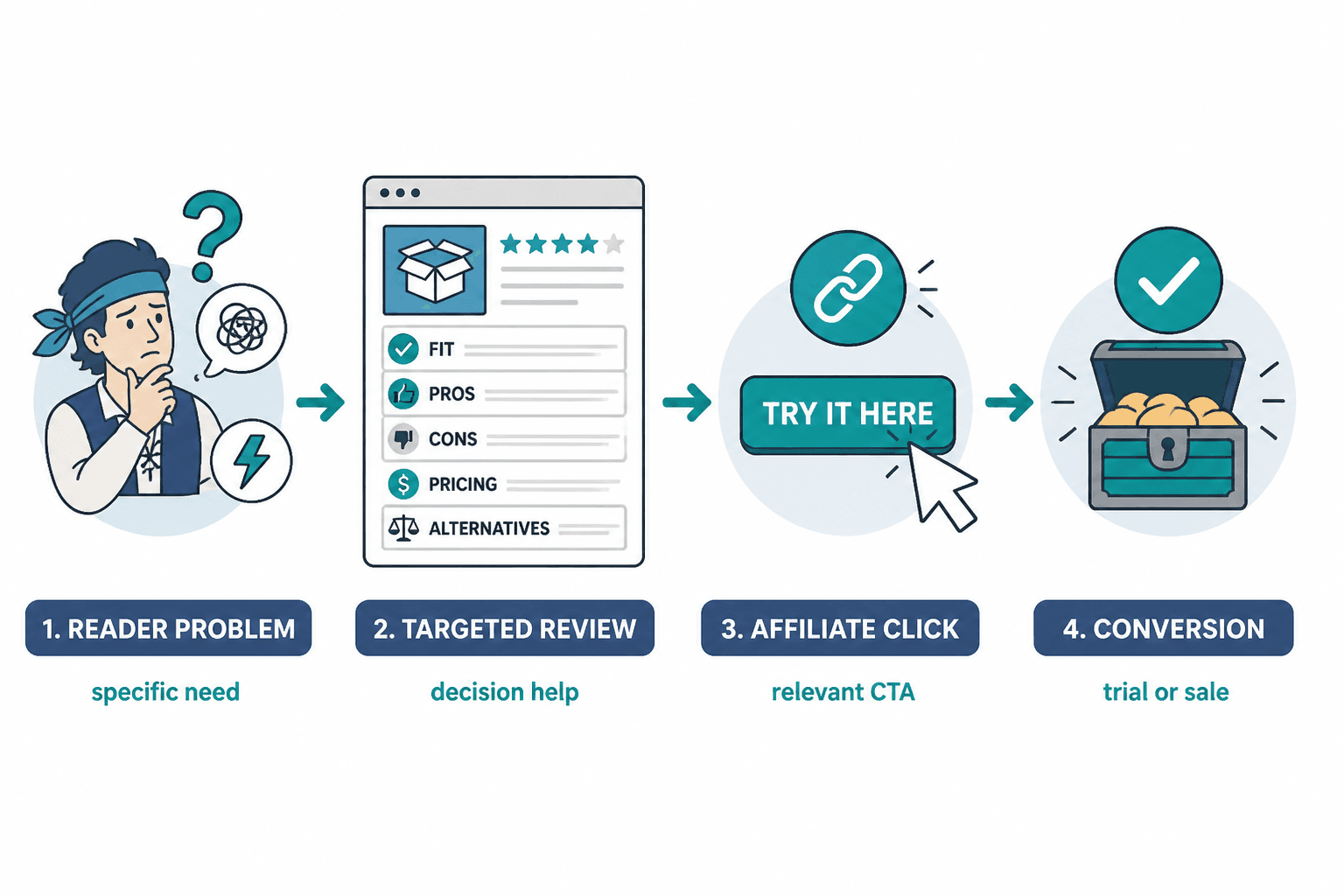
A review that earns affiliate revenue usually does four things well:
- It attracts readers with real buying intent.
- It helps them make a better decision fast.
- It shows enough proof or reasoning to feel trustworthy.
- It gives them a clean next step when they are ready.
That sounds obvious. Apparently it is not obvious enough.
Start with buyer intent, not product worship
The easiest way to write a weak review is to center the tool instead of the buyer.
People do not search for tools because they want to admire features. They search because they want a result. Better writing. Easier scheduling. Cleaner CRM management. Faster editing. Less admin. More leads. Less chaos. Your review should stay tied to that underlying job from the first paragraph to the CTA.
Before you write the review, get clear on these five points:
- What problem is the reader trying to solve?
- What kind of person is comparing this tool? Beginner, advanced user, solo creator, agency, coach, consultant, founder?
- What is making them hesitate? Price, complexity, lock-in, setup time, quality, integrations?
- What alternatives are they also considering?
- What action do you want them to take after reading? Click to try it, compare options, join your list, book help, read a related review?
That framing alone makes the review more commercially useful. Not because it is more aggressive, but because it is more relevant.
If your broader content strategy revolves around tool review monetization, it helps to understand where review content fits in a larger category of money-focused content. These related resources on monetization funnels, money content, and tool reviews are useful places to keep building from.
The review structure that actually supports affiliate revenue
You do not need some sacred review template. You do need structure. A good review should help a reader decide without forcing them to hunt for the useful part.
Here is a practical structure that works well for review articles, creator blogs, and personal-brand content.
1. Open with the decision, not the history of software
Your intro should quickly tell the reader what this tool is good for, who it suits, and what the article will help them decide.
Weak opening: “Tool X is an innovative platform designed to help businesses streamline their workflows.”
Better opening: “Tool X is a solid choice for solo creators who want simple scheduling and basic analytics without paying for an enterprise-shaped headache. It is less impressive if you need heavy collaboration or deep reporting.”
The second version gives the reader something they can use immediately. Which is kind of the point.
2. Explain who the tool is for and who should skip it
This is one of the highest-trust moves in affiliate content.
When you say who should not buy the tool, your recommendation gets more believable. You stop sounding like someone trying to collect a referral fee from anything with a login page.
- Good fit: solo consultants, service businesses, creators who need speed and simplicity
- Probably not a fit: teams that need advanced permissions, big reporting stacks, or custom workflows
3. Cover real use cases, not feature confetti
Features matter. But features only matter in context.
Do not write “It has automation, analytics, and integrations.” That says almost nothing. Explain what those things help the user do.
Flat: “The tool includes templates.”
Useful: “The built-in templates are handy if you want to get from blank page to first draft quickly, but they are generic enough that you will still need a point of view.”
That kind of sentence does two jobs at once. It informs, and it filters. Both help conversions.
4. Include limitations without turning dramatic
Every tool has tradeoffs. Mention them plainly.
- Slow setup
- Weak reporting
- Price climbs fast
- Not ideal for teams
- Good UI, but shallow customization
- Strong feature set, but steeper learning curve
This is where weak affiliate content usually falls apart. It either avoids criticism entirely or swings into fake honesty that still feels scripted. You do not need performative “balanced takes.” You just need to tell the truth in a useful way.
5. Compare it to the alternatives readers are already considering
A tool review without comparisons often leaves the reader half-convinced. They still need another tab to finish the decision.
You do not need a giant comparison matrix for every article. But you should usually explain where this tool sits relative to common alternatives:
- Cheaper but more limited
- More powerful but harder to use
- Better for teams than solo operators
- Stronger for content production than analytics
- Better starter option, worse long-term option
That keeps the article commercially useful instead of just descriptive.
6. Give a clear recommendation and next step
At some point, the reader needs your call.
Not “It depends” with a shrug. A recommendation.
Try a closing format like this:
- If you want X and care most about Y, this is a good pick.
- If you need A or B, skip it and look at alternatives.
- If you are still comparing, read the related breakdown next.
Then place the affiliate link where it makes sense. Not every six inches like you are trying to sell sunglasses at a traffic light.
How to Turn Tool Reviews Into Affiliate Revenue with better trust signals
Trust is the whole business model here.
If the reader trusts your judgment, they may click your link. If they trust your process, they may come back for future recommendations. If they trust your broader content, they may join your email list, book your service, or buy something else later. That means a tool review can generate more than one kind of revenue if you build it properly.
Useful trust signals include:
- Specific evaluation criteria: ease of use, setup time, support quality, pricing logic, best-fit use cases
- Clear tradeoffs: what the tool does well and where it falls short
- Scenario-based recommendations: who should use it and who should not
- Consistent reviewing method: readers can see how you judge tools across articles
- Non-hyped language: no miracle claims, no forced enthusiasm, no suspicious certainty
You do not need to pretend every tool is life-changing. Most are not. Some are useful. Some are overpriced. Some are decent but clunky. Readers can handle that level of honesty. In fact, they prefer it.
If you need help keeping reviews sharp instead of padded and promotional, read how to write tool reviews without sounding like affiliate fluff. It pairs well with this article because trust dies fast when the review starts sounding like a warmed-over sales page.
Where the affiliate revenue actually comes from
People often assume affiliate revenue is mostly about traffic volume. Traffic matters, sure. But for tool reviews, intent and fit usually matter more.
A smaller stream of readers actively comparing tools can outperform a bigger stream of casual readers who were just vaguely curious.
Here are the main drivers.
High-intent topics
These are searches and article angles tied to a real decision:
- Tool X review
- Tool X vs Tool Y
- Best tool for solo consultants
- Is Tool X worth it?
- Best email platform for creators
- Tool X pricing review
These readers are much closer to action than someone reading a fluffy “top trends” article.
Stronger recommendation clarity
If readers can tell exactly when you recommend the tool, they convert better. If your conclusion is vague, overloaded, or hedged into mush, the click rate drops.
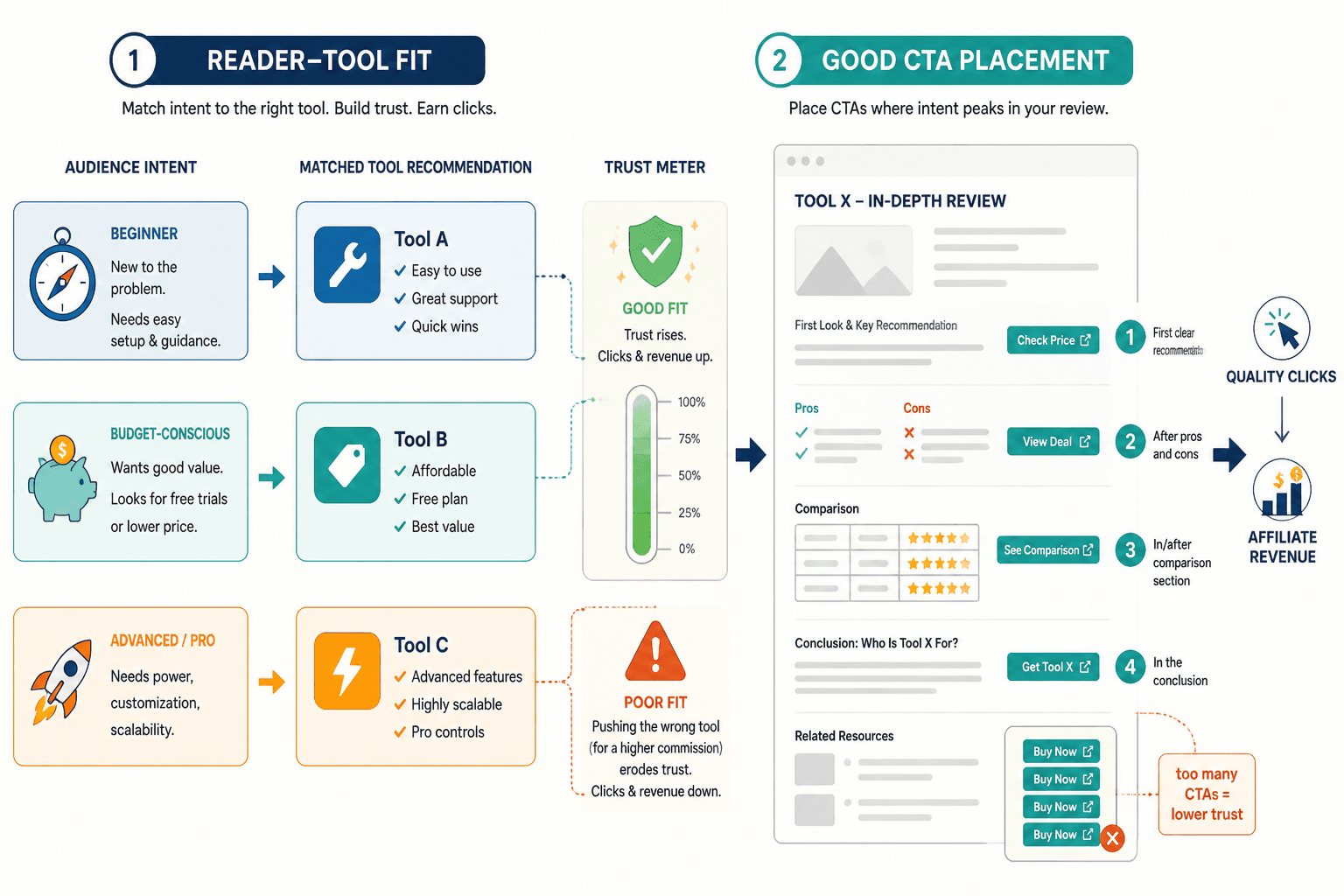
Better reader-tool fit
Recommending the right tool to the right audience beats pushing the highest commission product to everyone. Short-term greed tends to produce long-term distrust. Very efficient way to wreck a content asset, honestly.
Good CTA placement
You usually want affiliate links in a few practical places:
- Near the first clear recommendation
- After the pros and cons section
- In comparison sections where the choice becomes clear
- In the conclusion for ready-to-buy readers
You do not need to carpet-bomb the article with buttons and links. That often lowers trust more than it raises clicks.
Use a simple funnel instead of treating each review like a one-off
One review can earn a commission. A review system can build a real revenue stream.
This is where a lot of creators leave money on the table. They publish isolated review posts instead of building review clusters and funnel paths around them.
A simple funnel might look like this:
- Reader finds a tool review article through search, social, or internal links.
- The review helps them evaluate a specific tool clearly.
- The article links to related comparisons, alternatives, and implementation guides.
- The reader either clicks the affiliate link or joins your list for more guidance.
- Follow-up content leads to more affiliate clicks, service inquiries, or product sales.
That matters because not every reader converts on the first page. Some need another comparison. Some need a “best tools for X” roundup. Some need help implementing the tool after buying. Every one of those can become useful content and revenue support.
If you want to build that path deliberately, read how to use tool reviews in a creator funnel. It covers how reviews connect to list growth, service sales, and wider content monetization instead of just sitting around waiting for random clicks.
What to include in a review if you want clicks and conversions
You do not need every section in every article, but these are the elements that tend to make tool reviews more commercially effective.
| Review element | Why it helps revenue |
|---|---|
| Best-fit user description | Improves reader-tool match and trust |
| Clear pros and cons | Reduces hesitation and signals honesty |
| Use case examples | Helps readers picture real usage |
| Comparison notes | Prevents the reader leaving for another tab |
| Pricing commentary | Addresses buying friction directly |
| Recommendation summary | Makes the decision easier |
| Logical CTA placement | Catches ready readers at the right moment |
| Related internal links | Keeps non-buyers in your ecosystem |
One thing worth emphasizing here: pricing commentary is often underused. Readers care less about the number itself than the value logic around it.
For example, instead of saying “Plans start at $29/month,” say something more useful: “At $29/month, it is reasonable for solo operators if it saves you admin time every week, but it starts feeling expensive if you only need one or two basic functions.”
That kind of sentence helps the reader decide. Decision help is monetization fuel.
Common mistakes that kill affiliate revenue from reviews
Some of these are obvious. People still do them constantly.
Writing thin reviews
If the review says little beyond what the sales page already says, there is no reason for the article to exist. Thin review content can still rank poorly, convert poorly, and make your site look half-baked. A rare triple threat.
For that problem specifically, read how to monetize tool reviews without thin reviews.
Choosing commission over audience fit
If you keep pushing the highest-paying tool instead of the best-fit one, your content will eventually train readers not to trust you. That costs far more than the short-term payout is worth.
Hiding the flaws
No tool is perfect. Reviews that pretend otherwise sound fake. Readers do not need cynicism, but they do need realism.
Using vague praise
Words like “amazing,” “powerful,” “robust,” and “intuitive” are often doing the heavy lifting for people who forgot to say anything concrete.
Replace praise words with specifics:
- What exactly is easy?
- What exactly is fast?
- What type of user benefits?
- Compared to what?
No path beyond the review
Some readers will not click the affiliate link today. Fine. Give them another next step.
- Comparison article
- Alternative roundup
- Implementation guide
- Email list opt-in
- Related monetization article
That is how one review becomes part of a system instead of a lonely little commission trap.
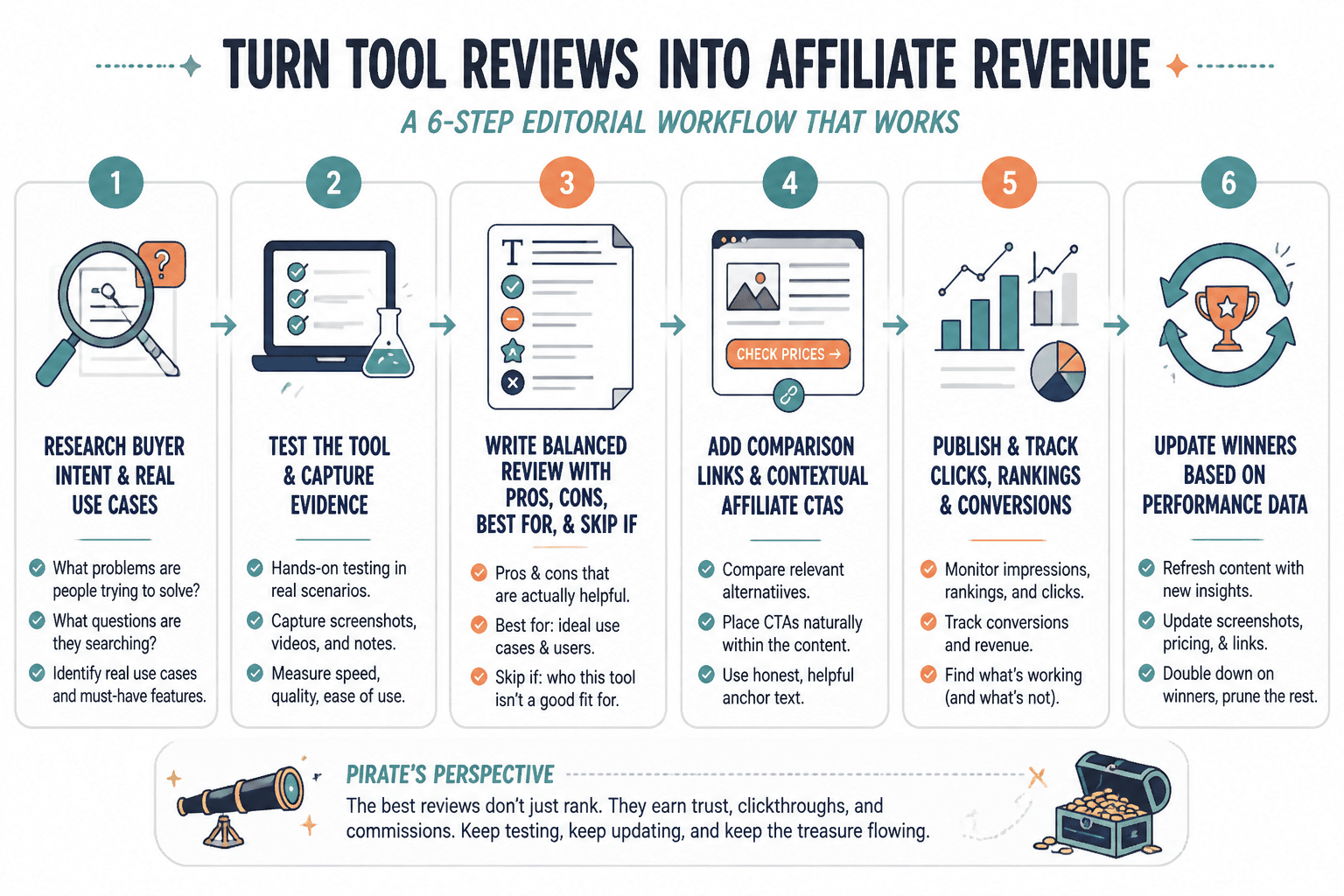
A practical review-to-revenue workflow
If you want this to become consistent, not accidental, use a repeatable workflow.
- Choose a tool topic with buying intent. Reviews, alternatives, versus content, pricing questions, and best-for-use-case articles are the strongest starting points.
- Define the reader. Be specific about who is evaluating the tool and what matters to them.
- Write the review around decision-making. Lead with fit, tradeoffs, and use cases rather than product fluff.
- Add an honest recommendation. Say who should use it, who should skip it, and why.
- Place affiliate links where the reader is ready. Not before they trust you. Not after they got bored and left.
- Link to related content. Comparisons, funnel articles, alternatives, and deeper monetization content.
- Track what actually gets clicks. Which review angles, CTA placements, and buyer-intent topics perform best?
- Improve the winners. Update comparisons, clarify recommendations, tighten intros, strengthen internal links.
That last point matters more than people think. A decent review can become a strong revenue page with updates. Better opening. Better comparison section. Better CTA placement. Cleaner recommendation. This is not glamorous work, but it is usually profitable work.
How tool reviews can lead to more than affiliate income
This part gets overlooked.
A good tool review does not just make affiliate revenue. It also shows how you think. That can lead to service inquiries, consulting, product sales, newsletter growth, and broader trust across your content ecosystem.
If you are a coach, consultant, strategist, or creator with offers, your review content can quietly position you as someone who understands workflows, tools, tradeoffs, and implementation. That is commercially useful positioning.
For example:
- A review of a writing tool can lead to content strategy work.
- A CRM comparison can lead to funnel audits or implementation support.
- An email platform review can lead to newsletter consulting.
- A scheduler review can lead to content system services.
If you want to push beyond affiliate commissions alone, read how to turn affiliate articles into more leads or sales. That is where review content starts acting like a business asset instead of a side hustle experiment.
FAQ
How long should a tool review be?
Long enough to help someone decide. For most reviews, that means enough detail to cover fit, use cases, pros, cons, comparisons, pricing logic, and a recommendation. Not 600 words of fluff. Not 4,000 words of recycled feature soup.
Should every tool review include affiliate links?
No. Include them when you genuinely recommend the tool and the program is a fit. If you would not recommend it without a payout attached, that is a clue.
Do tool review roundups convert better than single reviews?
They can, especially for early-stage comparison readers. But single reviews often convert well for high-intent searches. Ideally, you use both and link them together.
The bigger point is simple: clearer structure and clearer writing make the piece more useful. That is usually what makes the ending land better too.