
Most website bios and profile sections make one of two mistakes.
They either sound like a beige awards submission nobody asked for, or they try to monetize so hard they come off like a networking event in paragraph form. Neither one builds trust. Neither one helps the reader take the next step.
If you want to know how to monetize website bio and profile copy without wrecking trust, the answer is not “sell less” in some vague, noble way. It is to make your bio do the right selling job. A good bio should position you, reassure the reader, and gently move the right people toward action. It should not try to close the deal like it just drank three espresso shots and discovered urgency.
Done well, your bio and profile copy can support leads, consultations, email signups, applications, service inquiries, and even direct sales. Done badly, it makes people suspicious before they have even reached your offer page. That is a rough place to start.
Here is how to make your website bio earn money without sounding needy, slippery, or weirdly over-rehearsed.
If you want the bigger picture, start with the parent guide.
What website bio monetization actually means
Monetizing your bio does not mean stuffing it with offers, badges, and “work with me” buttons every six lines.
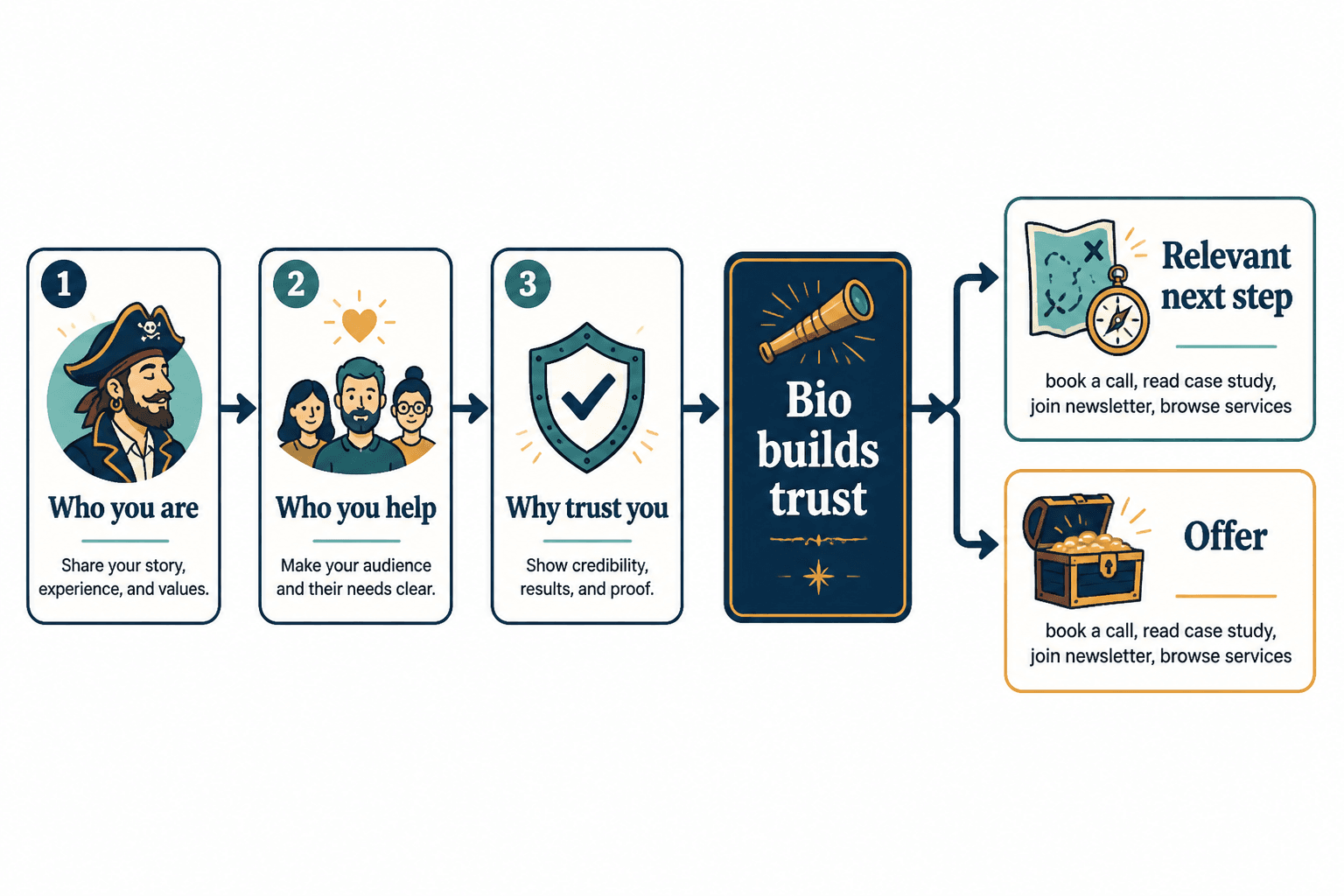
It means using your bio and profile copy to do three things well:
- Attract the right people
- Build enough trust that they keep reading
- Point them toward a relevant next step
That next step might be booking a call, reading a case study, joining your newsletter, browsing services, or checking out a specific offer. The bio is not always the closer. Often, it is the bridge.
This is where people get clumsy. They treat the bio like either a pure credibility block or a tiny sales page. It is neither. It lives in the middle. It should answer: who are you, who do you help, why should anyone trust you, and what should they do next?
If your current version only answers one of those, it is probably leaving money on the table.
Why aggressive bio copy kills conversion
People do not mind being sold to nearly as much as marketers pretend. What they mind is feeling pushed before they feel oriented.
When someone lands on your site, especially if they found you through content, search, or referral, they are asking quiet little questions in the background:
- Is this person relevant to me?
- Do they understand my kind of problem?
- Do they seem credible?
- Do I like the way they think?
- What am I supposed to do here?
A bio that jumps straight to “Apply now,” “Limited spots,” or “Ready to scale?” before establishing any of that creates friction. It feels premature. Like someone asking for the second date while still mispronouncing your name.
Trust breaks when the copy asks for more commitment than it has earned.
This is especially true for coaches, consultants, freelancers, and personal brands. In those businesses, you are part of the offer. Your credibility, judgment, and tone matter. Your bio is not decorative. It is conversion copy wearing a more polite outfit.
The job of a monetized bio
A strong bio should quietly move the reader through a sequence:
- Recognition: “This seems like it is for someone like me.”
- Clarity: “I understand what this person does.”
- Credibility: “Okay, they seem legit.”
- Fit: “Their approach sounds right for what I need.”
- Action: “I know where to go next.”
If you skip one of those steps, monetization gets weaker. If you skip three, the copy usually starts sounding like performance art for people who enjoy saying “impact-driven.”
For a stronger foundation, it helps to first understand how to write bio and profile copy for websites without sounding salesy or robotic. Monetization works better when the copy already sounds human.
What to include if you want your bio to support leads and sales
You do not need a huge bio. You need the right ingredients.
1. A clear statement of who you help and what you help them do
This is the base layer. If readers cannot quickly tell whether you are relevant, they will not care how accomplished you are.
Weak version: “I help brands thrive through strategic transformation.”
Better version: “I help coaches and consultants turn unclear website messaging into sharper positioning, stronger trust, and more qualified inquiries.”
The second one actually says something. A nice change.
2. A credibility line that proves you are not making things up
Trust needs evidence. Not a dramatic life story. Not twelve certifications in a row. Just enough proof to reduce skepticism.
This might include:
- Years of experience
- Client types or industries served
- Specific outcomes
- Published work or recognisable platforms
- A repeatable method or area of specialization
If you want help crafting these lines, this piece on better bio and profile copy for websites credibility lines for personal brands is worth reading next.
3. A point of view
This is one of the most underrated parts of a high-converting bio. People do not only buy services. They buy approaches.
If your bio says what you do but not how you think, it is flatter than it should be. A small opinion, philosophy, or contrast can make your positioning more believable and more memorable.
For example:
- “My work focuses on clear messaging over clever slogans.”
- “I build websites that sound credible without sounding corporate.”
- “I help experts simplify their message without sanding off their personality.”
That kind of line helps the right reader think, “Yes, that is what I want.”
4. A next step that matches reader intent
If your only CTA is “Book now,” you are assuming every reader is instantly ready to buy. Most are not. Some need to browse. Some want proof. Some want a lighter step first.
Good next steps from a bio might include:
- View services
- Read case studies
- See how I work
- Get the free guide
- Start here
- Book a consult
The best CTA depends on where the bio sits and how warm the reader already is.
How to monetize website bio and profile copy without sounding thirsty
There is a simple way to think about this: your bio should create commercial momentum, not commercial pressure.
That means the copy can absolutely support monetization, but it should do it through relevance, clarity, proof, and direction. Not through hype. Not through desperation. Not through tiny little urgency grenades.
Use “invite” energy, not “corner them at the kitchen island” energy
Compare these:
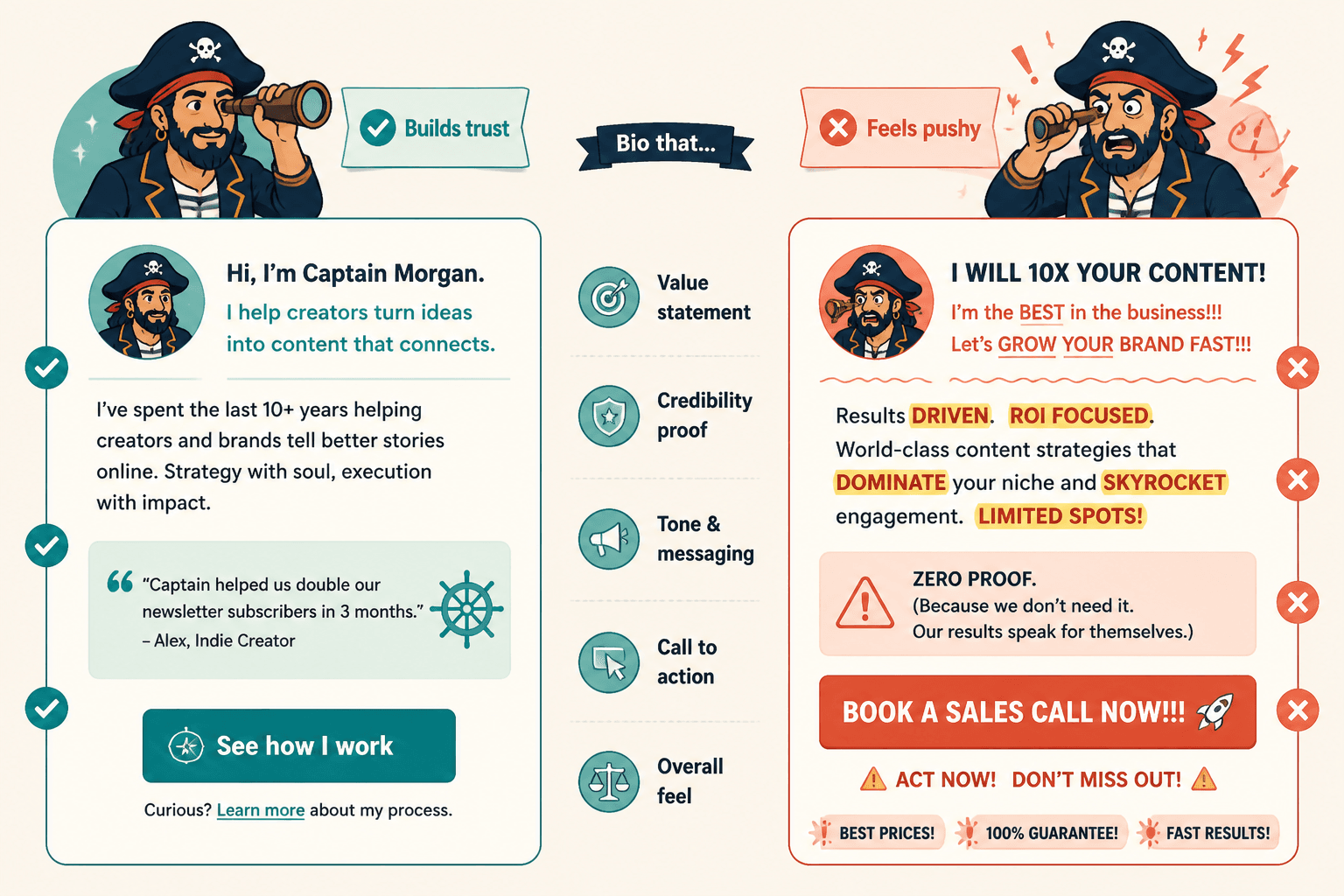
Ready to finally step into your next-level brand? Apply today for limited spots.
If your website sounds polished but does not actually move people, you can explore my messaging services here.
The second version sells. It just does not act like a motivational speaker trapped in a CTA button.
Sell the fit, not just the offer
A bio performs better when it helps readers self-qualify.
Instead of pushing everyone toward a service, tell people who it is best for. That reduces friction and improves lead quality. It also makes you sound more confident, because confident businesses do not try to be for literally everybody.
Example:
“I work best with service-based founders and personal brands who have expertise, offers, and traction, but a website message that still sounds blurrier than it should.”
That line monetizes. It filters. It reassures. It positions.
Make the CTA feel like the logical next click
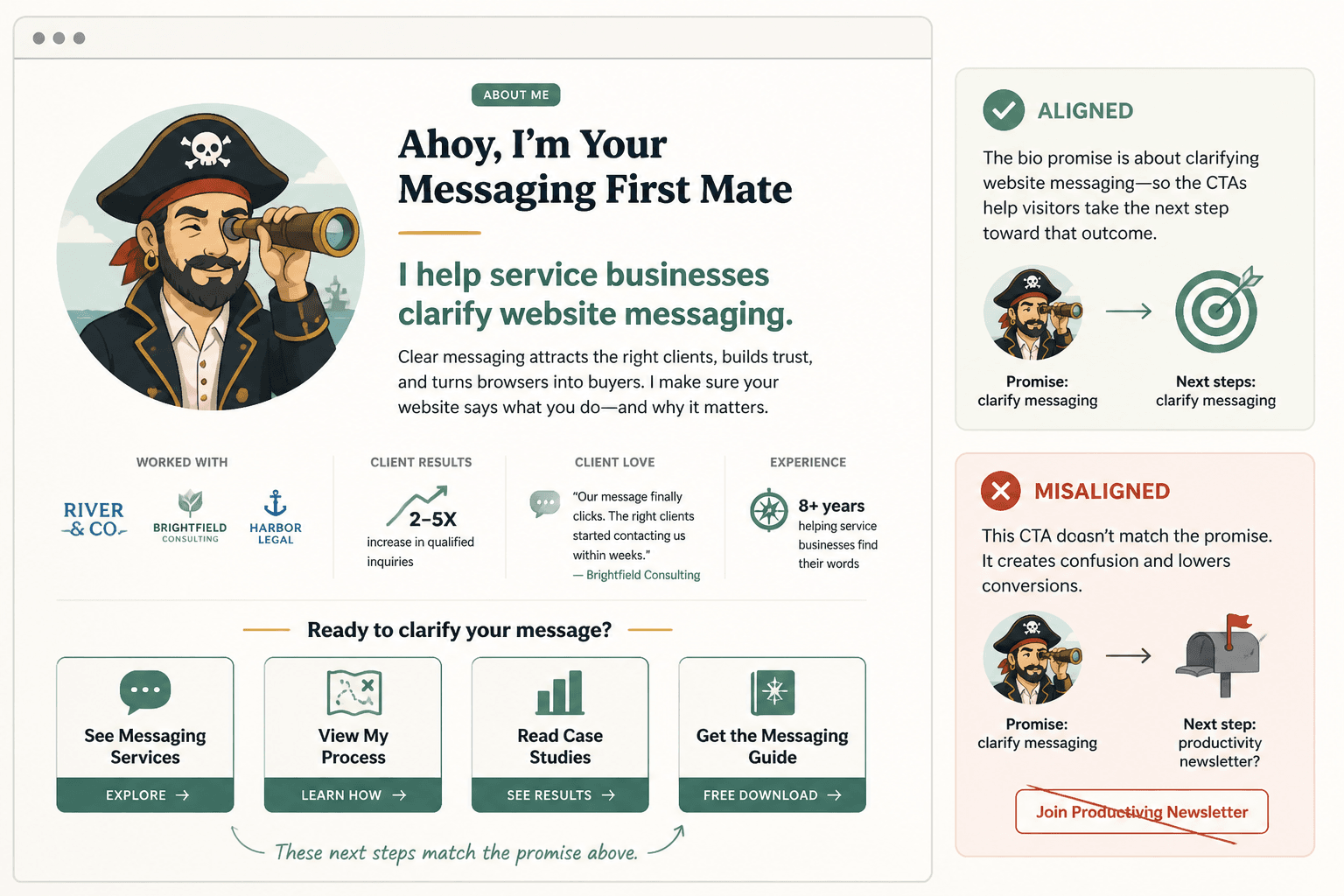
If your bio says you help with website messaging, the CTA should probably lead to a service page, a process page, examples, or a focused lead magnet on messaging. Not a random newsletter opt-in about productivity. Do not make people work that hard.
When the CTA matches the promise of the bio, conversions feel smoother because the reader is not being forced to mentally reroute.
For a fuller look at where these next steps can lead, see how to turn bio and profile copy for websites into more leads or sales.
Before and after: bio copy that repels vs bio copy that converts
Here is where this gets easier to see.
Example 1: The vague expert bio
Before:
I am a passionate strategist helping visionary entrepreneurs amplify their impact with authentic branding, aligned messaging, and transformational growth.
What is wrong with it:
It is vague, over-polished, and says almost nothing testable. “Passionate strategist” is not useful. “Visionary entrepreneurs” is code for “I have not chosen an audience.”
After:
I help coaches, consultants, and personal brands tighten their website messaging so visitors understand what they do, trust their expertise, and are more likely to inquire. My approach is simple: clearer positioning, stronger proof, less fluffy brand theater.
That version is easier to trust because it is easier to understand.
Example 2: The bio that sells too early
Before:
I help high-achieving founders scale fast. Book your free call now to secure one of my limited coaching spots.
What is wrong with it:
No proof. No specificity. No indication of how. The CTA is doing all the work while the copy does almost none.
After:
I work with founders who have strong offers but messy messaging, weak positioning, or websites that do not convert as well as they should. If that sounds familiar, you can review my consulting options or book a call to see if there is a fit.
Still monetized. Much less pushy. More believable.
Example 3: The over-credentialed wall of self-congratulation
Before:
Jane Smith is an award-winning, internationally recognized consultant, speaker, mentor, thought leader, educator, and founder with over 15 years of multidisciplinary expertise across brand, business, marketing, and leadership.
What is wrong with it:
It sounds like it was assembled by committee. It also centers the writer so hard that the reader disappears.
After:
I help service businesses clarify what they do, why it matters, and how to explain it on their website without sounding generic. Over the past 15 years, I have worked across brand strategy, messaging, and consulting, with a focus on making expertise easier to trust and easier to buy.
The credentials still exist. They are just in service of the reader now.
A simple framework for bio copy that monetizes cleanly
If you want a practical structure, use this:
- Who you help
- What you help them do
- How you do it differently
- Why people trust you
- What to do next
Here is a filled-in example:
I help consultants and personal brands turn unclear website copy into sharper positioning and stronger conversion. My work focuses on practical messaging that sounds credible, specific, and human, not inflated. After years of writing for service businesses and creator-led brands, I know most websites do not need more hype. They need better clarity. If you want help with that, you can explore my copy services or start with a few examples.
That works because it informs and monetizes at the same time.
Where to place monetization inside website bio and profile copy
You do not need to force the sell into the first sentence. In fact, that is often the wrong move.
Usually, the best placement looks like this:
- Opening line: relevance and clarity
- Middle: credibility and point of view
- End: CTA or directional next step
This mirrors how trust actually works. People want to understand you before they are asked to act.
If the bio appears on an about page, homepage intro, sidebar, author box, or footer, the CTA can vary slightly by context. A homepage bio can send people to services. An about-page bio might send them to “work with me” or case studies. An author bio may work better with a lighter CTA, like reading more articles or joining a newsletter.
That broader ecosystem matters too. If you are building out your core website messaging, the parent resource on bio and profile copy for websites is a strong next stop, along with the broader website conversion copy category and website core copy section.
Common mistakes that make bio copy feel gross
Talking only about yourself
Your bio is about you, yes. But in conversion terms, it is really about the reader evaluating you. That is different. Keep the reader’s needs in the frame.
Using inflated language to sound impressive
Words like “transformational,” “visionary,” “empower,” and “impactful” often create distance instead of trust. They sound expensive and hollow at the same time, which is a terrible combination.
Making the CTA too big for the moment
If the bio has not established enough trust, asking for a sales call may be too much. Offer a smaller next step when needed.
No proof at all
Without proof, a monetized bio can feel like wishful thinking. Add one or two credibility anchors. Enough to reassure, not enough to become a résumé hostage situation.
Trying to monetize every sentence
Not every line needs to push. Some lines should clarify. Some should reassure. Some should frame your approach. Sales pressure in every sentence makes the whole thing feel sticky.
What works especially well for coaches, consultants, and personal brands
These businesses often rely on trust-heavy buying decisions. The reader is not just buying a package or a session. They are buying your judgment.
That means a few things tend to work especially well in website bio copy:
The bigger point is simple: clearer structure and clearer writing make the piece more useful. That is usually what makes the ending land better too.