
Most creator bios are trying to do three jobs at once and barely managing one.
They introduce you, vaguely hint at what you do, then throw a random link under it like, “Well, good luck in there.” That is not a funnel. That is digital littering.
If you want your profile to bring in leads, subscribers, calls, or buyers, your bio and profile copy need to connect to a next step that actually makes sense. Not the most “optimized” next step. The right one for your audience, offer, trust level, and platform.
This is where the best funnel ideas to pair with creator bios & profile copy usually go wrong. People either ask for too much too early, or they send everyone to the same generic homepage and hope intent magically appears. It does not.
Here’s how to build a profile funnel that feels natural, earns trust, and gives people a clear path from “who is this?” to “okay, I’ll take that next step.”
For the broader learning path, visit our parent guide.
Your bio is not the funnel. It is the handoff.
A strong creator bio does four things fast:
- Says who you help
- Says what you help them do
- Gives a reason to trust you
- Points to the next step
That last part matters more than most people think. Your profile copy is not supposed to close the sale by itself. It is supposed to route the right people into a simple, low-friction journey.
If the bio is clear but the next step is weak, vague, or mismatched, the profile underperforms. If the bio is vague and the funnel is good, people still hesitate because they are not sure it is for them. You need both pieces working together.
If you have not tightened the profile itself yet, start with the broader guide on creator bios and profile copy, then come back and match it to a funnel that fits.
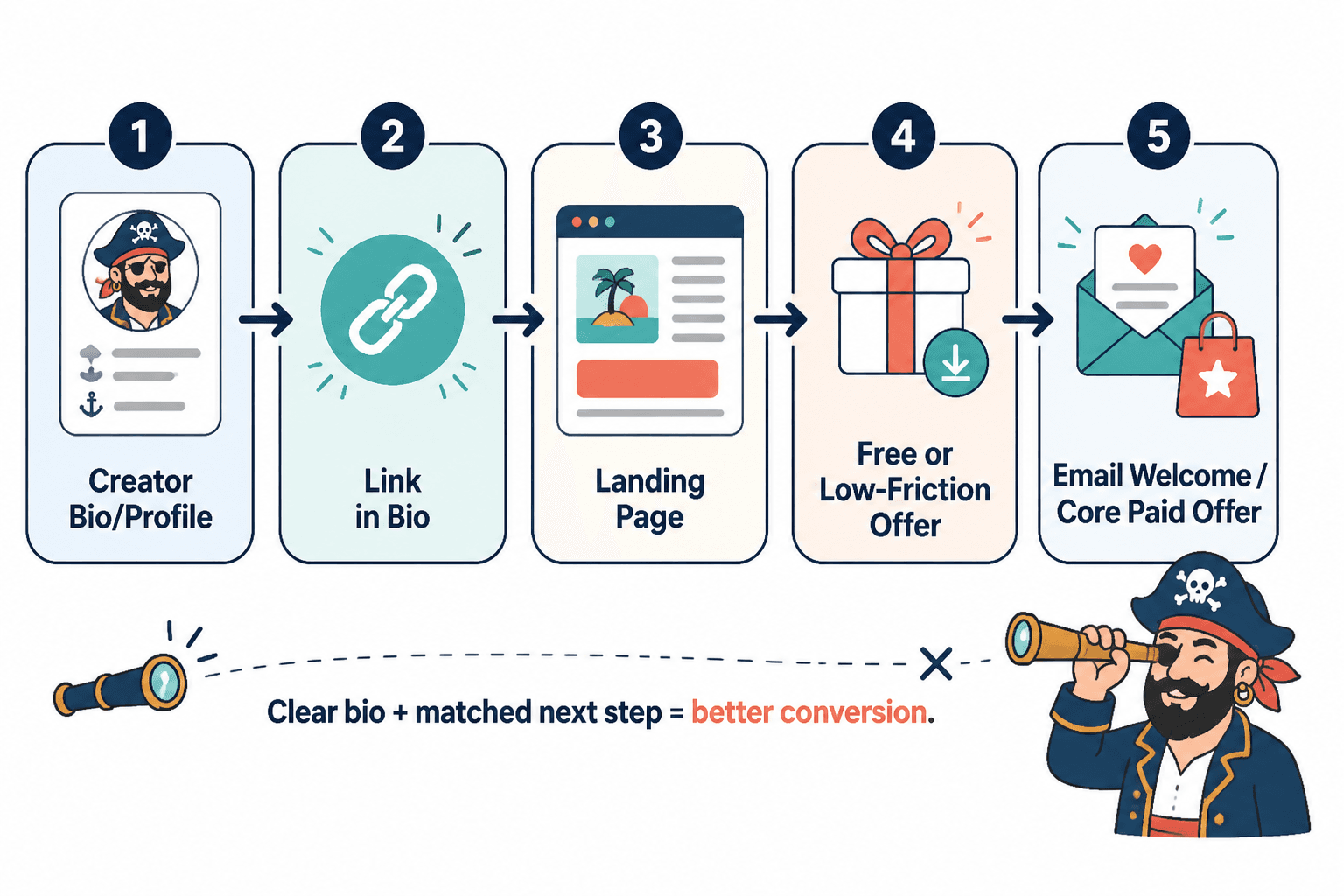
What makes a good bio funnel work
Before getting into funnel ideas, here is the filter: a good profile funnel should feel like the obvious next move.
Not a hard pivot. Not a bait-and-switch. Not “follow me for writing tips” in the bio and then a link to a high-ticket sales page for leadership transformation architecture. That kind of mismatch burns trust fast.
The best profile funnels usually share five traits:
- Clarity: the reader immediately understands what happens after the click
- Relevance: the next step matches the promise of the bio
- Low friction: the ask feels proportionate to the relationship
- Specificity: the offer solves a clear problem for a clear person
- Momentum: each step makes the next one easier
That means your bio should not just say what you do. It should quietly pre-frame the offer behind the link.
A creator bio works best when it answers the reader’s private question: “If I click this, is this actually for me?”
Best funnel ideas to pair with creator bios & profile copy
Not every creator needs the same setup. A coach with a high-trust service offer should not use the same profile funnel as a writer growing a newsletter or a consultant trying to book calls. Here are the funnel models that tend to work best, and where each one fits.
1. Bio → lead magnet → nurture emails → offer
This is one of the most reliable options because it does not ask for too much too soon. Someone finds your profile, sees a clear promise, clicks for a useful free resource, then gets pulled into email where trust can build without depending on social algorithms having a good day.
This works well for:
- Coaches
- Consultants
- Service providers
- Educators
- Creators with offers that need context
Good lead magnets for bio funnels include:
- A checklist
- A short guide
- A template
- A swipe file
- A mini email course
- A resource list
Bad lead magnets for bio funnels include giant vague ebooks nobody asked for, “ultimate guides” with no angle, and generic PDFs that smell like they were made to harvest email addresses rather than help anyone.
Bio example:
Helping B2B consultants turn scattered ideas into clear LinkedIn content that brings in leads.
Free: 12 high-converting post frameworks below.
That works because the promise in the bio and the promise in the freebie match. Clean handoff. No confusion.
2. Bio → newsletter signup
If your main engine is ideas, writing, teaching, or long-term audience building, this is often the smartest move. A newsletter is a strong destination because it lets you keep showing up in a calmer space than social, while stacking authority over time.
This works well for:
- Writers
- Personal brands
- Niche educators
- Creators building trust before selling
- Founders with thoughtful content
The mistake here is making the newsletter sound like homework.
“Weekly thoughts on business, mindset, growth, and life” is not a reason to subscribe. That is a content shrug. A better newsletter CTA names the reader, the topic, and the payoff.
Weak bio CTA:
Subscribe to my newsletter for insights on marketing.
Better bio CTA:
I write a weekly email for solo consultants who want sharper content and simpler client acquisition. Join here.
3. Bio → booking page
This is the obvious move for service providers, but it only works when the profile has enough trust and specificity to support it. If your bio is fuzzy and your booking link says “Book a free discovery call,” people will avoid it like a folding table at a hotel networking event.
Use this funnel if:
- Your service is clear
- Your audience already understands the problem
- Your profile includes some proof or credibility
- The booking call has a clear purpose
The key is to frame the call around a useful outcome, not your process.
Weak: Book a free consultation
Better: Book a 20-minute content audit and I’ll show you what is slowing down your profile conversions.
Now the click has a reason. Specific beats formal every time.
4. Bio → service page or offer page
This is a good fit when your audience is already warm enough, your offer is easy to understand, and your content has done a decent job pre-selling the problem.
It works best for straightforward offers like:
- Profile rewrites
- Copy audits
- VIP days
- Strategy sessions
- Productized services
It works less well for vague premium offers that require twelve layers of explanation and a mild spiritual awakening.
If you use this model, your bio should pre-qualify the visitor. Tell them who the offer is for and what result it helps create.
Example:
I rewrite creator bios and profile copy so your profile stops looking busy and starts pulling people toward the right offer.
See the profile rewrite service below.
5. Bio → case study or proof page → offer
If your audience is skeptical, expensive to convert, or comparing several experts at once, sending them straight to an offer page is sometimes too abrupt. A proof page can work better.
This funnel adds a useful middle layer:
- Bio makes the promise
- Case study proves you can deliver it
- Offer page gives the next action
This is especially helpful for consultants, ghostwriters, strategists, and higher-ticket service businesses. People do not just want claims. They want evidence that the claims are attached to reality.
A simple proof page can include:
- Before/after examples
- Client results
- Short testimonials
- What you changed
- Who it worked for
- A CTA to book or inquire
6. Bio → low-ticket product → upsell path
If you sell templates, mini-products, workshops, audits, or small digital offers, your profile can absolutely route people there. This works nicely when your audience wants a quick win before considering a larger offer.
This works well for creators selling:
- Prompt packs
- Swipe files
- Notion systems
- Mini-courses
- Workbooks
- Template bundles
The trick is not treating the low-ticket offer like the end of the road. If someone buys, there should be a logical next step afterward: newsletter, bundle upgrade, workshop, service, membership, or consultation.
Without that next step, you do not really have a funnel. You have a lonely checkout page.
7. Bio → content hub → segmented next steps
This is useful when your audience is mixed, your work spans a few related offers, or you are known for your content before your services. Instead of forcing everyone into one path, you send them to a simple content hub or landing page with a few clear options.
For example:
- Read the newsletter
- Get the free template
- Book a strategy call
- View services
This can work, but only if the options are tight. A cluttered link page with nine offers, a podcast, three freebies, two old courses, and a “work with me” button is just a prettier form of chaos.
Three good options beat ten confusing ones.
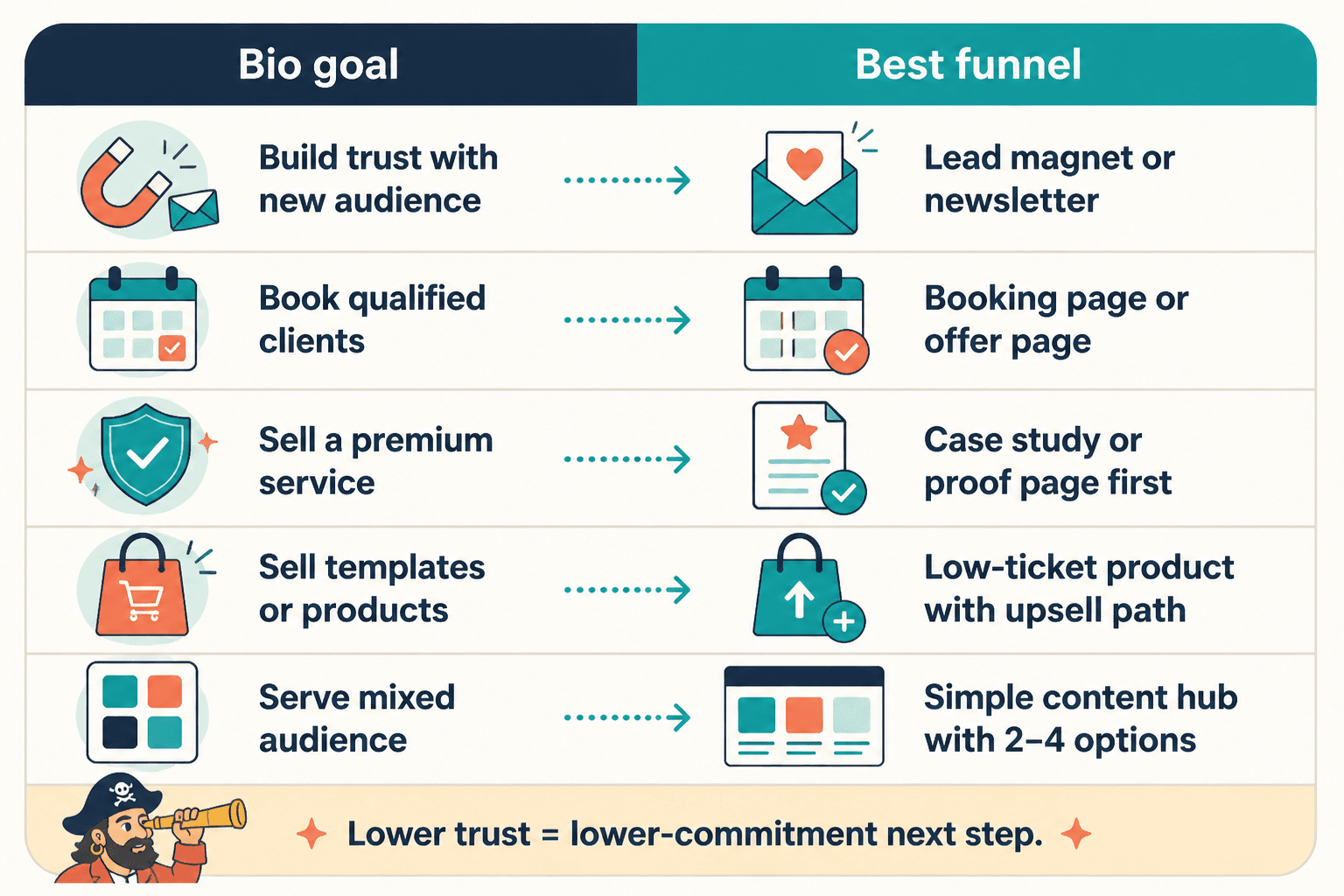
How to choose the right funnel for your bio
If you are not sure which model to use, choose based on trust level and buying intent.
| Situation | Best next step |
|---|---|
| Cold audience, complex offer | Lead magnet or newsletter |
| Warm audience, clear service | Booking page or offer page |
| Skeptical audience, premium offer | Case study or proof page first |
| Template/product audience | Low-ticket product with upsell path |
| Mixed audience, multiple entry points | Simple content hub with 2–4 options |
A decent rule: the less trust you have, the less commitment you should ask for.
This sounds obvious, yet people still write bios for strangers and attach funnels meant for people who already know them, trust them, and have mentally pre-approved the spend. That mismatch is one of the biggest reasons profile conversion rates stay sad.
How to make your bio and funnel actually match
This is where a lot of profiles quietly sabotage themselves. The bio says one thing. The link destination says another. The CTA says almost nothing. The result is friction that feels small but kills action.
Use this quick alignment check:
- Match the audience. If your bio speaks to coaches, do not send them to a generic page for “entrepreneurs.”
- Match the problem. If the bio promises better content, the destination should help with content, not wander into broad business growth fluff.
- Match the tone. If the bio is practical and direct, the landing page should not suddenly sound like a webinar funnel from another era.
- Match the commitment level. A soft profile promise should lead to a soft ask. A stronger ask needs stronger proof.
- Match the CTA language. Tell people what they get, not just where they click.
If your profile is already getting views but not clicks, this is probably where to look first.
Bio CTA examples that lead somewhere useful
A CTA in a creator bio does not need to be dramatic. It needs to be clear, relevant, and easy to act on.
Here are a few that work better than the usual “Learn more below” filler.
- Free guide: Grab the 10-point profile checklist below.
- Newsletter: Join 4,000+ consultants getting one sharp content idea each week.
- Service page: See how I rewrite bios that attract better-fit leads.
- Booking page: Book a 20-minute audit if your profile gets views but no action.
- Case study: See before/after profile rewrites and what changed.
- Template product: Get the bio template pack I use with clients.
The best ones lower uncertainty. They tell the reader what they are clicking into and why it is worth bothering.
Common bio funnel mistakes
A lot of creator funnels do not fail because the idea is bad. They fail because the setup is sloppy.
- Sending everyone to the homepage. Unless your homepage is extremely focused, it usually creates more choices than momentum.
- Using a vague link page. “My links” is not a strategy.
- Asking for a sales call too early. Cold visitors are rarely eager to book a chat just because your headshot looked competent.
- No proof in the profile. If the ask is strong, the profile needs some credibility.
- Too many audience types in one bio. If you help creators, founders, coaches, executives, agencies, and visionaries, your funnel has no idea who it is for either.
- Weak CTA language. “Click here” explains mechanics, not value.
- Broken continuity. The bio promise and landing page headline should feel like they belong to the same person.
One sharp line here because it is deserved: if your funnel begins with confusion, do not act shocked when it ends with silence.
Simple funnel setups for different creator types
For coaches
Best path: Bio → lead magnet → email nurture → call or offer
Coaching often needs trust, context, and a bit of belief transfer. A free resource plus thoughtful email sequence usually works better than trying to drag strangers straight onto a call.
The bigger point is simple: clearer structure and clearer writing make the piece more useful. That is usually what makes the ending land better too.