
Most Facebook rants do not fail because they are too opinionated. They fail because they are shapeless, repetitive, and weirdly proud of having no point.
And most long-form Facebook posts are not “too long.” They are just too slow, too soft, and too padded to earn the time they ask for.
If you are a creator, coach, consultant, writer, or solo business owner, Facebook long-form can still work extremely well. Not because the platform rewards random essays from the void, but because strong long-form posts can build familiarity, trust, and comments in a way short polished posts often cannot. They give people something to react to. Something to remember. Something to talk back to.
This Facebook Long-Form & Rants Guide for Creators Who Want Better Results will help you write posts that actually hold attention, carry an argument, create discussion, and lead somewhere useful for your business. Not sterile “thought leadership.” Not sloppy public journaling dressed up as strategy. Actual posts with shape.
If you want a broader hub for this topic, start with Facebook long-form and rants. If you want examples, audience-specific advice, templates, or tools, I’ll point you to a few useful related pieces as we go.
To see how this fits into the wider strategy, open the parent guide.
What Facebook long-form and rants are actually good for
Facebook is one of the few mainstream platforms where people will still tolerate a strong opinion with some actual texture behind it. That matters.
A good long-form post gives you room to do things that short content cannot do well: build tension, explain a nuanced take, tell a story with emotional shape, push back on a bad industry norm, or make a practical argument that earns comments from people who have something to add.
A good rant does something similar, but with more heat. The key word there is good. A strong rant is not random complaining. It has direction. It escalates on purpose. It lands on a takeaway. It gives the reader something besides your temporary irritation.
- Trust: people hear how you think, not just what you sell
- Positioning: your opinions show what you stand for and what you reject
- Conversation: long-form often earns better comments than polished one-liners
- Memory: people remember a shaped argument more than a generic tip
- Lead quality: the right readers self-select when your point of view is clear
That is the upside. The downside is that Facebook long-form also makes it very easy to ramble in public and call it authenticity.
If your post could lose 40 percent of its words and say the same thing, it was not long-form. It was just unedited.
The biggest mistake: confusing emotion with structure
A lot of creators assume a rant works if the feeling is real enough. It doesn’t.
Emotion can power a post, but it cannot organize one. Readers still need a path. They need to know what the issue is, why it matters, where the tension is, and what they are supposed to take from it. Otherwise your post just becomes a blob of intensity with line breaks.
This is where many Facebook posts go wrong. The writer starts hot, circles the same point five times, adds three side complaints, then ends with “Anyway, be kind.” That is not a strong close. That is a content shrug.
Better approach: treat your rant like an argument and your long-form post like a guided reading experience. You are not dumping thoughts. You are leading someone through them.
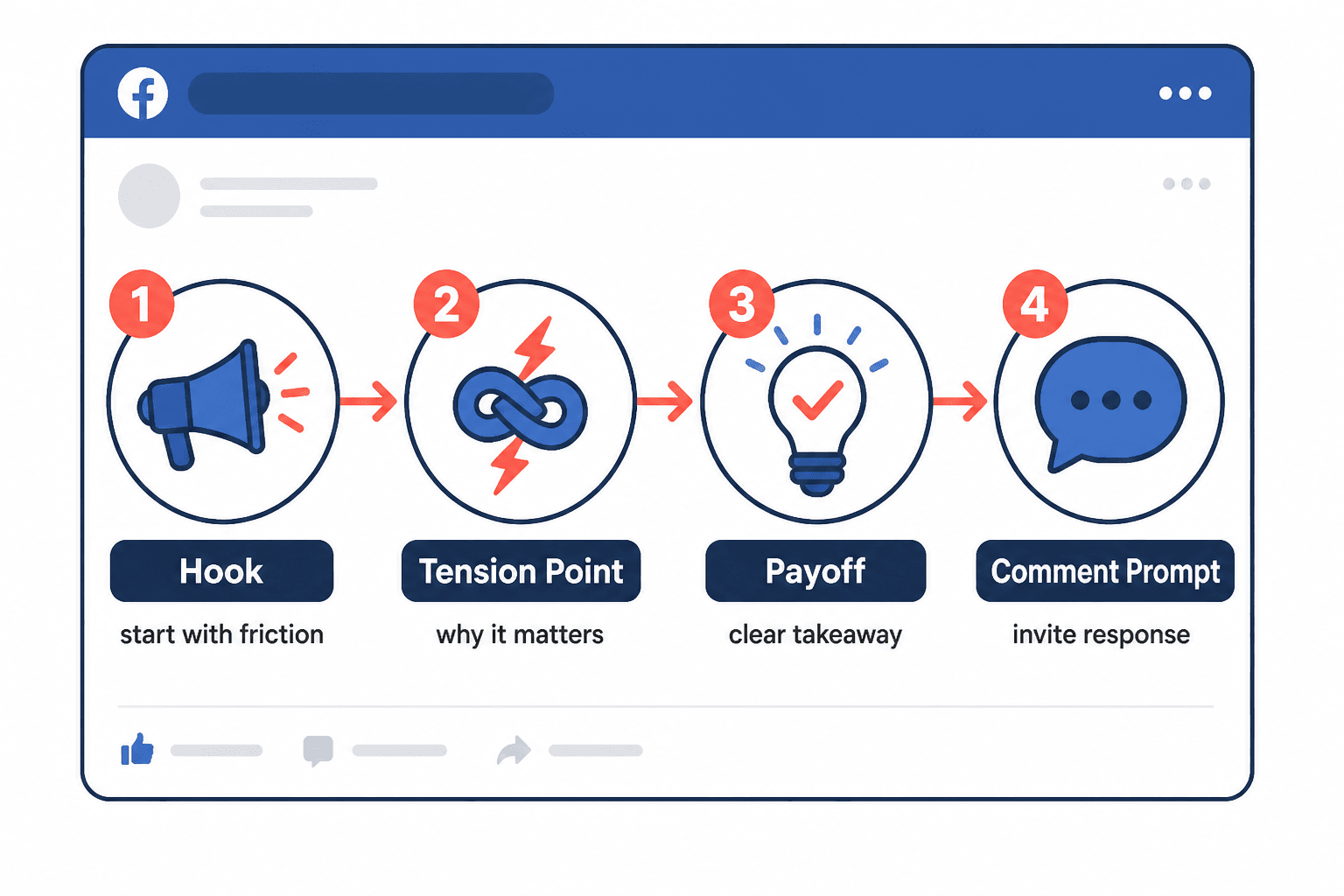
How to structure a Facebook long-form post so people actually read it
The cleanest way to improve your Facebook long-form writing is to stop thinking in terms of “write more” and start thinking in terms of “move the reader.”
Here is a practical structure that works for most long-form posts and controlled rants.
1. Open with the friction
Do not warm up for six lines. Start where the tension starts.
- Name the bad advice
- Call out the common mistake
- State the opinion cleanly
- Begin at the moment something became obvious
Weak opening: “I’ve been thinking a lot lately about content and what it means to create in a noisy world.”
Better opening: “A lot of Facebook ‘storytelling’ posts are just long excuses to avoid getting to the point.”
That second one has shape already. There is tension. There is a claim. There is a reason to continue.
2. Build the case, not just the mood
After the opening, explain the thing. Give evidence, examples, observations, mini-scenes, or a practical breakdown. This is where you earn the right to be long.
A strong long-form Facebook post usually includes at least one of these:
- A concrete example of what people do wrong
- A contrast between what seems smart and what actually works
- A personal observation framed as a useful pattern
- A short story with a lesson that applies beyond the story
- A breakdown of why a common tactic backfires
If all you are doing is restating your opinion in slightly different words, readers feel it. Fast.
3. Escalate with control
This matters most for rants. You want momentum, not chaos.
Each paragraph should increase clarity, tension, or usefulness. If a paragraph merely repeats your annoyance louder, cut it. A rant with no progression gets exhausting. A rant that sharpens as it goes becomes compelling.
Think of escalation like this:
- State the issue
- Show why it is a problem
- Show what it causes
- Challenge the excuse behind it
- Land on the bigger takeaway
4. End with a point, not a fade-out
The close is where too many creators waste a strong post. They build heat, build momentum, then end with a soft generic line that sounds borrowed from a coffee mug.
Instead, end with one of these:
- A sharp summary line
- A clear standard you believe in
- A practical next step
- A comment-worthy question
- A simple callout of what readers should stop doing
Weak ending: “Just something to think about.”
Better ending: “If your post needs 900 words to say ‘be consistent,’ the problem is not the algorithm. It is the writing.”
What makes a rant good instead of unbearable
A good rant is not “raw.” Raw is overrated. Raw often means undercooked.
A good rant has four things:
- A target: one clear bad idea, behavior, trend, or habit
- A reason: why it matters beyond your mood
- A shape: beginning, middle, payoff
- A use: something the reader can do, see, or understand better after reading
That last part is what separates a strategic rant from self-indulgence. Your job is not merely to vent. Your job is to turn frustration into insight.
For creators and service businesses, rants work best when they reveal standards. They show your audience what you care about, what you think is broken, and how you think things should be done instead. That is positioning. Very few people say it that plainly, but that is what is happening.
Good rant targets
- Bad content advice in your industry
- Lazy client or customer assumptions
- Common creator habits that kill trust
- Trendy tactics that look smart but perform badly
- Misleading shortcuts sold as systems
Bad rant targets
- Vague complaints about “people”
- Everyone and everything at once
- One weird interaction you have not processed yet
- A topic where your only point is “this annoyed me”
- Any rant that exists mainly to bait applause from your side
Facebook is not LinkedIn in a hoodie
This is where a lot of creators get clumsy. They write Facebook long-form like they are posting a polished LinkedIn mini-article, then wonder why it feels stiff.
Facebook long-form usually works better when it feels more conversational, more human, and slightly less stage-managed. That does not mean messy. It means readable. It means the reader can feel a person in the post, not a brand trying to project executive sincerity.
On Facebook, people often respond well to:
- Clear opinions with a little personality
- Stories that move quickly
- Arguments with a visible point
- Posts that invite reaction without begging for it
- Writing that sounds like someone talking intelligently, not presenting quarterly values
If you want more platform-specific context, the broader Facebook writing section and the Facebook long-form and rants hub are the right next stops.
A practical formula for Facebook long-form posts
If you want something simple, use this:
- Hook: say the uncomfortable or interesting thing fast
- Context: explain what you are reacting to
- Case: show why your point is true with examples or reasoning
- Shift: explain what should happen instead
- Close: land on a takeaway or discussion prompt
Here is a filled-in example.
Most “authentic” Facebook posts are still performative. They are just dressed down more casually.
What people call authenticity is often just strategic oversharing with softer lighting. The post sounds personal, but every line is steering toward approval.
You can feel it when a story takes five paragraphs to reach a lesson that was obvious by paragraph one. Or when a vulnerable moment is edited so neatly it somehow lands on a sales pitch.
That kind of post can still get engagement, sure. But it does not always build trust. Sometimes it teaches your audience that every emotional moment is a setup.
Better approach: say something true, make it useful, and leave a little room for the reader to think instead of handing them a polished moral.
People do not need more content that performs honesty. They need writing that sounds like someone meant it.
That is not magic. It just has a point, shape, and payoff.
How to pace a long Facebook post so it does not drag
Pacing is the quiet reason some long posts get read and others get abandoned halfway through.
You improve pacing by controlling paragraph length, idea flow, tension, and repetition. Small mechanics, big difference.
Use short paragraphs, but not fake dramatic spacing
Short paragraphs help on Facebook. They make the post feel readable. They reduce intimidation. They create rhythm.
But if you break every sentence into its own paragraph, the post starts sounding breathless and manipulative. It feels like the writing is begging to be felt.
Use line breaks to improve flow, not to cosplay intensity.
Change the job of each paragraph
One paragraph should not do the same job as the previous two. Good pacing comes from movement.
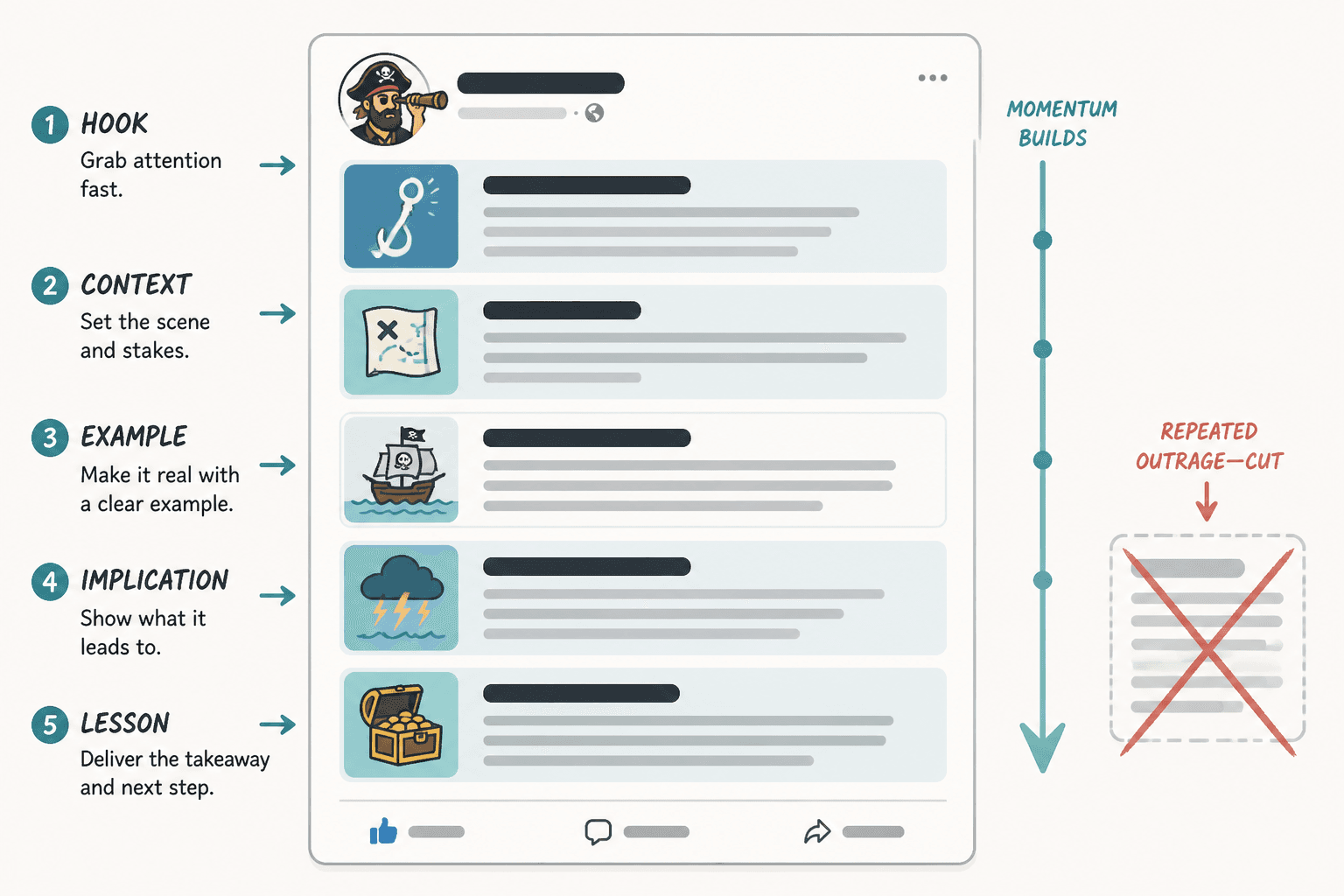
- Paragraph 1 opens the tension
- Paragraph 2 explains the trigger
- Paragraph 3 gives an example
- Paragraph 4 sharpens the implication
- Paragraph 5 lands the lesson
That is movement. Readers can feel it even if they cannot name it.
Cut repeated outrage
One of the easiest ways to tighten a rant is to remove every paragraph that expresses the same emotion without adding a new idea.
If paragraph 6 is basically paragraph 3 wearing a louder jacket, cut it.
If pacing is your weak point, this piece on simple Facebook long-form and rants story pacing templates for busy creators will help a lot.
Before and after: turning a weak rant into a strong one
Here is what a weak version often looks like:
I’m honestly tired of seeing people online act like posting more is the answer to everything. It’s frustrating because content takes time and people have lives and not everyone wants to be on all the time and it just feels like bad advice and I think we need to normalize doing what works for you and not listening to all these gurus because the online space is noisy and exhausting.
The issue is not the opinion. The issue is the shape. It is one blur of complaint with no real development.
Now the rewrite:
“Just post more” is lazy advice.
It sounds practical, but it usually ignores the real reason someone’s content is underperforming: the ideas are too vague, the positioning is muddy, or the posts are doing nothing memorable.
More volume can help if the foundation is solid. But for a lot of creators, posting more just means producing more forgettable content faster.
That is not discipline. That is a content treadmill.
A better question is not “How can I post more?” It is “What would make this worth reading in the first place?”
Same general opinion. Far better execution.
What creators should rant about if they want better results
You do not need a fake hot take factory. You need better targets.
The best rant topics usually sit at the intersection of three things:
- Something your audience keeps getting wrong
- Something you genuinely have a useful point of view on
- Something connected to the work you want to be known for
Examples:
- Why “just be authentic” is weak business advice
- Why most lead magnets are boring and ignored
- Why creators copy viral formats that do not fit their audience
- Why consultants hide behind abstract expertise instead of specific proof
- Why content calendars often kill stronger ideas
- Why engagement bait makes smart people sound needy
The point is not controversy for sport. It is useful friction. You want readers to think, “I had not put it that way, but yes.”
If you want more angles to work with, see best Facebook long-form and rants ideas and examples for creators.
How to connect long-form posts to business results without making them gross
A Facebook rant does not have to end in a pitch. In many cases, it should not.
But that does not mean it cannot support your business. It absolutely can. The trick is to let the post build trust and let the profile, comments, or next step do the selling work more quietly.
Here are smarter ways to connect long-form content to outcomes:
- Use the post to demonstrate your standards and expertise
- Make sure your profile explains who you help and how
- Invite discussion that naturally leads to relevant conversations
- Reference a framework, offer, or resource only when it clearly fits
- Let interested readers come toward you instead of dragging every post into a funnel costume
For example, if your post critiques why most messaging advice is too vague, it is fine to end with a light line like: “This is the kind of problem I help consultants fix every week.” That works because it matches the topic. What does not work is stapling “DM me ‘clarity’” onto every emotional or opinion-based post like a cursed bumper sticker.
Long-form for small audiences: yes, it can still work
Small audience creators often assume long-form is only worth doing once you already have attention. Not true.
In fact, thoughtful long-form can be especially useful when your audience is small, because it helps the right people understand you faster. You are not trying to impress a crowd. You are trying to become legible to the people who matter.
With a smaller audience, focus on:
- Specific opinions instead of broad “valuable” advice
- Stories or arguments that reflect your actual expertise
- Posts that make it easy for the right readers to recognize themselves
- Comment conversations over vanity metrics
- Consistency in point of view, not just posting frequency
If that is your situation, read Facebook long-form and rants for creators with small audiences. It will save you from copying bigger creators whose posts work for reasons you cannot borrow.
Editing checklist for Facebook long-form and rants
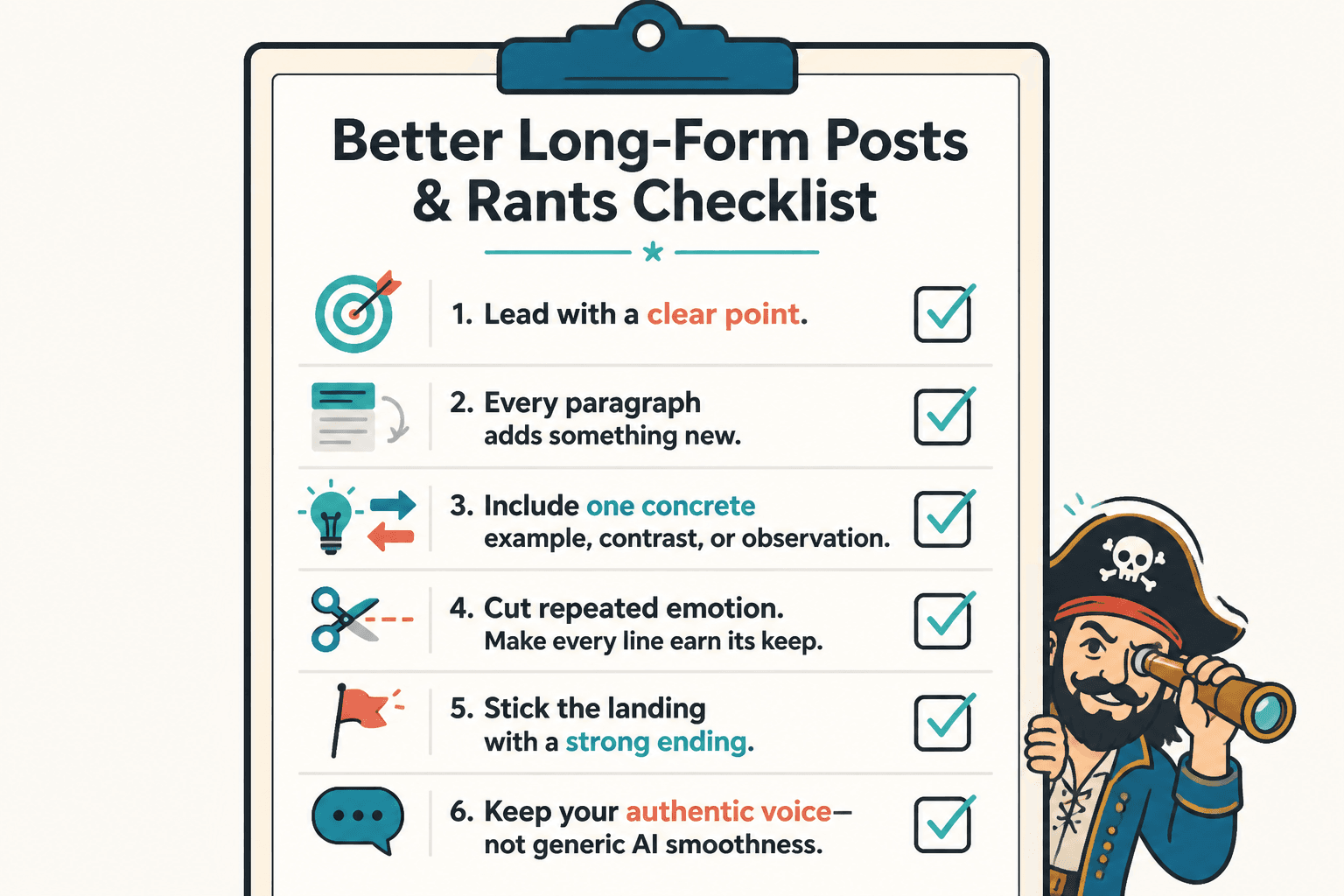
Before you hit publish, run through this:
- Is the opening clear in the first one or two lines?
- Can the reader tell what this post is really about?
- Does each paragraph add something new?
- Did I include at least one concrete example, contrast, or useful observation?
- Did I cut repeated emotion that does not move the point forward?
- Is the ending strong, clear, and worth remembering?
- Does the post sound like me, or like polished AI mush with a pulse?
That last one matters more than people think. Facebook readers are pretty good at sensing when a post has been scrubbed into generic smoothness. A little roughness is often fine. Blandness is not.
If you want support tools without pretending software will magically invent a point of view, check out best templates and tools for Facebook long-form and rants.
Common Facebook rant mistakes to stop making
- Starting too far back: get to the friction faster
- Ranting at everyone: pick one target
- No point beyond emotion: frustration is not a takeaway
- Repeating yourself: cut duplicate paragraphs
- Over-branding the post: not every rant needs a sales tie-in
- Using fake vulnerability: people can feel the staging
- Ending weakly: do not drift out of your own post
One sharp opinion carried well will beat five muddy ones jammed into the same post. Every time.
Quick FAQ
The bigger point is simple: clearer structure and clearer writing make the piece more useful. That is usually what makes the ending land better too.