
Most creator funnels get ruined long before the tech does.
Not because someone forgot an email automation. Not because they picked the wrong platform. Usually because they built a funnel that asks for too much, too soon, from people who barely know them. A post gets attention, then immediately shoves people toward a sales page, a discovery call, a 17-step nurture sequence, and somehow a webinar from 2021. That is not a funnel. That is an ambush.
Simple creator funnel examples work better because they match how trust actually forms online. Someone sees your content. They get curious. They check your profile. They take a small next step. Then, maybe, they buy.
This is where a lot of creators overcomplicate things. They think they need a giant machine. What they usually need is a cleaner path. One that turns attention into trust, and trust into action, without making people feel like they accidentally stepped into a funnel built by a copywriter with unresolved issues.
Here’s how to build simple creator funnels fast, plus practical funnel examples you can adapt to your audience, offer, and platform without needing a whiteboard and three paid tools you will resent by next month.
For the full path around this topic, head to the parent guide.
What makes a creator funnel simple and effective
A simple funnel is not lazy. It is focused.
It gives people one clear path from first contact to next action. Not five CTAs. Not seven offers. Not a vague “link in bio” leading to a digital junk drawer.
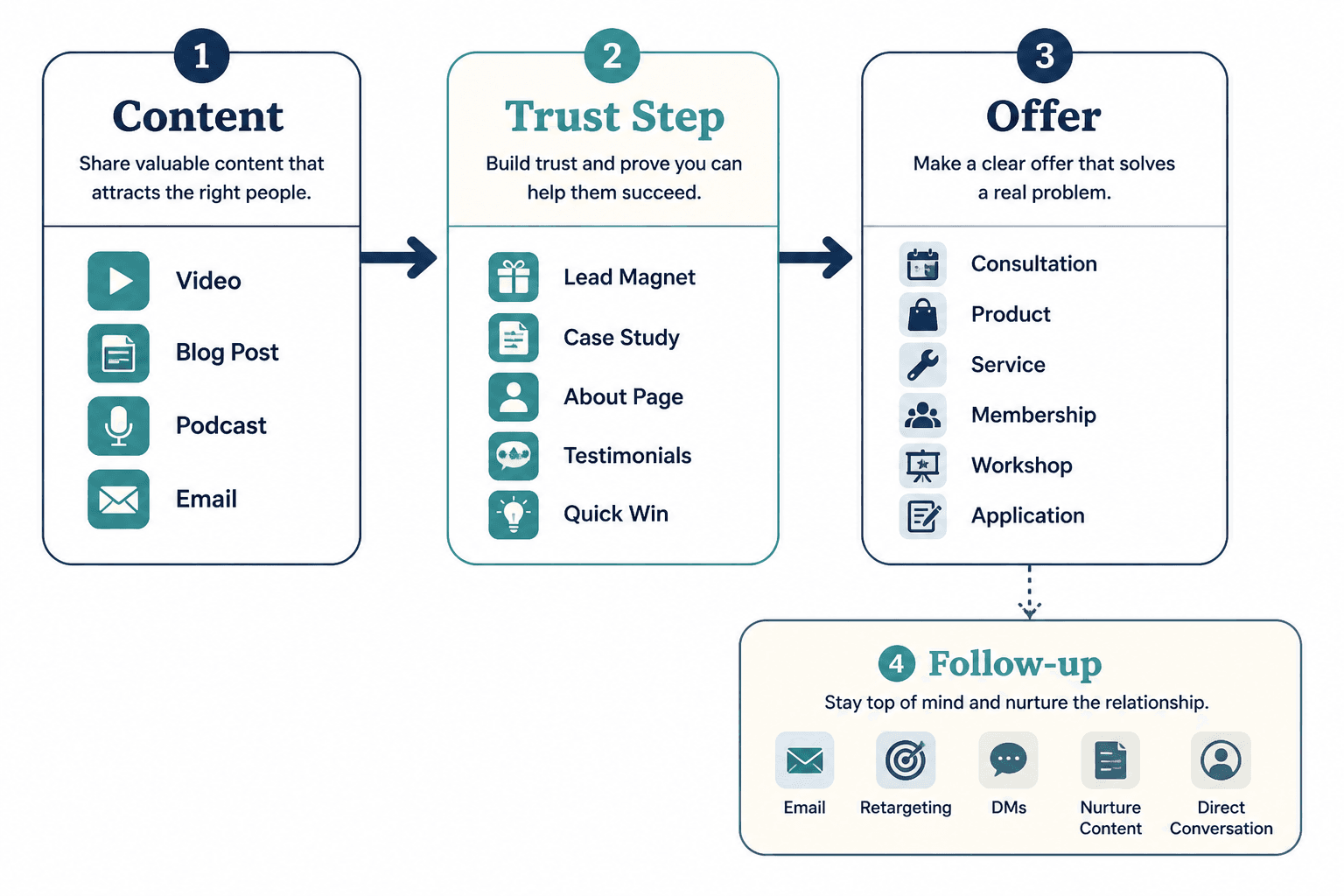
The strongest creator funnels usually have four parts:
- Attention: a post, article, thread, reel, comment strategy, or referral
- Trust step: profile, lead magnet, newsletter, case study, free resource, or strong content archive
- Offer step: consultation, product, service, membership, workshop, or application
- Follow-up: email, retargeting, DMs, nurture content, or direct conversation
That is it. The funnel can be more detailed behind the scenes, but the user experience should feel easy. Clean. Obvious. Low-friction.
If someone needs a map, your funnel is too complicated.
For a broader foundation, it helps to read the main creator funnels guide and the more detailed guide for creators who want better results. But for now, we are staying practical.
Before you copy any funnel example, figure out these 3 things
A lot of funnel advice fails because it skips the part where your offer, audience, and buying cycle actually matter.
Before you steal any of the examples below, answer these first.
1. What are you selling?
A $29 template pack does not need the same funnel as a $3,000 consulting offer.
Low-ticket offers often work with shorter funnels. High-ticket services usually need more proof, more trust, and more conversation.
2. How warm is your audience?
If people already know you, you can move faster. If they just found you from one smart post, asking them to book a strategy call immediately is a bit optimistic.
3. What is the next easiest yes?
This matters more than most creators realize. The best next step is usually not the biggest step. It is the easiest meaningful one.
That might be:
- Join the email list
- Read a case study
- Reply to a post
- Download a free resource
- Watch a short training
- Apply for a call
- Buy a low-friction starter offer
The mistake is trying to force every person into the same action. Cold readers need a softer path. Warm buyers can handle a stronger ask.
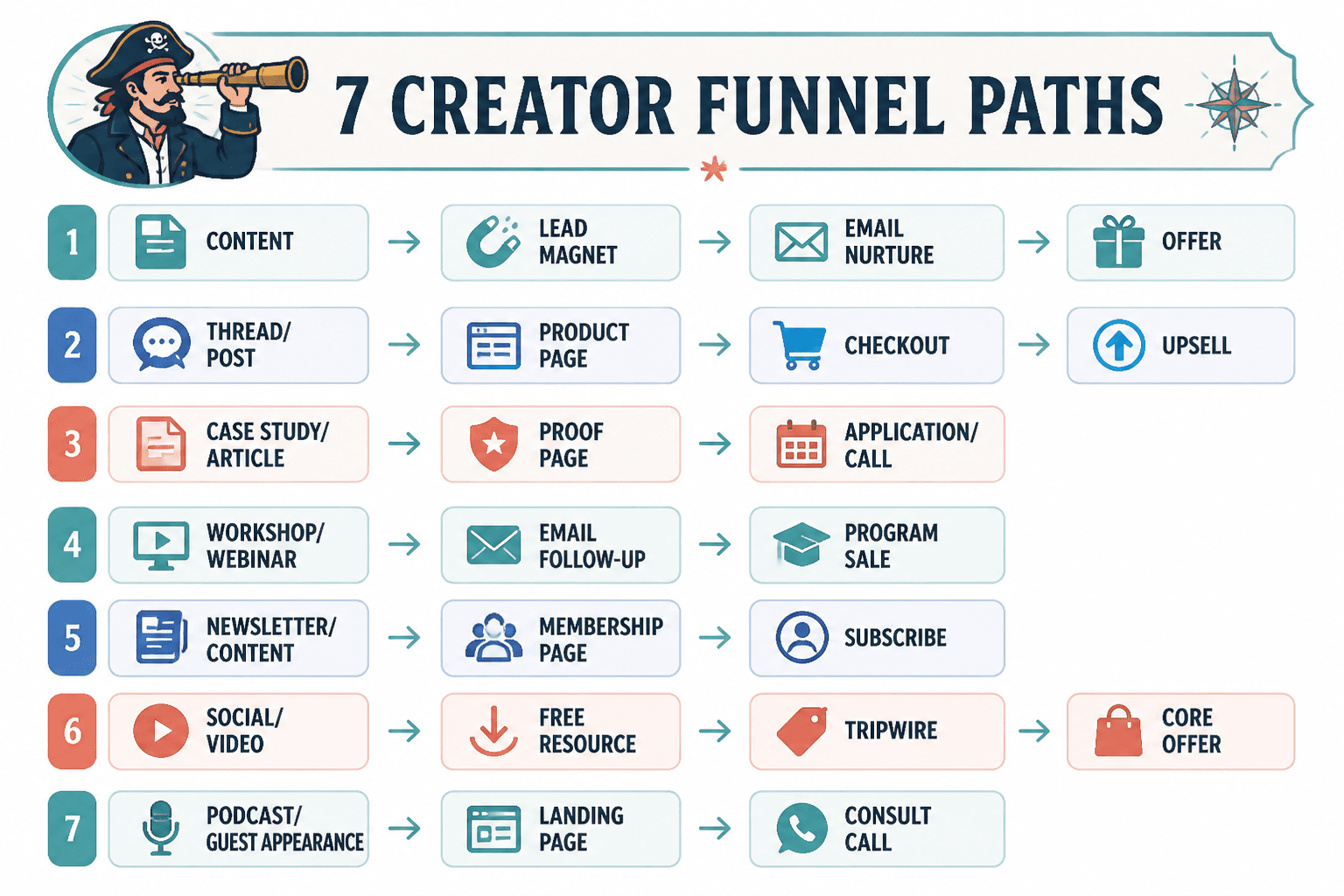
7 simple creator funnel examples you can adapt fast
These simple creator funnel examples are built for real creator businesses: coaches, writers, consultants, service providers, educators, and personal brands selling expertise.
Use them as models, not commandments.
1. Content → profile → lead magnet → email nurture → offer
This is one of the cleanest funnels for creators who publish educational content and want to turn attention into leads without pitching in every post.
Best for: coaches, consultants, service providers, educators, B2B creators
How it works:
- You publish useful posts around a clear problem
- Your profile makes the audience, problem, and outcome obvious
- Your lead magnet offers a practical shortcut or framework
- Email nurture builds trust with proof, insight, and next steps
- You introduce a paid offer naturally
Example: A messaging consultant posts about weak homepage copy. Readers visit the profile, download a “Homepage Message Fix” checklist, get three short emails with examples and rewrites, then receive an invitation to book a messaging audit.
Why it works: It creates a nice progression. Public content earns attention. The lead magnet turns casual interest into a contact. Email does the slower trust work that social posts cannot always do well.
Where creators mess it up: The lead magnet is too broad, the emails are generic, or the paid offer feels disconnected from what attracted the person in the first place.
2. Post → comments/conversation → soft DM → service offer
This works well when your service is custom, trust-heavy, and easier to sell in conversation than on a page.
Best for: freelancers, ghostwriters, strategists, consultants, done-for-you providers
How it works:
- You publish opinionated or useful content that attracts relevant people
- Interested readers comment or engage
- You continue the conversation naturally
- If there is clear fit, you move to DM
- You offer a call, audit, or direct proposal
Example: A LinkedIn ghostwriter posts a teardown of weak founder posts. A founder comments with a specific problem. The writer replies with a useful observation, continues in DM, then offers a paid profile and content audit.
Why it works: It feels like relationship-building, not funnel theater.
What to avoid: Using comments as bait for creepy automation. “Comment GUIDE and I’ll DM you” can work in some cases, but if every post smells like a lead trap, people notice.
3. Article → related resource → newsletter → consultation
This is a strong authority funnel for creators who write deeper content and want better-fit leads, not just more clicks.
Best for: consultants, niche experts, B2B creators, strategic service providers
How it works:
- You publish a strong article around a specific problem
- The article includes a relevant CTA to a resource or newsletter
- The subscriber gets ongoing insight related to that problem
- You invite the right readers into a call or offer
Example: A retention strategist writes an article on why most welcome email sequences underperform. Inside the article is a CTA for a welcome sequence checklist. Subscribers then receive weekly teardown emails and, later, an invitation to a paid sequence review.
This funnel tends to attract people who are already thinking seriously. That means fewer vanity leads and more qualified ones. Very glamorous, I know.
4. Thread → low-ticket product → upsell to service or membership
This is useful when your content is tactical and your audience wants quick wins before bigger commitments.
Best for: creators selling templates, mini-products, workshops, memberships, or implementation help
How it works:
- You publish a practical thread with a clear outcome
- The CTA points to a low-ticket offer that helps people do the thing faster
- Buyers get a good result from the entry product
- You upsell them into a deeper service, membership, or premium product
Example: A creator posts an X thread on writing better sales pages. The CTA offers a $27 sales page outline pack. Buyers then receive an upsell for a live teardown workshop or a premium messaging package.
Why it works: The low-ticket offer acts as a trust bridge. It is easier to buy, easier to test, and easier to say yes to than a high-ticket offer from a stranger.
Risk: Some creators get stuck selling cheap products forever and never build the path upward. If you use this funnel, decide what the next offer is before you launch the first one.
5. Post → booking page → consultation → custom offer
This is the direct route. It can work very well if your content is strong, your audience is warm enough, and the offer is clear.
Best for: established consultants, niche coaches, service providers with clear positioning
How it works:
- You post around painful, expensive, urgent problems
- The CTA points directly to a call or application page
- The call qualifies the lead and frames the offer
- You close or follow up
Example: A fractional CMO posts about three reasons founder-led content is not generating pipeline. The CTA invites qualified SaaS founders to book a strategy call.
Why it works: Less friction. No extra steps for people already convinced.
Why it fails: The content is too generic, the audience is too cold, or the creator has not earned enough trust to justify the ask.
If you have a smaller audience, do not assume this funnel is off-limits. It just needs stronger relevance and better positioning. The article on creator funnels for creators with small audiences goes deeper on that.
6. Free workshop or webinar → follow-up emails → offer
Yes, webinars still work. No, not the inflated fake-urgency kind with 94 slides and a countdown timer acting like a hostage negotiator.
Best for: coaches, educators, consultants, group program creators
How it works:
- You promote a live or recorded training around a clear problem
- People register with email
- The workshop gives real value and frames the gap
- Follow-up emails reinforce the problem, the solution, and the offer
Example: A business coach hosts a 30-minute session on fixing offers that get polite interest but no sales. The workshop ends with an invitation to join a paid group program focused on offer positioning.
Best use case: when your offer needs education before purchase.
What to watch: If the workshop exists only to pitch, people feel it. Give enough substance that attending is valuable even if they do not buy.
7. Case study → proof page → application funnel
This is one of the best simple creator funnels for higher-ticket offers, especially when proof matters more than charisma.
Best for: consultants, agencies, specialists, service providers with track record
How it works:
- You publish a case study post, article, or thread
- Interested people click to a proof-rich page
- The page explains who you help, how you help, and what results you drive
- Qualified leads apply or book a call
Example: A launch strategist shares a case study showing how a creator improved webinar-to-sale conversion. The CTA points to a page with more results, process details, and an application for strategic support.
Why it works: Proof reduces risk. It also filters out weak-fit leads because the positioning is more concrete.
How to choose the right funnel for your creator business
You do not need the “best” funnel. You need the one your audience can realistically move through.
| If you sell… | Usually start with… | Best next step |
|---|---|---|
| High-ticket consulting or services | Content, case studies, articles | Call, application, audit |
| Coaching or group programs | Content, workshop, lead magnet | Email nurture, webinar, call |
| Templates or low-ticket products | Threads, practical posts, tutorials | Product page, bundle, upsell |
| Membership or newsletter offers | Consistent thought leadership and utility content | Email signup, paid subscription, community invite |
| Done-for-you creative services | Proof-driven posts and conversation | DM, call, proposal |
If you are still sorting this out, simple creator funnel offer paths and templates can help you match the funnel to the offer more quickly.
There is also a bigger strategic point here. Funnels are not just conversion mechanics. They are positioning mechanics. The path you create teaches people how to see your business. A thoughtful newsletter funnel says one thing. A direct-booking service funnel says another. A low-ticket template funnel says something else entirely.
That is why copying someone else’s setup blindly is so often a waste. The funnel has to fit not just your offer, but your business model and buyer psychology.
Common creator funnel mistakes that make simple funnels stop working
Simple is good. Sloppy is not.
Here are the mistakes that quietly kill performance.
- No clear next step: The content is decent, but readers do not know what to do next.
- Weak profile or landing page: The post earns attention, then the profile wastes it.
- Offer mismatch: The free content attracts one audience, but the offer is for someone else.
- Too much friction: Too many clicks, too much copy, too many choices.
- Pitching too early: You have not earned the ask yet.
- No follow-up: People showed interest, then fell into the void.
- Generic lead magnets: “Ultimate guide” is not a strategy.
- No proof: People need reasons to trust you beyond “I post often.”
Creator funnels get better when the path feels simpler and the writing makes each next step obvious. A cleaner message usually fixes more than extra funnel complexity ever will.