Most creator bios are trying way too hard to sound impressive and somehow still say nothing.
You have probably seen the type. “Helping visionary founders unlock aligned growth through authentic storytelling.” That sounds polished right up until someone asks the obvious question: cool, but what do you actually do, for whom, and why should I care?
A good bio is not a tiny TED Talk. It is not your life mission in slogan form. It is profile copy that helps the right person understand you fast. That is the job.
These creator bio formula examples creators can adapt fast are built for real use, not motivational wallpaper. You will get simple formulas, filled-in examples, quick rewrites, and a few rules that stop your profile from sounding like a networking event name tag with delusions of grandeur.
If you want the wider framework behind this, start with this guide to creator bios and profile copy or browse the main creator bios and profile copy hub. For now, we are keeping this practical and fast.
If you want the bigger picture, start with the parent guide.
What a creator bio actually needs to do
Before formulas, one important thing.
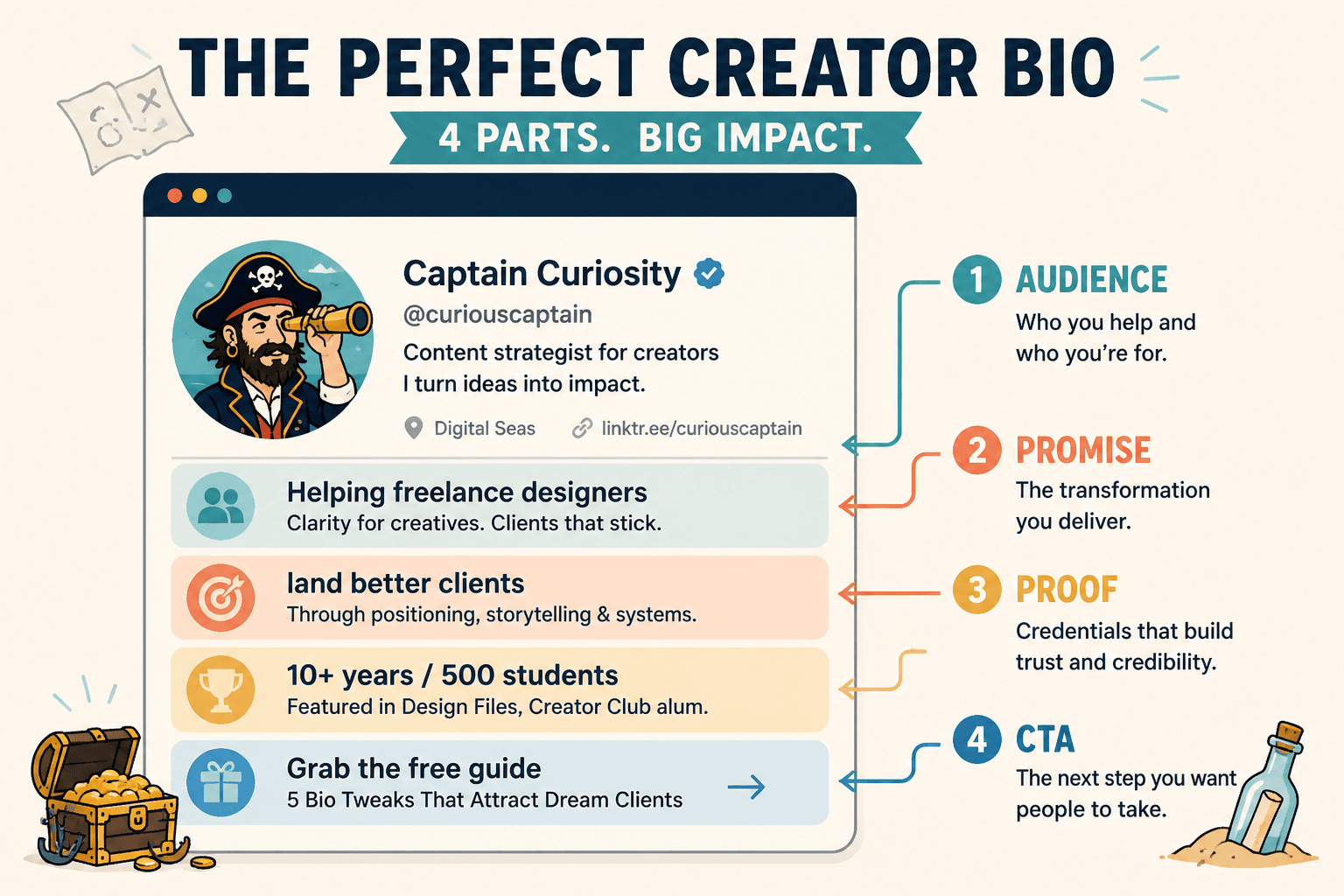
Your bio does not need to capture your entire personality, business model, worldview, and childhood dream of becoming “multi-passionate.” It needs to answer a few basic questions quickly:
- Who are you for?
- What do you help them do?
- Why should they trust you?
- What should they do next?
That is it. If your bio handles those four things clearly, it is already ahead of a huge chunk of the internet.
And no, clarity does not make you boring. Vague people love saying that. Clarity makes you useful. Useful is attractive.
The 4-part bio structure that works on most platforms
If you want one default structure for creator bios and profile copy, use this:
I help [specific audience] get [specific result] through [method, content angle, or offer]. [Proof or credibility]. [CTA or next step].
This formula works because it gives your profile shape. It tells people what bucket to put you in, which matters more than many creators want to admit. If people cannot place you, they usually leave.
That said, not every platform bio has enough room for the full version. So below, I am giving you several formulas you can use depending on your space, business type, and how direct you want to be.
7 creator bio formula examples creators can adapt fast
1. The straight-to-the-point service bio
Best for coaches, consultants, freelancers, and creators with a clear paid offer.
I help [audience] [result]. [Proof]. [CTA].
Example:
I help coaches turn scattered content into clear lead-generating posts.
Worked with 60+ service brands.
Grab the free content audit template below.
Why it works: it is clear, specific, and not trying to impress anyone with abstract nouns.
2. The niche-and-method bio
Best when your approach is part of your positioning.
I help [audience] [result] using [method/framework/process].
Example:
I help solo consultants turn expertise into simple LinkedIn content using sharp positioning, clean hooks, and sane content systems.
This one works well if your audience already understands the result they want, but your method gives them a reason to choose you over everyone else making the same claim.
3. The authority-first bio
Best when your proof is strong enough to carry the pitch.
[Role] helping [audience] [result]. [Notable proof or credibility].
Example:
Conversion copywriter helping B2B founders fix weak messaging and sharper sales pages.
Trusted by SaaS teams, consultants, and bootstrapped brands.
If you have real proof, use it. Not fake authority. Real authority. Clients served, outcomes delivered, platform built, category known. Skip the “thought leader” nonsense and say something people can actually believe.
4. The creator-educator bio
Best for writers, educators, and personal brands selling through content rather than direct outreach.
I share [type of content] to help [audience] [result]. [Optional proof or CTA].
Example:
I share practical content strategy for coaches and solo founders who want better posts, cleaner profiles, and more trust-driven leads.
This is useful when your profile is more “follow and learn” than “book now.” It softens the commercial edge without becoming vague mush.
5. The one-line punch bio
Best for platforms with limited space or creators who want a tighter personal brand line.
I help [audience] do [result] without [common frustration].
Example:
I help experts write better content without sounding like content marketers.
This formula earns its keep because contrast creates clarity. The “without” part signals you understand the annoying thing your audience wants to avoid.
6. The personality-plus-positioning bio
Best when you want a bit more voice without losing clarity.
[What you do for whom]. [Light personality line]. [CTA].
Example:
I help service businesses write clearer, less forgettable content.
Sharp strategy, no guru fog.
Templates and examples below.
This is a nice middle ground. You sound like a person, but still do the basic communication job your bio is supposed to do.
7. The audience-callout bio
Best if your niche matters more than your title.
For [specific audience]: [what you help them do]. [CTA/proof].
Example:
For coaches and consultants: clearer offers, stronger content, better client trust.
See examples and templates.
This style works because the right reader immediately sees themselves. It is efficient. And efficient tends to beat clever in profile copy.
How to choose the right bio formula for your profile
Do not just pick the “best” formula. Pick the one that fits your goal.
| If your main goal is… | Use this type of bio |
|---|---|
| Get leads for a service | Straight-to-the-point service bio |
| Show a differentiated method | Niche-and-method bio |
| Build credibility fast | Authority-first bio |
| Grow through educational content | Creator-educator bio |
| Fit a tight character limit | One-line punch bio |
| Add a little voice | Personality-plus-positioning bio |
| Speak directly to a niche | Audience-callout bio |
If you are still unsure, start with the simplest possible version. Profiles fail more often from trying to say too much than too little.
Before and after: boring bio rewrites
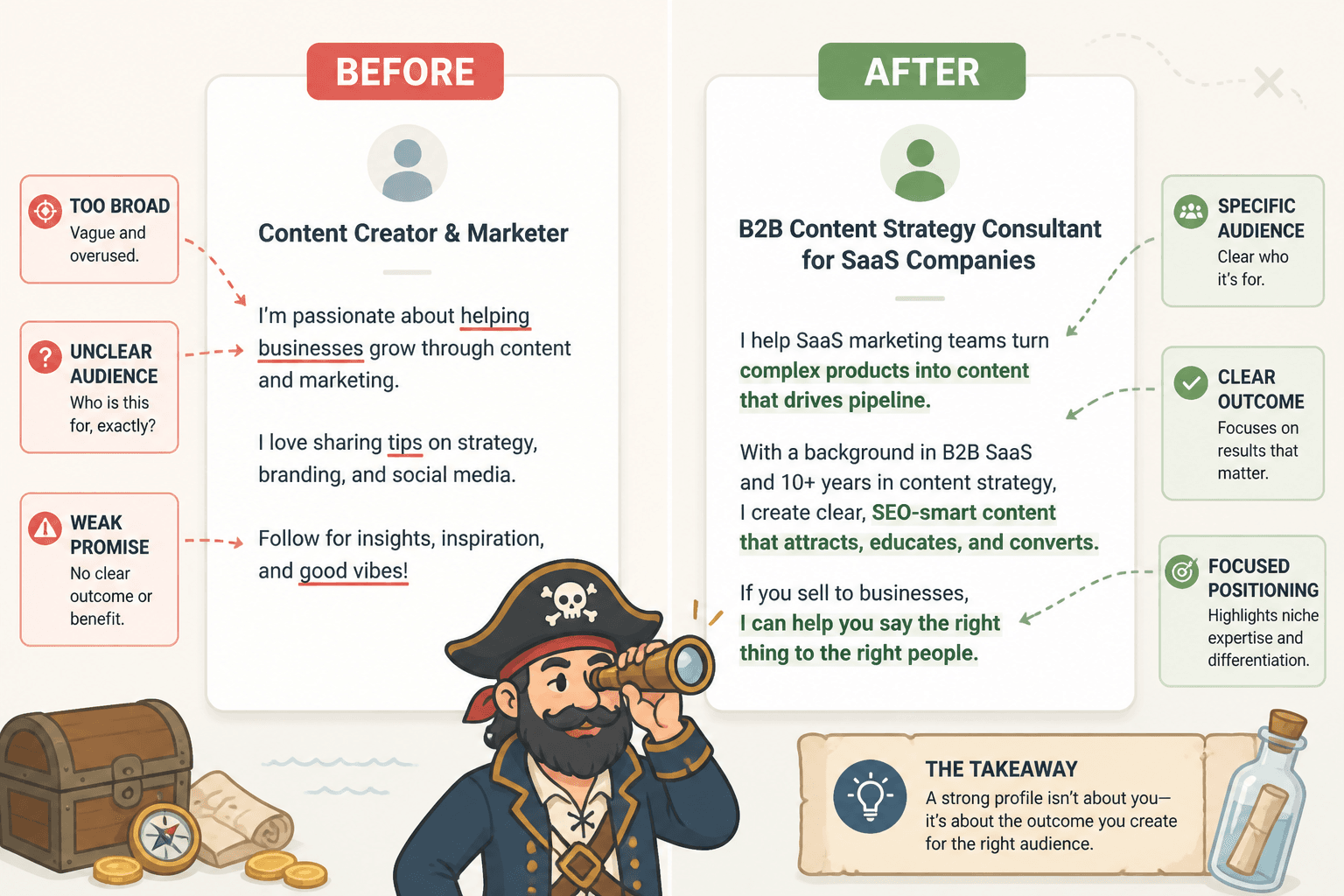
Here is where a lot of people get stuck. They know their current bio is weak, but they cannot see exactly why. Usually the issue is one of four things: it is vague, bloated, trying to sound important, or missing a clear audience.
Rewrite 1: vague and polished into clear and useful
Before:
Helping purpose-driven entrepreneurs amplify their voice and build authentic brands online.
After:
I help coaches and solo founders turn messy ideas into clear content and stronger personal brands.
What changed: specific audience, actual result, less fluffy language, no “amplify their voice” fog.
Rewrite 2: impressive-sounding into believable
Before:
Visionary strategist empowering leaders to unlock growth through magnetic messaging.
After:
Messaging strategist for consultants who need clearer offers, stronger positioning, and less forgettable websites.
What changed: the second one sounds like a person who does real work, not a scented candle with a Canva account.
Rewrite 3: too broad into niche-specific
Before:
I help businesses grow with content, marketing, branding, systems, and strategy.
After:
I help B2B consultants turn expertise into content that builds trust and brings in better-fit leads.
What changed: fewer services, tighter audience, stronger promise. Narrower usually reads stronger, even if you can technically do more.
Fast-fill bio templates you can customize in minutes
If you want quick starting points, use these. Fill the blanks, then tighten the wording until it sounds like you and not a template wearing your name badge.
Template for coaches
I help [type of client] get [result] without [common obstacle].
[Proof, framework, or credibility].
[CTA].
Example:
I help career coaches get more inbound leads without posting generic advice every day.
Content systems, profile strategy, and messaging support.
Free bio examples below.
Template for consultants
I help [audience] solve [specific business problem].
[How you do it].
[CTA or proof].
Example:
I help SaaS teams fix confusing messaging and weak conversion copy.
Positioning, website messaging, and launch copy.
Book a consult or browse the examples.
Template for writers and creators
I share [type of ideas/content] for [audience] who want [result].
[Optional personality or proof line].
Example:
I share sharp writing and content strategy for experts who want more trust and less generic posting.
Useful, direct, lightly allergic to fluff.
Template for personal brands with offers
[What you do] for [who].
[Proof].
[Offer or next step].
Example:
Profile and content strategy for coaches, consultants, and service brands.
Trusted by founders building authority-led businesses.
See templates, examples, and done-with-you support.
If you want more stripped-down versions, this collection of simple one-line bio templates for busy creators will help.
What to cut from your bio immediately
- Empty identity labels: visionary, thought leader, changemaker, catalyst
- Overwide audiences: founders, entrepreneurs, creatives, businesses, humans
- Foggy promises: unlock potential, elevate brands, transform lives, create impact
- Too many roles: writer | strategist | coach | speaker | podcaster | mentor | community builder | coffee enthusiast
- No outcome: saying what you are without saying what you help people do
- No CTA: making readers guess what to click, read, or do next
The bigger point is simple: clearer structure and clearer writing make the piece more useful. That is usually what makes the ending land better too.