
Most product and service descriptions do not fail because they are too short. They fail because they sound like they were written by someone trying very hard to sound professional while saying almost nothing a buyer can act on.
You see this constantly with personal brands. Coaches, consultants, creators, and solo service providers describe what they sell with vague polish: transformational support, customized solutions, high-touch experiences, premium offers. It sounds expensive. It also sounds slippery.
Better buyer-intent phrasing for product and service descriptions fixes that. It helps people quickly understand what the thing is, who it is for, what problem it solves, and why they should care now instead of later or never.
If your current description gets polite nods but weak clicks, this is usually the issue. The copy is describing your offer from your point of view, not from the buyer’s decision-making brain. Different problem. Different wording.
Here’s how to write descriptions that sound clear, credible, and useful without turning into hard-sell nonsense.
Want the broader roadmap? Start with the parent guide.
What buyer-intent phrasing actually means
Buyer-intent phrasing is language that matches the way people think when they are actively considering a purchase.
Not admiring. Not browsing. Not “just seeing what’s out there.” Considering.
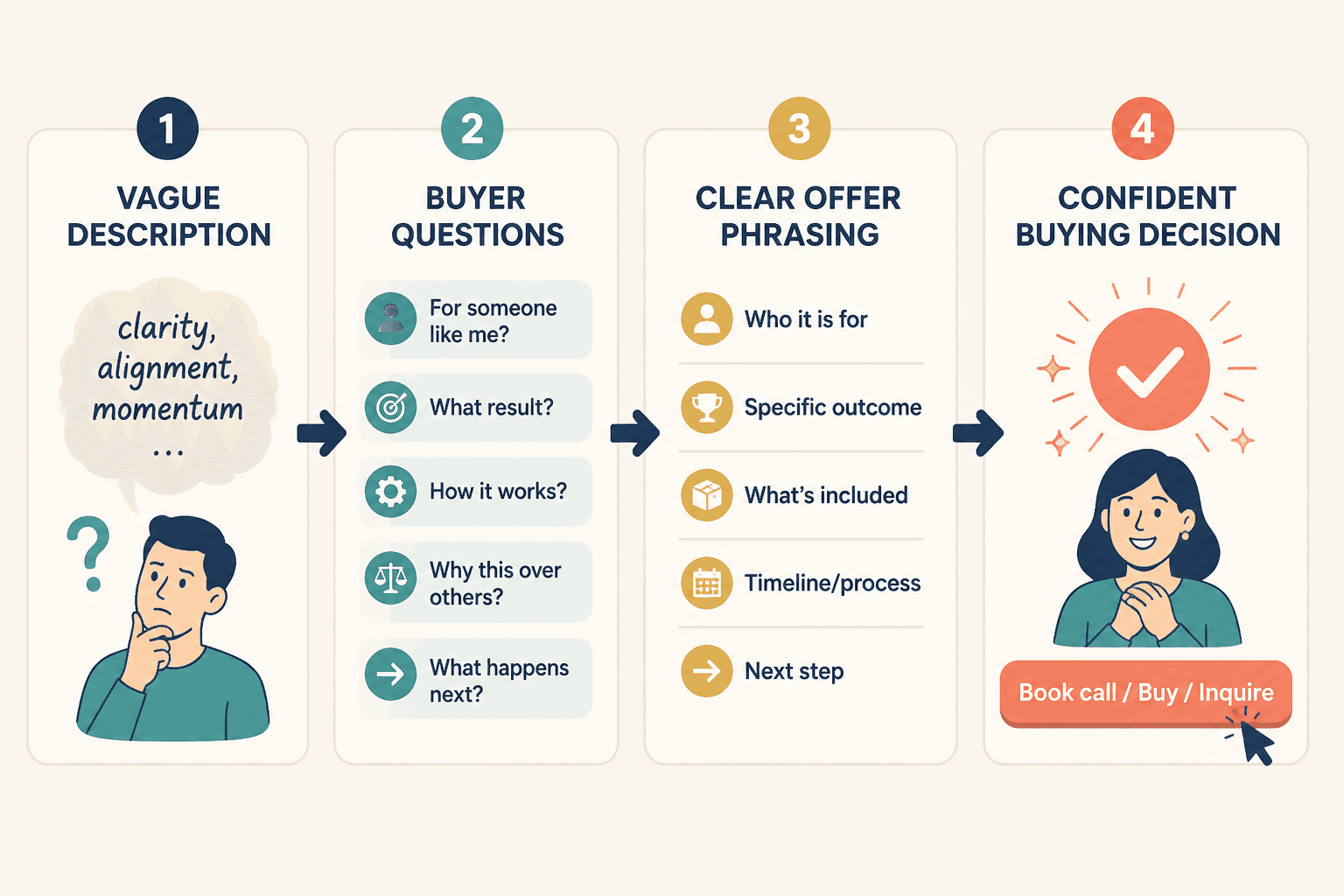
That means your phrasing should help answer questions like:
- What is this exactly?
- Is this for someone like me?
- What result does it help me get?
- How does it work?
- How is it different from the other six things I’ve looked at today?
- What happens next if I click?
Good buyer-intent copy reduces uncertainty. It does not perform intelligence. It does not posture. It does not hide behind brand fluff and hope the vibe closes the deal.
That is especially important for personal brands, where the offer is often tied to expertise, trust, and specificity. If you sell strategy, coaching, consulting, writing, design, implementation, or advisory work, buyers are not just evaluating the service. They are evaluating how clearly you think.
And yes, your description is part of that test.
Why most personal brand descriptions sound nice but sell badly
A lot of descriptions are written like mini mission statements. That is the problem.
Mission language can be fine on an about page. It is much less useful when someone is trying to decide whether your service or product is worth their time, money, or inbox space.
Here’s what usually goes wrong:
- Too much abstraction: “clarity,” “alignment,” “elevation,” “momentum,” “expansion”
- Too much self-focus: “I combine my passion, experience, and unique methodology…”
- No buying cues: no mention of deliverables, use case, fit, timeline, or expected outcome
- No contrast: the description could belong to 500 other people in the same market
- No friction reduction: buyers still have to guess what happens next
This is why a description can sound polished and still underperform. It is not helping a real person move from interest to decision.
If you want stronger examples of what good offer pages look like in practice, it helps to pair this with product and service descriptions examples for coaches, consultants, and personal brands and the broader product and service descriptions guide for creators who want better results.
Better Buyer-Intent Phrasing for Product and Service Descriptions starts with one shift
Stop describing your offer like a category.
Start describing it like a buying decision.
That means replacing broad identity language with decision-helping language. Buyers do not just want to know that you offer executive coaching, content strategy, or brand messaging. They want to know what kind, for whom, to solve what, in what format, and why this version is worth considering.
Compare these:
| Weak phrasing | Better buyer-intent phrasing |
|---|---|
| Custom content strategy support | Content strategy consulting for founders who need a clearer plan, better positioning, and a simpler publishing system |
| High-touch brand messaging experience | Brand messaging package for experts who need sharper website copy, clearer offers, and a stronger reason to hire them |
| Transformational coaching container | 1:1 coaching for consultants who want to tighten their niche, simplify their offer, and sell with less awkwardness |
| Done-for-you copy solutions | Website and sales page copywriting for personal brands launching or cleaning up a service-based offer |
Notice what changed. The better versions do not just sound nicer. They create a clearer mental picture. That lowers resistance.
The 5 parts of buyer-intent phrasing that actually help people convert
1. Name the offer plainly
People should not need three scrolls and a brand séance to figure out what you sell.
Use words buyers already understand. If it is a strategy session, say strategy session. If it is website copy, say website copy. If it is a messaging package, audit, workshop, consulting retainer, or done-for-you service, say that.
Clear beats clever here almost every time.
2. Show who it is for
Buyer-intent phrasing gets stronger when the right person can spot themselves fast.
This does not mean inventing a painfully specific identity label just for the sake of niche theater. It means giving enough context that the right buyer can say, “Yes, this sounds like my situation.”
Examples:
- for coaches with a booked-out but messy offer suite
- for consultants selling high-trust services online
- for founders who need clearer messaging before relaunching their site
- for creators turning expertise into a paid service
3. Tie it to a real outcome
Not a dreamy aspiration. A usable outcome.
People buy because they want a problem solved, a result improved, or a next step made easier. Your phrasing should reflect that.
Better outcome language tends to include things like:
- clearer positioning
- better conversion
- faster sales conversations
- less confusion on the page
- stronger lead quality
- more qualified inquiries
- easier decision-making for prospects
That is much more useful than “step into your next level.” Which, to be fair, could mean anything from a rebrand to buying a nicer notebook.
4. Add decision-shaping specifics
Specifics make your description feel buyable.
You do not need to dump every detail into one sentence, but you do want signals that help someone judge fit:
- format
- scope
- timeline
- deliverables
- use case
- buyer stage
For example:
- 90-minute strategy session with follow-up action plan
- done-for-you homepage and services page copy
- messaging audit for underperforming offers
- 2-week sprint to clarify positioning before launch
5. Reduce next-step friction
Your description should not end with a puff of mist.
Tell the reader what happens next. Book a call. Apply. Download the guide. View samples. See package details. Ask for availability. Start with the audit.
A clear next step makes buyer intent easier to act on. This sounds obvious, and yet many pages still end like they got distracted halfway through making a point.
Phrases that weaken buyer intent
Some phrases are not technically wrong. They are just too vague to help someone buy.
Here are common offenders and stronger replacements.
| Weak phrase | Why it underperforms | Stronger direction |
|---|---|---|
| tailored solutions | Says nothing concrete | custom messaging strategy for X situation |
| high-touch support | Sounds premium but vague | direct feedback, async support, or weekly calls |
| transformational experience | Feels inflated | helps you fix X so you can do Y |
| results-driven approach | Empty claim everybody uses | focused on lead quality, conversion, retention, or clarity |
| bespoke offer | Fancy word, weak meaning | custom package built around launch, audit, or rewrite needs |
| holistic support | Too soft and broad | strategy, copy, and implementation in one engagement |
If a phrase sounds expensive but not helpful, it probably needs work.
Before-and-after rewrites for personal brand offers
This is where the difference becomes painfully obvious in a useful way.
Example 1: Coach
Before: I help ambitious entrepreneurs unlock clarity, confidence, and aligned growth through personalized coaching containers.
After: 1:1 business coaching for solo founders who need a clearer offer, simpler marketing plan, and better weekly decision-making without adding more noise.
The second version is clearer, less floaty, and much easier to evaluate.
Example 2: Copywriter
Before: Strategic copy solutions designed to elevate your brand presence and drive meaningful engagement.
After: Website copy for consultants and experts who need sharper service pages, clearer positioning, and stronger inquiry conversion.
Less fluff. More buying cues.
Example 3: Consultant
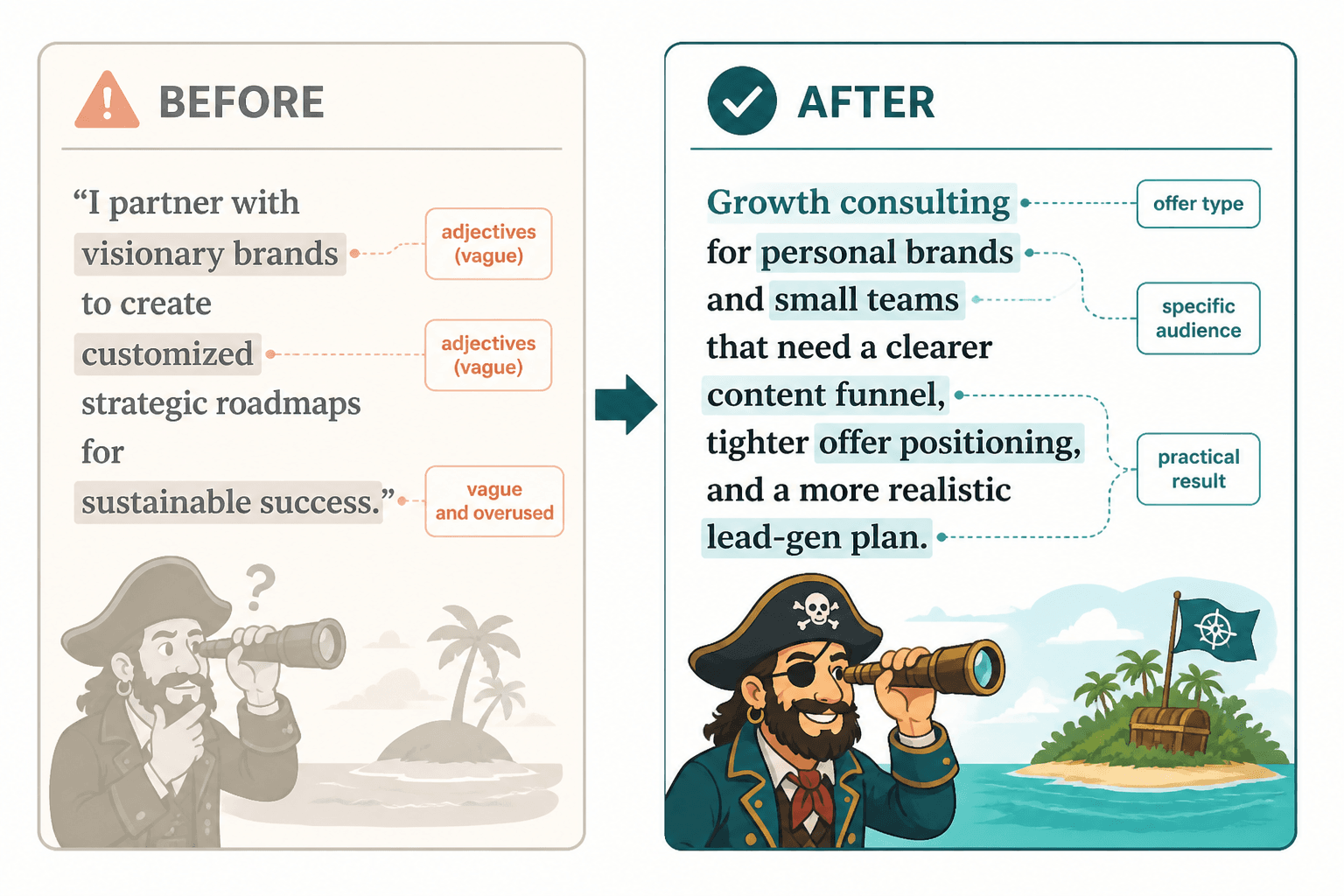
Before: I partner with visionary brands to create customized strategic roadmaps for sustainable success.
After: Growth consulting for personal brands and small teams that need a clearer content funnel, tighter offer positioning, and a more realistic lead-gen plan.
The revised version gives the buyer something to hold onto. The original mostly hands them adjectives.
If your first line is especially weak, fixing the opening often changes the whole page. That is worth pairing with how to start product and service descriptions without a weak opening.
A simple formula for stronger product and service description phrasing
If you want a repeatable structure, use this:
[Offer type] for [specific audience] who need [practical result] without [common frustration or unwanted approach].
Examples:
- Messaging strategy for consultants who need a clearer niche and stronger website copy without rewriting their whole brand from scratch.
- LinkedIn ghostwriting for founders who want consistent authority-building content without sounding like a recycled hustle-post machine.
- Offer audits for coaches whose services are getting attention but not enough qualified inquiries.
It is not magic. It is just a structure that forces clarity.
You can also use this variation when the buyer already knows the category and mostly needs differentiation:
Built for [buyer/context], this [offer] helps you [result] through [method or scope].
Example:
Built for personal brands with messy service pages, this homepage and offer copy package helps you explain what you do faster, earn more trust, and convert more of the right visitors into inquiries.
How to match phrasing to buyer stage
Not every visitor is equally ready. That does not mean you should write mushy copy for everyone. It means you should understand what kind of phrasing helps at different levels of intent.
Low intent: problem-aware but not shopping seriously yet
Use language that clarifies the problem and consequences.
- Why your service page attracts interest but weak leads
- What unclear offer copy is costing you
- Fix the messaging gap between traffic and inquiries
Mid intent: comparing options
Use language that shows fit, scope, and differentiation.
- Brand messaging support for experts selling high-trust services
- Done-for-you rewrite for service pages that confuse buyers
- Audit and rewrite package for underperforming website copy
High intent: ready to act if the offer looks right
Use language that reduces risk and makes the next step obvious.
- Book a 90-minute offer clarity session
- See what is included in the messaging package
- Request availability for a full service page rewrite
Strong descriptions often blend all three. They acknowledge the problem, clarify the offer, and make action easy.
What buyer-intent phrasing should sound like for personal brands
Personal brands have a weird habit of swinging between two bad extremes.
- Too corporate: stiff, abstract, overpolished, weirdly cold
- Too personality-heavy: charming but unclear, voice-first and buyer-second
The sweet spot is credible, human, and specific. You still sound like a person. You just sound like a person who understands what the buyer needs to know before making a decision.
A good test: if someone skimmed your description in ten seconds, would they know what you do, whether it is for them, and what they should do next?
If not, it probably needs fewer vibes and more signal.
A quick editing checklist for stronger descriptions
- Can a stranger identify the offer in one line?
- Does the description mention a clear audience or use case?
- Is the result practical rather than dreamy?
- Are there concrete signals like format, deliverables, or scope?
- Did you remove filler phrases that sound premium but mean little?
- Is the next step clear?
- Would this still make sense if you removed your brand adjectives?
The bigger point is simple: clearer structure and clearer writing make the piece more useful. That is usually what makes the ending land better too.