
A sales page on its own is not much of a funnel. It is a page with a job.
That job might be to sell a course, book a call, get an application, or move someone toward a paid offer. But if you slap up a sales page and expect cold traffic, mildly interested followers, and half-curious lurkers to convert at the same rate, you are asking one page to do far too much heavy lifting.
The best funnel ideas to pair with sales pages are the ones that match buyer temperature, offer complexity, and trust level. Not the ones that sound impressive in a marketing diagram with seventeen arrows and a “nurture ecosystem.”
Here’s what actually helps: pairing your sales page with the right path before it, after it, or around it so people get enough context, proof, and momentum to take action without feeling shoved into a checkout line by a stranger.
If your sales page is getting traffic but not converting well, the problem may not be the page. It may be the funnel attached to it. Or the lack of one.
To see how this fits into the wider strategy, open the parent guide.
What makes a funnel a good match for a sales page
A good funnel does one of four things:
- Warms people up before they hit the sales page
- Qualifies the right people so the page has an easier job
- Follows up with people who were interested but not ready
- Removes friction between curiosity and action
That means your funnel should depend on the offer, not your affection for automation.
A low-ticket template pack does not need the same funnel as a high-ticket consulting offer. A warm audience does not need the same path as paid traffic. And if your sales page is aimed at creators with small audiences, the funnel should probably lean more on trust and conversation than on volume. That’s where pieces like sales pages for creators with small audiences become useful context.
The simplest rule: match the funnel to the buying decision
People love asking for the best funnel. Singular. As if there is one sacred machine for every offer.
There isn’t. There is only a better match.
| Offer type | Better funnel style | Why it works |
|---|---|---|
| Low-ticket digital product | Content → sales page → follow-up emails | Fast path, low friction, enough reminder without overbuilding |
| Workshop or webinar | Registration page → event → sales page | Lets people experience your thinking before buying |
| High-ticket service | Content or lead magnet → nurture → application/sales page | Builds trust before asking for a bigger commitment |
| Consulting or coaching | Case study or authority article → sales page → call booking | Proof reduces skepticism |
| Membership or recurring offer | Email list → sales page → onboarding emails | Recurring offers need expectation setting and retention support |
If you want a stronger foundation first, it helps to read through sales pages guide for creators who want better results and the broader sales pages hub. A better funnel does not rescue a confusing page. It just gives that page a fairer shot.
Best funnel ideas to pair with sales pages
Here are the funnel setups that tend to work well for creators, coaches, consultants, solo founders, and service businesses without requiring a small operations team and a spreadsheet addiction.
1. Content to sales page to email follow-up
This is one of the cleanest options, and for many offers, it is enough.
You publish content that attracts the right problem-aware reader. That content points to the sales page. If they click but do not buy, you follow up through email if they joined your list elsewhere in the journey or via retargeting if you are running ads.
Best for:
- Low- to mid-ticket offers
- Products with obvious value
- Audiences already somewhat familiar with you
- Evergreen offers that solve a specific problem
Why it works:
- Keeps the path short
- Lets your content pre-sell the click
- Uses follow-up to catch people who were interested but distracted
Good content for this funnel includes:
- Problem-led posts
- Contrarian or myth-busting articles
- Case study content
- Before-and-after examples
- “Here’s what people keep doing wrong” posts
What people mess up: they send broad, fluffy content into a sales page for a specific offer, then act shocked when the conversion rate naps quietly in the corner.
2. Lead magnet to nurture emails to sales page
This one is classic because it still works when the offer needs more trust than a casual post can build.
The lead magnet should be tightly related to the offer. Not random “free value.” If you sell messaging services, the freebie should not be a generic productivity checklist because you had one lying around from 2021.
Better sequence:
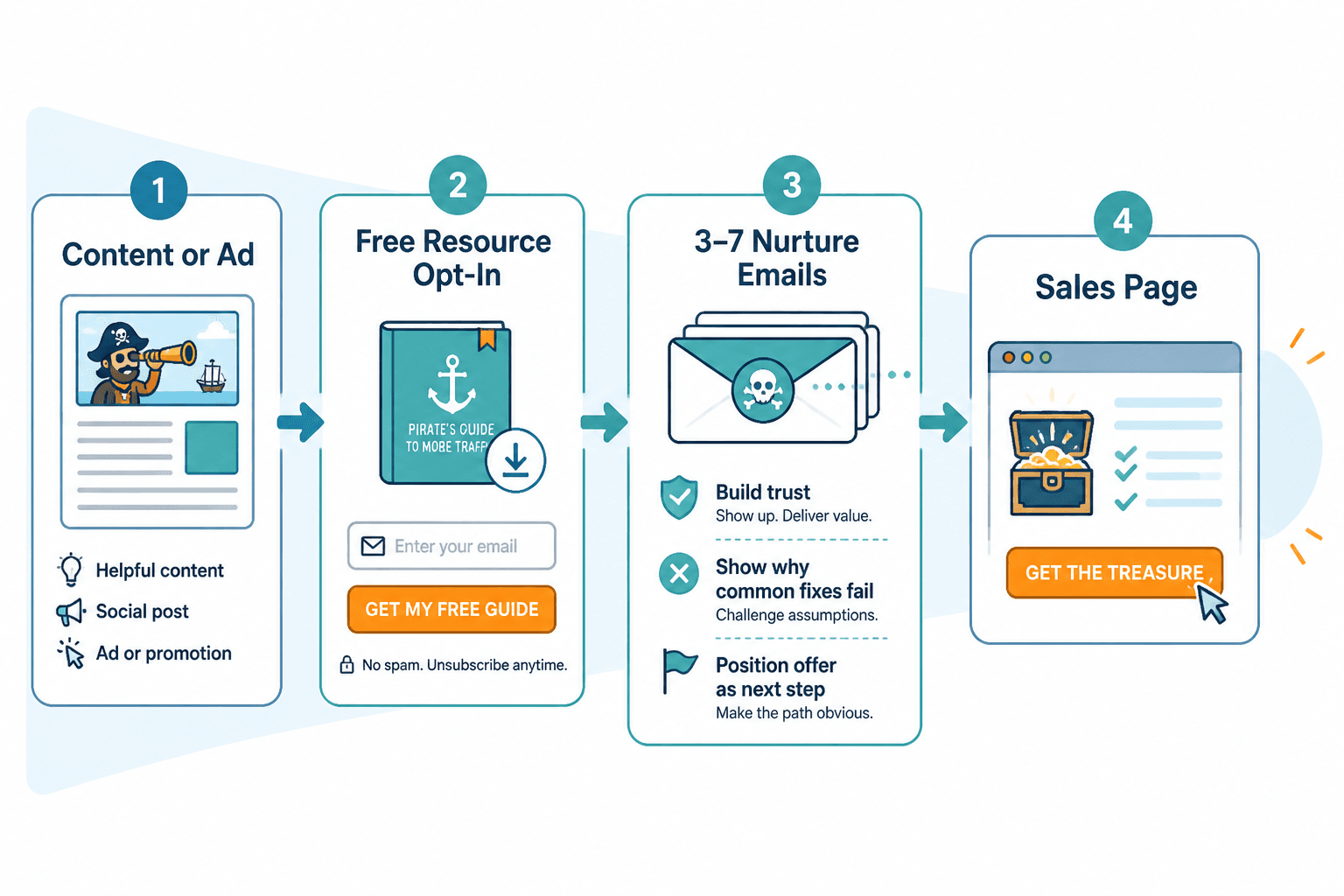
- Audience sees content or ad
- They opt in for a relevant free resource
- They get 3 to 7 nurture emails
- Those emails build trust, teach, and frame the problem clearly
- You send them to the sales page
Best for:
- Mid-ticket products
- Courses
- Memberships
- Services that need buyer education
- Offers aimed at colder audiences
The key is that the emails should not read like stitched-together sales residue. They should do three things well: help the reader understand the problem, help them see why common fixes fall short, and show why your offer is the next logical step.
3. Authority article to sales page
If your offer benefits from depth, this is one of the smartest funnel ideas to pair with sales pages.
An authority article does more than attract search traffic. It pre-handles objections, shows your thinking, and creates a smoother bridge to the offer. This works especially well for consultants, strategists, coaches, service providers, and niche educators.
Example path:
- Reader finds an article answering a high-intent question
- The article includes examples, proof, and practical detail
- The CTA points to the sales page as the next step
Best for:
- SEO traffic
- Complex offers
- Expert-led brands
- Buyers who need evidence before action
This is where your article and sales page should feel like part of the same conversation. Same problem. Same stakes. Same point of view.
If you need examples of how the page itself can support that handoff, best sales pages ideas and examples for creators is worth a look.
4. Webinar or workshop to sales page
For higher-friction offers, live or recorded teaching can do a lot of trust-building quickly.
A good workshop gives people a real shift in understanding. It does not spend 43 minutes warming up the room with vague “mindset” filler before flashing the pitch slide like a jump scare.
Simple flow:
- Traffic to registration page
- Attend live workshop or watch replay
- Strong CTA to sales page
- Short follow-up sequence after the event
Best for:
- Courses and cohorts
- Group programs
- Consulting offers
- Higher-ticket coaching
Why it works: teaching creates belief. And belief is usually the missing ingredient when someone visits a sales page, nods politely, and leaves to “think about it” until the sun burns out.
5. Case study to sales page to call booking
This is a strong option when you sell done-for-you services or custom consulting.
Instead of pushing cold prospects straight to “book a call,” lead with proof. A strong case study shows the problem, the work, the decision process, and the result. Then the sales page explains the service more clearly. Then the call booking becomes the natural next move.
Best for:
- Agencies
- Copywriters
- Strategists
- Consultants
- High-ticket services with variable scope
This structure is useful because it filters people before the call. The case study proves you can do the work. The sales page explains who it is for and how it works. By the time someone books, they are less confused and usually less annoying. Helpful for everyone.
6. Application page before the sales page
Not every offer should go straight to a checkout or booking page. If the offer is high-ticket, selective, or highly customized, an application step can improve conversion quality.
Two ways to use it:
- Application first, sales page second: useful when you want to qualify before giving full details
- Sales page first, application second: useful when the offer needs more context before someone is willing to apply
Best for:
- Coaching programs
- Advisory retainers
- Masterminds
- Selective service offers
Just be careful. Some people add applications because it feels fancy. But a pointless application for a modest offer is mostly an elegant way to lose buyers.
7. Sales page to low-friction tripwire to core offer
This can work when your main offer is too big a leap for cold visitors, but there is a smaller paid step that increases commitment.
Example:
- Visitor lands on sales page for a premium program
- They are not ready
- You offer a low-cost workshop, audit, starter product, or mini training
- That paid product leads into the core offer later
Best for:
- Higher-ticket offers
- New audiences
- Brands with a strong product ladder
This works best when the smaller offer actually helps. If it exists only as a funnel toll booth, people can feel that. And they do not love it.
8. Sales page to abandoned-interest follow-up sequence
Some people need a little more time, a little more proof, or a little more clarity. That does not mean they were never interested.
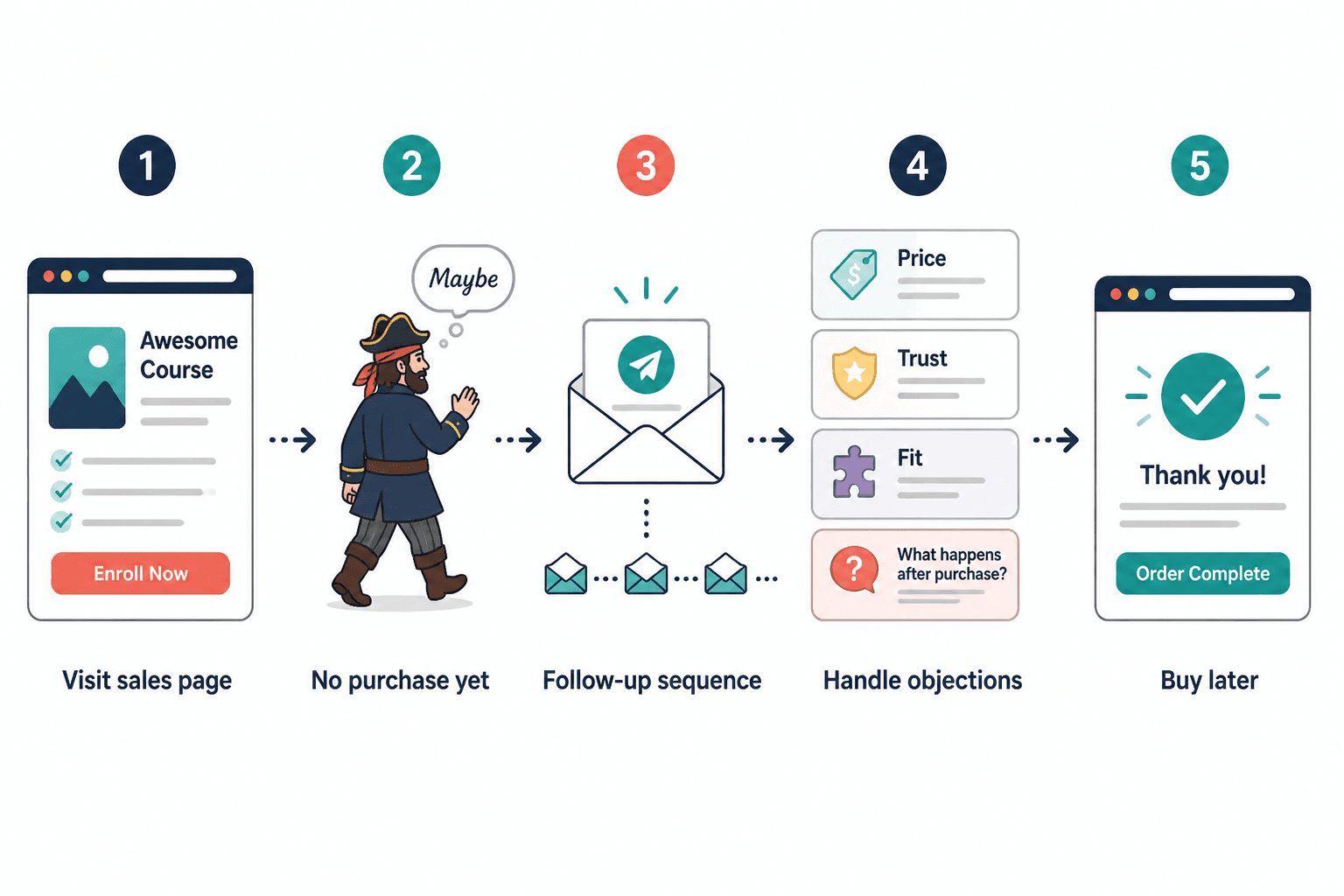
If someone hits the sales page and leaves, a follow-up sequence can recover a surprising amount of missed demand. This might happen through email, retargeting, or both.
Good follow-up angles:
- Answer common objections
- Share a specific case study
- Clarify who the offer is and is not for
- Explain what happens after purchase
- Show the cost of staying stuck
Best for:
- Offers with longer consideration windows
- Services
- Courses
- Anything above impulse-buy territory
This is one of the most overlooked pieces of funnel design. People obsess over getting traffic to the page and spend very little time on what happens after someone says “maybe.”
How to choose the right funnel for your sales page
If you are not sure which route makes sense, use these five filters.
1. How expensive is the offer?
As price goes up, trust needs to go up too. Usually that means more proof, more nurturing, or more buyer education before the sales page closes the deal.
2. How aware is the audience?
If people already understand the problem and want a solution, you can use a shorter path. If they still need convincing that the problem matters, the funnel has to educate before it sells.
3. How specific is the offer?
Specific offers usually need simpler funnels. Broad offers often need more framing because buyers are not sure what they are actually getting or why it matters to them.
4. Is the traffic warm or cold?
Warm audiences can often go content to sales page just fine. Cold audiences usually need an intermediate step like a lead magnet, article, workshop, or proof-heavy nurture.
5. What is the biggest point of friction?
If your buyers hesitate because they do not trust you, add proof. If they hesitate because they do not understand the offer, add clarity. If they hesitate because the commitment feels too big, add a smaller step or stronger expectation setting.
Common funnel mistakes that make sales pages work worse
- Sending mismatched traffic. Cute top-of-funnel content does not naturally convert into a serious service offer.
- Using a lead magnet unrelated to the paid offer. You collected an email. Great. From the wrong person, possibly.
- Asking for too much too soon. Cold prospect to expensive offer with no trust bridge is not bold. It is lazy.
- Adding too many steps. More funnel does not always mean more conversion. Sometimes it just means more ways to leak attention.
- No follow-up. A lot of people need a second or third touch. Silence is not a strategy.
- Treating the sales page like the whole funnel. It is a core asset, not a complete system.
If your page itself needs work, how to turn sales pages into more leads or sales can help diagnose the conversion side, not just the funnel side.
A practical way to build this without overcomplicating it
You do not need twelve automations and a mood board for your customer journey.
Start with one sales page and build the simplest supporting funnel that solves the biggest trust or friction problem around it. That might be one article. One lead magnet. One email sequence. One case study. One workshop. Not an entire digital labyrinth.
A surprisingly solid setup for many creators and service businesses looks like this:
- 2 to 4 strong content pieces around the problem
- 1 sales page with clear positioning and proof
- 1 email sequence for interested non-buyers
- 1 optional lead magnet or case study if more trust is needed
That is enough to learn from. Enough to improve. Enough to start seeing where people get stuck instead of guessing in the dark and calling it funnel strategy.
Where internal content can support the funnel
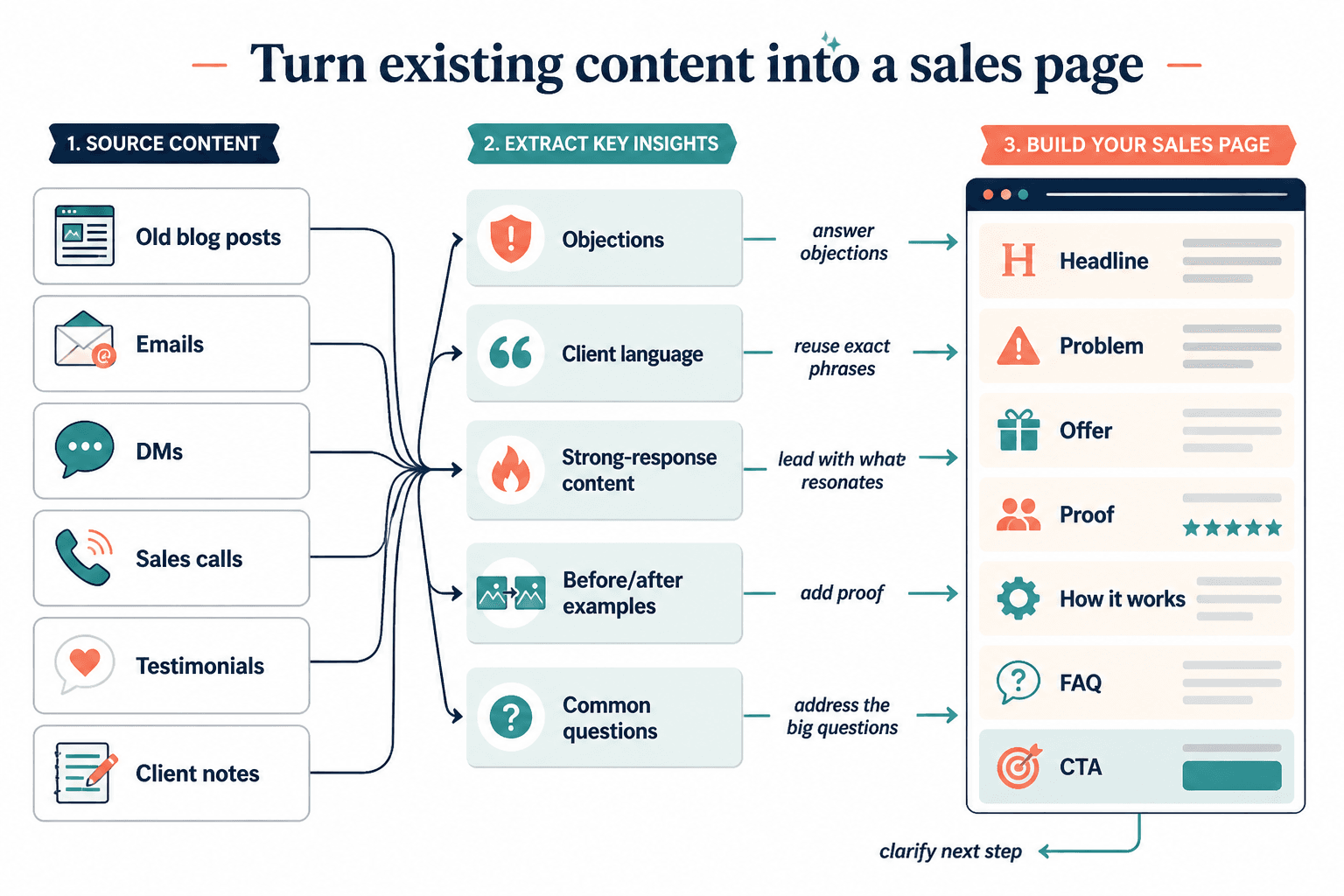
If you are building a stronger conversion system around your sales pages, internal content should do real work, not just exist as polite blog clutter.
- Link broad conversion content to your conversion copy and sales pages resources when readers need the bigger picture.
- Use the sales pages section to support buyers who need more examples, structure, or optimization help.
- Send people from educational content into focused articles like best sales pages ideas and examples for creators when they need stronger page direction.
That kind of internal linking helps readers move from vague interest to informed action. Which, conveniently, is also what a good funnel is supposed to do.
Quick FAQ
Do I need a lead magnet for every sales page?
No. If the offer is clear, low-friction, and aimed at a warm audience, content straight to sales page can work well.
What is the best funnel for high-ticket offers?
Usually one that builds trust first: case studies, authority content, workshops, nurture emails, or an application path.