
Most people treat blog titles and headlines like a traffic problem.
Get more clicks. Get more readers. Get more eyeballs. Great. And then what?
That is where a lot of otherwise smart content falls apart. The title does its job, the article gets opened, maybe even read, and then the funnel behind it is either missing, wildly mismatched, or painfully aggressive. So the content attracts attention but does not move people anywhere useful.
The best funnel ideas to pair with blog titles and headlines are not the fanciest ones. They are the ones that make sense for the promise of the headline, the intent of the reader, and the level of trust you have actually earned. Not the level of trust you wish you had because you wrote a confident subheading.
This is the real job: match the headline to a next step that feels natural. If someone clicks a tactical title, give them a tactical next step. If they clicked a strategic or pain-aware headline, move them into something that helps them think, evaluate, or buy with more confidence. The funnel should feel like a continuation of the article, not a trapdoor.
If you are already working on better blog titles and headlines, this is the part that turns good packaging into leads, conversations, and sales without making your content smell like a stale webinar funnel.
To see how this fits into the wider strategy, open the parent guide.
Why blog titles and funnel strategy need to be paired from the start
A headline creates an expectation. It tells the reader what kind of problem is being solved, how concrete the article will be, and what emotional state they are probably in when they click.
That means the title is not just a traffic device. It is a filtering device.
Someone clicking “10 homepage mistakes costing you conversions” is not in the same mode as someone clicking “Why your website feels polished but still does not sell.” One wants fixes. The other wants diagnosis. Different headline. Different reader mindset. Different funnel move.
When the funnel ignores that, things get clunky fast:
- A beginner article sends people straight to a high-ticket offer they are not ready for
- A high-intent article ends with “follow me for more tips” like that is somehow enough
- A practical post offers a vague newsletter instead of the exact checklist the reader obviously wants
- A problem-aware headline leads to a hard pitch before trust has been built
Good funnels do not interrupt the article. They complete it.
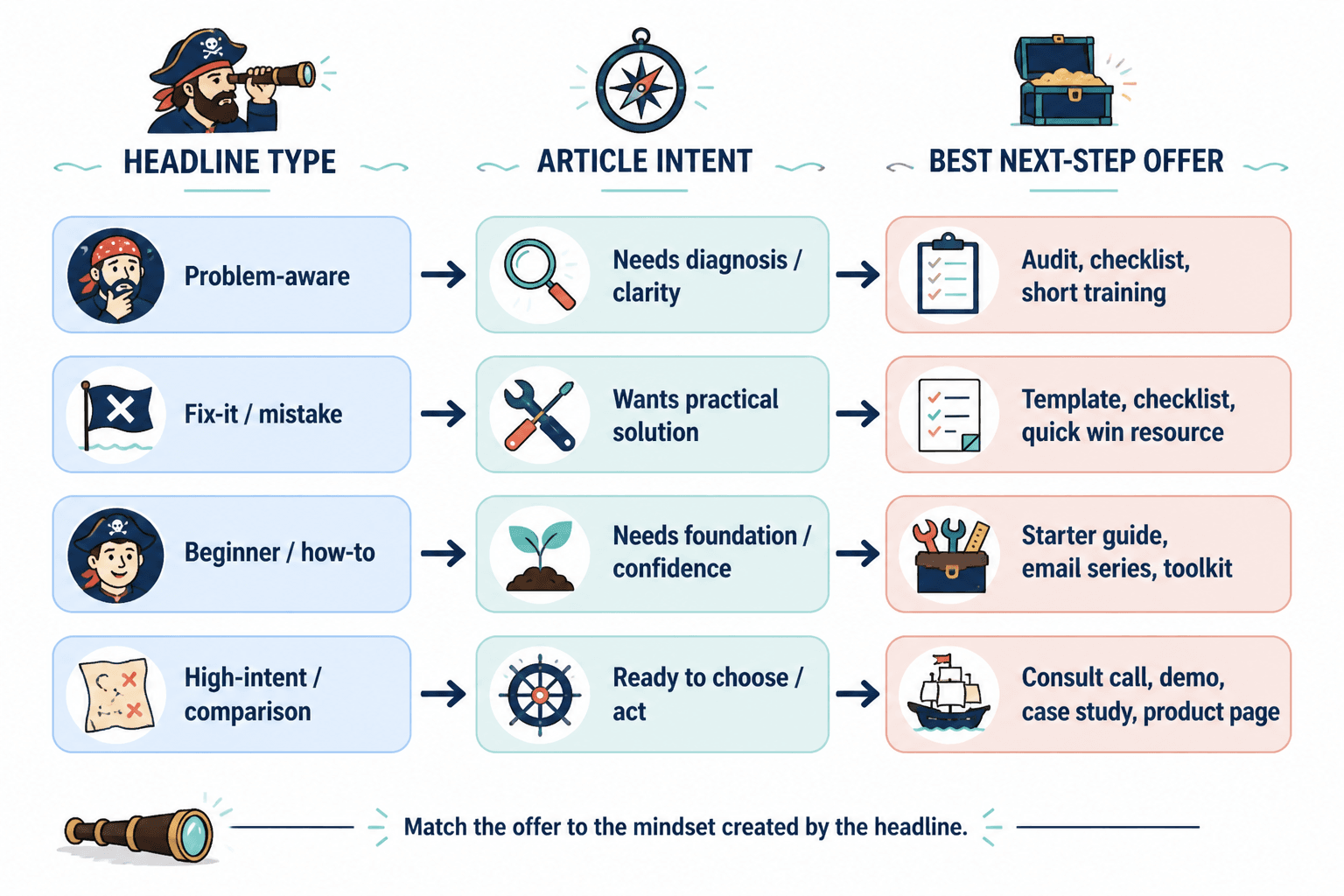
First, sort your blog titles by reader intent
Before you pick a funnel, sort the headline into the kind of intent it creates. This is the cleaner way to do it. Not perfect, but very usable.
1. Problem-aware headlines
These speak to frustration, confusion, missed results, hidden mistakes, or something not working.
Examples:
- Why your blog posts are getting traffic but no leads
- The real reason your headlines are not converting
- What most creators get wrong about content funnels
Best next steps: diagnosis, audit, checklist, short training, lead magnet, strategy call if the article earns it.
2. Solution-seeking headlines
These are practical. The reader wants a method, template, framework, or example.
Examples:
- Best Funnel Ideas to Pair With Blog Titles and Headlines
- How to write stronger article intros that keep people reading
- 7 CTA formulas for service-based blog posts
Best next steps: templates, swipe files, worksheets, toolkits, implementation guides, low-friction newsletter signup, relevant product or service.
3. Comparison or evaluation headlines
These readers are further along. They are comparing options, deciding between methods, or figuring out what is worth using.
Examples:
- Best AI tools for content repurposing
- Blog post versus landing page: which should sell your offer?
- What to use instead of generic lead magnets
Best next steps: buyer’s guide, case study, consultation, demo, offer page, curated shortlist.
4. Authority-building or opinion headlines
These are usually broader, more strategic, or more perspective-driven. They attract people evaluating your thinking, not just hunting a quick fix.
Examples:
- Why most content funnels feel pushy and underperform
- The problem with writing blog titles for clicks instead of trust
- What creators misunderstand about monetizing educational content
Best next steps: newsletter, related article series, case study, workshop, consultation inquiry, authority offer.
If you skip this step and just slap the same CTA on every article, the funnel gets lazy. And lazy funnels do not convert well, even when the writing is solid.
Best funnel ideas to pair with blog titles and headlines
Now for the useful part. Here are the funnel pairings that tend to work best, based on headline type and reader readiness.
1. Title → article → content upgrade
This is one of the cleanest options for practical, tactical headlines. The article teaches. The upgrade helps the reader apply it faster.
Good fit for titles like:
- How to write better blog headlines
- Best funnel ideas to pair with blog titles and headlines
- 10 ways to improve your CTA placement
Good upgrades include:
- Checklist
- Worksheet
- Template pack
- Headline swipe file
- CTA library
- Planning spreadsheet
Why it works: the offer is tightly aligned with the promise of the title. It does not ask for a giant leap. It says, “Want the working version of what you just learned?” That is a fair ask.
This is especially strong for creators, consultants, and service businesses because it builds your list without needing to force the sale too early.
2. Title → article → related newsletter signup
This works best when the headline is strategic, opinionated, or part of an ongoing topic cluster. The article gives one strong idea. The newsletter promises more thinking in the same category.
Good fit for titles like:
- Why most blog traffic advice is incomplete
- What creators get wrong about SEO content systems
- The problem with writing headlines only for clicks
The key is specificity. “Subscribe for updates” is weak. “Get weekly breakdowns on content strategy, funnels, and trust-first conversion” is better because it actually tells the reader what follows.
If the article is part of a broader content ecosystem, this is also a good place to point readers toward your category and system pages, like blog SEO writing or the broader blog article systems section, so they keep moving through related content instead of bouncing.
3. Title → article → diagnostic lead magnet
When the title points to something broken, unclear, or underperforming, a diagnostic funnel often works better than a generic freebie.
Good fit for titles like:
- Why your headlines are not converting
- Why your blog gets readers but not leads
- What is stopping your content from selling
Useful diagnostic offers:
- Self-audit worksheet
- Scorecard
- Content funnel teardown checklist
- Headline review rubric
- Mini email course on fixing the issue
This type of funnel works because the reader already feels friction. They want clarity. A diagnostic tool gives them a way to name the problem before you ask them to buy the cure.
4. Title → article → case study or proof asset
If the headline attracts readers who are skeptical, comparison-minded, or close to making a decision, give them proof instead of another pep talk.
Good fit for titles like:
- Do better headlines actually improve conversions?
- How article structure affects lead generation
- What happens when you align content with a funnel
Good next steps:
- Case study
- Before-and-after breakdown
- Short portfolio page
- Client result story
- Teardown of a working content funnel
This is a smart bridge into higher-trust offers because proof reduces the need for hard selling. It gives the reader something more useful than “book a call” after a single article. Which, to be honest, often feels a bit thirsty.
5. Title → article → low-ticket product
Some titles naturally attract readers who want a shortcut, system, or ready-made asset. Those are often good candidates for a low-ticket funnel.
Good fit for titles like:
- Best headline templates for consultants
- How to build a blog CTA system
- Best content planning frameworks for solo creators
Good low-ticket offers:
- Template bundle
- Mini course
- Notion system
- Prompt pack
- Content planner
- Audit toolkit
This works when the article already proves you understand the problem and the paid product clearly saves time. It does not work when the article is too thin and the product feels like the information you conveniently forgot to include.
6. Title → article → consultation or service page
This is the right move when the title pulls in high-intent readers with a real business problem, not casual browsers collecting ideas they will never implement.
Good fit for titles like:
- How to turn blog titles and headlines into more leads or sales
- How to build a blog funnel for a service business
- Why your content strategy is attracting the wrong readers
If the article is strong enough, a service CTA can be perfectly appropriate. But it should still be framed well:
- Who the offer is for
- What problem you help solve
- What happens next
- Why this is the right next step for this reader
A vague “work with me” is lazy. A clear next step like “Need help turning your article traffic into qualified leads? Here is how I help service brands build trust-first content funnels” is much better.
If this is your direction, it helps to support the article with related pieces like how to turn blog titles and headlines into more leads or sales and how to monetize blog titles and headlines without wrecking trust.
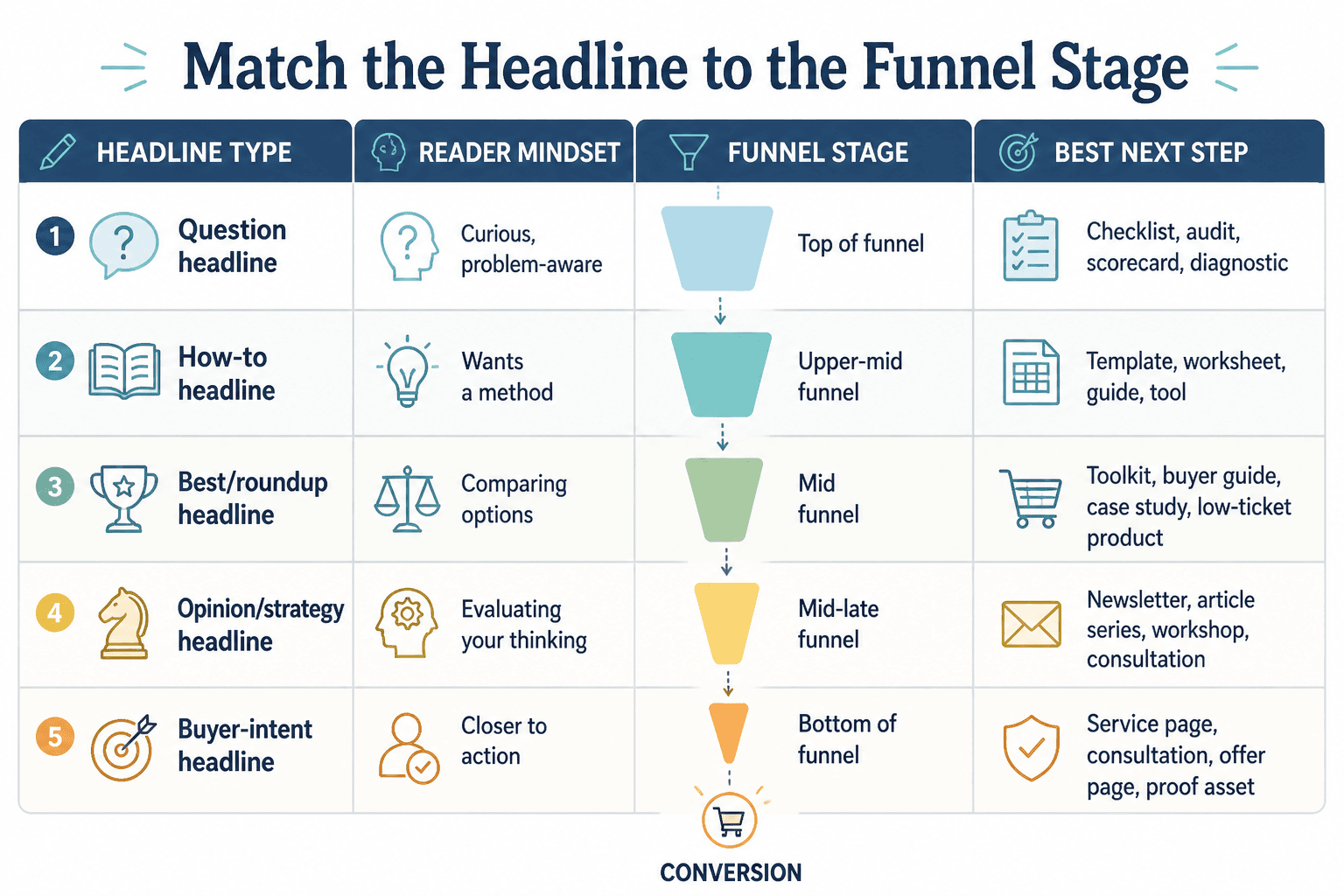
How to match headline types to the right funnel stage
If you want a simple framework, use this:
| Headline type | Reader state | Best funnel move |
|---|---|---|
| Pain/problem headline | Aware something is wrong | Audit, checklist, scorecard, diagnostic |
| How-to headline | Wants a method | Template, worksheet, guide, tool |
| Best/roundup headline | Comparing options | Toolkit, buyer guide, case study, low-ticket product |
| Opinion/strategy headline | Evaluating your thinking | Newsletter, article series, workshop, consultation |
| Buyer-intent headline | Closer to action | Service page, consultation, offer page, proof asset |
This is not a rigid law. It is a decent filter. It helps you avoid pairing a top-of-funnel article with a bottom-of-funnel ask, which is one of the most common ways people kill conversions while insisting the traffic is “low quality.” Sometimes the traffic is fine. The next step is the problem.
What people keep getting wrong
Using the same CTA on every article
This is easy to manage and bad for results. Different articles attract different levels of awareness and trust. Your CTA should reflect that.
Offering something broader than the headline promise
If the title is specific and the opt-in is generic, conversion usually drops. A reader who clicked for headline help does not necessarily want your catch-all “weekly creator newsletter.” They might. But they are much more likely to want the headline checklist you forgot to make.
Pitching too early
A lot of content tries to cash in before it has built enough trust. The result is that readers feel handled instead of helped. If the article is short, vague, or obvious, a high-commitment CTA will underperform because the article did not earn it.
No transition between article and offer
The CTA should not appear like it fell through the ceiling. Bridge it.
Bad:
Ready to scale your content marketing? Book a call today.
Better:
If your titles are doing their job but the traffic is not turning into leads, the missing piece is usually the next step. This is exactly what I help clients fix. Here is how that works.
Treating all readers like buyers
Some people want a resource. Some want proof. Some want help. Some just found you five minutes ago. Your funnel should respect that instead of trying to speed-run trust.
Practical funnel pairings by headline format
Here is a more concrete cheat sheet if you write a lot of blog content and want quick pairing ideas.
| If your headline says… | Pair it with… | Why it fits |
|---|---|---|
| How to… | Checklist, template, worksheet | The reader wants execution help |
| Why your… | Audit, scorecard, diagnostic | The reader wants clarity on a problem |
| Best… | Toolkit, shortlist, product, buyer guide | The reader is comparing options |
| Mistakes… | Fix-it guide, teardown, consultation | The reader wants correction and improvement |
| Examples of… | Swipe file, template pack, case study | The reader wants models to copy or adapt |
| What most people get wrong about… | Newsletter, workshop, strategy call | The reader is open to deeper thinking |
This is also where your internal linking can do some quiet heavy lifting. If a reader is not ready for an offer yet, send them to the next most relevant article instead of trying to force conversion. For example, an article like this can naturally point to best templates and tools for blog titles and headlines or blog titles and headlines for creators with small audiences depending on what they need next.
A simple way to build the funnel while you write the title
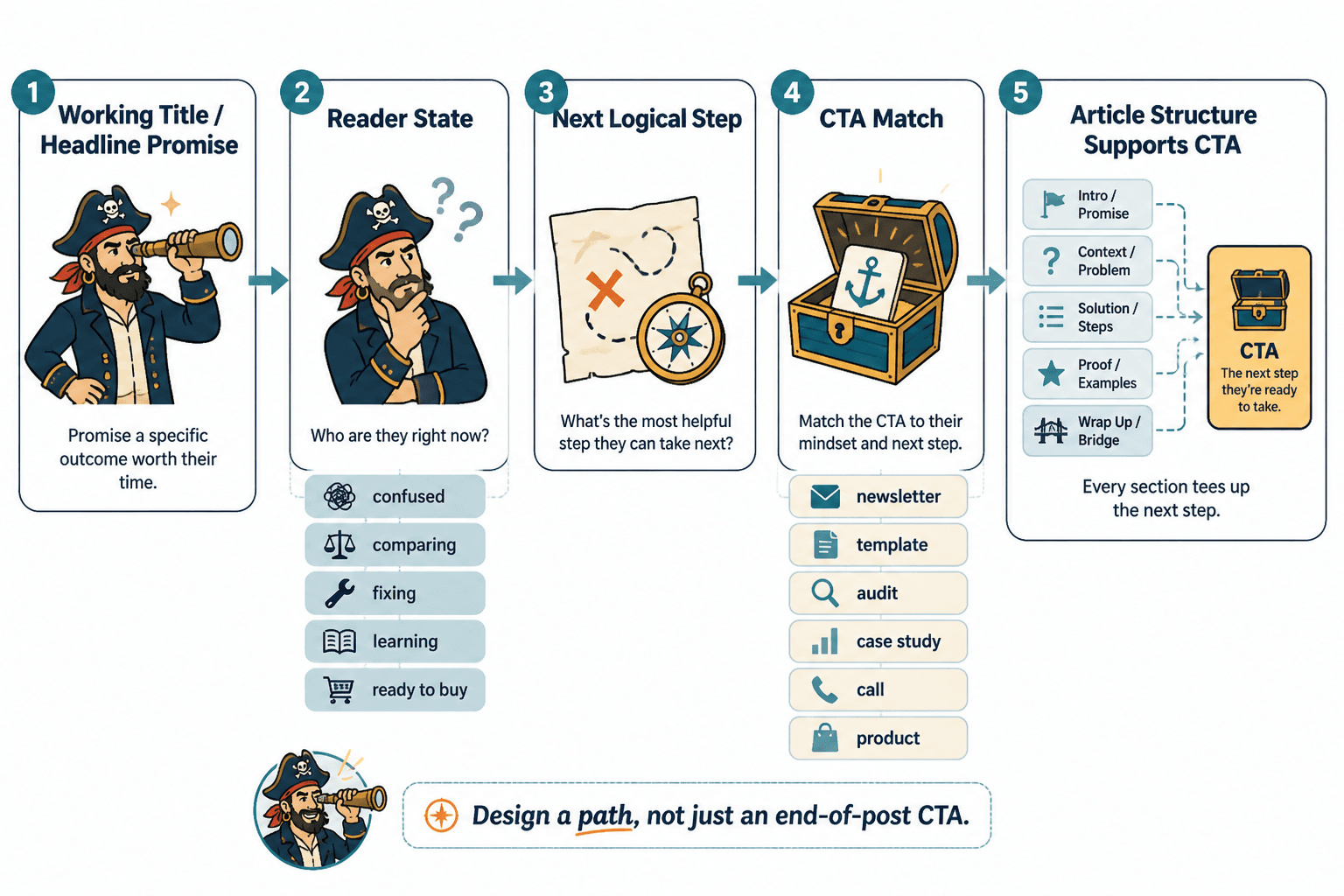
If you want your blog titles and headlines to actually support conversion, do not wait until publication day to think about the CTA. Use this quick planning sequence before you draft.
- Write the working title. What exact promise does it make?
- Name the reader state. Are they confused, comparing, fixing, learning, or ready to buy?
- Choose the next logical step. What would help them immediately after reading?
- Match the CTA to that next step. Newsletter, template, audit, case study, call, product.
- Build the article to support the CTA. If the CTA is a scorecard, the article should tee up why diagnosis matters. If the CTA is a service, the article needs enough proof and specificity to justify that ask.
That is the key part people miss. The article itself should prepare the reader for the funnel move. You are not just attaching a CTA at the end. You are designing a path.
Examples of better title-to-funnel matches
Example 1
Title: 12 Blog Headline Mistakes That Quietly Kill Conversions
Weak funnel: Book a discovery call
Better funnel: Download the headline review checklist
Why: the reader clicked for mistakes and fixes. A checklist helps them apply the article immediately. That is a much cleaner next step than asking for a discovery call before the reader has even diagnosed the problem.
The cleaner the match between title, article promise, and next step, the less the funnel feels forced. That is usually what separates a useful conversion path from a random CTA bolted onto the end of a decent article.