
Most creators do not have an audience problem. They have a journey problem.
People find the post, like the idea, maybe even follow you, and then… nothing. No next step. No path. No reason to move from “this person seems smart” to “I’d pay for help here.” That gap is where a lot of good content goes to die.
The best audience-to-offer journey ideas and examples are not complicated funnel contraptions with seventeen tags, a countdown timer, and a soul deficiency. They are simple, clear paths that move the right people from attention to trust to action.
This article will help you build that path without turning your content into a nonstop pitch parade. We’ll cover what makes an audience-to-offer journey work, the best journey types for creators, and concrete examples you can adapt if you sell coaching, consulting, services, products, memberships, or digital offers.
If you want the broader strategy first, start with the main guide on audience-to-offer journeys. If you want the practical version with less theory and more “what should I actually set up,” you are in the right place.
For the main guide behind this topic, visit the parent guide.
What an audience-to-offer journey actually is
An audience-to-offer journey is the path someone takes from discovering you to buying from you.
Not every person will move through it neatly. Real people wander. They lurk. They forget you exist for three weeks and then suddenly reply to an email like you were just speaking five minutes ago. That is normal.
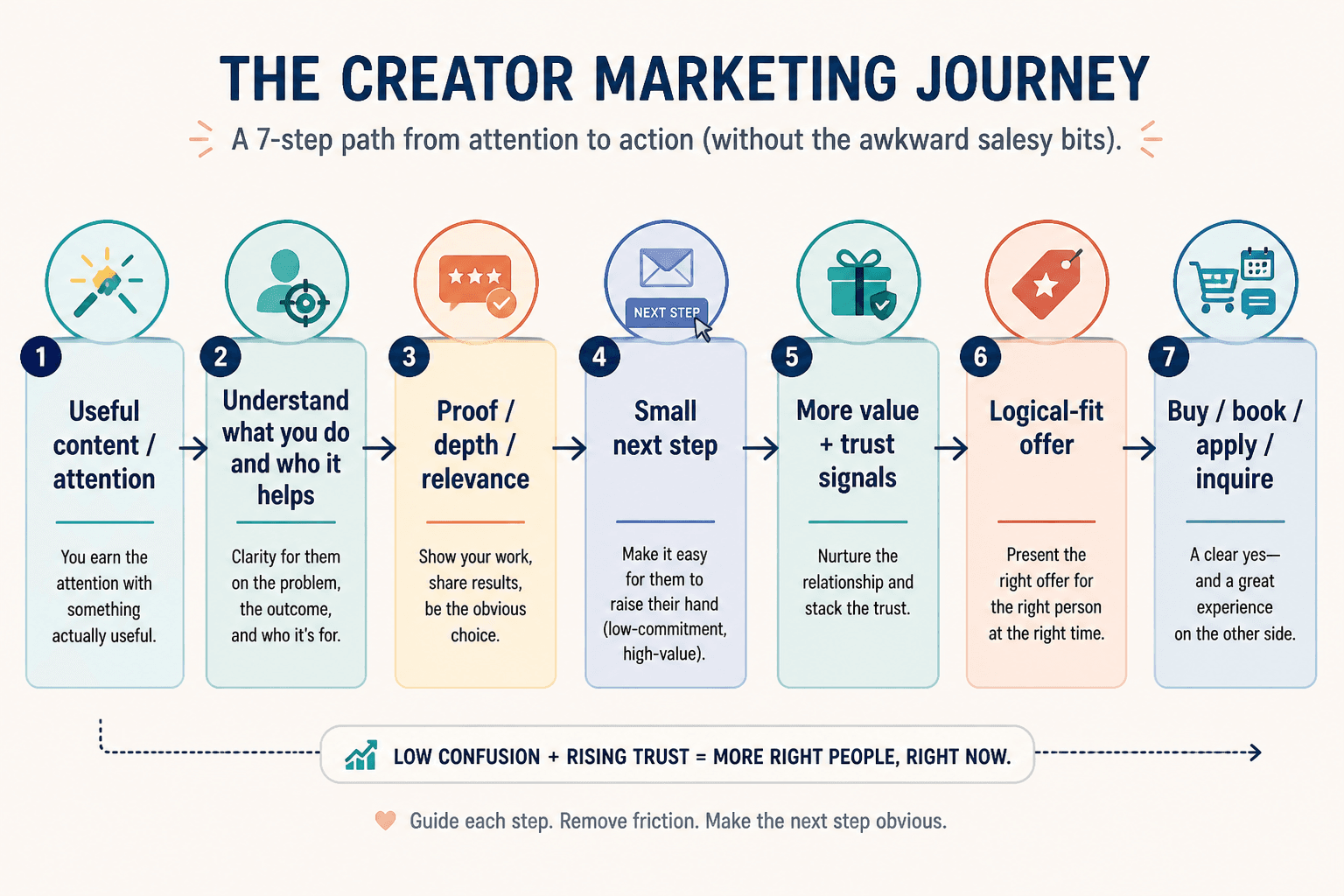
Still, the basic structure tends to look like this:
- They see something useful from you
- They get a clearer sense of what you do and who it is for
- They encounter proof, depth, or relevance
- They take a small next step
- They receive more value and trust signals
- They see an offer that feels like a logical fit
- They buy, book, apply, or inquire
That is it. No magic. No secret platform ritual. Just a well-built path with low confusion and enough trust.
Where creators get this wrong is usually one of two ways. They either pitch too early, before anyone has context, or they stay “helpful” forever and never give people a clean next step. Both kill conversions. One is needy. The other is timid. Neither pays especially well.
What makes the best audience-to-offer journey ideas work
Before getting into examples, it helps to know the traits that make these journeys convert without feeling gross.
1. The next step makes sense
If someone reads a post about fixing weak LinkedIn hooks, the next step should probably be a related guide, a template, a checklist, an audit, or a service tied to that problem.
Not a random webinar about mindset. Not a surprise offer for web design. Not “book a strategy call” before they even know what strategy you do. Relevance matters more than funnel cleverness.
2. The commitment level rises gradually
A good journey moves from low-friction actions to higher-friction ones.
- Read a post
- Click a profile
- Grab a free resource
- Read a welcome sequence
- Reply to an email
- Book a call
- Buy the offer
That sequence works because it respects the fact that trust is usually earned in layers. Asking a stranger to buy a premium service from one decent post is optimistic in the same way buying a treadmill because you stretched once is optimistic.
3. The journey matches the offer
A $29 template pack and a $5,000 consulting package should not have the same path.
Low-ticket offers can often convert from content straight to checkout. Higher-ticket offers usually need more depth, proof, objection handling, and direct conversation. If your journey ignores that, the problem is probably not your CTA. It is the architecture underneath it.
4. Trust is built on evidence, not performance
You do not need to sound more confident. You need to show people something believable.
- A sharp point of view
- A useful framework
- A specific example
- A case study
- A before-and-after
- A process breakdown
- A clear explanation of what happens next
Trust is not built by typing “I’m so passionate about helping purpose-driven leaders scale impact.” That sentence has never rescued a funnel.
The simplest audience-to-offer journey structure
If you want a baseline model, use this:
- Attention: post, thread, article, podcast clip, reel, email referral, comment visibility
- Interest: profile, pinned post, about page, lead magnet, article, case study
- Trust: nurture emails, more content, social proof, examples, FAQ, offer explanation
- Action: booking page, checkout page, application, DM prompt, reply prompt
You can keep it that simple and still do very well, especially if the audience is niche and the offer solves a clear problem.
For a deeper breakdown of systems around this, you can also browse the broader monetization funnels and funnel systems hub. Just ignore anyone trying to make this sound more mystical than it is.
Best audience-to-offer journey ideas and examples for creators
Here are practical journey models that work well for creators, consultants, coaches, experts, and service-based personal brands.
1. Post to profile to lead magnet to email sequence to offer
This is one of the cleanest and most reliable journeys because it does not ask for too much too soon.
Best for: consultants, coaches, educators, creators with service offers, newsletter-first brands
How it works:
- You publish a strong post on a narrow problem
- The post drives people to your profile
- Your profile offers a relevant free resource
- The resource leads into a short nurture sequence
- The sequence points to a paid service, product, or call
Example:
- LinkedIn post: “Why most consultants sound credible but not valuable”
- Profile CTA: “Get the consultant positioning checklist”
- Freebie: 2-page checklist for fixing a vague offer message
- Email sequence: 4 emails showing common mistakes, examples, and a mini case study
- Offer: paid positioning intensive
Why it works: the free step feels useful, not random. The emails deepen trust. The offer is the natural next move for readers who want help beyond the checklist.
2. Educational post to case study to consultation
This works especially well for higher-trust, higher-ticket services.
Best for: consultants, agency owners, ghostwriters, strategists, brand experts, conversion specialists
How it works:
- You publish content that identifies a painful problem
- You link or direct readers to a case study
- The case study shows your thinking, process, and results
- The CTA is a consult, audit, or inquiry
Example:
- X thread: “7 reasons your content gets attention but no leads”
- Case study: breakdown of how you rebuilt a creator’s content-to-consulting path
- CTA: “If you want help tightening your journey, apply for a strategy session”
Why it works: case studies bridge the trust gap. They turn abstract expertise into visible proof. For a warm lead, that often matters more than ten generic value posts.
3. Post to newsletter to soft pitch inside nurture
If your audience needs time, repetition, and depth before buying, this is a strong model.
Best for: writers, educators, creators with digital products, long-cycle consultants, experts building authority
How it works:
- Content earns attention
- The next step is joining your newsletter
- Your emails continue teaching, proving, and framing the problem
- Relevant paid offers are introduced naturally over time
Example:
- Facebook post: sharp take on why audience growth advice fails small creators
- CTA: “I write weekly about practical creator funnels that don’t require acting like an infomercial. Subscribe if you want that.”
- Newsletter: weekly issues with examples, teardown content, and occasional offer mentions
- Offer: funnel template pack or workshop
Why it works: email gives you more room to explain, segment, and build trust. Also, you are not renting all your audience access from a platform that can decide your post is suddenly decorative.
4. Short-form content to low-ticket product to premium offer
This is a good ladder when you want buyers, not just subscribers.
Best for: creators with templates, mini-products, workshops, audits, memberships, or service upsells
How it works:
- A post solves or names a specific problem
- The CTA points to a small paid product
- Buyers enter a sequence with support, usage prompts, and upgrade paths
- A premium product or service is introduced later
Example:
- LinkedIn post: “5 CTA mistakes that make smart people sound desperate”
- Offer: $27 CTA swipe file
- Post-purchase emails: how to use the swipe file, examples, upgrades
- Upsell: messaging review or content strategy sprint
Why it works: a small paid offer qualifies intent. Someone who buys a relevant low-ticket product is often much closer to buying higher-ticket help than someone who downloaded six freebies and forgot your name.
5. Problem-aware post to workshop or webinar to offer
Yes, workshops still work. Bad ones don’t. Useful ones do.
Best for: coaches, consultants, educators, B2B service providers, experts with a framework to teach
How it works:
- Your content frames a painful or expensive problem
- You invite people to a focused live or evergreen workshop
- The workshop teaches a useful solution and shows the limits of DIY
- You present a relevant offer at the end or in follow-up
Example:
- Post: “Why your audience growth is not turning into sales”
- Workshop: “How to build a simple audience-to-offer path that doesn’t annoy people”
- Offer: group coaching program or consulting package
Why it works: workshops build authority fast when they are specific and practical. They also handle objections live, which makes them useful for offers that need more explanation.
6. Content to DM conversation to tailored offer
This can work brilliantly. It can also become grimy fast if you abuse it.
Best for: consultants, freelancers, B2B creators, service providers with customized offers
How it works:
- A post sparks interest around a specific problem
- The CTA invites a reply or message for a resource, opinion, or audit
- You start a real conversation
- If fit exists, you move to a tailored offer or call
Example:
- LinkedIn post: “Three signs your profile is attracting attention but not buyers”
- CTA: “If you want, message me the word PROFILE and I’ll send my audit checklist”
- DM: send checklist, ask one relevant follow-up question, offer audit if there is fit
- Offer: paid profile rewrite or strategy package
Why it works: it creates direct contact with intent. But the key phrase here is real conversation. If your DM script sounds like it escaped from a lead-gen bunker, people will smell it instantly.
For more ways to structure trust before the pitch, see these trust sequence examples creators can adapt fast.
How to choose the right journey for your offer
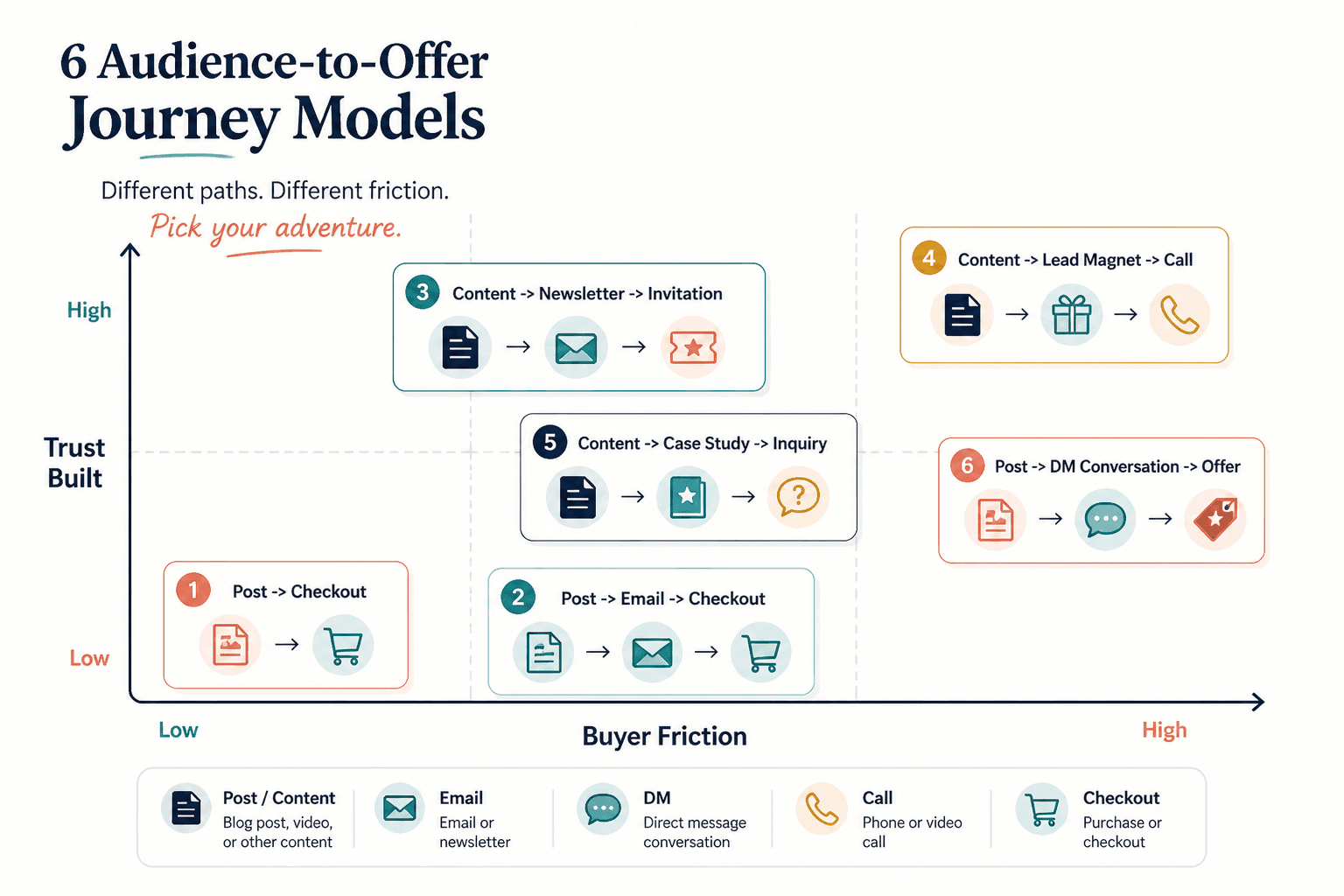
Do not choose based on what sounds sophisticated. Choose based on buying friction.
| Offer type | Usually works best with |
|---|---|
| Low-ticket template or guide | Post to checkout, or post to email to checkout |
| Workshop or mini-course | Post to registration page to follow-up emails |
| Membership | Content to newsletter to recurring proof to invitation |
| 1:1 coaching | Content to lead magnet or case study to call |
| Consulting service | Content to case study to inquiry or consultation |
| Done-for-you service | Content to portfolio or proof to conversation |
Here is the simpler way to think about it:
- If the offer is cheap and clear, shorten the journey
- If the offer is expensive or nuanced, deepen the journey
- If the audience already knows you, ask more directly
- If they are cold, earn context first
That sounds obvious, but a lot of funnel mess starts when people copy a model built for a completely different offer and audience. A newsletter writer selling a $19 product should not necessarily use the same path as a consultant selling a custom engagement. That is how you end up with an application funnel for something people should just be able to buy, which is a nice way to add friction for no reason.
Examples of clean audience-to-offer journeys by creator type
Coach
- Instagram or LinkedIn post about a recurring client problem
- Profile link to free diagnostic worksheet
- 3-email nurture sequence with reframes and client examples
- Invitation to book a clarity call
- Offer: coaching package
Consultant
- Article explaining a costly mistake in the market
- Case study showing your method
- FAQ page or email follow-up handling objections
- Consultation CTA
- Offer: strategy project or retainer
Writer or content strategist
- X post or LinkedIn post with before-and-after rewrite
- Link to swipe file or rewrite guide
- Email sequence with more examples
- Pitch content service or audit
Digital creator with products
- Short-form content around one annoying problem
- Direct CTA to a paid template, guide, or mini-workshop
- Buyer onboarding emails
- Upsell to bundle or membership
Personal brand educator
- Facebook or LinkedIn post sharing a specific lesson
- Newsletter sign-up for weekly deeper breakdowns
- Consistent authority-building emails
- Launch offer to cohort, course, or paid community
If you want more niche-specific examples, the companion guide on audience-to-offer journeys for coaches, consultants, and personal brands goes deeper.
Common mistakes that wreck the journey
Making the content and offer feel disconnected
If your content teaches one thing and your offer sells something adjacent but vague, people do not bridge that gap for you. They just move on.
Pitching before trust exists
Attention is not trust. A liked post is not buying intent. A follower is not a warm lead. This should not be a controversial sentence, yet here we are.
Giving no next step at all
Useful content with no journey attached often creates admiration without action. People enjoy it. They do not know what to do next. So they do nothing.
Creating too many steps
You do not need a labyrinth. You need a path. If the journey has eight pages, three unrelated CTAs, and a “book now” prompt in every paragraph, you are not nurturing. You are harassing with extra tabs.
Using generic trust content
“I’m passionate.” “I care deeply.” “Here are five lessons from entrepreneurship.” Fine. None of that is proof. Show your thinking. Show examples. Show process. Show outcomes. Show what makes your offer the right next step.
How to tighten your own audience-to-offer journey this week
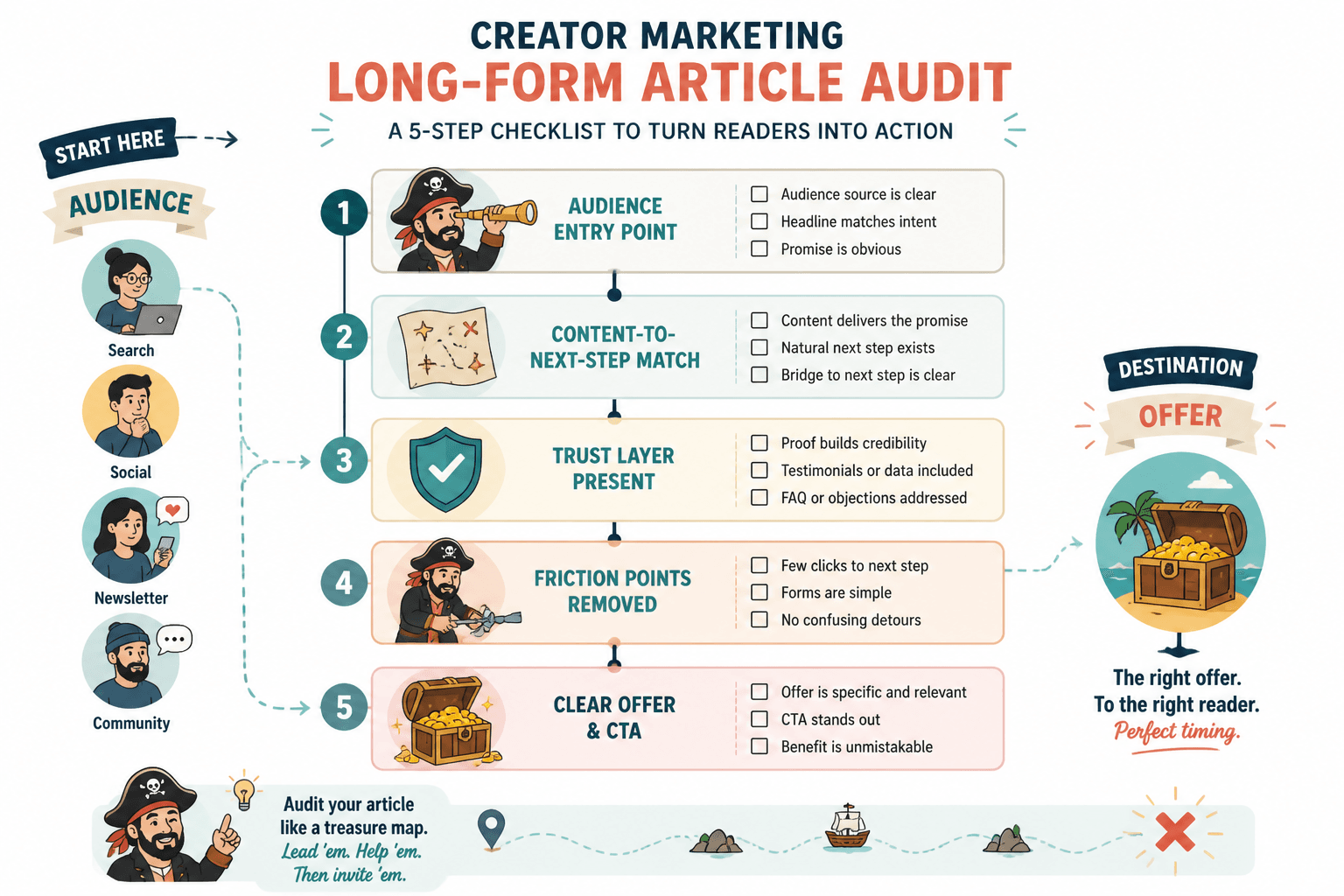
You do not need a full funnel rebuild to improve results. Start with this quick audit.
- Pick one offer. Not all offers. One.
- Identify the top problem that leads into it. What does the buyer already know hurts?
- Create one strong piece of content around that problem. Make it specific.
- Add one relevant next step. Newsletter, free resource, case study, consultation, or direct checkout.
- Check your profile and landing page. Do they clearly match the content and offer?
- Add one trust layer. Example, testimonial, process explanation, FAQ, or case study.
- Remove one friction point. Too many clicks, vague copy, weak CTA, bad fit form, unclear promise.
That alone will beat the setup most people have, which is roughly “post useful things and vaguely hope commerce happens.”
If you need more structure around pairing paths with actual funnel types, read the best funnel ideas to pair with audience-to-offer journeys. If you want implementation help, these templates and tools for audience-to-offer journeys will save you some wheel reinvention.
Quick FAQ
Do I need a lead magnet for every audience-to-offer journey?
Not at all. Lead magnets help when you need an easy first conversion, but some offers work better with a direct CTA, a case study, or a newsletter invitation.
What is the best platform for audience-to-offer journeys?
There is no universal winner. Use the platform where your audience already pays attention, then move people toward assets you control, like email, a landing page, or a booking flow.
Should every post point to an offer?
No. Every post should support your positioning somehow, but not every post needs a direct pitch. Some should build trust, some should create conversation, and some should move people forward.
How long should the journey be?
As short as trust allows. Cheap, obvious offers can convert fast. Expensive or nuanced offers usually need more proof and more touchpoints.
What if my audience is still small?
That is fine. A small relevant audience with a clean path will usually outperform a bigger vague audience with no path at all.
Build the path, not just the content
The bigger point is simple: clearer structure and clearer writing make the piece more useful. That is usually what makes the ending land better too.
Audience-to-offer journeys work better when the next step feels like a natural continuation of the problem. Better alignment usually beats more pressure.