
Most tool reviews do not fail because the writer picked the wrong software.
They fail because the workflow behind the review is a mess.
The screenshots are scattered across five folders. Notes live in three apps and one half-sent Slack message to yourself. Affiliate links are buried in an old spreadsheet you do not trust. You meant to compare pricing updates, but now the product has changed twice and your draft still opens with “this exciting platform…” which is never a good sign.
If you want to publish useful, credible, monetizable reviews consistently, you need more than a writing app and vibes. The Best Tool Stack to Support Tool Reviews is not one magical platform. It is a practical system: research, testing, capture, writing, publishing, tracking, and updating.
This article will help you build that stack without turning your review process into a bloated productivity cosplay routine. We’ll cover the core tool categories that actually matter, what each one should do, where people overcomplicate things, and a lean stack you can start using without needing seventeen logins and a color-coded second brain.
If tool reviews are part of your content business, affiliate strategy, or authority play, this is the infrastructure that keeps them useful instead of fluffy. If you want broader context on the category, start with tool reviews and then come back with slightly stronger opinions.
For the main guide behind this topic, visit the parent guide.
What the best tool stack for tool reviews actually needs to do
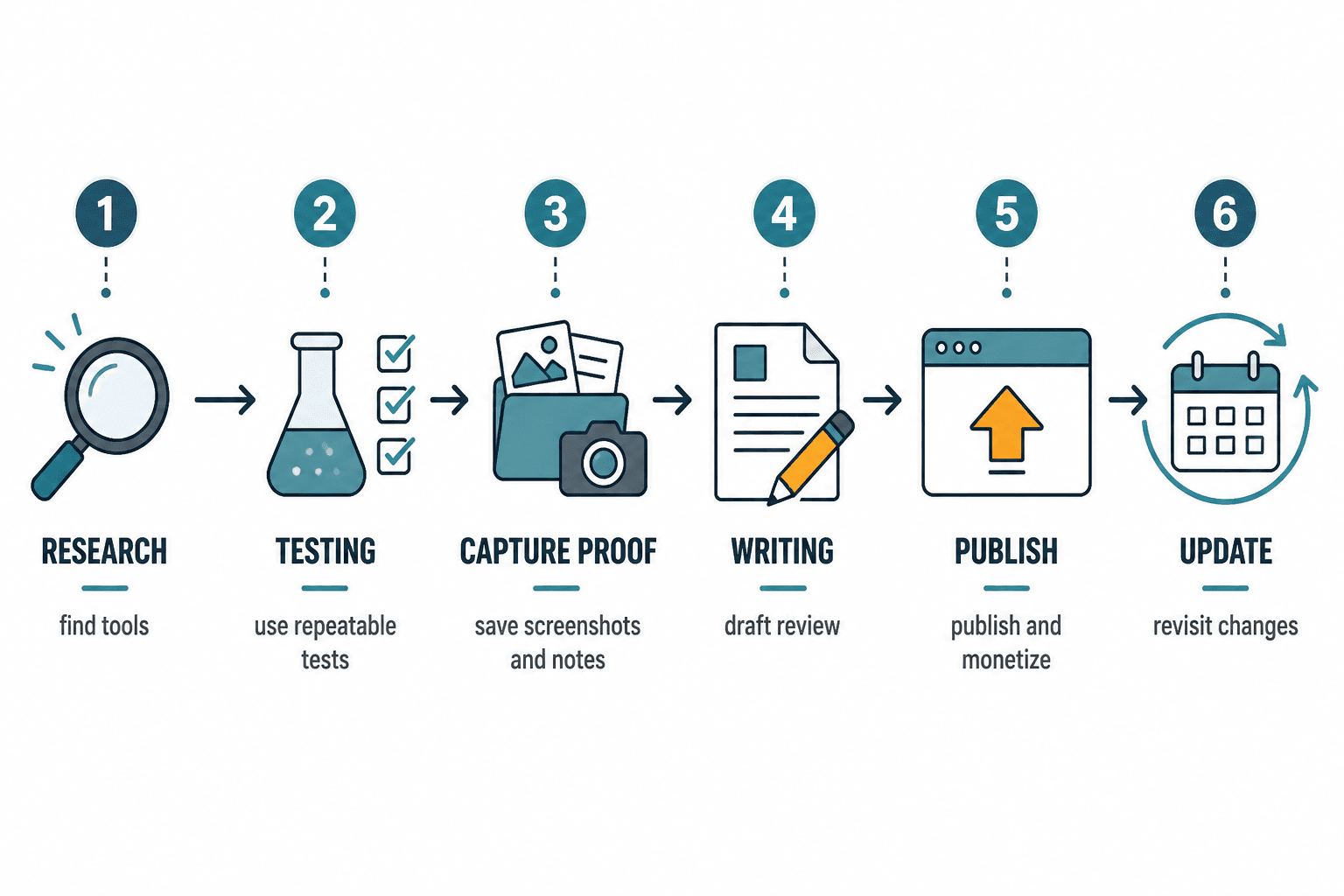
A good stack should help you do six things well:
- Find tools worth reviewing
- Test them in a repeatable way
- Capture proof while you use them
- Turn messy notes into strong review content
- Publish and monetize without sounding like affiliate mush
- Track what needs updates later
That is the real job. Not “optimize synergy.” Not “streamline creator excellence.” Just make your review process tighter, more trustworthy, and easier to repeat.
And yes, you can absolutely do this with a fairly small stack. In fact, most people should. More tools often create more admin, not more insight. Tool reviewers are especially vulnerable to this because reviewing tools makes you weirdly susceptible to collecting more tools. A little self-control helps.
The 7 tool categories that make tool reviews easier to produce
You do not need one app per micro-task. But you do need coverage across a few core categories.
1. Research and discovery tools
This category helps you decide what is worth reviewing in the first place. A lot of mediocre reviews start with bad review selection. The writer picks random tools instead of tools their audience is actively considering.
Your research setup should help you answer:
- What tools are people asking about?
- Which categories are growing?
- What comparisons keep coming up?
- Which tools are already crowded with lazy reviews?
- Where can you add a real perspective?
At minimum, this can be a simple notes database or spreadsheet where you track:
- Tool name
- Category
- Audience fit
- Main use case
- Pricing model
- Affiliate availability
- Competitors to compare
- Your angle for reviewing it
If you write for creators, for example, “email marketing tool” is too broad. “Email marketing tool for solo creators who sell digital products without a team” is a review angle. That gives you something sharper to test against.
If you want frameworks for evaluating what makes a review angle strong, this guide on creator tools and review frameworks pairs well with this stack article.
2. Testing and documentation tools
This is where credibility starts. If your review process is basically “clicked around for 14 minutes and formed a brand,” readers can tell.
Your testing setup should make it easy to document:
- First-use experience
- Onboarding friction
- Core feature quality
- Missing features
- Speed and usability
- Pricing clarity
- Support experience
- Best-fit and worst-fit users
You do not need a fancy QA system. You need a repeatable checklist.
A good move here is to create a review template you use every time you test a tool. That template might include sections like:
- What I tried to do
- How long setup took
- What worked immediately
- What was confusing
- What felt better or worse than alternatives
- What kind of user this is really built for
- Would I keep using it after the review?
The point is not to pretend every review is scientific. It is to make your process consistent enough that your opinions are grounded in actual use, not polished guesswork.
3. Screenshot and visual capture tools
If you review tools, visuals are not optional fluff. They are proof.
You need a reliable way to capture:
- Dashboard views
- Setup steps
- Key features
- Pricing pages
- Important settings
- Comparisons between tools
Use a screenshot tool that lets you annotate quickly. Arrows, highlights, and simple labels help readers see what matters without reading a 900-word paragraph explaining where the button lives.
Also, save visuals systematically. Not “Desktop / final-final-review-assets-actual-final.” A simple folder structure works:
- Tool name
- Date tested
- Screenshots
- Pricing
- Feature examples
- Comparison visuals
This matters later when pricing changes, interfaces get redesigned, or you need to update a post without retesting the entire product from scratch.
4. Writing and drafting tools
Your writing tool does not need to be clever. It needs to stay out of the way.
Good drafting tools for reviews should help you:
- Outline clearly
- Store reusable review templates
- Draft comparison sections fast
- Keep screenshots and notes nearby
- Track versions as the review evolves
This is also where AI can be useful, with an asterisk the size of a truck. AI can help you reorganize raw notes, generate draft section options, tighten repetitive phrasing, or format a comparison table faster. It cannot tell you what was genuinely frustrating about the onboarding flow if you did not test it. It also cannot fake taste convincingly, no matter how business-casual the sentences look.
If your review sounds like it was assembled by a polite intern who never used the tool, trust drops immediately. For a cleaner approach, pair your drafting stack with how to write tool reviews without sounding like affiliate fluff.
5. Publishing and formatting tools
A review that is genuinely useful can still underperform if the page is ugly, hard to scan, or impossible to update.
Your publishing setup should make it easy to include:
- Clear headings
- Quick verdict summaries
- Pros and cons lists
- Comparison tables
- FAQ blocks if needed
- CTAs that do not read like a hostage note from affiliate marketing
Tool reviews usually work best when readers can skim first, then go deeper where needed. That means clean structure matters more than decorative cleverness. A messy review page tells readers your thinking is probably messy too.
If you are building reviews as part of a broader content business, it also helps to understand where they fit within your content monetization structure. These related sections can help: monetization funnels and money content.
6. Link management and monetization tools
If your reviews include affiliate links, you need a sane system for managing them. Not because it is glamorous. Because broken links, outdated offers, and random copy-paste errors quietly wreck revenue.
Your link management setup should help you track:
- Affiliate program status
- Link destination
- Commission structure
- Disclosure requirements
- Which articles use each link
- What needs replacing if a program changes
A spreadsheet is fine at first. A dedicated link management tool may make sense later if you have dozens of reviews and regular updates. The principle is simple: one source of truth. If your links live in old docs, browser bookmarks, and one note called “important money stuff,” you are building future headaches on purpose.
7. Update and performance tracking tools
Tool reviews age badly if nobody maintains them.
Features change. Pricing changes. Entire companies get acquired, broken, or weird. A review published once and ignored for a year is not authority. It is stale content wearing a nice outfit.
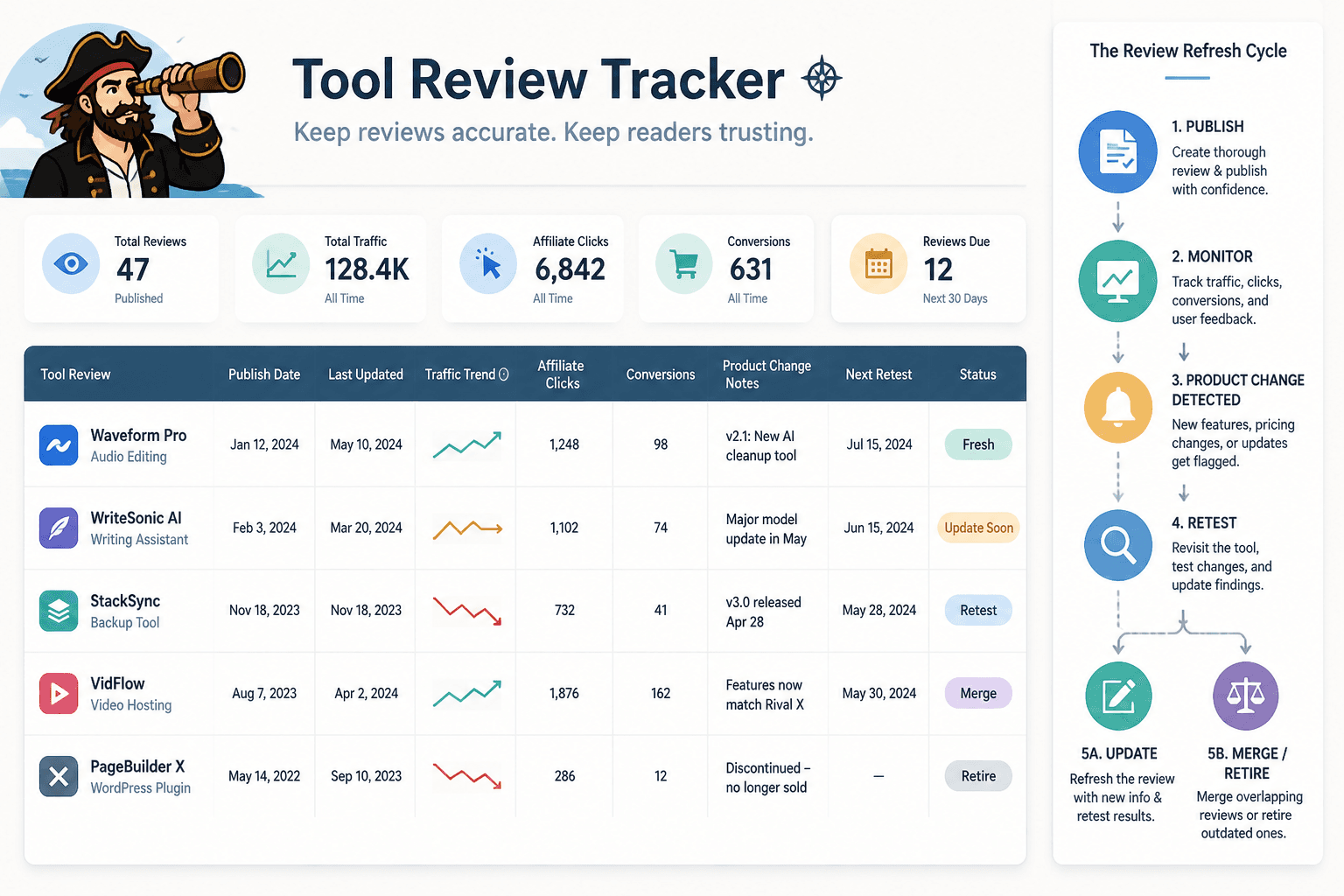
You need a lightweight tracking system for:
- Publish date
- Last updated date
- Traffic trend
- Affiliate clicks
- Conversions if available
- Notes on product changes
- When to retest
This does not have to be sophisticated. A content database with status fields is enough for many solo creators. What matters is that you can see which reviews are worth refreshing and which ones should be merged, replaced, or quietly retired.
A lean version of the Best Tool Stack to Support Tool Reviews
If you want a practical setup without turning your workflow into an app museum, here is a lean version.
| Function | What you need | Why it matters |
|---|---|---|
| Research tracker | Spreadsheet or simple database | Keeps review ideas, categories, and comparisons organized |
| Testing checklist | Reusable template in notes or docs | Makes reviews more consistent and credible |
| Visual capture | Screenshot tool with annotation | Provides proof and improves scannability |
| Drafting space | Document editor or writing app | Turns raw testing notes into a usable review |
| Publishing CMS | Website editor with tables and clear formatting | Makes the review easier to read and update |
| Affiliate link tracker | Spreadsheet or link manager | Prevents monetization chaos |
| Update tracker | Content database or editorial calendar | Keeps reviews fresh and worth trusting |
That stack is enough for a lot of creators.
You do not need the “best” app in every category. You need a stack that reduces friction. If a tool is technically powerful but makes you avoid using it, it is not helping your review workflow. It is just sitting there looking expensive.
How to choose your stack without overbuilding it
Before adding anything, ask these questions.
Does it save time on a repeated task?
If the task happens every review, the tool may be worth it. If it solves a tiny problem you face once every three months, probably not.
Does it improve trust or proof?
A tool that makes screenshots clearer, comparisons easier, or update tracking cleaner can directly improve review quality. That matters more than some “productivity booster” that just gives you another dashboard.
Can you reuse the output?
The best review tools create assets you can reuse across articles, social posts, videos, newsletters, and comparisons. Notes, screenshots, scoring frameworks, and pricing snapshots are all reusable if you store them properly.
Does it fit how you actually work?
This part gets ignored a lot. A brilliant system you hate using will collapse. Build a stack you will maintain when you are busy, tired, or three reviews behind schedule.
The stack changes depending on your review model
Not every reviewer needs the same setup. Your stack should match the kind of review content you publish.
If you publish quick creator-focused reviews
Keep it lean. You probably need:
- Idea tracker
- Simple test template
- Screenshot tool
- Writing doc
- Affiliate tracker
This works well if you publish concise reviews, “best tools” roundups, and short-form recommendation content.
If you publish deep comparison reviews
You will need more structure. Usually:
- Comparison matrix
- Scoring system
- Pricing snapshot archive
- Detailed testing notes
- Update calendar
Comparison reviews are where sloppiness gets exposed fast. If you are comparing multiple tools side by side, your documentation needs to be cleaner than your opinions.
If you use tool reviews as a monetization funnel
Your stack also needs conversion visibility. That means tracking:
- Which reviews drive clicks
- Which CTAs get action
- Which tools convert best for your audience
- Which review topics lead to newsletter signups or consultations
This is where reviews stop being isolated content pieces and start functioning like business assets. A review can lead to an affiliate click, an email signup, a template download, or a service inquiry. But only if your process is deliberate.
If you want examples of review-focused creator tools and practical setups, best tool reviews tools for creators in 2026 and best tool reviews for creators in 2026 are useful next reads.
A simple workflow you can use for every review
Here is a repeatable process that keeps your stack from turning into a pile of disconnected apps.
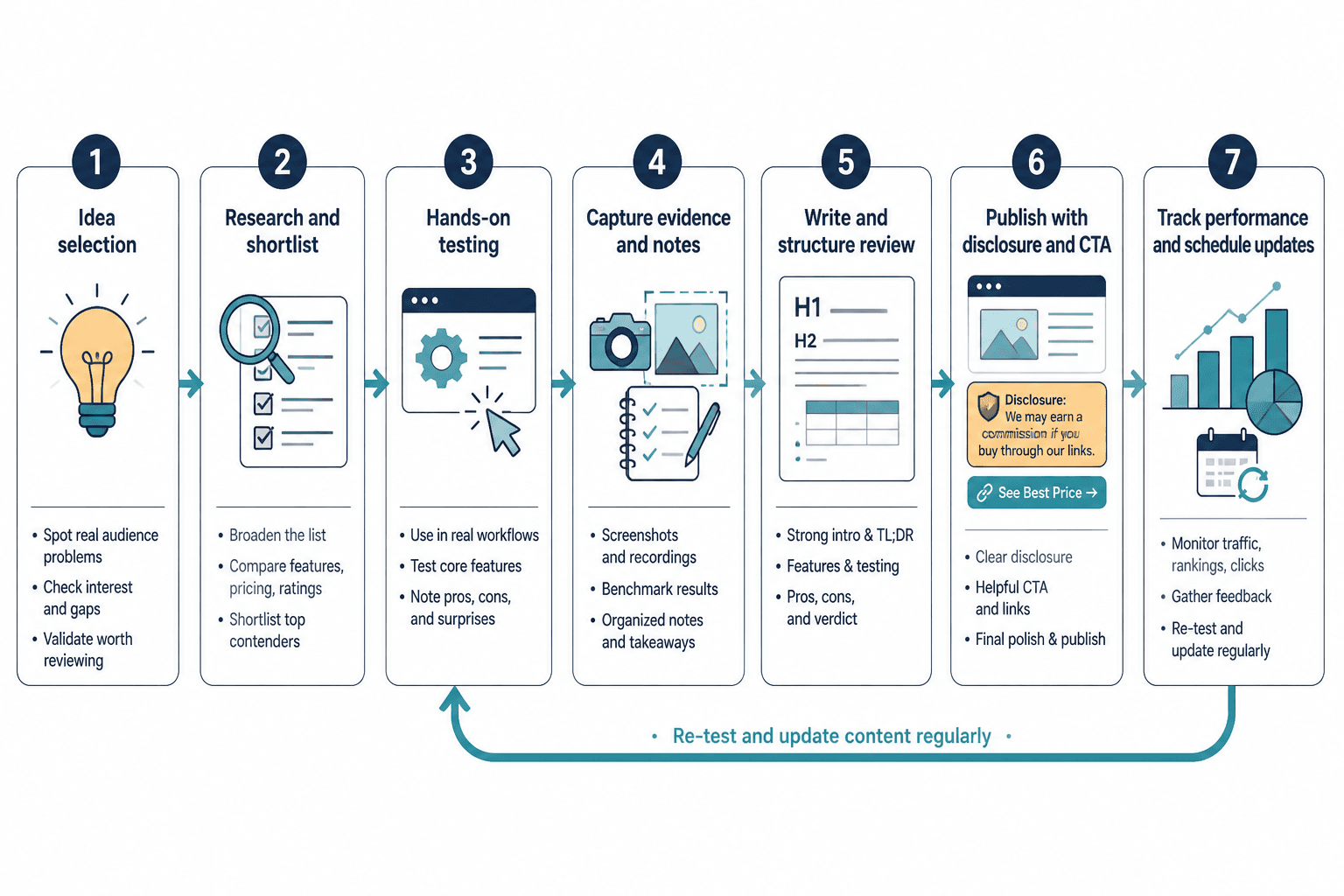
- Log the tool idea. Add the tool to your research tracker with audience, category, and review angle.
- Run the test. Use the same review checklist every time so your notes are comparable.
- Capture proof. Save screenshots, pricing pages, and feature examples in one folder.
- Draft from notes, not memory. Build the review around actual use, friction, and outcomes.
- Add monetization cleanly. Insert disclosures, affiliate links, and a useful CTA without turning the piece into a pitch swamp.
- Publish with clear structure. Use headings, tables, verdict summaries, and scannable formatting.
- Track performance and updates. Note clicks, traffic, changes, and retest dates.
That is enough structure to stay professional without becoming absurdly elaborate.
And yes, some of this will feel boring. Good. Boring systems are often what make consistent publishing possible. The exciting part is not your file naming convention. The exciting part is having enough usable proof and clean notes to write a review people actually trust.
Common stack mistakes that make tool reviews worse
A bigger stack does not automatically mean better reviews. Sometimes it just means more places to lose information.
Using too many tools for notes
If screenshots are in one app, testing notes in another, outlines in a third, and affiliate data in a forgotten spreadsheet, your review process gets slower every time you publish. Consolidate where you can.
Not creating a standard review template
This is one of the biggest misses. Without a repeatable review structure, every article starts from zero and quality swings all over the place.
Trusting AI to invent insight
AI can help process information. It cannot replace testing. If your stack depends on generated summaries instead of actual product use, readers will smell it. Usually by paragraph three.
Ignoring update systems
A review is not done when it is published. It is done when it is maintained enough to stay useful. If you review software, update workflows are part of the job.
Building the stack around tools instead of outcomes
The best stack supports your process. It should not become the process. If you are spending more time maintaining your setup than reviewing products, something has gone sideways.
What to include in your review stack if you want better monetization
If the point of your reviews is partly revenue, your stack needs to support that without making the content feel greasy.
That usually means three extra pieces:
- Disclosure handling: a clear way to add affiliate disclosures consistently
- CTA templates: soft, useful calls to action you can adapt per review
- Link performance tracking: enough data to see what actually drives clicks and conversions
For example, a weak CTA says:
Click here now to get the best deal on this amazing platform.
A better review CTA says:
If you want a simple option for managing client intake without wrestling a giant CRM, this is a solid place to start.
One sounds like affiliate cologne. The other sounds like a person with judgment.
That difference matters. Monetization works better when the review still feels like advice first.
A practical starter stack for solo creators and small teams
If you want the plain version, here is a good starter setup model:
- One research tracker: to log tool ideas, comparisons, and audience fit
- One review template: to standardize testing and note-taking
- One screenshot workflow: to capture proof cleanly
- One drafting space: to turn notes into reviews
- One publishing system: to format and update content
- One link tracker: to manage affiliate links and disclosures
- One update database: to keep content current
That is enough. Seriously.
You can always add layers later if volume grows or the business model gets more complex. But if you are still early, do not build an enterprise review stack for a content operation that currently consists of you, a laptop, and righteous irritation at bad software.
FAQ
What is the most important tool in a review stack?
Usually the review template. A consistent testing framework improves quality faster than adding another app.
Do I need AI tools to write better tool reviews?
No. They can help with organization and drafting speed, but they cannot replace product testing, judgment, or audience awareness.
Should I use a dedicated affiliate link manager?
Only if your volume justifies it. A clean spreadsheet works for many creators at the start.
How often should tool reviews be updated?
It depends on the category, but reviews of active software products should be checked regularly for pricing, feature, and UX changes.
Can a small creator build an effective review stack without expensive software?
Yes. A lean stack with a database, document editor, screenshot tool, CMS, and tracking sheet can carry a lot of weight.
Build a stack that supports better reviews, not more clutter
The Best Tool Stack to Support Tool Reviews is the one that helps you review products with more clarity, more proof, and less chaos.
That means a stack built around repeatable testing, clean note capture, strong drafting, simple monetization, and regular updates. Not endless tools. Not workflow theater. Not pretending a prettier dashboard counts as better analysis.
If your current review process feels scattered, fix the system before you try to publish more. Better infrastructure makes better reviews. And better reviews are the part readers, buyers, and affiliate clicks actually care about.
Start small. Standardize the process. Keep the stack useful. That is usually what separates trustworthy review content from the usual pile of polished nonsense.
The bigger point is simple: clearer structure and clearer writing make the piece more useful. That is usually what makes the ending land better too.