
Big tool roundups look impressive. “37 best tools for creators.” “51 platforms compared.” “The only software list you need.” Very serious. Very thorough. Very likely to be skimmed for twelve seconds and forgotten.
Meanwhile, a simple review of one tool, written by someone who actually used it for a real job, often does more work. It builds trust faster. It converts better. It gives the reader a cleaner decision. And it does not feel like a content warehouse coughed up a comparison table.
That is the real reason When Simple Tool Reviews Beat Giant Roundups is worth talking about. Not because giant roundups are always bad. They are not. But a lot of creators, affiliates, consultants, and niche publishers keep making giant lists when a focused review would be far more useful and far more believable.
If you write about tools to drive affiliate revenue, newsletter growth, leads, or authority, this matters. Here is how to tell when a simple tool review is the smarter play, why readers trust it more, and how to structure one so it actually helps somebody decide.
For the broader learning path, visit our parent guide.
Why giant roundups often underperform
The problem with giant roundups is not the format itself. The problem is what usually happens inside the format.
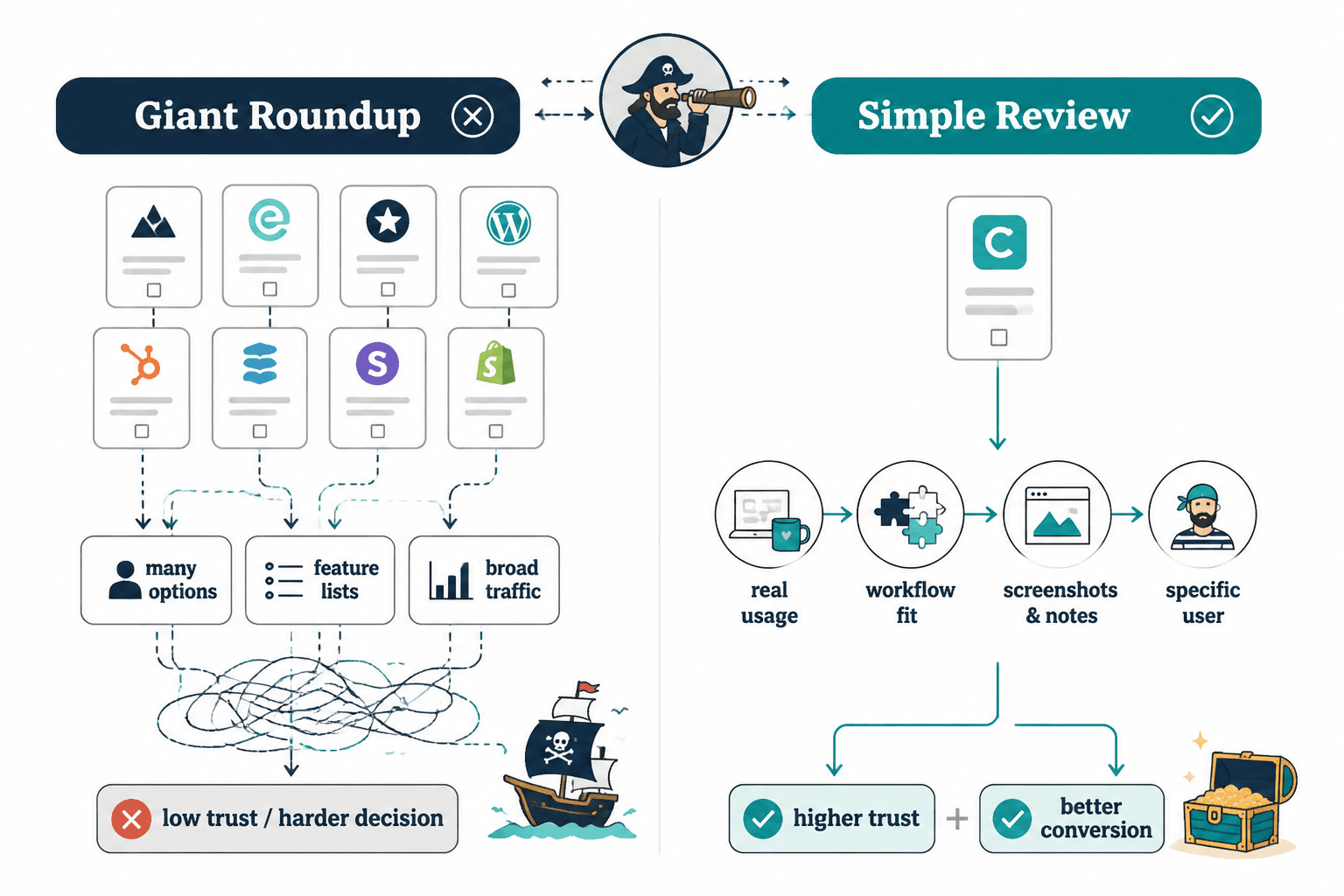
Most giant roundups are too broad, too thin, and too obviously built for search coverage first and decision-making second. They try to rank for every variation of “best tools,” then end up saying the same three things about every option:
- easy to use
- great features
- good for beginners and professionals
That tells the reader almost nothing. It also quietly tells them you probably did not spend much time inside the product.
And readers are not stupid. If they are trying to choose a writing tool, CRM, scheduler, design app, or analytics platform, they want friction, tradeoffs, context, and proof. They want to know what gets annoying after week two. They want to know who the tool is actually for. They want to know what kind of workflow it fits without needing a translator.
Roundups often smooth all of that out. Everything gets flattened into “top picks.” Which is neat for a spreadsheet, not so great for trust.
When simple tool reviews beat giant roundups
A simple review wins when the reader is closer to a decision than to discovery.
If somebody searches for broad options, a roundup can help them map the field. But if they are already considering one tool, comparing two likely choices, or trying to solve a specific workflow problem, a focused review usually does the job better.
That is when simple tool reviews beat giant roundups. They reduce noise. They feel more honest. They answer the question behind the click instead of flexing how many logos you can fit in one article.
- The reader already knows the category and wants to evaluate one tool
- You have real usage experience, screenshots, notes, or outcomes
- The tool solves a specific problem for a specific type of user
- The buying decision depends on workflow fit, not just features
- You want stronger trust and conversion, not just broad traffic
- You have a smaller site or audience and need credibility more than coverage
A giant roundup says, “Here are many options.”
A simple review says, “Here is what this thing is like in real life, and whether you should bother.”
One of those is easier to monetize, especially when your whole business depends on people believing you are not just publishing affiliate bait in a slightly nicer font.
Simple reviews build trust faster
Trust does not come from listing more tools. It comes from saying sharper, more verifiable things about fewer tools.
A strong simple review usually contains details a giant roundup cannot hold without becoming unreadable:
- what setup felt like
- what the interface gets right or wrong
- what type of creator or business fits it best
- what annoyed you
- what surprised you
- what it replaced in your workflow
- what happened after repeated use
Those details are persuasive because they are concrete. They sound like lived experience, not category filler.
This matters even more if your audience is skeptical, budget-conscious, or already burned by overhyped software. A coach choosing a booking tool, a consultant comparing CRMs, or a solo founder testing content tools does not need a giant popularity contest. They need a sane recommendation with actual texture.
If you want a cleaner way to add proof, this is where screenshots, process notes, and small observations do a lot of heavy lifting. A review does not need cinematic production value. It needs receipts. That is also why a proof-first framework matters in simple reviews, especially for creators working with smaller audiences or tighter authority. If that is you, pair this piece with Simple Tool Reviews Proof Screenshots Framework for Creators.
Roundups are discovery content. Reviews are decision content.
This distinction cleans up a lot.
Roundups are often best near the top of the funnel. Someone is exploring a category. They want orientation. They may not know the names yet. They are asking, “What kinds of tools exist?”
Simple reviews sit lower in the funnel. The reader is asking, “Should I use this?” Or, “Will this fit how I work?” That is a much better question for conversions.
If your goal is monetization, this is not a minor detail. Broad traffic is nice. Decision-stage traffic is better. A smaller stream of readers with strong intent usually beats a giant pile of random visitors who wanted a master list and bounced.
That is why a tool review can outperform a roundup in affiliate clicks, demos, signups, booked calls, and even newsletter subscribers. It attracts people closer to action.
There is also less cognitive drag. Readers do not have to compare fifteen similar tools while your page politely pretends every option is amazing. They can just evaluate one thing clearly.
Why focused reviews tend to convert better
A focused review has a structural advantage: it can create narrative momentum.
Instead of bouncing from tool to tool, the reader stays inside one decision arc:
- Here is the problem.
- Here is the tool.
- Here is how it works in practice.
- Here is where it fits.
- Here is where it falls short.
- Here is whether it is worth trying.
That sequence is simple, but it matters. Good monetization content usually works because it lowers uncertainty, not because it shouts louder.
A giant roundup keeps reopening the decision. “Maybe choose this one. Or this one. Or this one. Also here are seven honorable mentions.” At some point the reader either tabs out or says they will decide later, which is internet language for never.
Simple reviews are better at moving a reader toward a next step because they are narrower and more committed. Not manipulative. Just useful in a more direct way.
What converts inside a simple review
- A clear use case in the opening
- Proof that you actually used the tool
- Specific pros and cons, not padded feature praise
- Honest tradeoffs
- A recommendation for a certain kind of user
- A clean CTA that matches the reader’s stage
That final point gets missed a lot. Your CTA should fit the article. If the reader is close to trying the tool, a direct CTA works. If they still need context, offer a comparison, a workflow guide, or a related article from your tool reviews section instead of pushing too hard too early.
The hidden strength: simple reviews are easier to make well
There is another reason simple reviews beat giant roundups: quality control.
It is hard to create a genuinely good roundup with ten, fifteen, or twenty tools. To do it properly, you need solid testing, up-to-date details, category logic, differentiation, and enough space to say something non-generic about each option. That is a lot of work.
Most publishers do not do that work. So the article becomes a broad but shallow asset that looks useful from a distance and gets less useful the closer you read.
A simple review is more manageable. You can test one tool more deeply. You can update one article more easily. You can notice small details. You can write something tighter and sharper because your attention is not split across an entire category.
For solo creators and lean teams, that is not just convenient. It is strategic. Better one excellent review than one giant roundup stuffed with vague summaries and optimism.
If you are unsure how many tools a comparison piece should include before it starts getting mushy, read How Many Tools Belong in Tool Reviews. It helps draw the line between useful range and chaotic overkill.
What a strong simple tool review should include
A simple review does not mean casual, lazy, or thin. It means focused. The best ones are structured enough to help the reader move, but not so bloated they start sounding like enterprise documentation.
1. A clear use case
Start with the real problem the tool solves.
Bad: “This is a powerful all-in-one platform for businesses of all sizes.”
Better: “If you are a solo consultant juggling leads, follow-ups, and notes in five places, this tool can clean that up fast. If you need a giant sales org setup, probably not.”
2. Real-world context
Explain how you used it. Not in a grand dramatic memoir. Just enough context to make your opinion credible.
- what type of work you used it for
- how long you used it
- what you were trying to replace or improve
- what kind of user you think it fits
3. Pros and cons with actual teeth
“Good interface” is not a pro. “Takes five minutes to set up and does not bury core functions in twelve menus” is a pro.
“May not suit everyone” is not a con. “Reporting is too thin if you need team-level visibility” is a con.
This is where most reviews either become fluffy or weirdly timid. You are allowed to say what is annoying. In fact, you probably should.
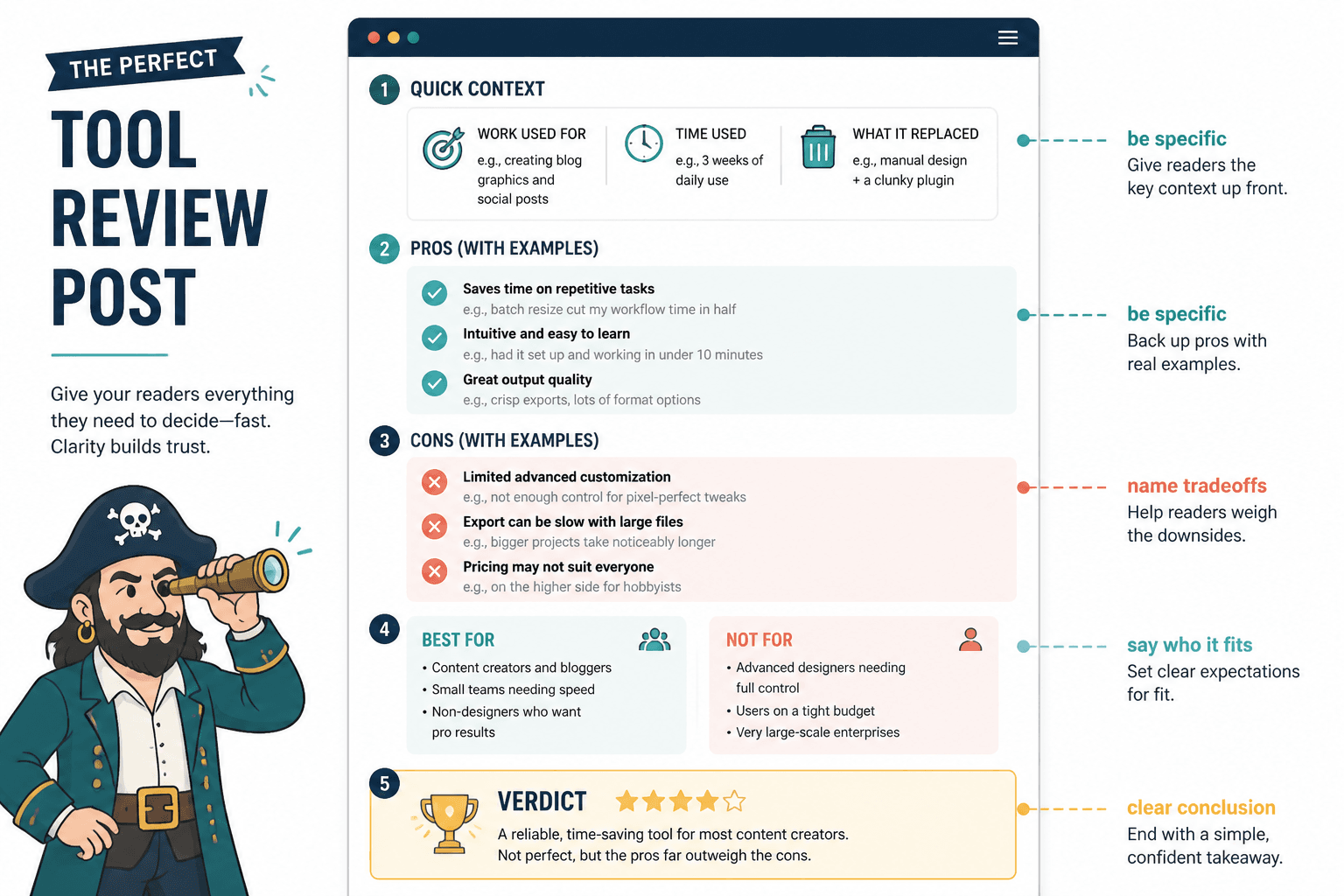
4. Best for / not for
This section is underrated. It makes your recommendation more trustworthy because you are not trying to sell the tool to everyone with a pulse.
- Best for: solo creators, service businesses, newsletter writers, coaches, tiny teams
- Not for: large ops-heavy teams, advanced analysts, people needing deep customization, anyone wanting a full enterprise stack
5. A simple verdict
The reader should not have to extract your conclusion with tweezers. Say the thing.
Try something like:
- Worth it if you want speed and simplicity more than advanced control
- Good starter option, but you may outgrow it
- Best when used for one clear workflow, not as an all-in-one system
- Overpriced unless you will actually use the premium features
When a roundup still makes sense
To be fair, giant roundups are not useless. They just get abused.
A roundup makes sense when:
- the category is confusing and readers need orientation
- you can sort tools by use case clearly
- you have enough knowledge to compare them honestly
- your goal is discovery traffic and category coverage
- you plan to link readers into more detailed individual reviews
That last point is the real move. The best roundup often acts like a hub, not the final answer. It points readers to focused reviews, comparisons, and use-case guides. In other words, it should feed your content system, not try to be the entire system by itself.
If you are building a broader content path, your roundup can sit inside a larger tool review strategy and support related monetization content in the wider money content category.
A smarter content funnel: roundup for discovery, review for conversion
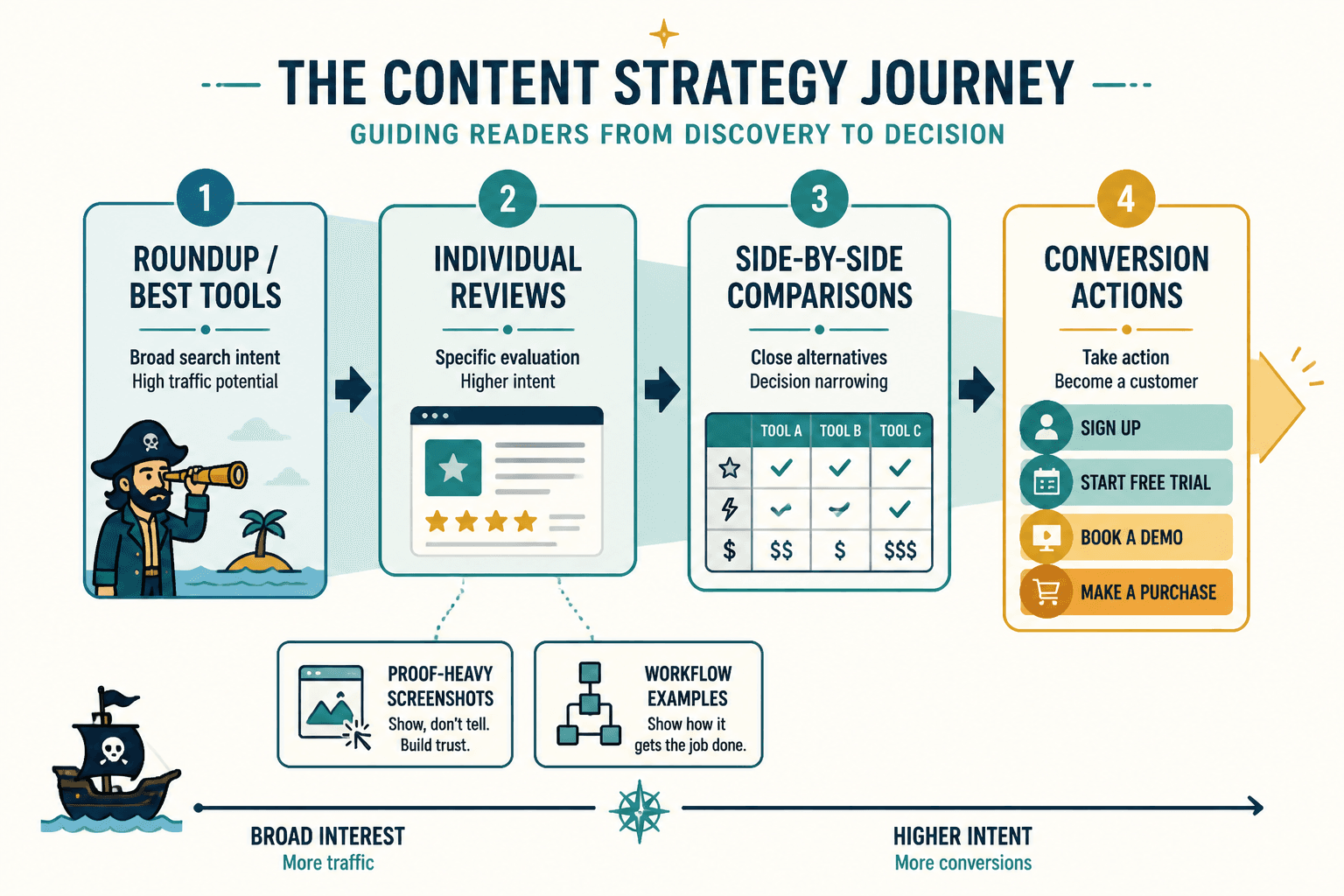
If you want both traffic and revenue, you do not need to pick one format forever. You need to use each format for the job it is actually good at.
A practical structure looks like this:
- Create a category or “best tools” roundup for broad search intent.
- Break out your top tools into individual reviews.
- Add side-by-side comparisons for close competitors.
- Use proof-heavy screenshots and workflow examples inside the review pages.
- Link readers toward the next best action based on intent.
That gives you both breadth and depth. More importantly, it gives readers what they need at each stage instead of dumping everyone into one giant article and hoping for the best.
If you have a tiny budget, simple reviews are even more useful
Small publishers often assume they need giant “best tools” lists to compete. Usually the opposite is true.
If your budget is limited, your edge is not publishing more options than bigger sites. It is being more specific, more honest, and more experience-based. You are not trying to win a quantity contest with media sites and affiliate farms. That would be a fairly miserable hobby.
A simple review lets you use what you actually have: one subscription, one workflow, one real opinion, one clean recommendation. That can be enough if the review is well framed and useful.
For a practical approach to doing this without buying half the internet, read How to Review Tool Reviews When You Have a Tiny Budget.
Common mistakes in simple tool reviews
- Being too nice. If every tool is “great,” your review has no edge and no credibility.
- Talking only about features. Readers care about outcomes, friction, and fit.
- Hiding the verdict. Say what you think.
- Ignoring who the tool is not for. This weakens trust fast.
- Using fake neutrality. Honest perspective is better than mushy balance.
- Writing from demo-page knowledge. If you did not use it, do not pretend you did.
The bar is not perfection. It is usefulness. If your review helps the right reader make a cleaner decision, it is doing its job.
The bigger point is simple: clearer structure and clearer writing make the piece more useful. That is usually what makes the ending land better too.